Hubei, the most passionate arena for the Chinese people
To understand the passion of the Chinese people, you have to look at Hubei.
Rivers and lakes form a real Hubei. Among so many places in China, Hubei is the province through which the main stream of the Yangtze River flows the longest distance, more than a thousand kilometers. Coupled with the title of "Province of a Thousand Lakes", it has woven the largest river - lake water network in the country. If you look at it from the air, this land seems as if someone has knocked over a basin of water, with the water spreading out in a winding and intricate way.
This unique water area in the country has nurtured the tough character and true nature of the people in Hubei. The spirit of the rivers and lakes is the essence of Hubei.
However, for a long time, Hubei was a vague memory for the Chinese people. Wuhan, the Yangtze River Bridge, hot dry noodles, and the impression of the shrewd "Nine - Headed Bird", that seemed to be all. It wasn't until recent years that Optics Valley emerged, Qianjiang crayfish became popular, and Hubei's tourism boomed. Many people rediscovered the rivers and lakes of Hubei.
Those great rivers and lakes and the tough temper have always been there. Why were they ignored before and suddenly became popular now?
In my opinion, perhaps it's because in this era when lying flat is popular but people still long for a sense of real life, Hubei is still full of passion, wild, and full of vitality.
Hubei: Great Rivers, Great Lakes, Central China
To talk about Hubei, we have to start with water.
Last summer, I took a ferry across the river in Yichang. The ferryman was in his fifties, with dark - tanned skin. He held the rudder in his hand and had a cigarette in his mouth. The river wind blew, and he squinted and said, "I've been running on this river for thirty years. I've seen all the tempers of the Yangtze River. When it's fierce, the waves can smash your boat; when it's gentle, the water surface is so flat that you can see the moon reflected on it."
Indeed, after the Yangtze River flows into Hubei, it shows both the danger of the canyons and the meandering in the plains, displaying all the tempers a great river can have.
But the Yangtze River is not just a river; it is also the busiest waterway in China. For thousands of years, salt boats, tea boats, and grain boats, as well as various supplies, have sailed on this "Golden Waterway". After the Tang and Song Dynasties, the freight volume of the Yangtze River has accounted for more than half of the country's inland freight volume all year round. In modern times, foreign industrial products went upstream along the Yangtze River, were unloaded in Hankou, Hubei, and then sold to the central and western regions; agricultural and sideline products, industrial and mining raw materials from central, south - western, and north - western China were transported downstream to Shanghai for export.
In the past hundred years, the flow of goods on this waterway has hardly stopped. It is truly a "Golden Waterway" and has brought huge trade growth to Hubei.
After talking about the great rivers, let's talk about the great lakes. How did the title of "Province of a Thousand Lakes" come about?
These lakes are the marks left by the Yangtze River. In ancient times, Yunmeng Marsh spanned the entire Jianghan Plain, vast and misty. Later, due to the silt deposition of the Yangtze River, the marsh gradually broke into more than a thousand small lakes. Among them, Honghu Lake is the largest lake in Hubei Province and the seventh - largest freshwater lake in China, known as the "Kidney of Hubei". In summer, the lotus flowers cover the lake surface as far as the eye can see. Everyone in the country can hum the line "The waves of Honghu Lake, oh, are beating against the shore" from the opera "The Red Guards of Honghu".
During the flood season, the lake water rises, and during the dry season, it slowly recedes. There is an invisible hand between the rivers and lakes, adjusting year after year. It is precisely because of its continuous scouring, overflowing, and sedimentation that several feet of black soil have been deposited on the Jianghan Plain, nurturing patches of paddy fields, full ponds of fish and shrimp, and white lotuses. The temper of the Yangtze River has finally turned into the land of fish and rice in Hubei.
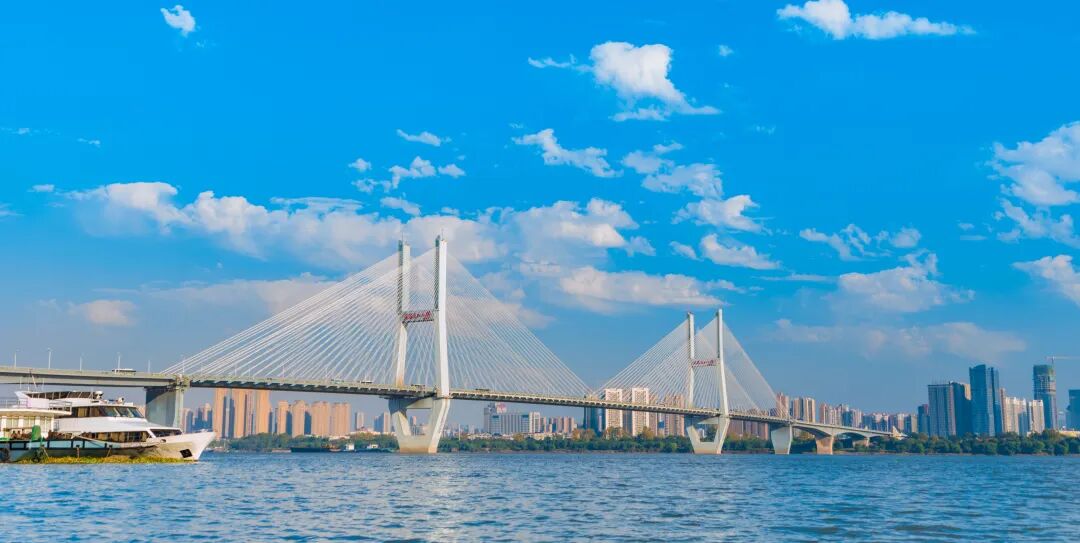
With great rivers and great lakes, Hubei also has a natural advantage: location.
Hubei is located in the hinterland of China. Starting from Hubei, you can reach any provincial - level administrative region in the country by crossing at most two provinces, which is unique in the whole country.
Now, the Beijing - Guangzhou Railway and the Shanghai - Wuhan - Chengdu High - speed Railway intersect in Hubei, and the major transportation arteries in the east - west and north - south directions are intertwined. Four major urban agglomerations revolve around Hubei: the Yangtze River Delta to the east, the Chengdu - Chongqing region to the west, the Pearl River Delta to the south, and the Beijing - Tianjin - Hebei region to the north.
Hubei is the center of this crossroads.
The phrase "Nine - Province Thoroughfare" refers to Wuhan. With Wuhan as the center and a radius of one thousand kilometers, most of the provincial capitals in China are covered. The straight - line distances from Wuhan to Beijing, Shanghai, Guangzhou, and Chengdu are all about the same.
This place has made full use of its locational advantages. After the Han River changed its course in the Ming Dynasty, Hankou rose rapidly due to its convenient waterway. Boats came and went, and goods piled up like mountains. There is a folk saying that "Goods come to life in Hankou", which means that even the most difficult - to - sell things can find buyers in Hankou.
During the late Ming and early Qing Dynasties, Hankou was already one of the "Four Famous Towns" in the country, along with Zhuxian Town, Jingdezhen, and Foshan Town. After the opening of the port in the late Qing Dynasty, foreign firms and commercial houses were established one after another, and Wuhan was then called the "Oriental Chicago" by foreigners.
Where there is water, there is business; where there is a wharf, there are people working hard. The geographical advantages accumulated over thousands of years of water transportation, a hundred years of railway construction, and decades of highway development have finally turned into business and life.
So, what kind of people and stories will such rivers and lakes and such a location nurture?
The Unyielding People of Hubei
The temper of the people in Hubei is hidden in two words: Unyielding.
This is a phrase often on the lips of the people in Hubei, and its origin can be traced back more than two thousand years ago. During the Spring and Autumn and Warring States periods, Hubei was the core area of the State of Chu. At that time, the State of Chu was just a small vassal state of the Zhou Dynasty, with a low - ranking title of viscount. The people of Chu were not convinced and proclaimed themselves kings, challenging the Zhou Emperor. King Zhuang of Chu, who made a sudden show of prowess, even led his army to the Central Plains.
Unyielding means not submitting to the arrangement of fate and having the courage to venture in the rivers and lakes. This spirit has been passed down and become the essence of the people in Hubei.
Throughout history, what tough people have come from Hubei?
Qu Yuan was from Zigui, Hubei. On the day when the capital of the State of Chu was captured, he walked along the riverbank with disheveled hair for a long time. Someone advised him, "Why bother? There are other places in the world besides the State of Chu." He shook his head and jumped into the Miluo River with a stone in his arms. He never compromised or bowed his head.
Zhang Juzheng was from Jingzhou, Hubei. In the middle and late Ming Dynasty, the country was in a mess. Officials were just muddling through, and the emperor didn't go to court. Zhang Juzheng single - handedly carried out the reform, reviewing memorials until dawn and never stopping even when coughing up blood. With the implementation of the Single - Whip Law, he managed to extend the life of the Ming Dynasty for several decades.
Li Shizhen was from Qichun, Hubei. He spent decades climbing mountains and trying all kinds of herbs, and wrote the famous medical masterpiece "Compendium of Materia Medica". When someone asked him what he was after, he said, "I'm afraid future generations will take the wrong medicine."
These people from Hubei have one thing in common: once they set their minds on something, they will definitely achieve it.
This kind of character is equally fierce in the business world. More than two thousand years ago, E Junqi, a feudal lord of the State of Chu, led a large water - land commercial caravan, trading between the State of Chu and neighboring countries. At that time, when the caravan went out, they had to guard against mountain bandits and water pirates, and their lives were at risk at any time on the road. He dared to take the routes that others didn't dare to take and go to the places that others didn't dare to go. He managed to sell the copperware and silk of the State of Chu all over half of China - this was doing business at the risk of his life.
In modern times, the Hubei merchants got together and made a name for themselves - the Chu merchants. As soon as Hankou opened its port, these people were not only good at doing business but also very daring. The salt merchants dared to negotiate between the official and the business circles, and the tea merchants dared to expand their business all the way to Russia. They fought for territory and goods on the wharf, and no one would give in to the other, relying on their daring to venture. At its peak, the total foreign trade volume of Hankou once "surpassed Tianjin and was close to Shanghai". An inland wharf managed to outperform the coastal ports.
This spirit is fierce in business and firm in the face of major events.
In 1911, the Wuchang Uprising fired the first shot to overthrow the Qing Dynasty. Later, in the Wuhan Defense War, the Chinese army held out for four months. Just one county, Hong'an, produced more than two hundred generals, which is unparalleled in the country. In the epidemic in 2020, Wuhan locked down, and the people in Hubei confined themselves at home to fight against the virus. That was the most passionate battle in this rivers - and - lakes land. Since then, Wuhan has been called the "Heroic City".
Besides their fierce spirit, the people in Hubei never hesitate in matters of right and wrong. In order to build the Three Gorges Dam, hundreds of thousands of people in Hubei left their ancestral homes. Some people knelt in front of their homes and kowtowed three times before getting on the relocation vehicle. Sacrificing their small families for the greater good - this kind of affection that can move the home but not the root is also a kind of passion.
Moreover, the people in Hubei are very inclusive. As the central part of China, people from all over the country settle here. They have seen all kinds of tempers and can get used to all kinds of tastes. So the people in Hubei are not exclusive, and everyone is welcome.
You can tell from Hubei cuisine. Sichuan cuisine is more spicy with a numbing taste, Hunan cuisine is spicier, Cantonese cuisine is lighter, and Shandong cuisine is saltier. Hubei cuisine includes steamed Wuchang fish, spareribs and lotus root soup, Qianjiang crayfish, Enshi cured meat, Xiangyang beef noodles... They can accept both spicy and light flavors, integrating the cuisines of the north, south, east, and west. People from other places can eat comfortably here.
There is an old saying, "Nine - Headed Birds in the sky, Hubei people on the ground." In the past, this saying was a bit derogatory, saying that Hubei people were shrewd and cunning. Now the people in Hubei don't care about it anymore, and the Nine - Headed Bird has become a synonym for being smart and capable. The people in Hubei are impatient and have a fiery temper, but they are efficient in handling things and are generous and loyal.
The impatience of the people in Hubei can be seen from a breakfast.
In other places, you rarely see people eating breakfast while walking on the street. But in Hubei, especially in Wuhan, this is a very normal sight. People hold a bowl of hot dry noodles, stir it with chopsticks a few times, gobble it up in three mouthfuls, throw away the bowl, wipe their mouths, and then leave.
In the past, because people in Hubei, especially in Wuhan, made a living by relying on the Yangtze River, a unique wharf culture was formed. Dock workers had to go to work before dawn and did physical work, so their breakfast had to be substantial and quick to eat. Therefore, Hubei's breakfast not only has a wide variety but also emphasizes being filling. Hot dry noodles, egg wine, bean curd sheets, fried dough cakes... Some people say that you can have different breakfasts in Wuhan for a month without repetition.
So the question is: What has this unyielding spirit of the people in Hubei brought to them? What has Hubei become today?
Today's Hubei: From Steel to Optics Valley, from Infrastructure to Culture and Tourism
To put it simply, the people in Hubei in modern and contemporary times have accomplished three major things: Laying a solid industrial foundation, building infrastructure, and continuously upgrading industries.
Let's start with industry.
The industrial foundation of Hubei was laid more than a hundred years ago. During the Westernization Movement in the late Qing Dynasty, Zhang Zhidong built an ironworks and manufactured guns and cannons in Hanyang. The "Hanyang - made" rifles produced were used from the late Qing Dynasty to the War of Resistance against Japanese Aggression.
After the founding of the People's Republic of China, Hubei took on the important task of being the industrial backbone. Wuhan Iron and Steel Corporation, the first large - scale iron and steel complex in New China, was established in Wuhan. During the First Five - Year Plan, Wuhan Iron and Steel Corporation, Wuhan Heavy Machinery Plant, Qingshan Thermal Power Plant, and Wuchang Shipyard were all located in Hubei. During the Third - Front Construction period, the Second Automobile Works was built in the mountains of Shiyan and later became Dongfeng Motor Corporation, laying the foundation for Hubei's automobile industry.
But having an industrial foundation alone is not enough. There is an old saying, "If you want to get rich, build roads first." How did Hubei's infrastructure develop step by step?
A few years ago, Wuhan was full of construction sites and was criticized as the largest "county - town" in the country. Many people complained at that time, but now it's clear: the subway is well - connected, and the overpasses and high - speed railways are criss - crossed. The transportation has become more developed, and the economic vitality has increased. What was not understood at that time is now seen as far - sightedness.
With a solid infrastructure foundation, there is more confidence for industrial upgrading. All parts of Hubei are finding their own ways.
Let's start with Wuhan. Last year, its economic aggregate ranked ninth in the country and first in central China. The key is that it has an emerging trump card - Optics Valley.
