In-depth Research Report on the Counter-Cyclical Growth of China's Top 100 Chain Retailers
On June 15th, the China Chain Store & Franchise Association released the "Top 100 Chinese Chains in 2026" (the list uses the release year for dating, and the statistical sampling period is the business data of 2025). In 2025, the sales scale of the top 100 chain enterprises reached 2.07 trillion yuan, with a total of 289,000 stores. Under the same sample conditions, the sales scale of 89 enterprises increased by 5.8% year-on-year, and the number of stores increased by 6.3%, indicating that the industry as a whole is still expanding.
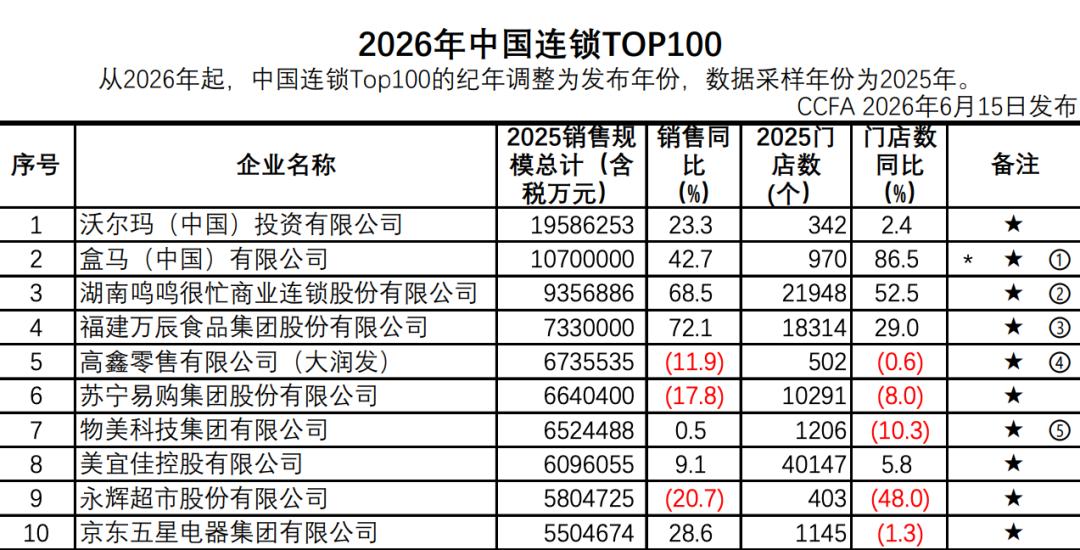
Image source: Top 100 Chinese Chains in 2026
However, the industry is undergoing a drastic reshuffle internally. The total sales of the top 10 enterprises reached 842.79 billion yuan, accounting for 40.7% of the total sales of the top 100; the number of stores was 94,788, accounting for 32.8% of the total. Walmart China continued to top the list with a growth rate of 23.3%. Hema jumped from the fifth to the second place. Two bulk snack enterprises, Mingming Busy and Wanchen Group, entered the top five for the first time. Meanwhile, a group of
home building materials and traditional supermarket enterprises that used to rank high have seen their rankings continue to decline. Yonghui Supermarket dropped from the fourth place in 2022 to the ninth place, with a significant decline in sales. The differentiation among leading enterprises is more intense than ever before.
Changes in the Top 10 Pattern
The changes in the rankings of the top 10 on the list reflect the structural restructuring that the Chinese retail industry is undergoing. Looking back at the changes in the past five years, in 2021, home building materials and home appliance retail enterprises occupied four seats among the top 10, including Suning, Gome Retail, Red Star Macalline, and Juran Home. By 2025, only Suning remained among the top 10, and it had dropped to the sixth place. Juran Home fell out of the top 10, and Gome Retail and Red Star Macalline were no longer at the top of the list. This change is directly related to the downward cycle of the real estate market and the contraction of home consumption.
Instead, there are two new paths. One is the continuous leadership of membership-based warehouses and fresh food e-commerce. Walmart China's sales in 2025 reached 195.86 billion yuan, ranking first for three consecutive years. It operates about 342 stores in total, among which the hypermarket format continues to shrink, and almost all the growth is driven by Sam's Club (about 54 stores).
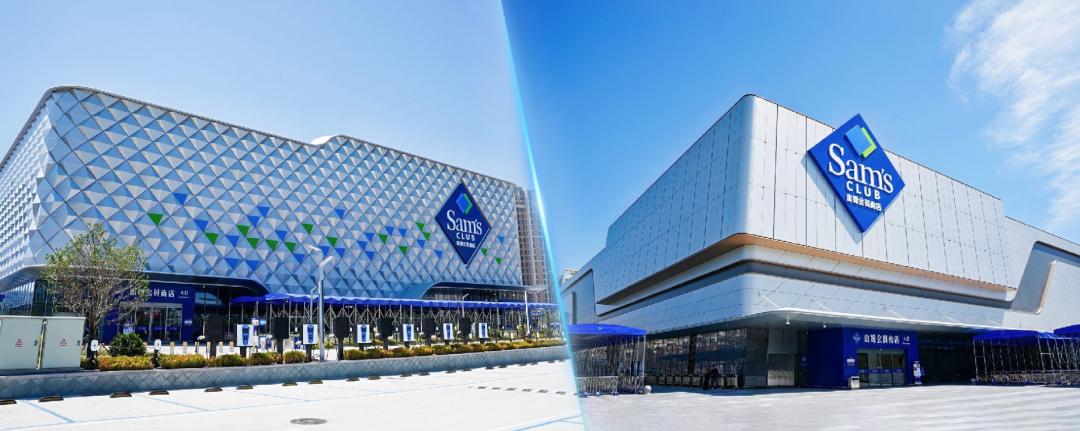
Image source: Walmart China official website
Sam's Club's core competitiveness lies in the full-link design that precisely matches the needs of middle and high-income consumers, and it builds its product strength with carefully selected SKUs and high cost-performance. In the fourth quarter of fiscal year 2025, Walmart China's net e-commerce sales increased by 34% year-on-year, and the proportion of online sales exceeded 50%. Hema entered the top three for the first time with 107 billion yuan. It took ten years from the opening of its first store in 2016 to entering the top three in 2025. Its growth is based on the synergy between Hema Fresh and Hema NB, which have formed a differentiated layout in the mid - high - end market and the sinking market respectively, and it achieved annual profitability for the first time in fiscal year 2025.
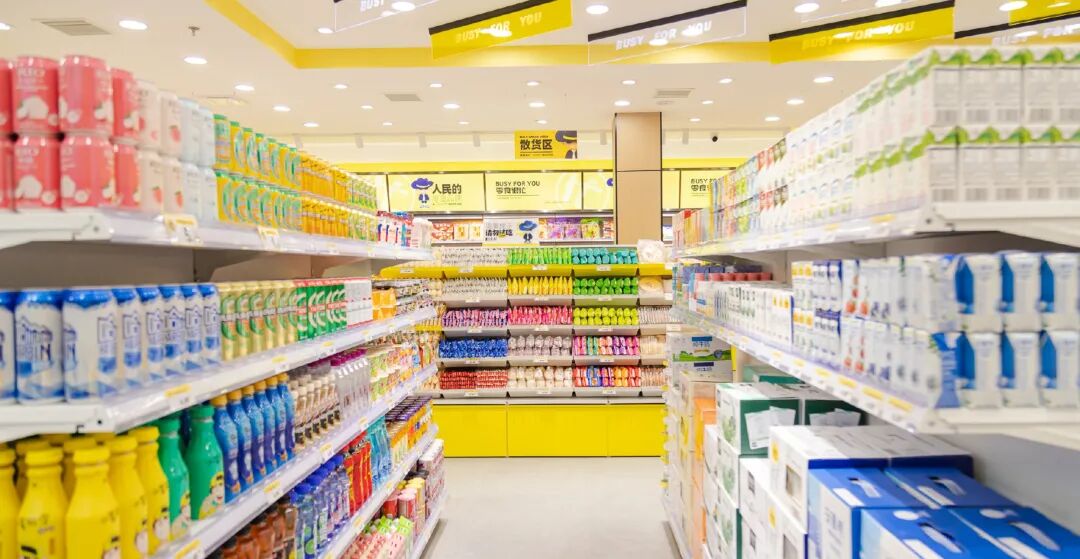
Image source: Internet
The other path is the explosive rise of bulk snacks and discount retail. Mingming Busy was formed by the merger of Ling Shi Hen Mang and Zhao Yiming Snacks at the end of 2023. It entered the top 10 in 2024 and jumped to the third place in 2025 with 93.568 billion yuan in sales and 21,948 stores. Wanchen Group, with its Haoxianglai brand as the core, ranked fourth in 2025, with the bulk snack business revenue reaching 50.857 billion yuan. Wanchen Group's total sales in 2025 were about 73.3 billion yuan (including other businesses such as edible fungi), thus ranking fourth. The common logic of the two enterprises is to support the low - price strategy with extreme supply chain efficiency, achieve rapid expansion through large - scale franchising, and reduce costs through economies of scale. ALDI's estimated sales in China in 2024 were about 2 billion yuan (according to industry estimates), almost doubling compared with 2023; in 2025, it entered Suzhou and Wuxi for the first time after leaving Shanghai. Biyoute's sales exceeded 10 billion yuan in 2025, and it took over 12 stores that Carrefour exited from the Northeast and 11 stores in the Jilin - Heilongjiang region of Yonghui in the past three years.
The Underlying Logic of Counter - Cyclical Growth
Walmart, Hema, Mingming Busy, ALDI, and Biyoute are enterprises that achieved counter - cyclical growth when the industry as a whole was under pressure. Although their paths are different, there are commonalities in the underlying logic.
First, supply chain efficiency is the core dividing line. Walmart's growth benefits from the carefully selected SKUs and global procurement capabilities of Sam's Club, which support the operation of the membership - based model with extremely low product costs. The growth of Mingming Busy and Wanchen Group is based on the large - scale procurement and efficient turnover of bulk snacks, using the density of the supply chain to offset the loss of gross profit caused by low prices. Biyoute's "daily delivery" mechanism relies on an intelligent supply chain system to support rapid expansion. Supply chain efficiency is becoming the core variable that determines whether an enterprise can win in the stock market.
Second, private brands are the key to differentiated competition. Sam's Club's private brand, Member's Mark, is the source of its core product strength, covering multiple categories such as food and daily necessities, and contributing a considerable proportion of sales. Hema's private brand system covers multiple categories from fresh food to processed food, which is the core means of differentiated competition and increasing the gross profit margin. Regional supermarkets such as Jiajiayue customize private brands through the SPAR system, further expanding their differentiated advantages on the basis of direct fresh food procurement.
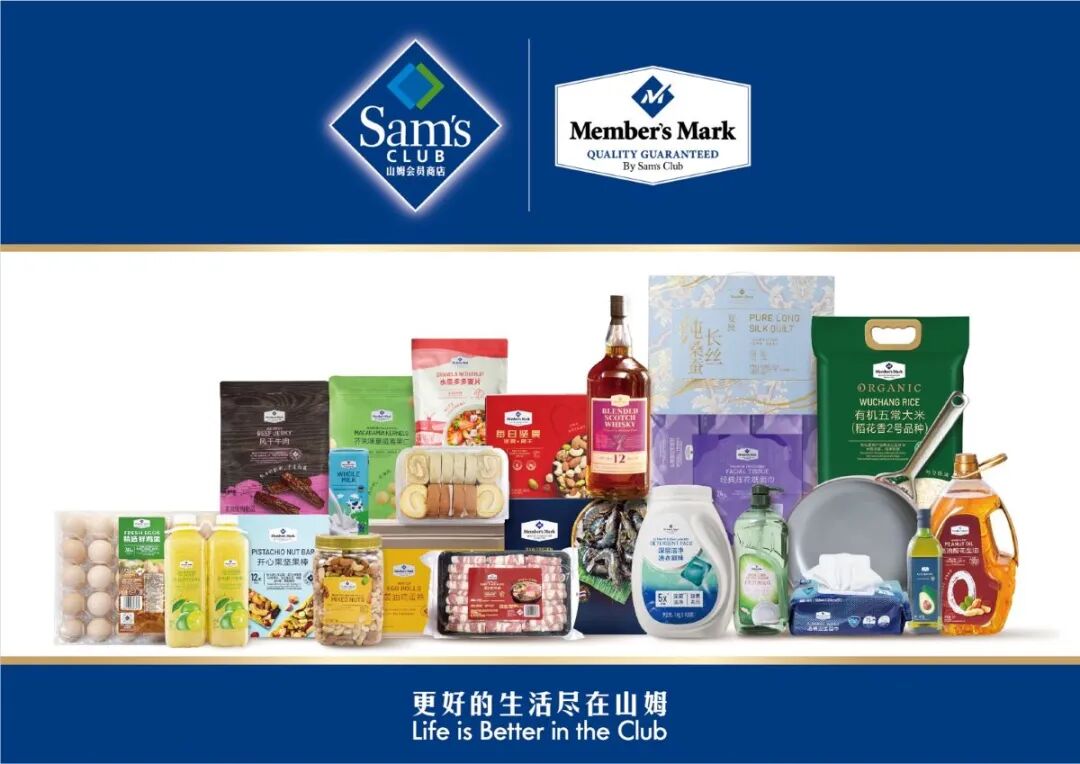
Image source: Sam's official website
Third, store operation is shifting from quantity expansion to quality improvement. In 2025, the total number of stores of supermarket enterprises decreased slightly, but the single - store operation ability of 60% of the enterprises improved. Similarly, 60% of comprehensive retail enterprises achieved single - store operation improvement. Biyoute opened 32 new stores in fiscal year 2025, verifying the key role of standardized operation ability in rapid expansion. This change marks a new stage of efficiency competition in the industry's stock era.
Fourth, against the background of continuously rising labor costs, organizational ability has become the foundation to support expansion. Biyoute's ability to quickly take over and integrate, and Hema's format innovation and rapid store expansion are all supported by organizational ability. According to data from the China Chain Store & Franchise Association, from 2021 to 2025, the proportion of labor costs to sales of the top 100 chain enterprises increased from 4.7% to 4.9%, and improving labor efficiency has become an issue that enterprises must face.
The Survival Foundation of Mid - Tier Enterprises
Shifting our focus from the leading enterprises to the mid - tier enterprises ranked 20th to 50th, we can observe another dimension of the survival logic. The business formats in this range are more diverse, covering regional supermarkets, convenience stores, specialty stores, and pharmacy chains.
According to the "Top 100 Chinese Chains in 2026" list of CCFA, the 15th to 21st places are as follows: Changchun Eurasia Group (about 39.1 billion yuan), Wushang Group (about 38.2 billion yuan), Tianhong Digital Technology (about 36.6 billion yuan), Yinzuo Group (about 34.8 billion yuan), Jiajiayue (about 31.9 billion yuan), AEON (China) (about 30.9 billion yuan), and Dashenglin Pharmaceutical (about 29.8 billion yuan). ①
① According to the "Top 100 Chinese Chains in 2026" list of CCFA; all sales are the total tax - included product sales statistics of the association, excluding the turnover of the wholesale market. Due to rounding, there may be slight differences from the final published annex of the association. Please refer to the official publication of the association.
The core competitiveness of regional leading enterprises is based on the in - depth penetration of the regional market. The local supply chain reduces the fulfillment cost, the long - term accumulated customer relationship forms a natural switching barrier, and the accurate grasp of regional consumption habits makes the product structure more in line with local needs. Jiajiayue relies on the SPAR global procurement network and the local supply chain system to achieve direct fresh food procurement and private brand customization. Wushang Group has been deeply involved in the Hubei market for decades, and its store network covers the main cities in the province. The logistics efficiency and brand awareness brought by regional density are difficult for external competitors to replicate in the short term. Although these enterprises do not have the economies of scale of leading enterprises, their respective moats are also clear.
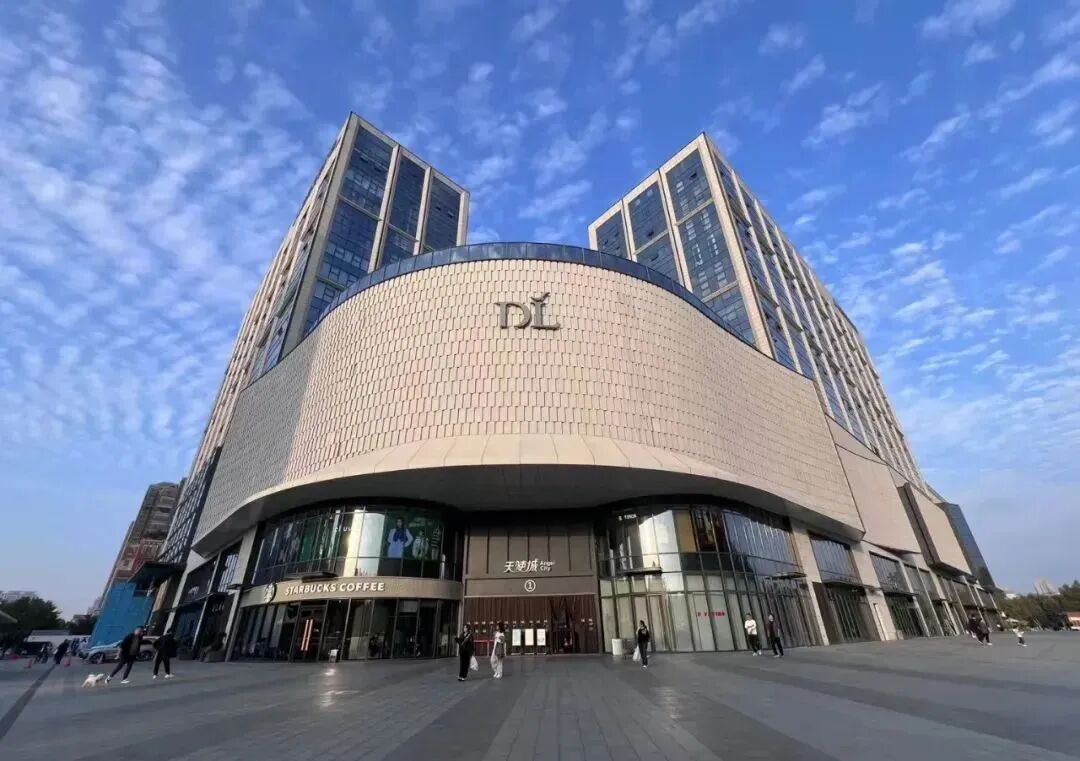
Image source: Internet
Xuchang Fat Donglai Trading Group Co., Ltd. is a unique and worthy - of - attention sample among mid - tier enterprises. Fat Donglai's sales in 2025 reached 23.531 billion yuan (according to the enterprise's officially announced annual business data), ranking 28th on the CCFA list of the same period. In 2022, Fat Donglai's sales were about 7 billion yuan, rising to 10.7 billion yuan in 2023, and increasing by 38.71% in 2025 compared with 16.964 billion yuan in 2024. Fat Donglai achieved sales of 23.5 billion yuan with about 15 stores, and its single - store efficiency is extremely prominent in the industry. Different from the mainstream path of large - scale expansion, Fat Donglai has established an irreplaceable competitive position in the regional market with extreme service and in - depth operation of single stores.
Specialty stores and pharmacy chains provide another differentiated path. Dashenglin Pharmaceutical represents the large - scale path of pharmacy chains. Benefiting from the aging population and the upgrading of health consumption, it has strong anti - cyclical properties. Mei Yijia firmly holds the leading position in convenience stores with the scale advantage of 40,147 stores. Specialty stores such as Kidswant (maternal and child products) and Cool Mobile Digital (3C products) build competitive barriers through category focus in niche markets and achieved double - digit growth in 2025. The common feature of these enterprises is to avoid the all - encompassing frontal battlefield and establish an irreplaceable competitive position in specific categories or specific regions. In the era of stock competition, single - store efficiency, supply chain ability, and product differentiation are becoming the three core variables that determine whether mid - tier enterprises can stay in the game.
Conclusion
In 2025, the sales scale of the top 100 chain enterprises reached 2.07 trillion yuan, with 289,000 stores. Behind this figure is a comprehensive competition about efficiency, model, and organizational ability. Walmart has proven that the depth of the supply chain can transcend the cycle. Hema has proven that format iteration can reshape the growth curve. Mingming Busy and Wanchen have proven that economies of scale can restructure the cost structure. Biyoute and ALDI have proven that in - depth regional operation and hard discounts can also hold their ground. The common feature of leading enterprises is not scale itself, but choosing a differentiated growth path when the industry as a whole is under pressure and transforming strategic choices into executable operational actions. The large - scale withdrawal of home building materials and traditional home appliance retail enterprises, the explosive rise of bulk snacks and discount retail, and the continuous leadership of membership - based warehouses and fresh food e - commerce together form the main line of this round of industry reshuffle. In the stock competition environment, an enterprise's strategic choice and execution efficiency determine its market position.
Data description: Unless otherwise specified, all data in this article are quoted from the "Top 100 Chinese Chains in 2026" list and related explanations released by the China Chain Store & Franchise Association on June 15, 2026. The financial data of listed companies such as Mingming Busy and Wanchen Group are taken from their publicly released annual reports. The sales data of Fat Donglai are quoted from its officially announced business data in 2025. The sales of ALDI are industry estimates. Unless otherwise specified, the "sales" in this article refer to the total tax - included product sales (including the turnover of franchised stores) statistics of the China Chain Store & Franchise Association, which is different from the "operating income" in the enterprise's financial statements. The data in this report are for reference only. Please refer to the official release of the China Chain Store & Franchise Association and the enterprise's announcements.
This article is from the WeChat public account "Retail Business Finance" (ID: Retail - Finance). The author is the RBF content team. It is published by 36Kr with authorization.