Daring to compete head-on with Japanese giants, China's electronic fabric industry has become tough and confident.
Just as retail investors were about to celebrate halfway through, the major shareholders of the electronic cloth giant had decided to secure their profits first.
Recently, against the backdrop of the collective upsurge in the AI computing power sector, Honghe Technology, which occupies a key position in the industry chain, has also shown strong performance. At the close on June 9th, the company's stock price reached 207.34 yuan per share, soaring by 463.47% this year. Its market value soared to 187.557 billion yuan, making it a double - bull stock in the AI computing power segment.
That night, Honghe Technology issued an announcement stating that SHARP TONE and UNICORN ACE, the concerted action parties of the company's controlling shareholder, planned to reduce their holdings by no more than 27.1376 million shares in total due to capital needs. Calculated at the closing price of that day, the maximum cash - out would be about 5.6 billion yuan.
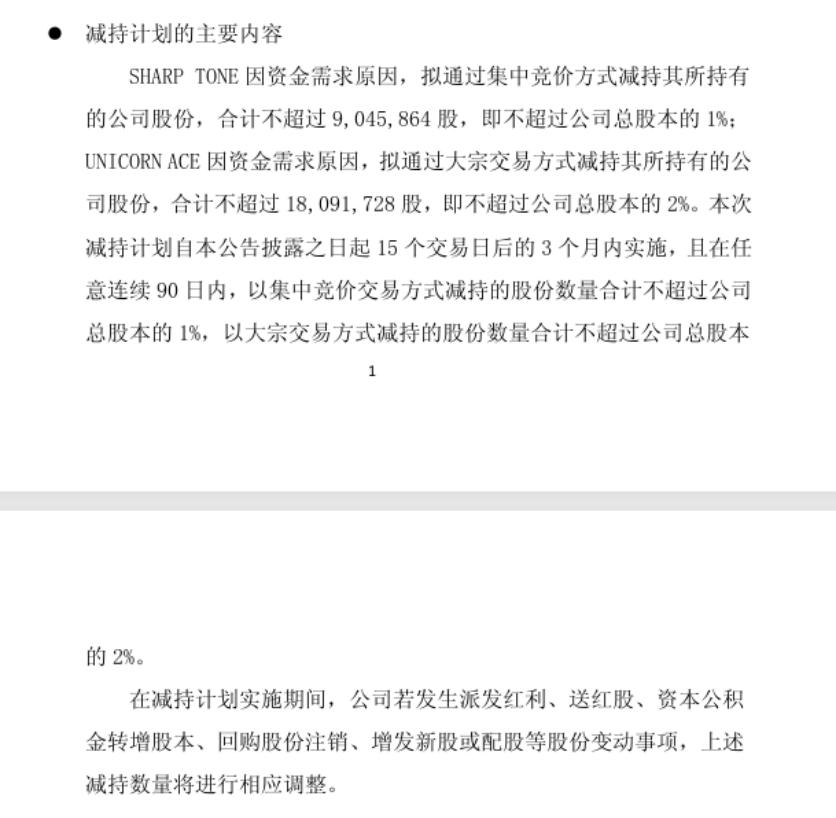
Image source: Honghe Technology's announcement
In the past, such a large - scale reduction in holdings would have caused the stock price to collapse. However, instead of plummeting as expected, Honghe Technology's stock price actually rose sharply. As of the close on June 16th, its stock price closed at 251.55 yuan per share, up 33.45% from the day of the reduction announcement.
This abnormal trend has made many stock investors sigh. Only in the A - share market can we see a situation where the stock price rises despite a large - scale reduction in holdings.
What kind of "magic cloth" is this electronic cloth? Why does the stock price rise even as the major shareholders cash out more than 5 billion yuan?
01 A Piece of "Cloth" Choking the Neck of AI Computing Power
Don't be misled by the word "cloth".
What Honghe Technology produces is not the ordinary textile fabric we are familiar with. Its full name is "electronic - grade glass fiber cloth". In simple terms, it is made by pulling glass into extremely fine filaments and then weaving them into cloth. This is electronic cloth, also known as electronic glass fiber cloth.
It may sound traditional, but if you disassemble a PCB circuit board, you'll find that the core substrate inside is this layer of cloth. It's not ordinary glass, but the "skeleton" in the electronics industry. The conduction logic of the entire industrial chain is very clear: electronic yarn is twisted into filaments, woven into cloth, and then pressed into copper - clad laminates (CCL), which finally become printed circuit boards (PCB) that carry chips, leading all the way to AI servers, smart cars, and chip packaging factories.
The PCB of an AI server usually has 20 to 30 layers, and each layer requires electronic cloth as a base reinforcement material. The consumption of electronic cloth by an AI server is 8 - 12 times that of a traditional server, and the value of its PCB is also 8 - 12 times that of a traditional server. It is estimated that by 2027, the global AI PCB market will reach 46.5 billion US dollars.
Electronic cloth accounts for nearly 20% of the cost of copper - clad laminates. Although this figure may seem small, this is where the problem lies. Once there is a shortage of electronic cloth, the entire PCB production line has to stop.
Since 2026, the global demand for computing power has continued to explode, directly driving up the price of this layer of cloth. According to comprehensive reports, as of early June, the commonly used specifications of electronic cloth in the market have completed the fifth round of price increases this year, with an average price of 7.4 yuan per meter, doubling compared to the low point in the third quarter of last year. The price of the more high - end Low - Dk second - generation cloth has reached 160 yuan per meter.
Behind this round of price increases is the structural increase in demand and the obvious lag in supply.
Generally, the delivery cycle of high - end weaving equipment is as long as 12 to 18 months, and it takes at least 18 to 24 months for a new production line to be planned and put into production. The expansion rhythm of upstream electronic yarn is also slow. More importantly, if a common electronic cloth production line wants to switch to producing high - end electronic cloth, it has to undergo process transformation. As a result, the production capacity not only fails to expand but also shrinks periodically, further exacerbating the supply shortage of high - end products.
With the sharp increase in downstream demand and the inability of the upstream to supply, price increases have become the only solution.
This is the story of how electronic cloth suddenly stepped into the spotlight from an obscure material.
02 The Money - Printing Machine Hidden in PCB
In the domestic electronic cloth industry, Honghe Technology is not the company with the largest production capacity, but it is the leading enterprise with the most precise positioning in the track and the deepest high - end barriers, perfectly avoiding the low - end track with intense industry involution.
Currently, the production capacity of the common 7628 standard electronic cloth in the domestic market is in surplus, with serious homogeneous competition and meager profits. However, Honghe Technology has been targeting special products from the very beginning, such as ultra - thin cloth, extremely thin cloth, and low - dielectric - constant cloth and low - thermal - expansion - coefficient cloth used in AI servers and high - speed switches.
The thickness of extremely thin cloth is less than 28 microns, thinner than a hair. The key is that the uniformity and dielectric loss of the cloth must be extremely stable. Even a micron - level defect on the cloth surface will render the entire copper - clad laminate useless. The technological difficulty behind this is far from being solved by simply "buying a few weaving machines". The threshold is extremely high, and the customer certification cycle is as long as 1 to 2 years. Once a customer passes the certification, few manufacturers will take the initiative to change suppliers.
Honghe Technology's deepest moat is precisely this deeply - bound customer chain. Its downstream customers cover the top ten copper - clad laminate manufacturers in the world, including Taiguang Electronics, Shengyi Technology, Lianmao Electronics, and Nanya New Materials. The cooperation period with the top five customers has exceeded 10 years. This kind of customer barrier cannot be replicated in a short time by simply throwing money at it.
Another key barrier is the "integration of yarn and cloth". Honghe Technology is one of the few companies that simultaneously master the technologies of electronic yarn drawing and electronic cloth weaving. Its subsidiary, Huangshi Honghe, has the mass - production capacity of 3 - micron extremely fine electronic - grade glass fiber yarn, becoming one of the only two companies in the world that can mass - produce 8 - micron extremely thin electronic cloth on a large scale. The other one is Nittobo of Japan.
This kind of barrier value has also been directly translated into outstanding performance.
In 2023, Honghe Technology was still in the red. It made a small profit in 2024, and in 2025, its net profit suddenly soared to 202 million yuan, a year - on - year increase of 785.55%. The performance in the first quarter of 2026 was even more amazing: the single - quarter revenue was 442 million yuan, a year - on - year increase of 79.72%; the net profit attributable to the parent company was 140 million yuan, a year - on - year increase of 354.22%. The single - quarter profit is already close to 70% of the whole - year profit in 2025.
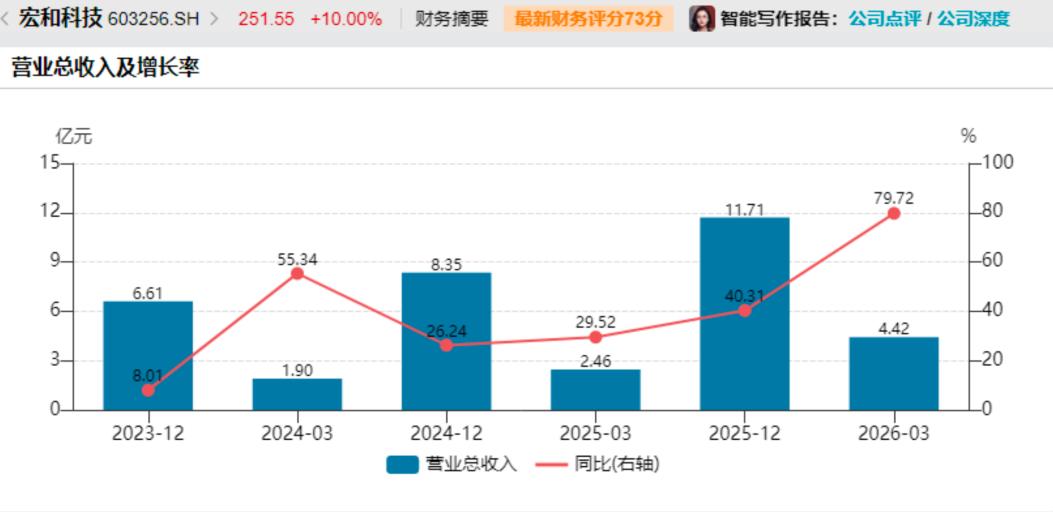
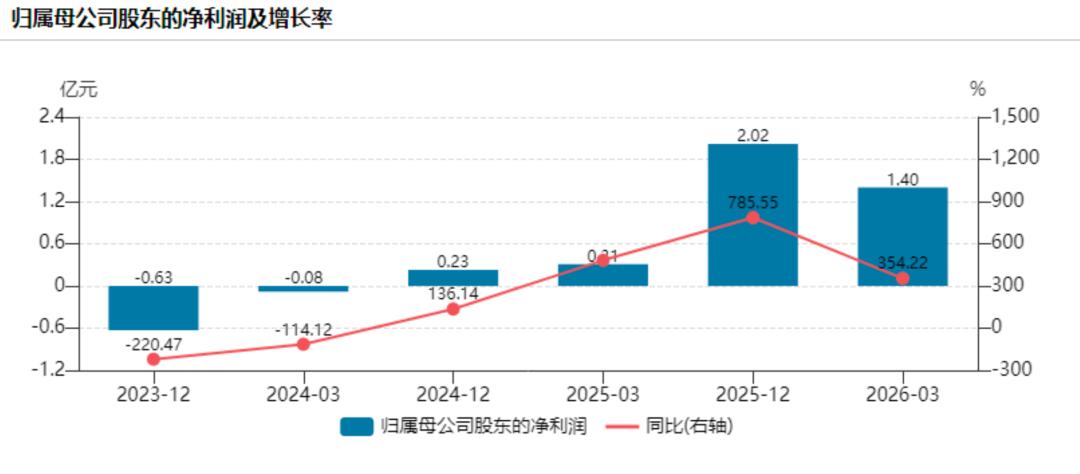
Image source: wind
The gross profit margin has also skyrocketed. The prospectus shows that in 2025, the company's comprehensive gross profit margin was 35.1%. Among them, the comprehensive gross profit margins of common electronic cloth and special electronic cloth were 31.6% and 59.7% respectively.
It is worth mentioning that in 2025, the company's revenue from special electronic cloth was only 178 million yuan, accounting for only 15.95% of the electronic cloth segment, but its contribution to profit far exceeded that of common products. In its first year of formal operation, special electronic cloth demonstrated strong profit elasticity, indicating the high premium brought by high - end products.
This may also be the core logic for the market to give Honghe Technology a high valuation. What the market is speculating on is not the current profit, but the profit - making elasticity after the large - scale production of special cloth.
03 Competing with Nittobo
When it comes to domestic competitors in the electronic cloth industry, one name is inevitable - Nittobo.
Nittobo is an established global leader in the electronic glass fiber industry, long - term dominating the high - end low - dielectric cloth and quartz cloth markets, with a market share of over 60%. It is also one of the very few companies in the world that can compete with Honghe Technology in the field of 8 - micron extremely thin electronic cloth.
In a sense, the existence of Honghe Technology itself is a microcosm of the accelerating domestic substitution.
In the high - end niche market where the second - generation low - dielectric cloth is applied, although Honghe Technology's global market share is only 4.0%, it is one of the only two domestic manufacturers that can achieve stable mass - supply of the second - generation low - Dk/Df cloth. In the field of low - CTE cloth, Honghe ranks third in the world and first in China, and it is the only domestic manufacturer with the mass - production capacity of the full range of low - CTE cloth. In terms of the total revenue scale of extremely thin cloth and ultra - thin cloth, Honghe is already the world's number one, with a market share of 20.5%.
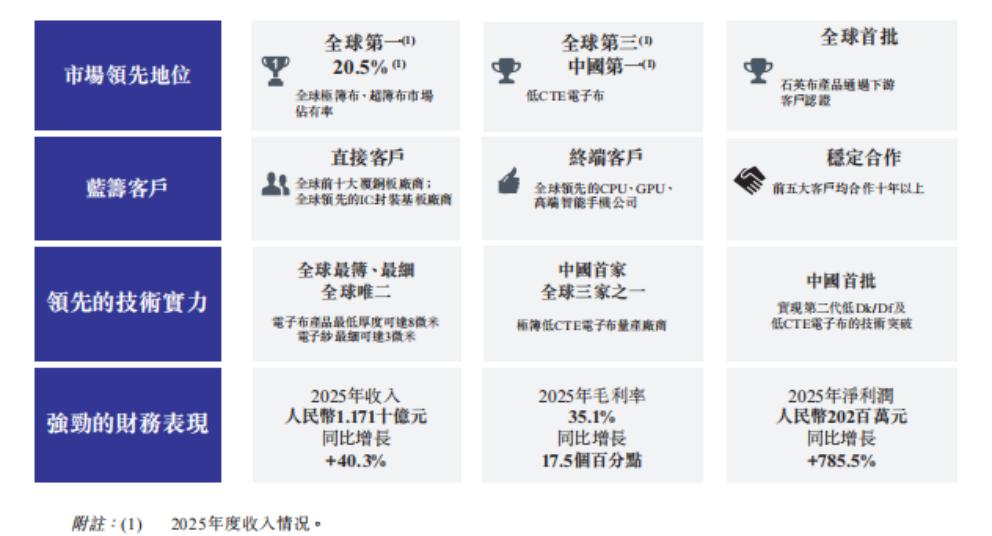
Screenshot from the company's financial report
Facing the incremental market spawned by AI computing power, Nittobo is accelerating its production expansion. Previously, it announced a plan to invest about 15 billion yen to build a new factory, which will be put into production by the end of 2026, with the goal of tripling its production capacity by 2028 compared to 2025. However, even if the new production line is fully operational, its expansion speed may still be far behind the explosive growth of AI demand.
From the perspective of industry impact, Nittobo's production expansion will have a certain impact on the industry's competitive landscape in the medium and long term. In the short term, it further confirms the extremely high prosperity of the high - end electronic cloth track and provides strong support for Honghe Technology's growth.
Under the wave of domestic substitution, Honghe Technology's competitive barriers are continuously strengthened: its rich resources of top - tier customers almost block the substitution space for new entrants; its globally leading production capacity and market share in the fields of extremely thin and ultra - thin cloth have consolidated its track advantages; at the same time, it is the first domestic enterprise to achieve mass - shipment of the first - and second - generation low - dielectric cloth and the full range of low - expansion special cloth.
Currently, Nittobo still has technological and production - capacity advantages in high - end niche fields such as second - generation Low - Dk cloth and quartz cloth. However, Honghe Technology is narrowing the gap with the trend of domestic substitution.
Behind the narrowing gap, Honghe Technology is using its performance and barriers to prove its scarcity. The fact that the stock price rises instead of falling despite the major shareholders' reduction in holdings precisely reflects the market's pricing logic for the long - term supply - demand mismatch of high - end electronic cloth. This piece of cloth has evolved from an auxiliary material to a key material for AI computing power, and Honghe Technology has a precise position in the market.
In the future, as the production capacity of special cloth at the Huangshi base further ramps up and the penetration rate of high - end products such as low - dielectric and low - expansion cloth in AI servers continues to increase, Honghe Technology and Nittobo will most likely shift from "catching up" to "fierce competition".
Domestic substitution is never an overnight success. However, in this electronic material revolution triggered by computing power demand, Honghe Technology has clearly secured a seat at the table.
This article is from the WeChat official account "Source Media Collection", author: Xie Chunsheng. Republished by 36Kr with authorization.