Why can't enterprises see tangible results from 80% of their AI investments?
This article is based on an in-depth research-oriented intellectual exchange spanning 2 months, and aims to systematically answer a core question: In the AI era, how can enterprises build a correct cognitive framework and make high-quality strategic judgments? This research fully integrates an original analytical framework with academic research evidence, management theory, technological history laws, and current AI transformation practices and trends. It contains extensive reasoning analysis and core outcomes, aiming to provide enterprise decision-makers with a set of cognitive methods, analytical frameworks and judgment bases for thinking and decision-making on enterprise transformation in the AI era that have been tested through rigorous speculation.
This article is approximately 20,000 words, with the following core structure:
Problem Awareness and Core Proposition
The Importance of Building Basic Understanding and Judgment of AI
The Starting Point and End Point of AI Research — Return to the Basic Law of Business Success
Complete Variable System Affecting Sustained Business Success (V1-V17)
What Changes and What Remains Unchanged for Key Variables in the AI Era
Building Competitive Advantage After Technological Equalization
Objective Cognition of Organizational Change — Boundaries, Position and Limitations
An Examination of the Current Mainstream AI Discourse System
Core Conclusions and Strategic Implications
01 Problem Awareness and Core Proposition
In 2026, a profound contradiction faces all business managers.
On one hand, the AI boom continues to heat up. Management consulting firms have intensively released transformation reports, emphasizing "transform or die"; global AI capital expenditure has exceeded one trillion US dollars, showing a pattern similar to the telecom bubble of the 1990s — where large-scale vendors "dare not appear underinvested in front of their peers"; AI transformation has become the hottest topic, with various new terms emerging one after another; propositions such as "AI Agents will replace 80% of knowledge work", "AI literacy for all employees", and "organizational change is the key" dominate the mainstream discourse. Against this background, enterprise decision-makers also face huge judgment pressure and action anxiety.
However, rigorous empirical data presents a completely different picture:
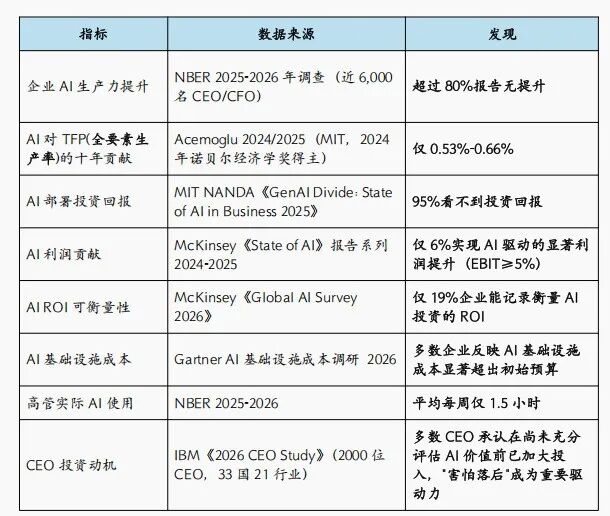
(Note: The "80%" mentioned in this article comes from this NBER survey)
This constitutes a profound contradiction: AI is extremely powerful in the discourse system, but AI in data is still in its infancy. The investment side is equally striking — 95% of enterprises do not see a return on investment, and only 6% have achieved significant profit improvement; at the same time, the cost of AI infrastructure for most enterprises significantly exceeds the initial budget, and the driving force for investment is not even business judgment but fear — most CEOs admit that they have increased investment without fully evaluating the value of AI, and "fear of falling behind" has become an important driving force.
The deeper problem is that even if AI does improve individual efficiency at the micro level, this improvement does not necessarily automatically translate into actual value for the enterprise. From a business logic perspective, the real value of efficiency must be reflected in the improvement of a company's turnover speed —
DuPont Formula: ROE = Profit Margin × Asset Turnover × Leverage Ratio
Turnover is the core factor that directly drives shareholder value. But from "1 hour of work is reduced to 1 minute by AI, and the individual or team saves 59 minutes" to "accelerated company turnover", there is actually a long distance, especially for large enterprises. There are at least two breaking points:
Time Whereabouts Disconnection: If the saved time is not directed by the organizational mechanism to higher-value activities, it will dissipate — employees may use the remaining time to do things unrelated to the core business. Micro efficiency improvement becomes the release of personal time, rather than the improvement of organizational productivity.
Quality Breakthrough Disconnection: If AI only allows people (or AI-led work) to produce work of roughly the same quality faster (one hour of data analysis becomes one minute, but there is no qualitative change in the depth of insight), then the speed increase will not bring innovation and growth — and innovation and quality are precisely another key engine of a company's business growth.
To some extent, these two disconnections explain the deep root cause of "80%+ no productivity improvement". Micro efficiency improvement ≠ macro efficiency improvement. From individual efficiency improvement to organizational turnover, there is a "transmission mechanism" problem that was once ignored, is still underestimated by many people, and is still difficult to accurately measure today. Without this mechanism, the improved efficiency may be like water leaking into sand and disappear, not reflected in any organizational indicators. The design of this transmission mechanism precisely requires us to return to a more fundamental question:
Core Problem Awareness
Facing the above contradiction, a fundamental problem awareness constitutes the starting point of this research:
In the AI era, the primary challenge for enterprises is not "how to use AI", but "how to build a correct basic understanding and judgment of this new variable AI". Because the actions and measures brought by different judgments can be very different, which ultimately affects the actual effect.
This problem awareness has several layers of meaning behind it:
1. When a new variable is driving a profound change, the basic understanding and judgment of it may determine half of the success or failure of the entire change.
2. Basic understanding and judgment do not mean conservatism or lack of new thinking. On the contrary, they are a concentrated reflection of cognitive level and logical level.
3. Vigilance against superficial cognition is necessary — the danger of superficial cognition is not that it makes people do nothing, but that it makes people confidently do the wrong thing.
4. Truth does not necessarily lie in the hands of the majority — especially in the early stage of paradigm shift, the error rate of mainstream consensus is historically high.
Core Proposition of This Article
After in-depth research and speculative testing, the core proposition established in this article is:
To study the impact of AI on enterprises, we still need to return to the basic logic of "sustainable business and business success", and take this as the fundamental fulcrum and starting point, rather than taking AI itself as the starting point. If we deviate from this starting point, the research will lose its direction, and enterprises will likely fall into the dilemma of "AI correctness" or blind following.
This proposition is neither conservatism nor a denial of AI. It fully agrees that AI will profoundly affect and reshape current production methods, management methods and business. But it insists: Setting a clear starting point (what does sustainable business success depend on) and end point (whether sustainable business success can be achieved) is the prerequisite to ensure that research has direction, boundaries and evaluation standards.
02 The Importance of Building Basic Understanding and Judgment of AI
Why is "basic understanding and judgment" so critical
For a new variable that is driving change, the cognitive act of "building basic understanding and judgment" itself may be the most critical link that determines the success or failure of the change. The argument for this is based on the following logic:
Logic 1: Judgment is the "multiplier" of action — execution only brings positive returns when the direction is correct
Final effect = Direction correctness × Execution × Environment fit
If the direction correctness is negative (the basic judgment is wrong), the stronger the execution, the further away from the correct result.
Typical case: Nokia had extremely strong execution from 2007 to 2012 — it efficiently implemented a wrong judgment (insisting that the Symbian system was the future). Execution was perfect, but the direction was fatal.
"Basic understanding and judgment" directly determines the multiplier of "direction correctness". When the multiplier is positive, all efforts accumulate value; when the multiplier is negative, all efforts accumulate liabilities.
Logic 2: Once a basic judgment is formed, it has a very strong locking effect
The primacy effect, which has been verified by a large number of experiments in cognitive psychology, shows that people's first judgment framework of a thing will greatly affect the processing of all subsequent information.
Once an enterprise leader forms a certain "basic understanding" of AI:
Information consistent with this understanding will be automatically received and strengthened.
Information contradictory to this understanding will be automatically filtered or rationalized.
Organizational resources will be allocated around this understanding.
Recruitment, KPI setting, and investment decisions will all be carried out along this understanding.
The cost of correcting a basic judgment that has already been put into action is much higher than getting it right at the beginning. This is why investing in-depth cognitive resources in the construction phase has the highest rate of return.
Logic 3: During periods of change, the difference in results caused by differences in judgment is amplified exponentially
In a stable period, differences in understanding of a certain variable among different enterprises may only lead to a 5-10% difference in performance. But in a period of change (such as the current AI era), the same difference in understanding can lead to huge differences.
The reason is: The period of change breaks the old balance, and all parties compete for position again. In the process of reordering, small differences in initial conditions will be amplified into huge result differences by positive feedback mechanisms. This is the "bifurcation point" phenomenon in complex systems — near a critical turning point, a small force can determine the system's trajectory towards completely different paths. The basic judgment of AI is precisely the "initial condition" at this current critical turning point.
What does the cognitive act of "building basic judgment" include
"Building basic judgment" is not a moment of epiphany or intuitive experience, but a structured cognitive process. It can be broken down into four levels:
Level 1: Positioning — what position does this new variable occupy in the business logic system
This is the most fundamental cognitive act: finding the position of AI in the business logic system. Is it an end or a means? Is it a cause or a condition? Which basic propositions does it affect?
The quality of positioning depends on: how deeply you understand the business logic system itself.
The depth of judgment on a new variable can never exceed the depth of your understanding of the system it is embedded in.
If a person only has a shallow or biased understanding of "what makes an enterprise continuously successful" (for example, only knows or pays most attention to "cost reduction and efficiency increase"), then his positioning of AI will inevitably be shallow and biased ("AI is used for cost reduction and efficiency increase"). Only if a person has a deep and multi-dimensional understanding of business success can he give an accurate positioning to AI.
Level 2: Distinguishing — what is essential and what is phenomenal
AI now presents a large number of phenomena: generating text, generating images, writing code, providing decision assistance, Agent automation... Shallow cognition may prioritize listing these phenomena side by side and then ask "which one should I use". Deep cognition, on the other hand, finds a unified essential feature behind all these phenomena.
Regarding the essence of AI, here is a judgment (for challenge and testing):
The essential feature of AI is not "intelligence", but "reducing the marginal cost of cognitive behavior to close to zero".
In the past, every judgment, analysis, creation, and translation required a person to spend time doing. AI changes the marginal cost of these cognitive behaviors from "one person's one hour" to "a few dollars of computing power".
If this judgment holds, the impact on business becomes structurally clear:
Any industry that takes cognitive behavior as its core deliverable will face a fundamental reshaping of its cost structure.
Any service that takes the scarcity of cognitive behavior as its pricing basis will face value revaluation.
But the goal served by cognitive behavior (meeting customer needs, solving problems) — this goal itself remains unchanged.
Level 3: Judging the rhythm and nodes of change
Superficial judgment only answers "will AI change X". Deep judgment also answers "when, under what conditions, in what order". For example, different judgments in the example below correspond to different action plans:
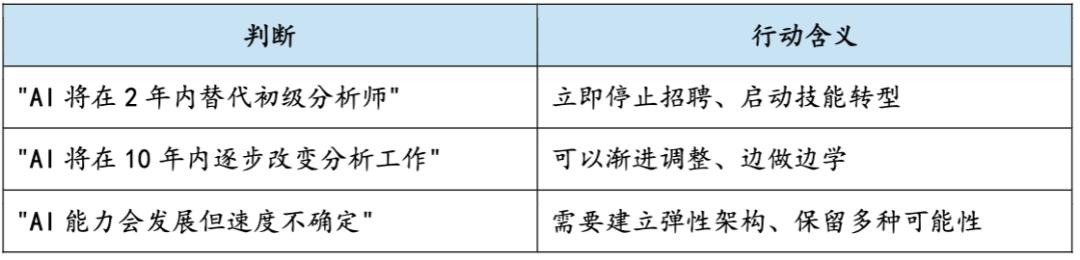
The accuracy of time judgment directly determines the rationality of action rhythm. And time judgment is precisely the hardest to make and the most easily distorted by mainstream narratives. Roy Amara's law accurately describes this trap:
"We tend to overestimate the short-term impact of a new technology, and underestimate its long-term impact."
Level 4: Recognizing your own cognitive boundaries — knowing what you "don't know"
This is the highest level of cognitive behavior. The characteristic of shallow cognition is not "wrong", but "not knowing where your judgment may go wrong". It manifests as a false sense of certainty.
The characteristic of deep cognition is: while giving a judgment, it precisely knows which premise assumptions the judgment depends on, and how the judgment needs to be revised if these assumptions are broken.
Five Levels of AI Cognition (L1-L5 Model)
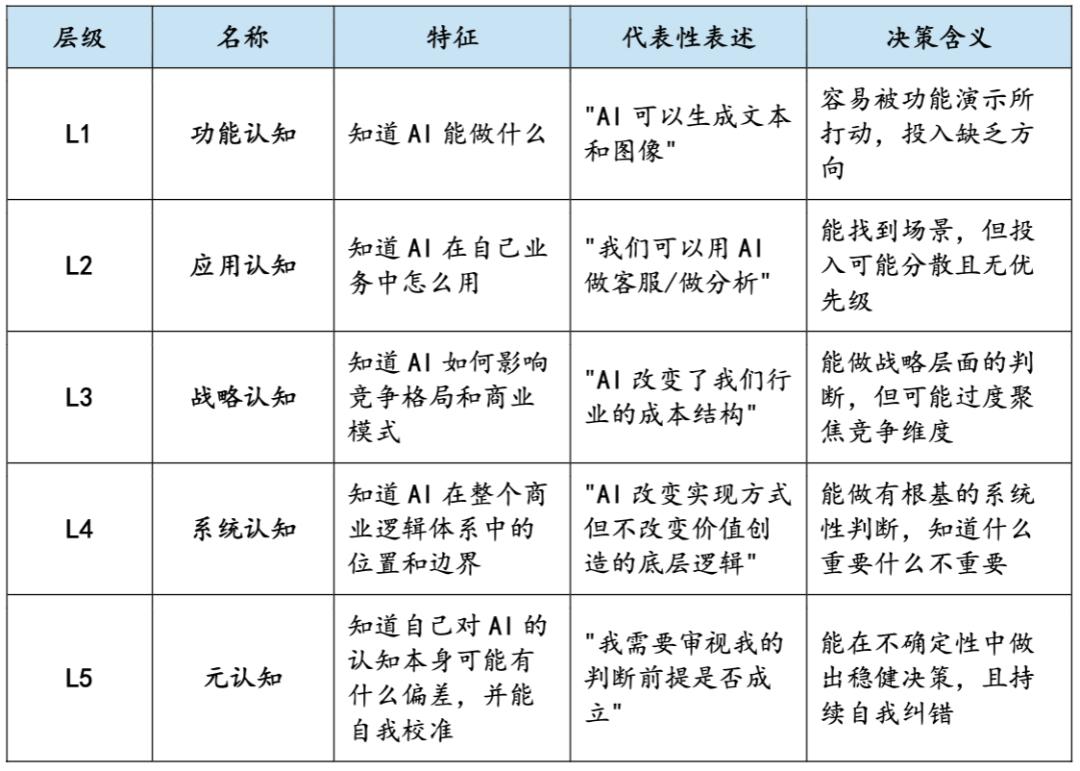
Based on this standard, we give a non-rigorous current status judgment based on public information:
Most enterprise leaders stay at L2-L3
Most management consulting reports stay at L3
Most academic research is at L3-L4
People who can do both L4 and L5 — both build a system and question the system — are truly scarce
Core Insight:
AI technology is rapidly democratizing (accessible to everyone) , but deep cognition of AI has not democratized (it is still extremely scarce) . When everyone has the tools but only a few have judgment, judgment becomes the most scarce competitive factor.
Four Superficial Modes of "Basic Judgment" on AI Currently
People who form judgments at the L1-L2 level usually present the following superficial modes:
Superficial Mode 1: Function listing replaces essential understanding
"AI can write articles,