40 top global experts gathered secretly in Washington for a closed-door discussion on avoiding the AI doomsday
Forty top experts conducted a simulation of the AI economy in 2030 in Washington. The results are disturbing. GDP doubles, but white-collar workers are largely pushed into the gig economy. A lot of solutions are proposed, but the real bottleneck lies in the governance speed. And 2030 might just be the prologue.
Last week, at the Peterson Institute for International Economics in Washington, D.C., USA.
Forty economists, technology experts, and policymakers were gathered in the same meeting room, with work manuals, easels, and markers in front of them.
Their task was to simulate an economic scenario for the United States in 2030, a scenario called "Paper Prosperity".
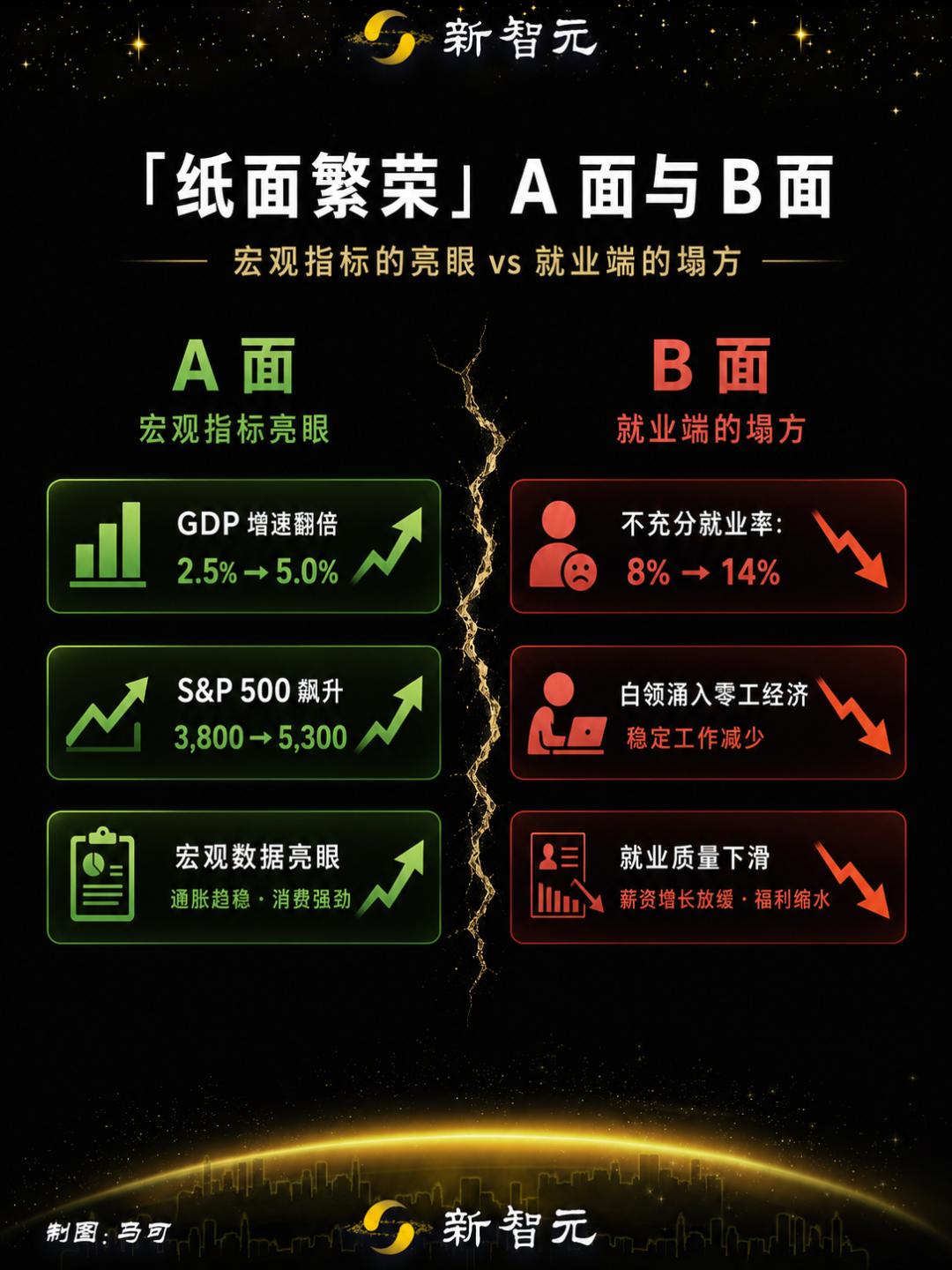
In this scenario, AI nearly doubles the GDP growth rate, and the S&P 500 keeps rising. However, the underemployment rate jumps from 8% to 14%, and millions of highly educated white-collar workers are squeezed into gig jobs, part-time jobs, and positions below their qualifications.
They discussed for a whole day, and the conclusion is hardly optimistic.
2030, a Well-Designed Scenario
The organizer of this simulation is Windfall Trust, a non-profit organization focusing on addressing the economic impacts of AI. It has held similar scenario simulations in multiple cities around the world in the past few years.
The participants in this Washington event include labor economists, AI researchers, and sitting members of Congress, making it a very impressive lineup.
The organizer deliberately narrowed the topic to the economic aspect, avoiding AI security topics such as cyber security and biological threats.
Adrian Brown, the CEO of Windfall Trust, believes that when people start to worry that AI will disrupt their own and their children's jobs, the social pressure caused by economic anxiety will come faster and more violently than any technological security threat.

Sam Altman of OpenAI and Dario Amodei of Anthropic have recently downplayed their earlier predictions of large-scale white-collar unemployment in public. Coincidentally, both companies have recently announced their IPO plans.
However, the public is not reassured. A survey by the Pew Research Center in March this year shows that only 17% of Americans believe that AI will have a positive impact on the United States in the next 20 years.
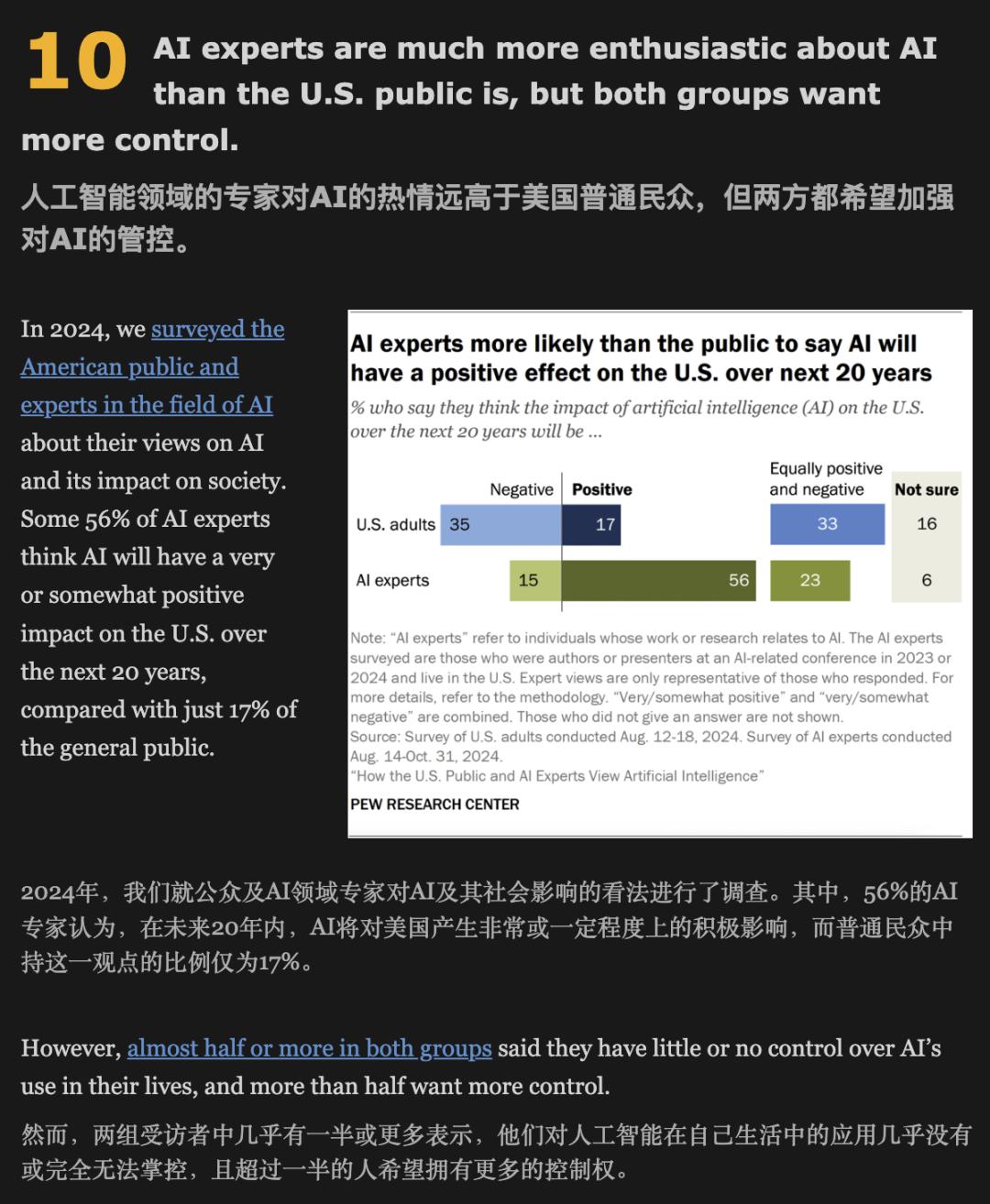
https://www.pewresearch.org/short-reads/2026/03/12/key-findings-about-how-americans-view-artificial-intelligence
The Other Side of Doubled GDP
The macro data in the "Paper Prosperity" scenario is quite impressive.
The efficiency improvement driven by AI almost doubles the GDP and labor productivity growth rates, and the capital market is in a frenzy.
However, the employment situation tells a completely different story.
The unemployment rate only rises slightly, and the real alarm lies in another indicator.
The underemployment rate soars from 8% to 14%. In terms of people's situations, a large number of white-collar workers who originally worked in office buildings start to take scattered online tasks, do part-time jobs that do not match their education levels at all, or switch from full-time to flexible employment.
The simulation scenario accurately summarizes this situation. The problems that have long troubled grass-roots workers, such as gig work, unstable income, and the anxiety of being replaced at any time, are starting to spread to the upper middle class.
Some participating experts point out that in the short term, physical jobs that rely on on-site operations, such as welders, nurses, and plumbers, may see a wave of salary increases.
However, this bonus is likely to be short-lived.
When a large number of white-collar workers displaced by AI enter the blue-collar retraining channels, the surge in the supply side will quickly drive down the salary levels of these jobs.
A cycle of "displacement → influx → further reduction" may occur simultaneously in multiple industries.
When the Social Contract Starts to Fail
The economic shocks will eventually spread to every corner of the social structure.
During the group discussions in the morning of the simulation day, experts at each table quickly reached a consensus on several judgments.
Social instability factors will increase significantly.
The generational divide will deepen further.
Due to their pessimistic outlook on the future, young people's willingness to have children continues to decline.
These judgments point to a deeper rift. The implicit social contract that has been in operation for decades - going to school, working hard, and living a decent life - is losing its persuasiveness.
When a graduate from a top university finds that their income is lower than that of a temporary task-taker on a gig platform, this narrative becomes hard to believe.
Neil Thompson, the head of the MIT FutureTech research group, provided a different perspective during the discussion.

AI may significantly reduce the costs of healthcare and education, and Americans may become healthier and live longer as a result.
Those who are in underemployment may even have more leisure time to engage in creative activities.
A on-site coordinator half-jokingly called it the "crochet economy".
However, the benefits at the system level are difficult to automatically translate into a sense of security at the individual level.
The figure of 17% is, to some extent, a quantitative expression of this gap.
Solutions on the Table
The discussion in the afternoon entered the policy stage.
The solutions proposed by the experts are not lacking in imagination, but there is a long "but" behind almost every solution.
Skill retraining is mentioned most frequently.
However, it is a common understanding in the academic community that the government-led retraining programs implemented by the United States in response to the outsourcing of the manufacturing industry have not achieved ideal results.
Harry Holzer, a labor economist at Georgetown University in the United States, further pointed out a fundamental dilemma. At present, it is still unclear what new tasks and new occupations AI will create, so it is impossible to determine the training direction.

Income redistribution is also a focal issue. The paths include universal basic income (UBI), increasing taxes on AI companies and their shareholders, and injecting part of the AI companies' revenues into public funds to benefit a wider range of people.
In terms of the social safety net, universal medical insurance, employment guarantees, wage subsidies for those who re-enter the job market with a pay cut, and large-scale investment in industries that rely on interpersonal skills, such as child and elderly care, are also put on the table one by one.
There are many solutions on the table, but the real bottleneck lies in the implementation.
AI technology iterates on a monthly basis, while the formulation and implementation of policies are measured in years or even political cycles.
A member of Congress who participated in the lunch Q&A session bluntly said that the response speed of the legislative body when facing technological issues is far behind the pace of real - world changes.
A bipartisan draft bill, the "Great American AI Act", which covers the collection of AI labor data and the disclosure of catastrophic risks, was just released this month. However, there is still a long way to go from the draft to the formal legislation.
Positive signals come from across the ocean.
The UK just established the AI Economics Institute last week, a government - level research institution dedicated to providing research support in the field of AI economics for public policies.
Adrian Brown commented, "It is encouraging to see some countries starting to take these issues seriously."
2030 Is Just the Prologue
The underlying assumption of all the discussions in this simulation is still a relatively mild scenario. AI has significantly improved efficiency and replaced a considerable number of white - collar jobs, but it has not fully replaced most human labor.
However, the public roadmaps of several leading AI laboratories all point to the 2030s, suggesting that AGI may emerge within this window period. If this expectation is fulfilled, what "Paper Prosperity" depicts is just an overture to a deeper - level transformation.
By then, the questions to be answered will far exceed the scope of employment and income distribution, pointing directly to a more fundamental proposition: When machines can perform all the intellectual work that humans can do, what is the position of humans in the economic system?
Taking it a step further, if ASI follows, what may need to be redefined is not just "work" but "value" itself.
These forty people discussed in Washington for a whole day, and the greatest consensus they reached may be condensed into one sentence: the cost of inaction is far greater than the cost of trial - and - error.
The window period for humans to establish a governance framework may be much shorter than most people think.
Reference materials:
https://www.wsj.com/tech/ai/inside-the-room-where-americas-brightest-game-out-how-to-avoid-an-ai-apocalypse-9e5e8526
This article is from the WeChat official account "New Intelligence Yuan", author: ASI Revelation. It is published by 36Kr with authorization.