Some stay out of the fray, but in the AI office arena, we have no choice but to fight
Recently, a 70,000 - word "post - departure review" titled Inside DingTalk by a former core product manager of DingTalk ONE project has drawn external attention to its internal management. Beyond internal management, the experience of the DingTalk ONE project in the past year, from project initiation, release, strategic contraction to being split and incorporated into Wukong, actually reflects the increasingly fierce competition landscape in the AI - powered office field.
What the public has not noticed is that before this, the functional positioning of the enterprise office market has been upgraded from "product - service" centered around office software to the "enterprise digital foundation", and it has continuously penetrated into the enterprise business level. After the incremental stage from 2018 to 2022, a stable tripartite pattern of DingTalk, Feishu, and WeCom has been formed in the entire market.
However, stability is just an appearance. With the new round of productivity transformation triggered by large - scale AI models and AI Agents, the enterprise office market is accelerating into the new battlefield of AI - powered office.
The "New Stage" of AI - Powered Office
Before 2023, the "historical mission" of the Chinese office software market was office digitization. That is, to enable enterprises to shift from traditional paper - based processes to online approvals, replace offline meetings with video conferences, and move internal and external communications into instant messaging scenarios. At this stage, the core value of enterprise office products was to help enterprises improve collaboration efficiency.
However, with the explosion of large - scale models, AI - empowered documents can automatically generate content, spreadsheets can analyze data, online meetings can automatically generate meeting minutes, knowledge bases can automatically answer questions, and even project management tools have the ability to execute tasks autonomously. Thus, the accelerated implementation of AI in office scenarios has turned traditional office software from mere tools into "digital employees" capable of doing work.
On the business level, the profitability of AI - powered office has been proven in the market.
In 2023, Microsoft launched Microsoft 365 Copilot, fully integrating the capabilities of GPT into the "office suite" consisting of Word, Excel, PowerPoint, and Outlook. At that time, Microsoft CEO Satya Nadella defined it as "a new generation of office methods". As of now, the official Microsoft website shows that more than 90% of the Fortune 500 companies globally are using Copilot products.

*Image source: Microsoft 365 official website
In April this year, when Microsoft announced its financial results for the third quarter of fiscal year 2026 ending March 31, Satya Nadella said, "We are focused on providing cloud and artificial intelligence infrastructure and solutions to help various enterprises maximize their results in the era of intelligent agent computing. Our annual recurring revenue (ARR) from AI business has exceeded $37 billion, a year - on - year increase of 123%."
Besides Microsoft, almost all other software giants are adopting similar strategies. For example, Google Workspace has fully integrated Gemini, Salesforce has launched Einstein AI, Notion has launched Notion AI, and Adobe has launched Acrobat AI Assistant. Integrating AI into office scenarios has changed from a trend to an unspoken agreement among companies in the industry.
From the perspective of the AI development strategies of domestic technology giants like Tencent, ByteDance, and Alibaba, the office scenario is also a rare high - quality entry point and display window.
Firstly, writing documents, creating spreadsheets, holding meetings, and processing approvals are daily tasks for enterprise employees. Compared with regular consumption behaviors like shopping, office work is obviously a more essential and high - frequency usage scenario.
Secondly, for enterprises with organizational operations, although internal processes are complex and there are certain differences among companies, there are usually standard templates or complete SOPs within a company. This provides a large amount of available learning materials for AI, not only reducing the difficulty of AI implementation but also providing a mature and clear commercialization path.
Thirdly, compared with the emotional value pursued in the current consumer market, enterprises and their employees are more willing to pay for efficiency. The product value and service value in the office scenario can be truly reflected in the form of "efficiency". For example, if AI can help a salesperson save 30% of the time spent on document processing, it means that he can respond to customer needs more quickly and devote more energy to sales conversion. The changes brought about by efficiency improvement can be reflected by the ROI calculated based on the comprehensive AI - powered office products and labor costs.
Therefore, for technology giants, AI - powered office is not only a new growth point in the enterprise office market but also an important stage to showcase their large - scale model capabilities - and the latter point is particularly important.
Looking back at the latest "AI wave" since 2023, Chatbot, generative AI, and AI Agent have successively contributed to industry hotspots. However, while technology giants are following up on the complete AI layout, they also face a concern: compared with the business innovation model in the mobile Internet era where "one APP could drive a round of data growth", the AI business not only requires continuous large - scale investment in hardware and technology but also lacks a mature and relatively clear successful path in the business aspect (except for AI - powered office).
On one hand, there is continuous "power generation for AI" with a large amount of money being burned. On the other hand, the "financial prospect is unclear" and the "path is unknown". Even if technology giants have deep pockets, they need to be responsible for the figures on the financial statements and give an explanation to the investors in the capital market. The current AI - powered office market has become a "talent show" to prove strength.
Four Samples of AI - Powered Office
If we observe the current Chinese enterprise office market, we will find that the competitive pattern of the "Four Major Players" has gradually become clear.
According to QuestMobile data, in 2025, the combined market coverage of DingTalk, Feishu, and WeCom in the domestic collaborative office market reached 92%. In terms of monthly active users, DingTalk ranked first with about 200 million monthly active users, WeCom ranked second with about 100 million monthly active users, and Feishu ranked third with about 30 million monthly active users. In addition, Kingsoft Office, with its continuous accumulation since the office software era, also has strong strength. As of the end of 2025, the number of monthly active devices of WPS Office globally exceeded 678 million.
However, when comparing DingTalk, Feishu, WeCom, and WPS 365, we will find that although product functions such as instant messaging, documents, spreadsheets, and knowledge bases are almost standard in the industry, there are still some obvious differences among them.
Among the "Four Major Players", DingTalk is the least like an "office software company". DingTalk's early success was based on the needs of enterprise bosses to reverse - engineer product functions, resulting in features such as "read but not replied" and "DING" that were later criticized by the outside world for "high - pressure management".
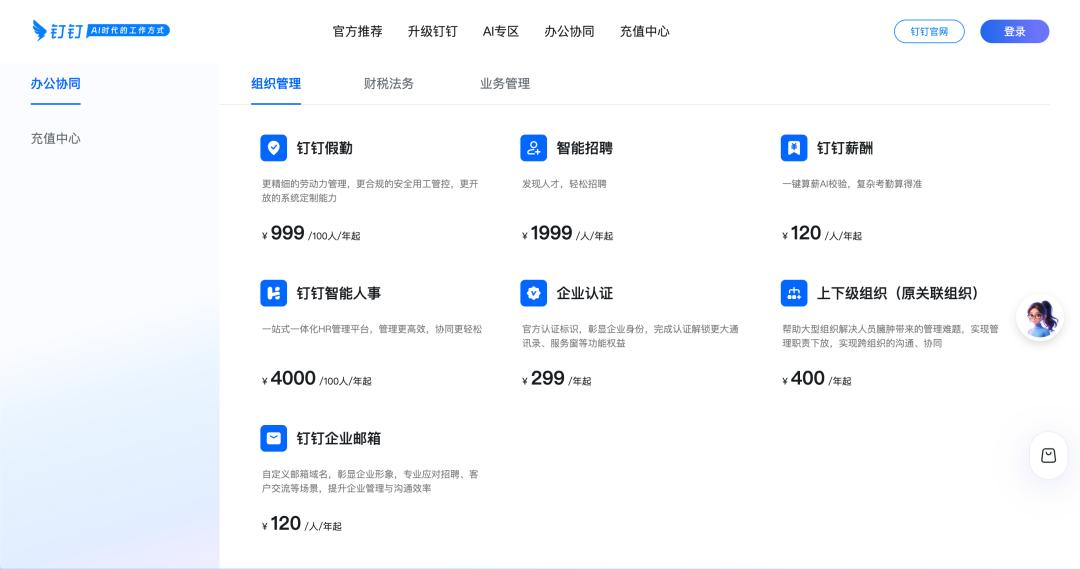
*Image source: DingTalk official website
For many enterprises, DingTalk is more like an internal management system that connects various internal units such as OA, ERP, human resources, and financial approvals. After entering the AI era, DingTalk's main goal is not to help employees improve the efficiency of writing documents and creating spreadsheets but to use AI to call internal enterprise resources to assist business promotion. So in the past few years, DingTalk has formed a product system including AI assistants, AI search and question - answering, and AI spreadsheets around AI, with the core being to build an Agent OS to quickly participate in business processes.
For example, AI assistants can enable enterprises to quickly create exclusive intelligent agents, AI search and question - answering can conduct rapid Q&A based on the enterprise knowledge base, AI spreadsheets can assist in data management and analysis, and AI customer service can build internal employee Q&A spaces and external customer service spaces. In this ecosystem with full - scale AI integration, employees are not using office software or operating office systems but commanding agents to call systems to complete work.
Different from DingTalk, the products of Feishu that have left a deep impression on enterprise users in the past few years are not instant messaging and process management but Feishu Documents and Multi - dimensional Spreadsheets. However, the value of Feishu in the office scenario goes far beyond the improvement of collaboration efficiency.
For example, a large amount of "knowledge" is generated in the daily operation of enterprises, such as the lessons and conclusions summarized in internal review meetings, the real pain points and product suggestions feedback from user interviews. As part of the enterprise's assets, this knowledge is usually not utilized after being sorted into meeting minutes or audio files and submitted internally in a process - oriented manner.
However, if this knowledge is generated through products such as intelligent meeting minutes, Feishu Magic Notes, and multi - dimensional spreadsheet AI analysis and stored in the Feishu system, it will be precipitated as the enterprise's knowledge assets. Whether new employees want to understand the past experiences of projects or query detailed data, they can retrieve them at any time in Feishu's knowledge Q&A.
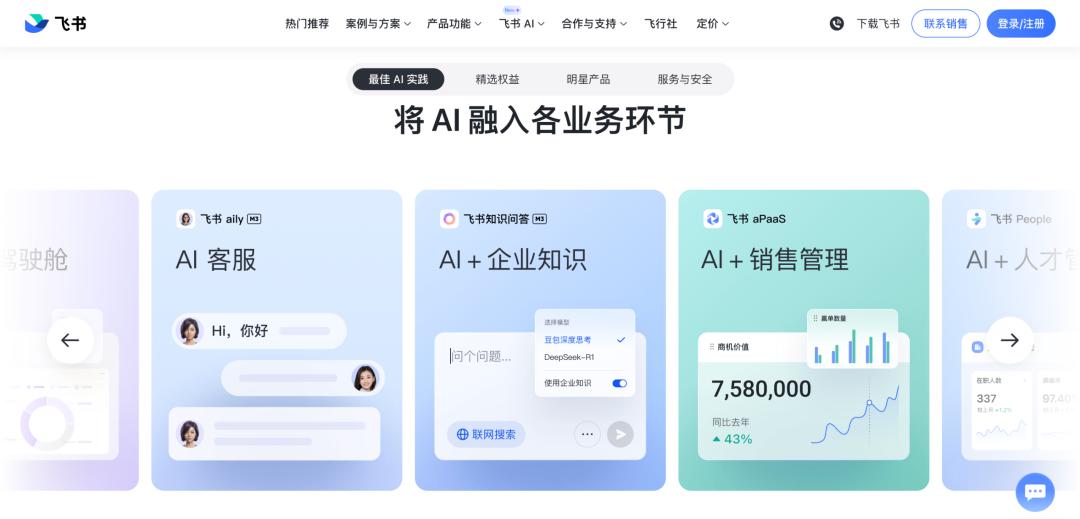
*Image source: Feishu official website
This ability to manage knowledge assets not only improves the office efficiency of individual employees but also makes employees and the enterprise an integral whole. Each employee can use AI to generate knowledge and also use AI to obtain knowledge, fully excavating the value of enterprise knowledge assets at the business level.
Compared with DingTalk and Feishu, WeCom has the most special business logic. Because WeCom's biggest moat is not its office capabilities but WeChat. Since the official launch of WeCom on April 18, 2016, a large number of retail brands, educational institutions, chain enterprises, and insurance companies in the Chinese market have been using WeCom to manage customer relationships and operate private domain traffic.
After entering the AI era, WeCom's focus is not on documents or knowledge bases but on customer management. For example, WeCom users can use the intelligent summary function to automatically summarize communication content, use AI to generate customer profiles, identify potential needs, and provide follow - up suggestions. For positions with strong sales attributes, the AI functions in WeCom can also help shopping guides identify high - value customers and improve repurchase and conversion rates.
This actual value generated at the client end is obviously more important than content generation and internal collaboration in the eyes of sales - driven enterprises in the service and retail industries.
Compared with the previous three, Kingsoft Office seems the least like an Internet company, but it is precisely this traditional characteristic that constitutes its advantage.
Returning to the most daily and basic office scenarios, the work of most enterprise employees still revolves around documents, spreadsheets, and PPTs. Especially for government and enterprise users, the continuous use in the past has formed an internal standard and work method. Improving office efficiency on the basis of stability and security is more important than connecting the internal and external and improving collaboration efficiency.
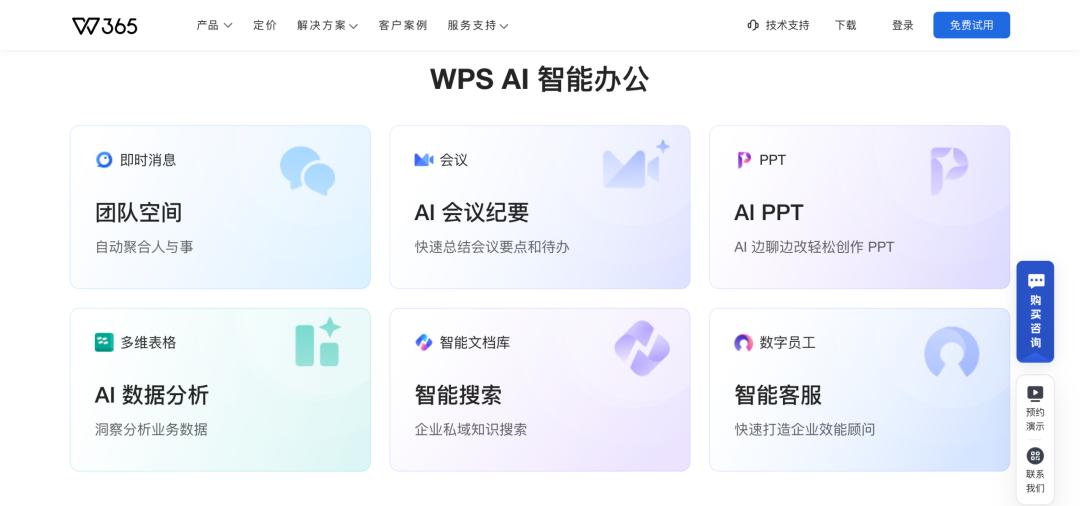
*Image source: WPS 365 official website
Therefore, WPS 365's practice of embedding AI in its document, spreadsheet, and PPT products actually caters to the most basic and common office needs of its core government and enterprise customers. On the business level, when Microsoft fully integrated GPT capabilities into its "office suite" and achieved success, WPS 365, which has taken a similar path, has naturally found the shortest successful path for AI - powered office.
What Exactly Does AI - Powered Office Compete On?
When discussing AI - related topics, many people like to compare models. In the AI - powered office market, people also easily associate DingTalk, Feishu, and WeCom with the large - scale model layouts of the big companies behind them. However, for enterprise customers, the capabilities of the models are indeed important, but not that crucial.
The models are important because when AI is fully integrated into documents and spreadsheets, enabling enterprises to build knowledge bases and implement project management, the essence of AI - powered office has shifted from a collaborative tool to a model - driven operating system. Therefore, model capabilities are the foundation of AI - powered office. They are not that important because the capabilities of large - scale models are rapidly converging.
The AI Index Report released by Stanford shows that as of March 2026, the Arena Elo score gap among Anthropic, xAI, Google, and OpenAI has narrowed to within only 25 points (from 1481 to 1503 points), which is almost negligible in the overall score range of the leaderboard.
The same is true in the domestic market. The latest May 2026 evaluation results of the SuperCLUE, a comprehensive evaluation benchmark for Chinese general large - scale models, show that the score gaps among mainstream base models such as Wenxin Yiyan, Tongyi Qianwen, Doubao, and Kimi in the comprehensive ability evaluation of six tasks, including mathematical reasoning, scientific reasoning, code generation, precise instruction following, hallucination control, and intelligent agent (task planning), have narrowed to single - digit numbers.
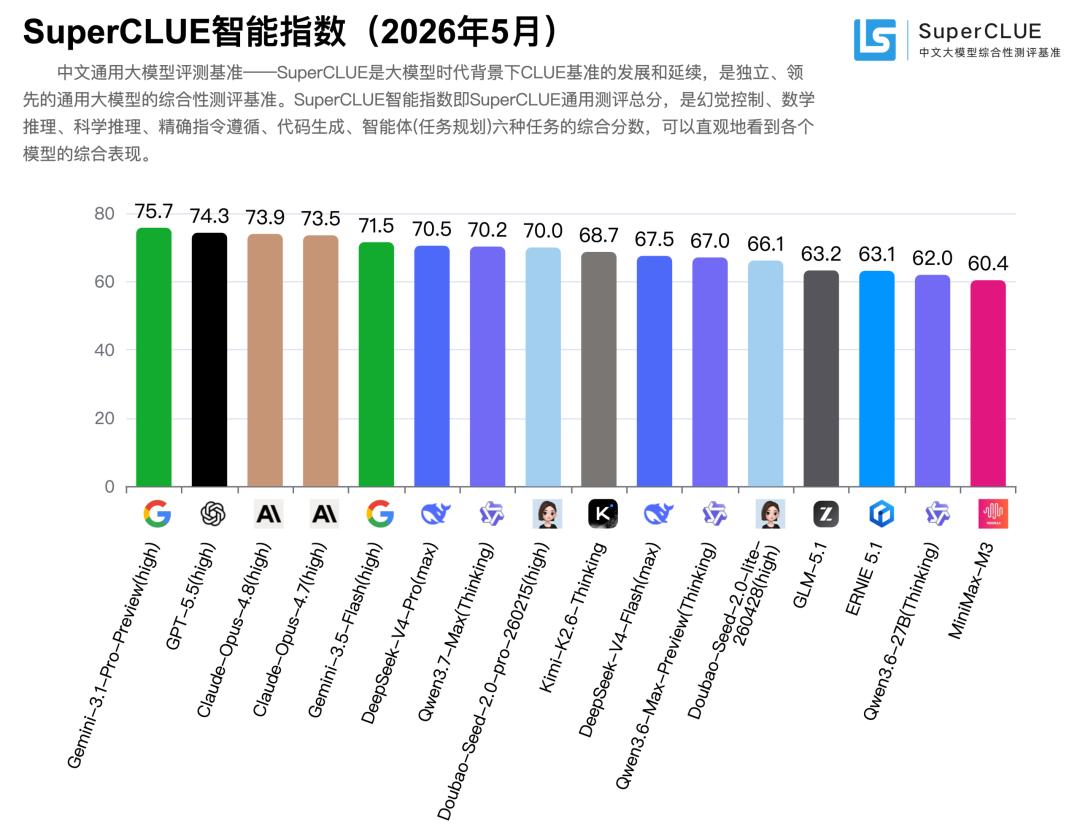
*Image source: SuperCLUE official website
As the capability gap between models becomes smaller, AI - powered office based on models naturally needs to find new points of differential competition, such as cost. In the public's perception, the simplest business model of current large - scale models is to "sell tokens". However, in the AI - powered office scenario, the cost for enterprise users to use AI functions is not directly linked to tokens but is packaged into different levels of membership fees or subscription fees. There are indeed cost differences between different models.
According to the May evaluation list released by SuperCLUE, domestic large - scale models such as Deepseek, Doubao, and Hunyuan have obvious price advantages over other models, and the price per million tokens of models in the same series but different versions may also vary by more than three times.
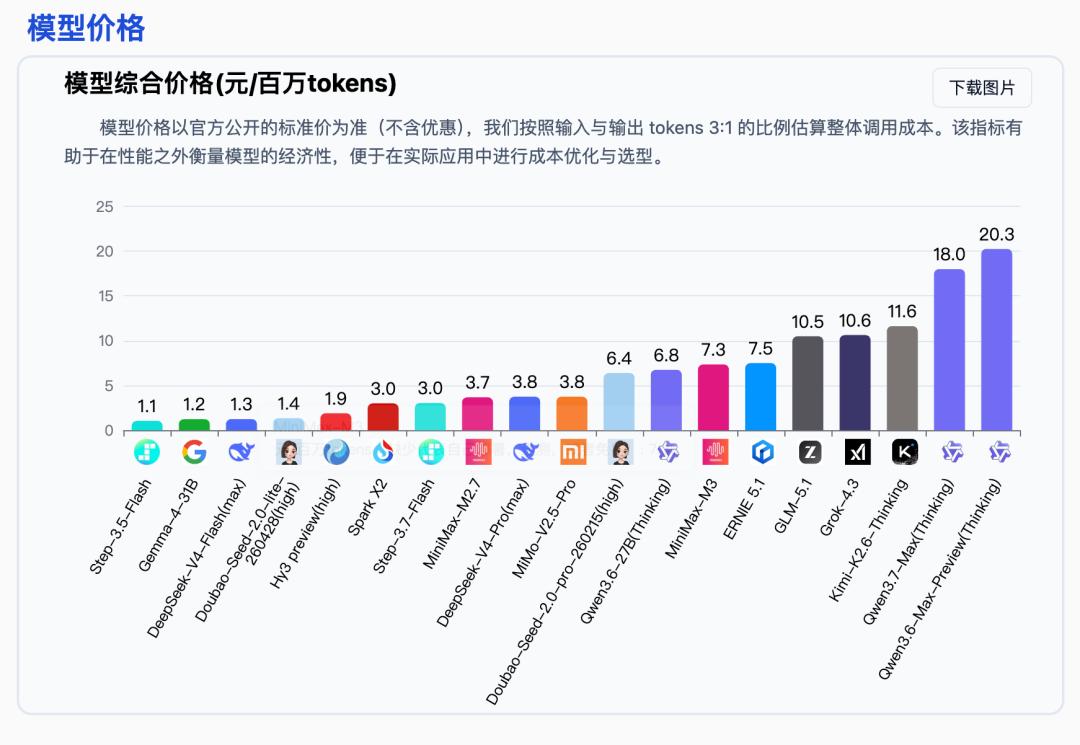
*Image source: SuperCLUE official website
However, the Jingzhe Research Institute has noticed that the AI functions provided by DingTalk, Feishu, WeCom, and WPS 365 do not specify which large - scale model is used, and the token consumption of large - scale models is not the basis for paying for AI functions. Therefore