"BigXiao Robotics", which has raised hundreds of millions of US dollars in financing, sees its founder reveal the fragmented side of the embodied intelligence industry
Text by | Zhou Xinyu
Edited by | Zhang Yuxin
When summarizing the achievements of the past six months, Wang Xiaogang, the chairman of ACE Robotics and a co-founder of SenseTime, talked non-stop for more than 10 minutes.
Founded in July 2025, ACE Robotics is a latecomer in the embodied intelligence field. However, in just one year, this new player has become the "king of involution" in the industry:
On the model side, ACE Robotics' newly released embodied brain - the world model "Kairos 3.0", achieved SOTA in 4 global embodied intelligence benchmark tests. The open - source Kairos 3.0 - 4B was the first to realize the ability to directly drive the embodied intelligence entity on the edge side.
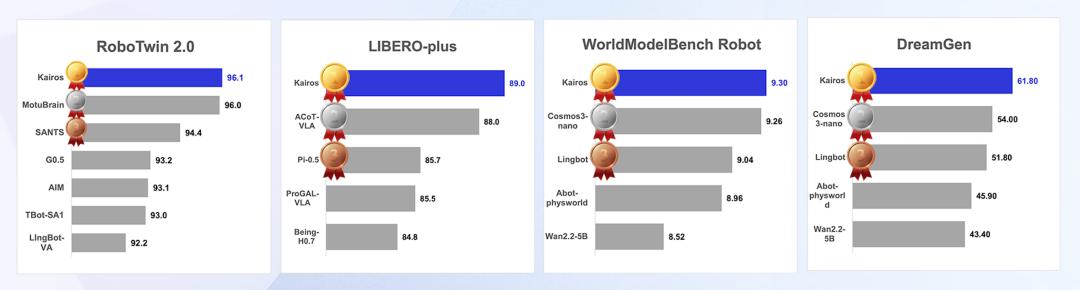
△Kairos 3.0 achieved SOTA in 4 world model - generated prediction embodied intelligence lists. Image source: ACE Robotics
On the data side, the "human - centered" environmental data collection plan proposed by ACE Robotics expands the training data volume of the world model to 1 million hours by large - scale collection of the interaction process between humans and the real environment, reaching 10 times that of the traditional real - machine (human - controlled robot) collection mode.
As for implementation - half a year ago, the main scenarios for the implementation of ACE Robotics' embodied brain module A1 were still the robotic dogs engaged in road inspections. Now, this "brain" has entered multiple scenarios such as hotels, unmanned retail stores, and unmanned logistics warehouses along with various forms of robots.

△The robotic dog patrol plan implemented by ACE Robotics in the West Bund of Shanghai. Image source: ACE Robotics
On June 15, 2026, ACE Robotics officially announced the completion of the Angel + round of financing - only 4 months had passed since the previous official announcement.
The investors in this round include funds such as Fortune Capital, Shenzhen Capital Group, Shanghai Science and Technology Innovation Fund, Muxi Semiconductor Co., Ltd., Shengyu Investment, Fosun RZ Capital, Huakong Fund, Lingang New Area Fund, and Yuzi Zhangquan. The old shareholder, SenseTime Guoxiang Capital, continued to increase its investment, and Gaojie Capital served as the long - term financial advisor.
So far, since 2026, the cumulative financing amount of ACE Robotics has reached hundreds of millions of US dollars. According to "Intelligent Emergence", ACE Robotics has also become one of the fastest companies to become a unicorn in the embodied intelligence field.
In the embodied intelligence track where the single - round financing amount often reaches hundreds of millions of yuan, it is not only a technological race, but also a battle for scenario enclosures among the participating players has already begun:
"Qianjue Technology", incubated from Tsinghua University, aims at real - world projects such as hotel cleaning, commercial services, and precision indoor operations. Tashizhihang, founded by Chen Yilun, the former chief scientist of Huawei's Vehicle BU, focuses on the wire harness assembly scenario.
"The industrial chain in the embodied intelligence field is very long, and it is difficult for a single enterprise to do everything." Wang Xiaogang told "Intelligent Emergence", "So how to leverage more resources and grasp the dominant position in the ecological niche in the entire embodied intelligence industrial chain is very crucial."
However, in the process of implementation, Wang Xiaogang felt that the combination of hardware, data, and models is not sufficient.
Overseas, leading embodied intelligence companies such as Figure and Tesla are integrating hardware R & D, data collection, and model training internally to improve the efficiency of collaborative iteration.
In China, this closed - loop has not yet been formed. Wang Xiaogang admitted that due to the technical maturity and the pressure of resource investment, many entity companies are cautious about scenario implementation. The upstream data collection standards have not been unified, and the supply of high - quality data directly available for embodied model training is insufficient. At the same time, the hardware iteration cycle is much longer than that of the model, resulting in difficulties in design collaboration.
Finding scalable implementation scenarios and entity manufacturers for in - depth cooperation is the current methodology for ACE Robotics to build the closed - loop of "hardware, data, and model".
In Wang Xiaogang's plan, ACE Robotics will first deeply penetrate into the broad scenarios of road inspections and unmanned logistics warehouses, and then expand to the more complex and safety - demanding C - end family scenarios.
The advantage of this is that ACE Robotics can first collect enough scenario data from B - end scenarios. While improving the world model's capabilities, it can also quickly form scalable solutions to help entity manufacturers enter the scenarios.
Recently, Wang Xiaogang talked with "Intelligent Emergence" about the progress of ACE Robotics and his observations on the embodied intelligence industry. The following dialogue has been slightly edited:
Find Replicable Scenarios
Intelligent Emergence: This year, embodied intelligence and world models are the hottest tracks in the primary market. Has the difficulty of financing changed compared to when ACE Robotics was founded?
Wang Xiaogang: The advantage of financing at this time is that the market has heat and attention.
However, relatively speaking, there are too many enterprises, and sometimes investors are not clear about the value points of each company. So we need to pay more explanation costs to help investors sort out our development path and technical ideas.
Intelligent Emergence: ACE Robotics was founded in July 2025. Did you think it was late for ACE Robotics to enter the embodied intelligence track at that time?
Wang Xiaogang: We chose this time to enter the market because we saw the change in the research paradigm of the embodied brain: the original mainstream VLA (Vision - Language - Action) paradigm has limitations and lacks a structured understanding of the physical world. The world model can just solve this problem. So by entering the market at that time, we had the possibility of overtaking on a curve.
Moreover, in the stage when the technology was not yet mature, a lot of resources such as data, model training, and human resources were wasted in the process of exploring the technology paradigm, especially the embodied brain. So by entering the market last year, we could avoid detours and even have a late - comer advantage.
Intelligent Emergence: Relatively speaking, entering the market late means more intense competition.
Wang Xiaogang: The industrial chain in the embodied intelligence field is very long, and it is difficult for a single enterprise to do everything. So how to leverage more resources and grasp the dominant position in the ecological niche in the entire embodied intelligence industrial chain is very crucial.
Before the establishment of ACE Robotics last year, we interviewed many embodied intelligence companies. I found that at that time, embodied intelligence companies generally had a cautious attitude towards entering scenarios.
However, scenarios play a key role in the development of embodied intelligence. The embodied intelligence field is divided by scenarios. As long as a closed - loop verification is carried out in one scenario, it is easy to carry out large - scale replication globally. In the process of large - scale replication, the volume of data collection and the scale of hardware can be increased by several orders of magnitude.
Intelligent Emergence: Why are embodied intelligence companies not very willing to enter scenarios?
Wang Xiaogang: On the one hand, the technological maturity is not high. On the other hand, solving problems in scenarios involves a large amount of resource investment in data collection and R & D. In addition, many emerging embodied intelligence companies do not have a deep understanding of the industry and scenarios.
So the attitude of many companies is: first raise money and wait for a mature time point in the industry, and then catch up. But when the time point comes, the opportunity has been taken by others.
Intelligent Emergence: In the stage when the technology was not mature, how did you talk with the leading customers in the scenarios?
Wang Xiaogang: It is very important to find the boundaries of technology. We need to find the real - world boundaries according to the maturity of technology, software, and hardware.
If we enter the To C scenario, such as L4 - level autonomous driving, my technology cannot have boundaries. But when entering the To B scenario, with various controllable conditions, the technology can be implemented.
We also need to judge: which scenarios can be directly solved, and which scenarios can be solved by some means. In addition, the solutions for these scenarios must be replicable. If the scenarios you find are not replicable, you have to customize each one after another, which is actually not a good choice.
Intelligent Emergence: How to judge whether a scenario is replicable?
Wang Xiaogang: For example, we preferentially penetrate into scenarios such as retail and warehousing because their business systems and demands can be replicated across the country. Another example is the hotel, which is also a replicable scenario. There are many hotels across the country, and we deliver the same set of inspection, navigation robots, and robotic dogs.
Intelligent Emergence: Will the competition in these scenarios be more intense?
Wang Xiaogang: Although many companies are targeting these scenarios, many of them do not go deep enough. The consequence is that you cannot control the cost and cannot achieve marginal cost reduction.
You can make a demo to show off your skills, but it does not have the pre - conditions for large - scale implementation.
Intelligent Emergence: What kind of implementation model can be regarded as "deeply" penetrating into the scenario?
Wang Xiaogang: First of all, you need to have close - cooperation ecological partners. For example, in the unmanned retail scenario, we cooperate with Shanhuo Robotics, a company in the SenseTime ecosystem, to provide them with unmanned retail solutions.
Shanhuo Robotics will first put forward requirements such as cost, battery life, and emission reduction. Secondly, in specific complex scenarios, they will give a lot of technical feedback. These requirements and feedback help us form a data closed - loop and quickly iterate in the scenario.
After doing the "pre - work" with ecological partners, we can also know which solutions are necessary, which can be omitted, or which can be compensated by other solutions.
When the solutions are mature, we can also expand business cooperation to other leading enterprises in the retail industry and reduce the cost through large - scale implementation. Through this set of strategies, ACE Robotics can currently reduce the cost of solutions to one - third of the industry level.
Intelligent Emergence: You mentioned before that the implementation plan of ACE Robotics' scenarios is: road inspection - unmanned logistics - family scenarios. What are the considerations behind this implementation order?
Wang Xiaogang: On the one hand, we consider the difficulty of technological implementation. On the other hand, we still follow the strategy of To B first and then To C. Because the rules and boundaries in C - end scenarios are not strong, and there are many unstructured scenarios. But B - end scenarios are controllable and can ensure safety.
So after accumulating more experience in the B - end, we will move towards the To C market.
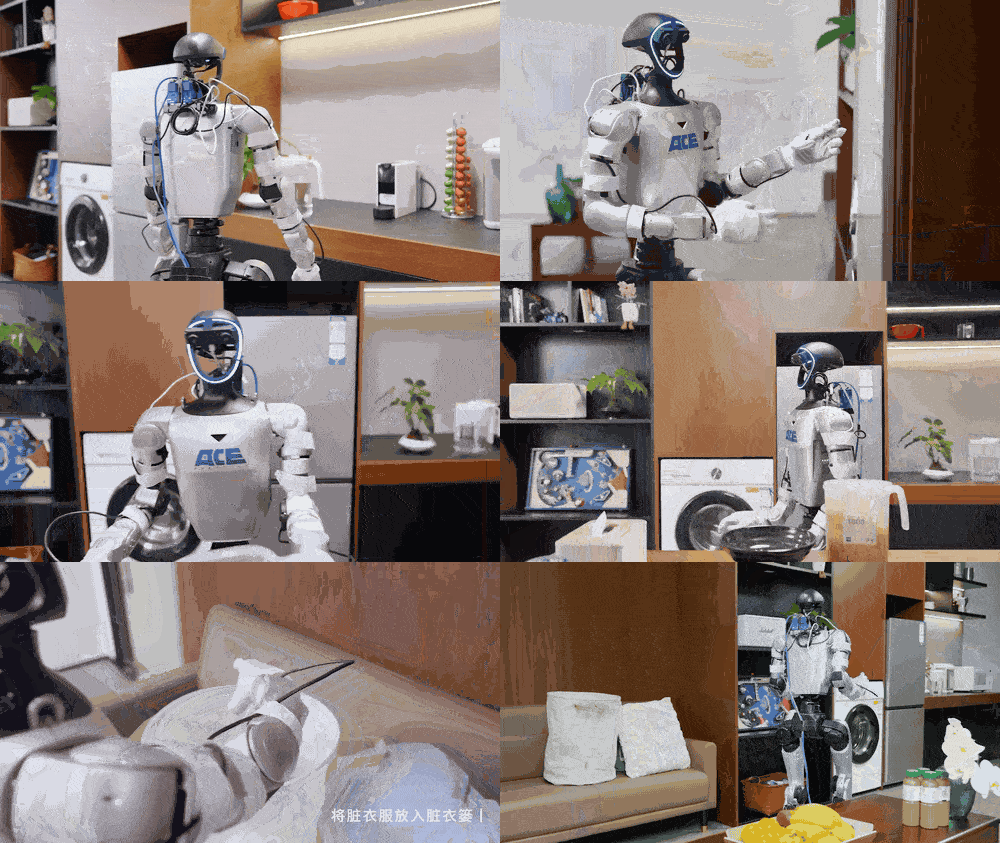
△The home scenario of ACE Robotics' world model. Image source: ACE Robotics
The World Model Has Not Yet Achieved "Intelligent Emergence"
Intelligent Emergence: In the early stage of entrepreneurship, you put forward many new ideas. For example, when VLA was still the mainstream paradigm in embodied intelligence, you chose to work on the world model. Another example is the "human - centered data collection paradigm". How did you judge that this paradigm is feasible?
Wang Xiaogang: The judgment on the general direction is very certain. First of all, compared with VLA, only generative models like the world model have the ability of intelligent emergence. So when we started working on embodied intelligence, we chose the world model direction from the very beginning.
Secondly, only real - human data, in terms of both the efficiency and scale of collection and the authenticity of anthropomorphism, can meet the requirements for training the world model.
However, many details became clear only in the process of practice. For example, when working on the world model, at the beginning, our main focus was on the generation ability. But in real - world scenarios, the world model not only needs to generate data but also needs to control real machines and interact with the physical world through robots. This puts forward higher requirements for the physical intelligence and spatial intelligence of the world model.
So we recently released the open - source general spatial intelligence model ACE - Brain - 0 and the physical 3D generation framework PhysX - Omni to improve the spatial intelligence and physical intelligence of the world model.
Intelligent Emergence: Video generation models, VLA, etc. all claim to be "world models". What is your definition of the world model?
Wang Xiaogang: Simply put, a world model must have three capabilities: understanding, generation, and prediction. Only when it has all three capabilities can the model evolve, correct, and evolve by itself.
Why do everyone claim to be a world model? Because there is no evaluation system for the world model in the industry. For example, the industry lacks benchmarks for the execution effects of long - term and complex tasks.
Some so - called "world models" only promote what they are good at, but actually lack other capabilities. For example, VLA lacks the generation ability, and video generation models lack the understanding ability of physics and space.
Intelligent Emergence: How do you evaluate the capabilities of the world model internally?
Wang Xiaogang: We are working with some academic institutions and embodied intelligence companies to establish a world model benchmark. The evaluation dimensions include the generalization ability across entities and the simulation ability, which ultimately aim to measure the model's understanding, generation, and prediction abilities.
Intelligent Emergence: ACE Robotics' world model Kairos has recently been iterated to version 3.0. What stage is its ability comparable to in the language model?
Wang Xiaogang: It has not reached the level of GPT 3.0 yet. When it reaches the GPT 3.0 stage, the world model can achieve intelligent emergence, which also means a high degree of certainty in the research paradigm.
Currently, we are still iterating Kairos step by step according to the three dimensions of "understanding, generation, and prediction". In the early days, Kairos was mainly used for video generation. Later, it gradually began to control real machines. Correspondingly, we also need to improve its understanding of spatial and physical attributes.
Intelligent Emergence: At the current stage of the development of the world model, which of the links such as the quantity, quality, annotation of data, and subsequent evaluation has the greatest impact on the model's capabilities?
Wang Xiaogang: At present, the world model is still in the 0 - 1 stage, and there is very little data available for training. So at this stage, the quantity of data has a more obvious impact on the improvement of the effect. When the training data increases by 10 times or 100 times, I can immediately see the improvement of the model's capabilities.
But when the world model achieves intelligent emergence, it is necessary to conduct fine - screening and fine - annotation of the data. This is similar to the development of large - language models.
Currently, the world model has not achieved "intelligent emergence", so we need to increase the quantity of data first and then