XPeng and NIO compete for computing power, Li Auto switches architecture
On June 15th, Li Auto detailed the self-developed chip Maher M100 at a press conference. This is a self-developed intelligent driving chip designed for the new-generation L9 Livis. CTO Xie Yan emphasized that it's not about making a chip that's just faster than the old ones; instead, it's about creating a completely different type of chip. This "difference" refers to the chip architecture.
In 2026, when many car companies are rushing to develop their own chips, TOPS is the most commonly used promotional ammunition for each. NIO's Shenji NX9031, XPeng's Turing, and Huawei's MDC 810 Pro all put the computing power figures in the most prominent position without exception. Li Auto chose to make changes at the underlying architecture level.
What Maher M100 wants to prove is that architecture is more important than computing power figures. However, whether it's right or not still needs to be tested by the market.
01. The Divergence in Chip-making under Computing Power Inflation
Developing self-owned chips has become a common choice for leading domestic car companies.
NIO's Shenji NX9031 is the world's first 5nm high-performance intelligent driving chip. Its special feature lies in the self-developed ISP. The pedestrian recognition rate under low-light conditions of 1 lux at night is 40% higher than that of general chips, with special reinforcement at the perception layer.
XPeng's Turing chip is also highly customized. It's specifically designed for XPeng's large self-driving model and is also intended to be extended to flying cars and robots.
Huawei takes a different approach, using Ascend to build MDC. It emphasizes the complete alignment between cloud training and in-vehicle inference, saying "one minute of cloud training, one minute of in-vehicle following."
These companies all use variants of the von Neumann architecture: a central processing unit where data is shuttled back and forth between the computing unit and the memory. The more advanced the manufacturing process, the faster the data transfer. However, Maher M100 wants to change the very act of data transfer itself.
02. Changing the Underlying Logic
The von Neumann architecture works well in the era of general computing, but large model inference is a different computing form. VLM inference involves large-scale matrix parallelism, not sequential instruction execution. Almost all the bottlenecks lie in the memory bandwidth. The loss caused by data repeatedly entering and leaving the memory directly consumes a large amount of effective computing power.
The idea behind the dynamic data flow architecture is to let the data flow along the computational graph without the need to repeatedly store it back in the memory. Li Auto's result shows that the effective computing power of a single Maher M100 is about three times that of NVIDIA's Thor U, and the end-to-end latency is reduced by 40%.
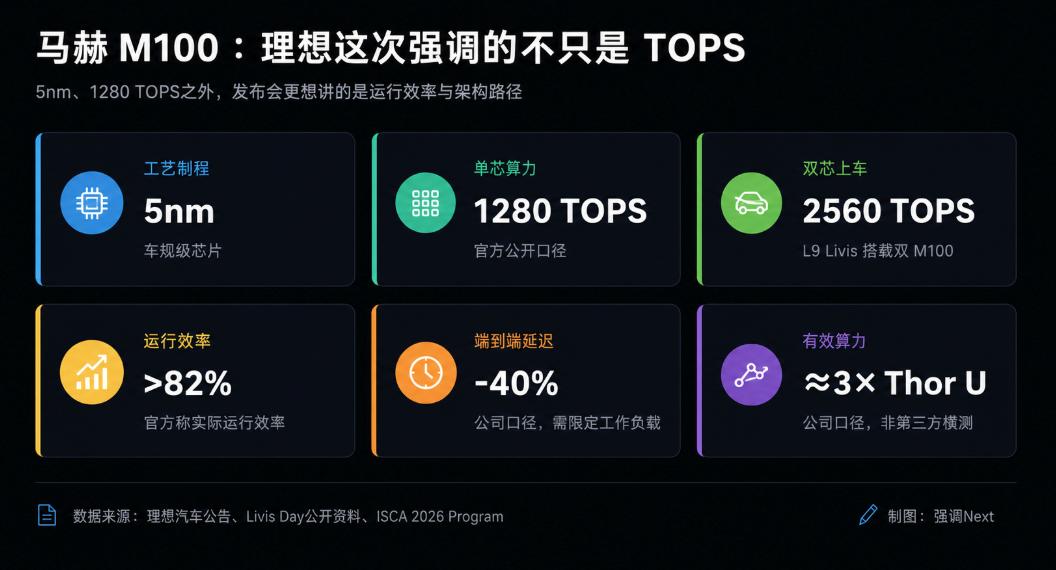
How much can we trust this "three times"? There is an external verification for reference. The architecture paper of Maher M100 was selected for the industrial division of ISCA 2026. ISCA is a top academic conference in computer architecture. The papers in the industrial division have undergone peer review, and the details of the architecture design are public. Li Auto is the first complete vehicle company to be selected since the establishment of this division.
However, this "three times" figure has its preconditions. The effective computing power depends on the specific workload. The three times achieved with Li Auto's VLA2.1 algorithm may not hold true with another system. Maher M100 is an algorithm-native chip. The chip and the model are developed synchronously and are deeply adapted to its own algorithms. It performs best with its own models but may not be as good for general tasks.
This is similar to the design logic of XPeng's Turing. Tesla's FSD Chip also follows this approach. The difference is that Tesla and XPeng haven't made a paradigm shift at the architecture level, while Maher M100 has made changes to the underlying logic. Whether a complete vehicle company can mass-produce a new architecture reliably is itself a challenge without precedent.
With the installation of Maher M100 in vehicles, Li Auto has achieved full-stack self-development of chips, compilers, operating systems, AI algorithms, and domain controllers. This closed-loop is rare among its peers.
NIO has self-developed chips but has different degrees of OS dependence. XPeng has self-developed chips but still relies on external sources for compilers and OS. Huawei has a closed-loop but is not a complete vehicle company. The strategic significance of Li Auto's chain is that it allows Li Auto not to be constrained by NVIDIA in the supply chain, keeps the data within its own platform, and gives it full autonomy in optimizing the software-hardware collaboration.
03. Taking the Lead in "Embodied Intelligence"
The chip is just one of the protagonists at the press conference. Li Xiang also proposed a "four-in-one" definition of an embodied intelligent vehicle at the conference: an electric vehicle, a professional driver, an AI computer, and a life assistant.
This is quite a big leap from Li Auto's past brand narrative.
In 2023, the L9 penetrated the 300,000 - 500,000 RMB market with its "large six-seater family SUV" positioning, and a series of similar models followed. The problem with this positioning is that the replication cost is too low. Wenjie M9, NIO ES9, and ZEEKR 9X have all entered the market. Refrigerators, color TVs, and big sofas have become standard in the industry, and no company can gain an edge. All that's left is a price war.
The concept of "embodied intelligent vehicles" shifts the competition from configurations to system capabilities. In this framework, refrigerators and rear screens are basic configurations, and the differentiating factor becomes "whose system can perceive, think, and grow." Defining a category is itself a strategic asset, and the first to speak up takes the lead.
Li Auto has provided a relatively complete technology chain for this narrative. The Maher M100 computing power base, the Maher VLA2.1 intelligent driving large model, the Maher Mind-Pro and Mind-Edge end-side base models, and the full-stack integration of the Star Ring OS. Each layer has corresponding products implemented.
At the press conference, demonstrations were made of the vehicle moving in rhythm with music, a 4D racing simulator, and command parking. These are tangible experiences. Li Xiang also said at the conference that self-driving is just the "first half" of embodied intelligence, and general humanoid robots are the "second half." However, the specific schedule and implementation path for the second half are not clear yet.
04. The Order for Q4
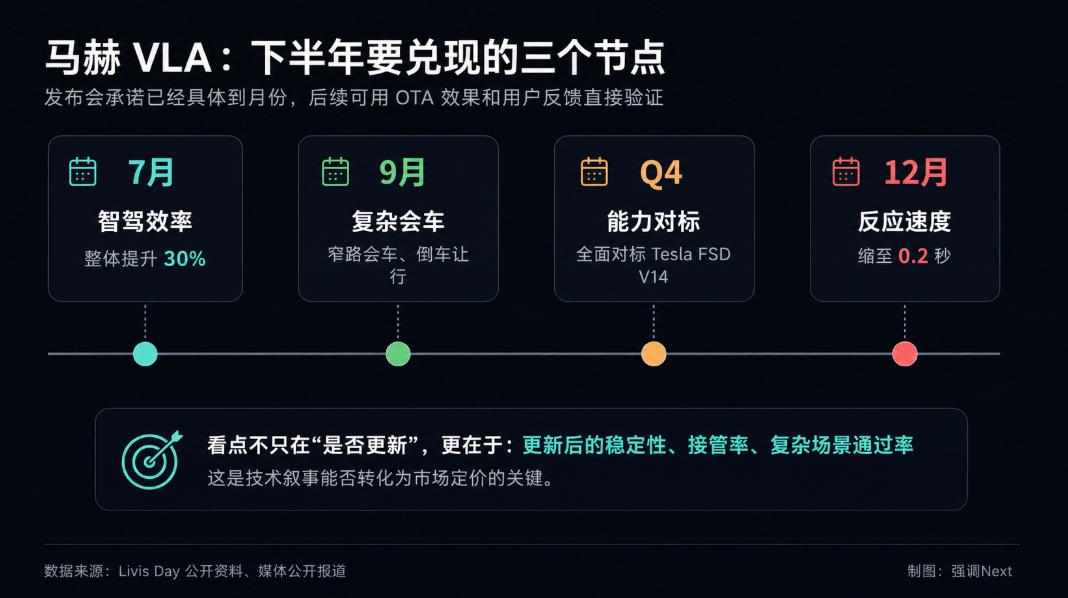
There was also a key statement at the press conference. Li Auto's intelligent driving large model, Maher VLA, will be fully comparable to Tesla's FSD V14 in Q4 this year.
Li Xiang's consistent style is to make public commitments and use external pressure to force internal execution. Once he said it will be comparable to FSD V14 in Q4, everyone will use this as a benchmark at the end of the year.
In terms of the technical route, Li Auto and Tesla have highly similar choices: end-to-end + VLA large model + mainly pure vision. Huawei takes the route of lidar + multi-sensor fusion + a combination of rules and neural networks. This solution has stable short-term engineering implementation and low computing power requirements. However, in the long run, if the pure vision + large model route ultimately wins, Huawei's system will face a higher switching cost. Li Auto is betting on the same technological belief as Tesla. Whether this judgment is correct now remains to be seen at the end of the year.
The OTA commitments for the second half of the year are specified by month. In July, the intelligent driving efficiency will be improved by 30%. In September, the vehicle will be able to give way when meeting other vehicles on narrow roads and reversing. In December, the vehicle's reaction speed will be reduced to 0.2 seconds. Each milestone has clear technical indicators, and there will be data for comparison at the end of the year.
05. Several Sets of Data Beyond the Press Conference
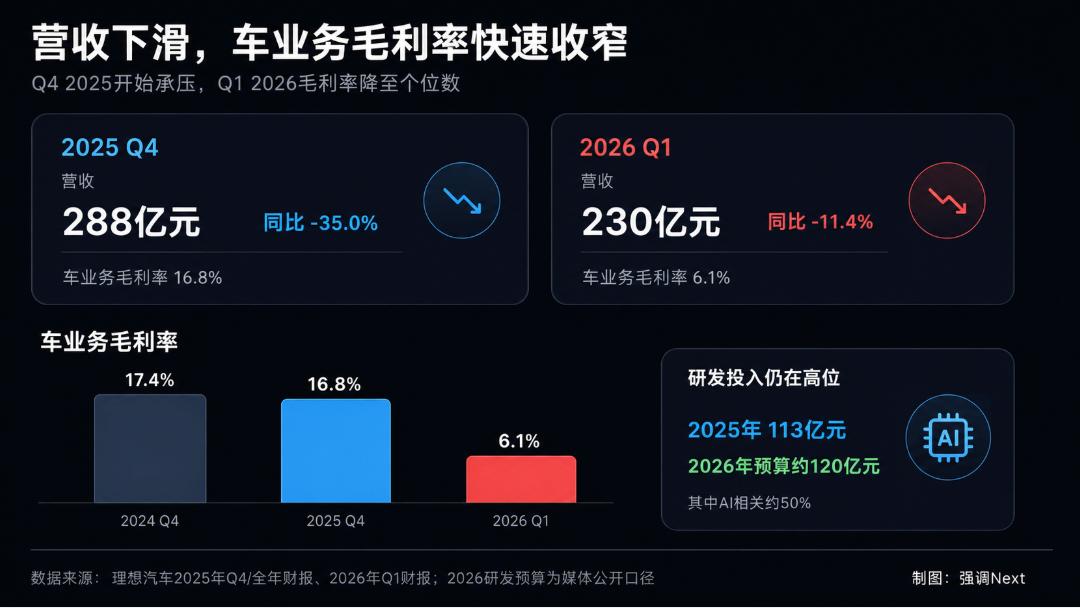
Li Auto's current financial situation is not easy. Since Q4 2025, Li Auto's revenue has declined year-on-year, and the gross profit margin of its vehicle business has significantly narrowed. Meanwhile, the R & D budget in 2026 remains at around 12 billion RMB, with about 50% related to AI, which is basically the same as the 11.3 billion RMB and 50% proportion in 2025. The R & D investment remains high, and the profit pressure still exists.
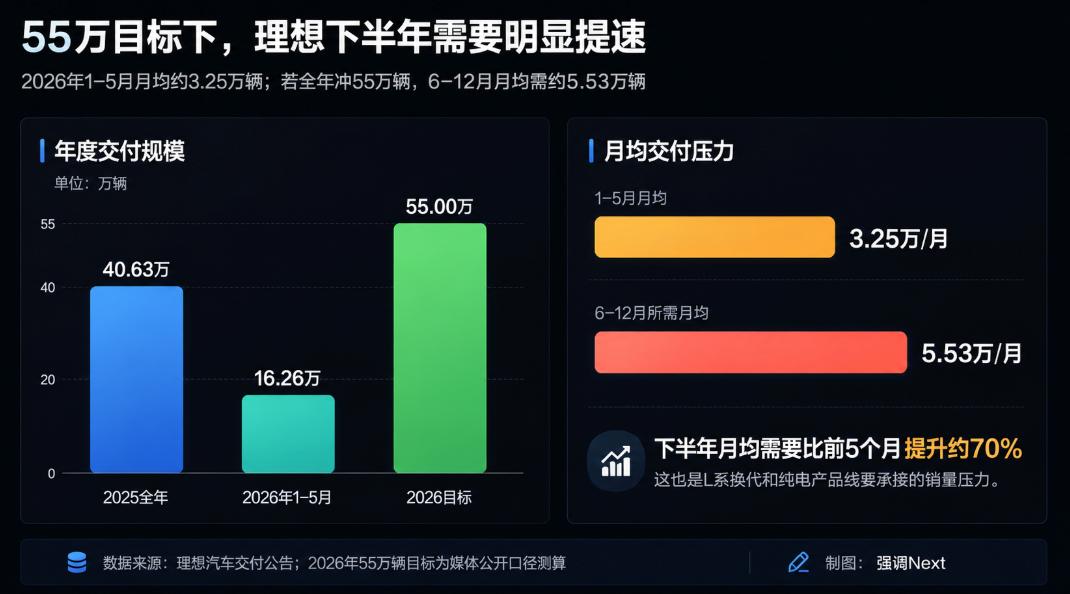
In terms of sales, Li Auto's goal for 2026 is 550,000 vehicles. In 2025, it actually delivered 406,000 vehicles. In May, it delivered 33,000 vehicles in a single month, and the year-on-year figure is still declining. The L9 Livis received over 10,000 large orders within two weeks of its launch, and its performance in the market above 500,000 RMB is stable. However, the overall delivery volume still needs the full replacement of the L series and the release of the pure electric product line in the second half of the year.
At the chip level, the deep binding of Maher M100 with its own algorithms is a design choice, which brings the efficiency advantage of software-hardware collaboration. However, it also means that if the future technical route needs to be adjusted, the switching cost will be higher than that of manufacturers using third-party chip solutions. XPeng's Turing, NIO's Shenji, and Tesla's FSD Chip all face similar situations. This is a common feature in the industry for self-developed algorithm-native chips.
06. Revealing the Cards in Q3
The initial results of the new L9 launch, the follow-up launch of the L8, and the first OTA milestone in July will all be revealed in the Q3 financial report.
Xie Yan said that he needs to create a completely different chip. The fact that the architecture paper has passed peer review is an external recognition of this design concept. However, there is still a long way to go from design to mass production and then to the real feedback from users' daily driving. The OTA milestone in July is the first test, and the comparison with FSD V14 at the end of the year is a more crucial one.
This article is from the WeChat official account “Emphasize Next” (ID: leo89203898), author: Yixiu, editor: Xiaobai. Republished by 36Kr with authorization.