A large number of small and medium-sized online car-hailing platforms are rushing to go public, and Amap is the biggest winner.
A group of small and medium-sized ride-hailing platforms are making a desperate dash for IPOs, and the real beneficiaries may not be them.
T3 Chuxing, Xiangdao Chuxing, 365 Ride-hailing, and Huoli Chuxing are all heading to the Hong Kong stock market. Hello is intensively planning a backdoor listing on the A-share market. The wave of listings of small and medium-sized ride-hailing platforms is on the verge of breaking out.
Behind them, Gaode, the aggregator platform, may become the biggest winner in this industry and capital feast.
Most of these small and medium-sized ride-hailing platforms rely on the aggregator model to gain a foothold. Once they are successfully listed, they will have greater motivation and resources to expand their business scale, and Gaode can naturally achieve stable growth.
On the other hand, Gaode and Alibaba behind it have invested in a large number of small and medium-sized ride-hailing platforms. They can not only obtain capital gains from this but also strengthen their voice in the travel ecosystem.
The wave of ride-hailing platform listings
At the end of May, Xiangdao Chuxing, which has maintained a leading position in the Shanghai regional market, updated its IPO prospectus and continued to strive for a listing on the Hong Kong stock market.
If we add T3 Chuxing, Shengwei Times (365 Ride-hailing), and Huoli Chuxing (Huoli Group) queuing up for IPOs on the Hong Kong stock market, as well as Hello Chuxing, which is planning a backdoor listing on the A-share market, a small climax of ride-hailing platform listings has taken shape.
Since 2020, Dida, Ruqi, and Caocao have jointly rushed for IPOs on the Hong Kong stock market, triggering the first wave of ride-hailing platform listings. Four or five years have passed, and the second wave of listings is "on the verge", and the ride-hailing market is entering an era of "a hundred flowers blooming".
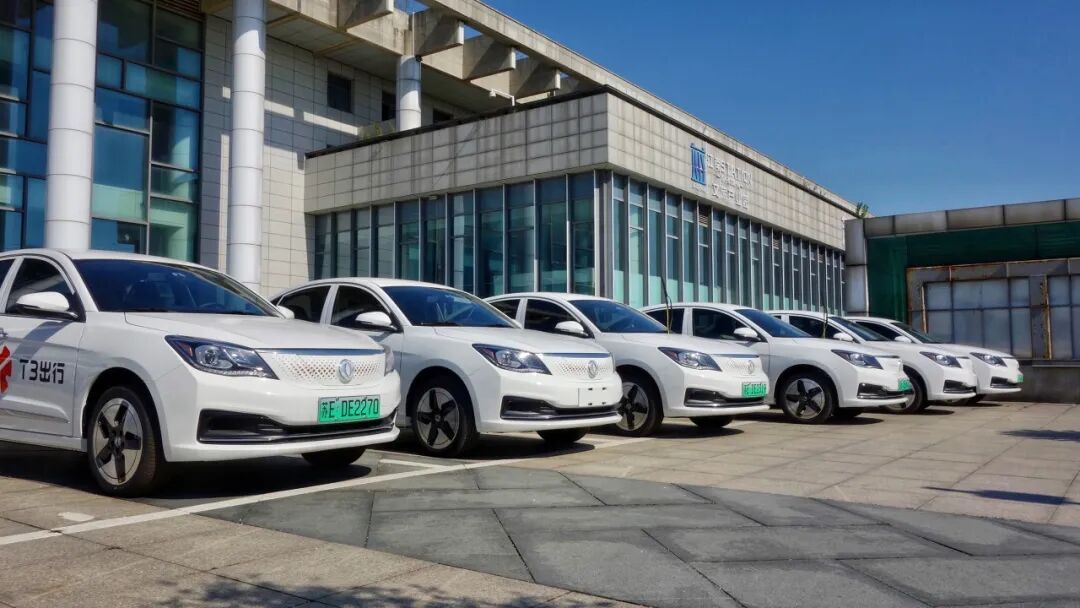
It has only taken more than a decade for the ride-hailing industry to grow from its inception to a market scale of over 400 billion yuan.
In the past, there were only taxis without ride-hailing services. It wasn't until the wave of the mobile Internet transforming traditional industries reached here that several effective solutions were proposed to address the pain points of the taxi industry.
In 2010, Yidao Yongche was established. It was one of the earliest ride-hailing platforms in the world, almost synchronous with Uber.
In the next two years, ride-hailing platforms such as Didi and Kuaidi were successively established, and Uber entered the Chinese market. With the support of various capitals, the "thousand-group war" broke out in the ride-hailing market.
It wasn't until Didi merged with Kuaidi and acquired Uber China that the chaos in the ride-hailing market at this stage ended. Didi officially became the leader in the Chinese ride-hailing market and has remained in this position ever since.

A few years later, automobile manufacturers realized the value of long-term operation and launched their own ride-hailing brands. The former Shenzhou Group is behind Shenzhou Zhuanche; Caocao Chuxing is controlled by Geely; Shouqi Yueche is a brand under Shouqi; Xiangdao Chuxing was initiated by SAIC; GAC launched Ruqi Chuxing; and behind T3 Chuxing are Dongfeng, FAW, and Changan.
With the support of automobile manufacturers, they quickly grew into a stable second echelon in the ride-hailing market. Didi also welcomed its most powerful competitors.
However, there was still no new story in the ride-hailing market at this time. Until Gaode entered the scene.
Gaode, a map software, launched the "one-click multi-platform car-hailing" function in 2017, and deployed its ride-hailing business in an aggregator model, starting low-key operations.
Around 2021, the entire Internet market began to enter the era of stock. Alibaba planned to spin off its various business segments, and Gaode had the motivation to expand its own business scale.
So, Gaode seized the market opportunity. Based on hundreds of millions of accurate and high-frequency users, with the promotion of subsidies, it continued to penetrate the market with the ride-hailing aggregator model and finally took the second place in the ride-hailing market.
The greatest value of Gaode lies in that, as a "platform within a platform", it uses the e-commerce thinking to separate the ride-hailing entry from the fulfillment, thus changing the operation mode of the ride-hailing market.
It can be said that if it weren't for Gaode, there would be no second half of the story in the ride-hailing market, and of course, there wouldn't be the current wave of ride-hailing platform listings.
Gaode becomes the big winner
Once T3 Chuxing, Xiangdao Chuxing, 365 Ride-hailing, and Huoli Chuxing are successfully listed, Gaode will be the biggest winner.
It is precisely because small and medium-sized ride-hailing platforms are deeply bound to aggregator platforms such as Gaode that the aggregator model of ride-hailing has achieved its current market position. This has not only rewritten the pattern of the ride-hailing market but also enabled many small and medium-sized ride-hailing platforms with little presence to stand up again.
For T3 Chuxing, the third-largest ride-hailing platform in China, the proportion of orders from aggregator platforms in the past three years was 61.5%, 77.5%, and 85.9% respectively, and the proportion of GMV was 61.8%, 78.6%, and 86.4% respectively.
The situation is even more exaggerated for small platforms. Taking 365 Ride-hailing under Shengwei Times as an example, from 2021 to 2023 and the first half of 2024, the proportion of GTV generated through Gaode was 95.3%, 92.9%, 89.5%, and 93.4% respectively.
In 2020, the share of aggregated ride-hailing in the ride-hailing market was only 10.9%, and it increased to 32.5% in 2025. The market expects that it will reach 53.1% by 2030.
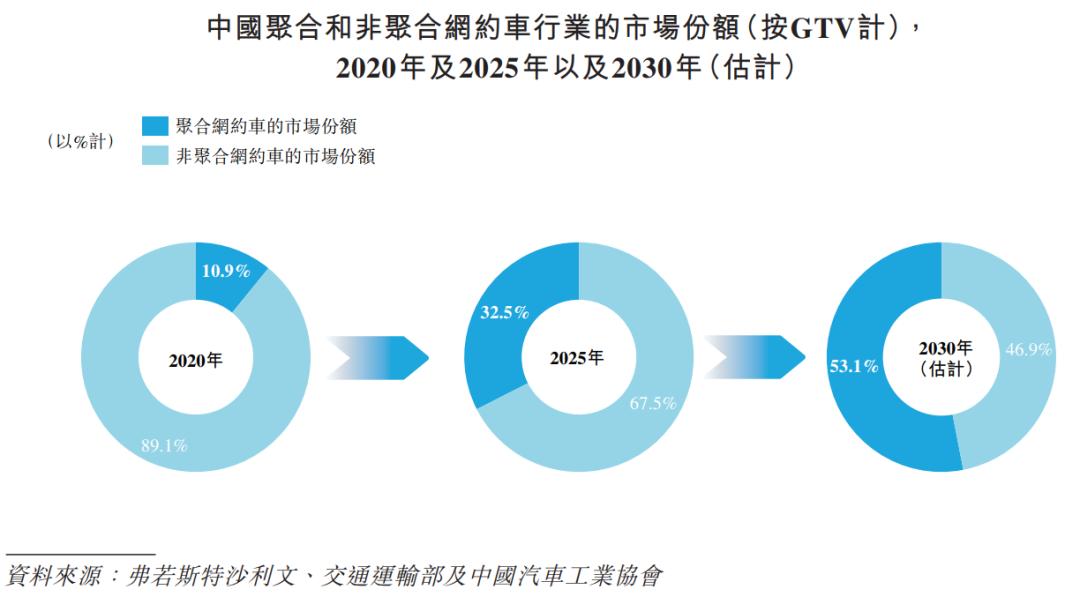
After the listing of small and medium-sized ride-hailing platforms, they will have greater motivation and more resources to expand their business, and Gaode can naturally gain a larger market scale.
Another hidden line is that among the shareholders of these ride-hailing platforms that have risen with the help of Gaode, Gaode and Alibaba behind it mostly stand.
People only know that T3 Chuxing was initiated by FAW, Dongfeng, and Changan, with each holding a 15% stake. In fact, Tencent Holdings and Alibaba are both its founding shareholders, each holding a 12% stake.
Xiangdao Chuxing was established in 2019 and received investments from Alibaba and CATL in 2020. Later, Alibaba transferred its shares to Gaode, which holds a 6.47% stake before its listing.
Shengwei Times, the parent company of 365 Ride-hailing, has always been the largest intercity road passenger transport information service provider in China. Due to its presence in the travel ecosystem, it received Series A financing from Alitrip in 2016; later, Alitrip increased its investment several times and has become the single largest shareholder of Shengwei Times, holding a 27.01% stake.
Needless to say, Hello Chuxing was jointly incubated by Alibaba and Ant Group. It is a small giant that has expanded from shared bicycles to the entire scenario of mobile travel.
According to incomplete statistics, there are at least ride-hailing platforms such as Xiehua Chuxing, Dazhong Chuxing, Fengyun Chuxing, and Xindong Chuxing that have not disclosed their listing plans but have an equity relationship with Gaode and Alibaba.
According to Tianyancha, Gaoxing (Tianjin) Management Consulting Co., Ltd., the operating entity of Gaode, directly holds a 25.71% stake in Xiehua Chuxing, a 5.26% stake in Dazhong Chuxing, and a 16.67% stake in Fengyun Chuxing; Alibaba Venture Capital has invested in Xindong Chuxing, holding a 30% stake.
If the second wave of ride-hailing platform listings can be successfully promoted, the Gaode system can not only obtain substantial book profits but also amplify the synergy with small and medium-sized ride-hailing platforms and strengthen the ecosystem of its own ride-hailing aggregator platform.

The upgrade battle in the ride-hailing market
The greatest advantage of the ride-hailing aggregator model promoted by Gaode is its ability to quickly increase the volume. It combines Gaode's user scale and scenario convenience with the transportation capacity of small and medium-sized ride-hailing platforms to meet each other's needs.
However, the aggregator platform takes commissions as its core profit point, which makes the profitability of the already highly competitive ride-hailing industry even more challenging.
Shengwei Times once disclosed in its prospectus that the service fee rate of the Gaode ride-hailing platform is 9%, while the rate of the Fliggy airport passenger transport aggregator platform under Alitrip is as high as 15%.
From the performance of relevant companies planning to go public, it can be seen that small and medium-sized ride-hailing companies relying on the aggregator model need to bear high sales and marketing expenses, so most of them are still in the red.
Therefore, when facing the concerns of investors, most of them stated that they are actively taking measures to reduce their dependence on aggregator platforms.
The stock trend in the ride-hailing market is becoming more and more obvious. In the future, the industry is expected to develop in the direction of stable prices, ecological win-win, and sustainable development. Under the ride-hailing aggregator ecosystem, Gaode needs to pay more attention to the impossible triangle among growth, profitability, and user experience.

More realistically, Gaode, as one of the Chinese Internet infrastructure, has almost become indispensable to Chinese netizens; however, this star APP with hundreds of millions of users does not have other better profit models.
In the early days, Gaode positioned itself as a tool APP. This is both an advantage and a shortcoming - in order to maintain the user experience of this super tool, it is impossible to insert too many advertisements.
Later, Gaode launched its ride-hailing business. When you search for a destination on Gaode, if you don't drive yourself, you need to take a taxi. This natural scenario introduction is a model of Internet traffic monetization.
Last year, Gaode learned from Google Map and launched the Gaode Street Scanning List, an offline consumption evaluation system, in line with Meituan's Dianping. However, it proposed "never commercialize" at the beginning of its launch, making the Gaode Street Scanning List seem more like a safeguard for Alibaba's instant consumption circle strategy.
There is no doubt that the next core of competition in the ride-hailing market is AI-powered Robotaxi. Currently, there are three major factions in the Robotaxi market: technology companies, automobile manufacturers, and ride-hailing operators.
As a leading ride-hailing platform, Gaode still adopts a cooperation model to enter the Robotaxi market. What the market is more concerned about is how much technological assets the cooperation model can ultimately leave for Gaode?
Recently, Didi Chuxing officially changed its name to Didi. This means that Didi is breaking out of the single travel scenario, and its long-planned transformation into a one-stop super lifestyle service platform has officially begun.
The competition in the ride-hailing market is going beyond the ride-hailing itself.
This article is from the WeChat official account "Zebra Consumption" (ID: banmaxiaofei), author: Ren Jianxin, published by 36Kr with authorization.