Breaking news: Real-name verification will be required for using Claude, Anthropic's new policy will take effect next month.
Do we really need to "verify our identity" before using Claude in the future?
Recently, a netizen posted on the X platform, revealing that they received an official email from Anthropic. The email shows that Anthropic is about to update the privacy policy for Claude Free, Pro, and Max users. One of the most notable points is: The platform may require users to verify their age or identity in the future.
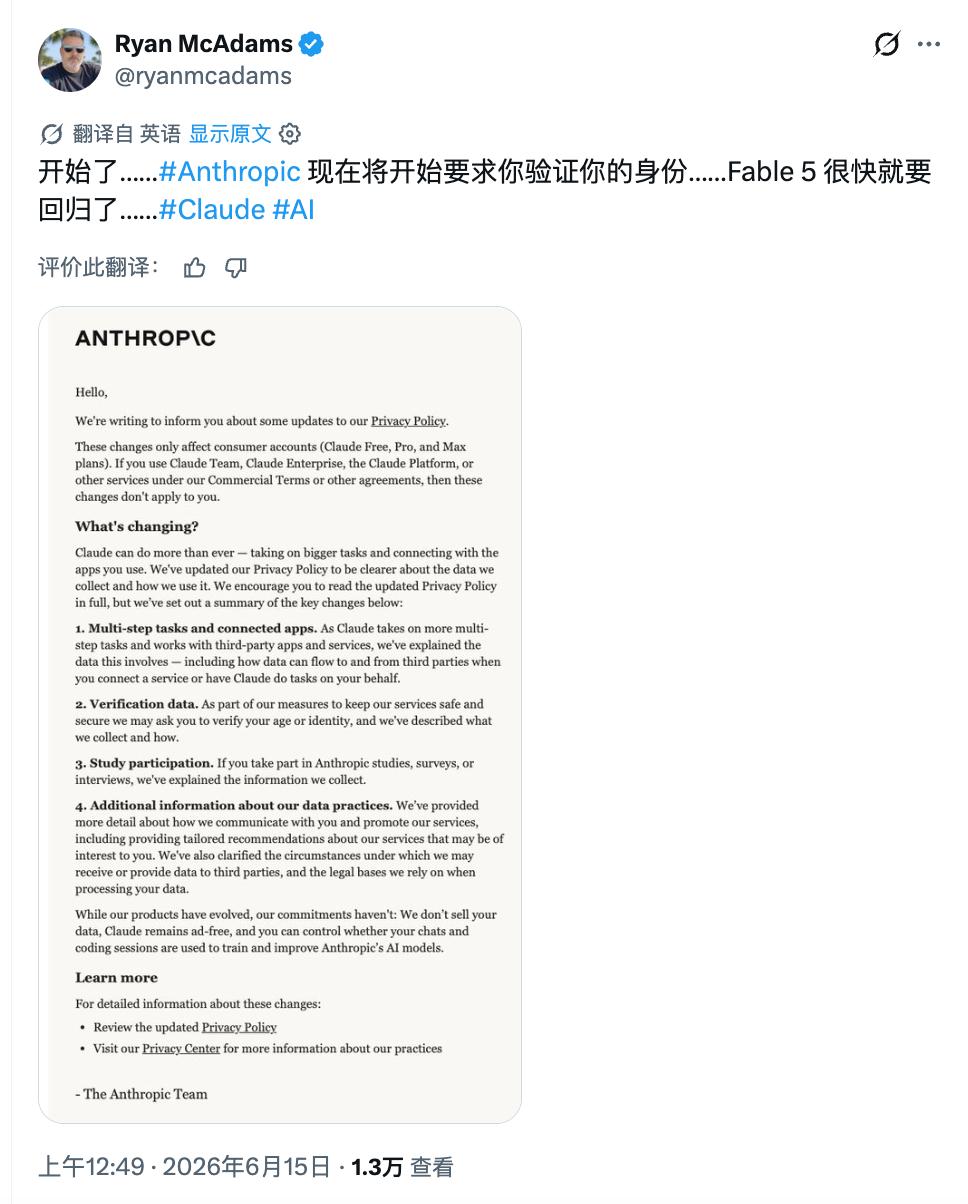
If it were an ordinary Internet product, such a policy adjustment would not be uncommon. However, in the current context of increasingly fierce AI competition and the globalization of AI tools, this matter seems different when it comes to Claude, one of the world's mainstream large models.
Anthropic is rewriting the usage rules for Claude
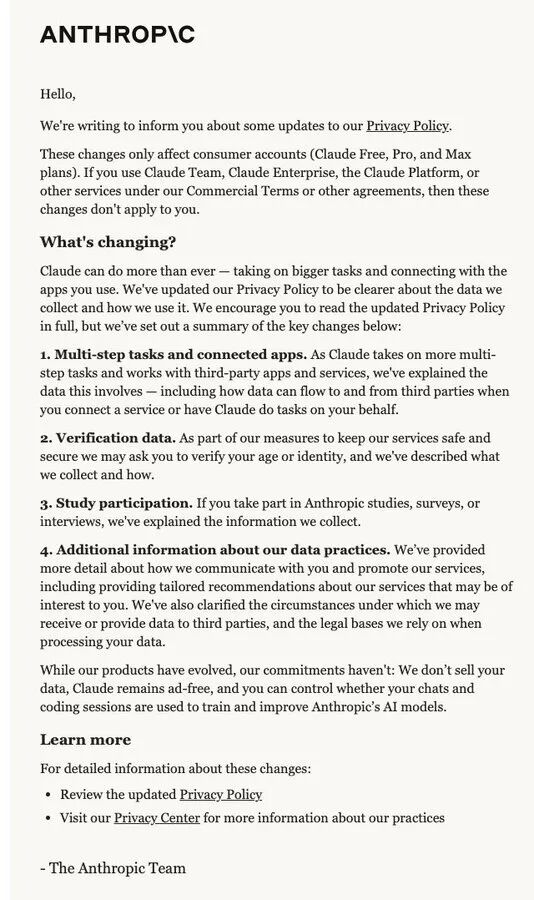
According to the email, the update to the privacy policy mainly focuses on four aspects, including the connection of multi - step tasks with third - party applications, the collection and use of identity verification information, the information processing when users participate in research projects, and a further explanation of the overall data processing and third - party data sharing rules.
Specifically:
1. Connection of multi - step tasks with third - party applications
As Claude starts to support more multi - step tasks and can work in collaboration with third - party applications and services, Anthropic has provided additional explanations for the relevant data transfer mechanism. This includes how data is transmitted and processed between Anthropic and third parties when users connect to external services or authorize Claude to perform tasks on their behalf.
2. Identity verification data
Anthropic stated that to ensure the security of the platform and the reliability of services, it may require users to verify their age or identity. The new privacy policy further clarifies the types of information that may be collected during this process and the way the relevant data is processed.
3. Participation in research projects
For users who participate in Anthropic's research, questionnaires, or interview activities, the new policy supplements the scope and purpose of the information that may be collected during the activity.
4. Supplementary explanation of data processing rules
Anthropic has also added more details about the data processing methods, including how to communicate with users, how to promote its own services, and how to provide personalized service recommendations based on user interests. In addition, the new policy further clarifies the applicable scenarios for obtaining data from third parties or providing data to third parties, as well as the legal basis for relevant data processing.
Anthropic emphasized at the end of the email that although the product's capabilities are constantly expanding, its core commitments remain unchanged, including not selling user data, Claude continuing to operate in an ad - free mode, and users still being able to independently decide whether to allow chat records and programming sessions to be used for training and improving Anthropic's AI models.
Effective as of July 8, 2026
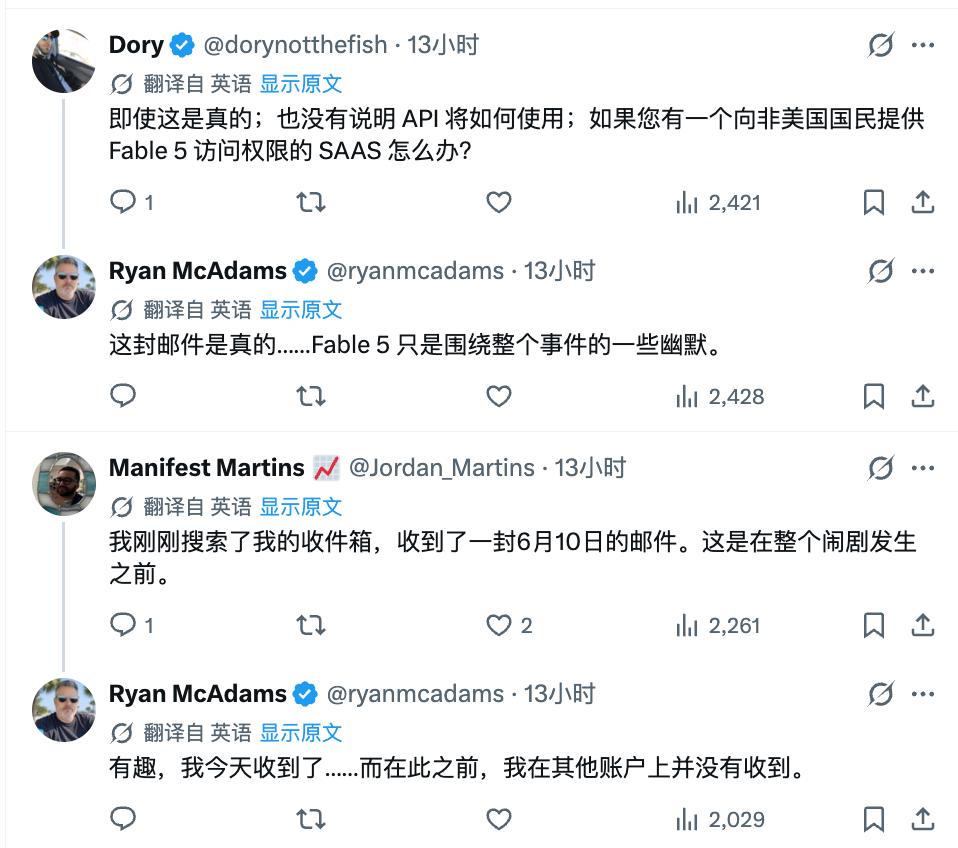
After this news spread, some people were incredulous, and some questioned its authenticity. However, the netizen later responded that the email was indeed from the official source and said that they had received it, but other accounts had not received it yet, presumably still in the phased gray - testing stage.
Amid the controversy, some users also found that Anthropic's official website had indeed updated the relevant privacy policy terms and clearly stated that it would take effect as of July 8, 2026.
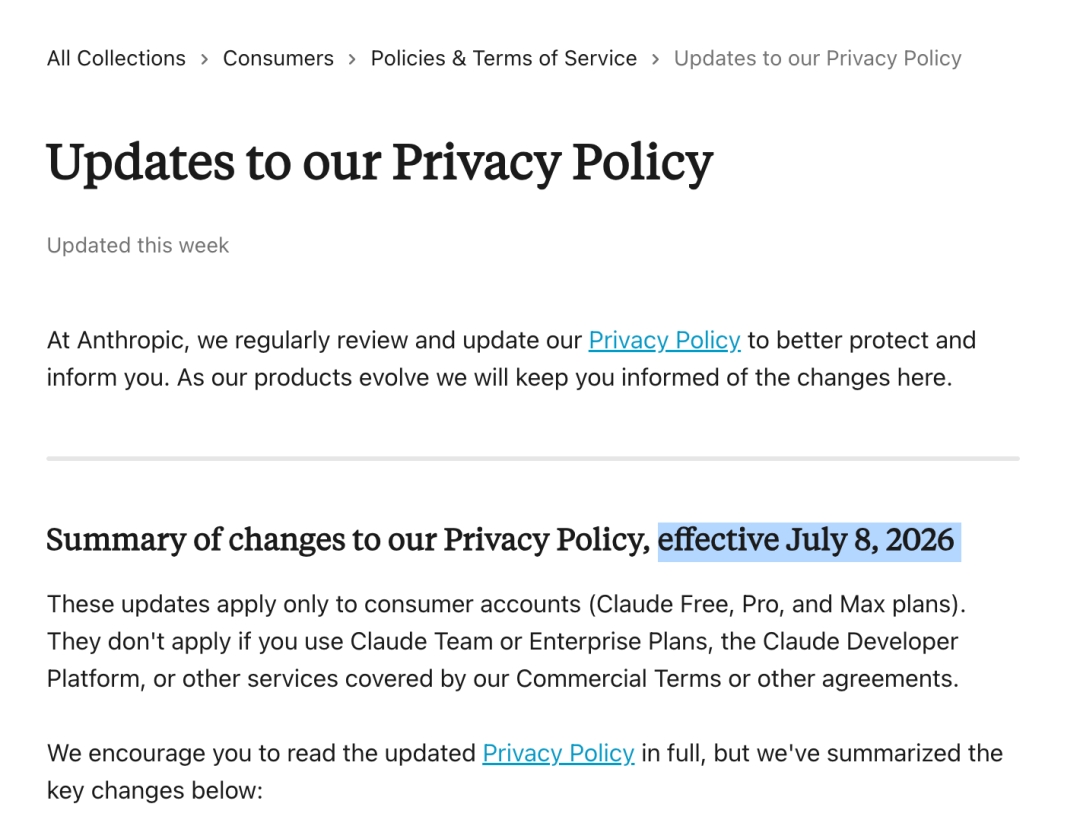
This means that starting next month, Claude Free, Pro, and Max users may gradually be included in the age or identity verification process.
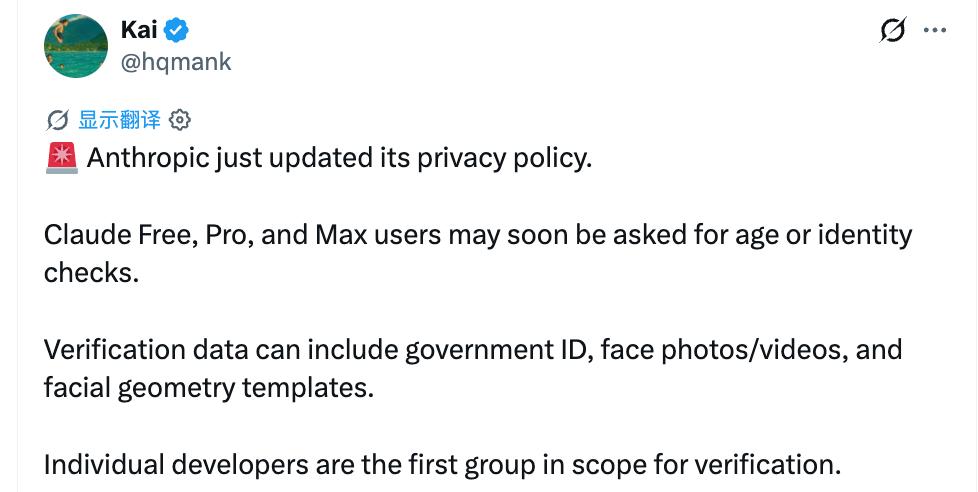
Some netizens even pointed out further that the verification data may include government - issued identification documents, face photos or videos, and face geometric feature templates, and individual developers may be among the first to be verified.
Access restrictions have already begun
Before this policy change, Anthropic had just taken offline its two most powerful models.
Last week, Anthropic released two new models, Fable 5 and Mythos 5. Among them, Mythos 5 is positioned as a restricted model for security research and critical infrastructure, while Fable 5 is a more widely - used flagship version.
However, just three days after the release, Anthropic issued an announcement stating that the US government, based on the opinions of the national security department, required the suspension of access to Fable 5 and Mythos 5 for all foreign citizens (whether inside or outside the US, including foreign employees) and demanded immediate compliance and disablement.
Anthropic said that it would comply with the directive and remove the access rights to the relevant models, while emphasizing that other models were not affected. In the announcement, Anthropic mentioned that this decision was based on an assessment of the so - called "limited jailbreak risk," but the company believes that such capabilities also exist in other mainstream models and have been widely used in security defense practices. Nevertheless, due to compliance requirements, access was forcibly terminated.
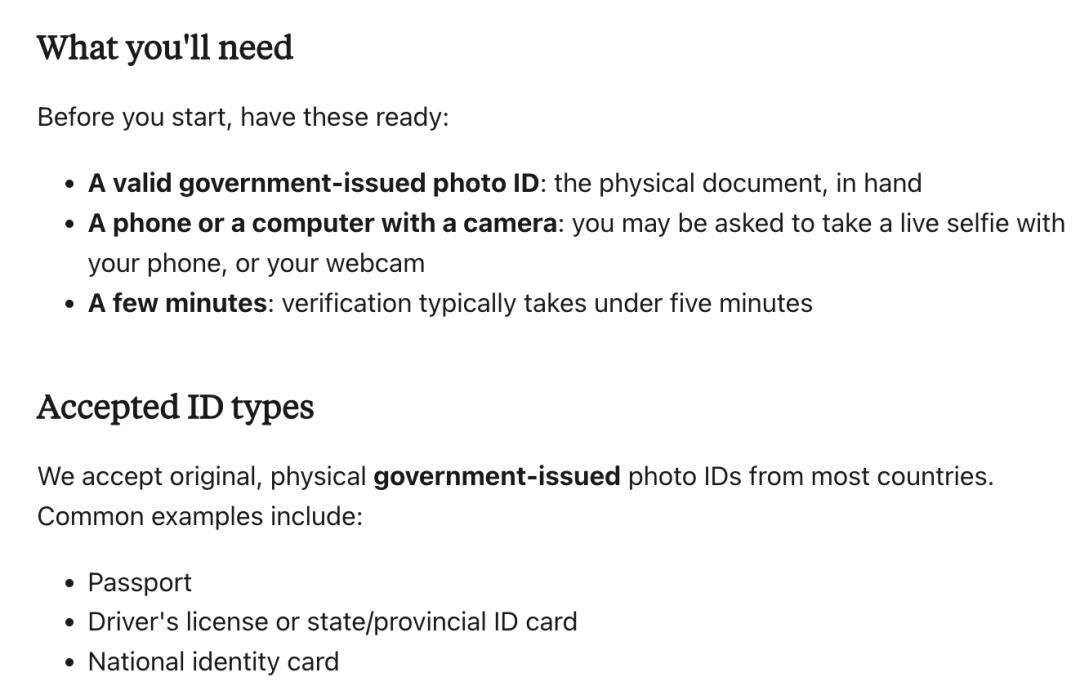
In fact, two months ago, Anthropic issued an announcement titled "Authenticating Claude," which mentioned that when using this tool, users need to check their ID cards.
As a user of Claude, you need:
A valid government - issued photo ID: That is, the physical ID in your hand.
A mobile phone or a computer with a camera: You may be required to take a real - time selfie using your mobile phone or webcam.
A few minutes: Verification usually takes less than five minutes.
This method is also called KYC (Know Your Customer). It originated from the financial industry. In essence, it is to confirm the user's identity before providing services, usually including processes such as ID verification and face recognition, which are used to meet regulatory requirements such as the protection of minors or regional compliance.
However, in the context of AI products, the introduction of KYC is more sensitive: Users are no longer just "people who register accounts" but are included in an identifiable and traceable identity system, which will change the relatively open and anonymous usage mode of AI tools.
Now, Anthropic's update of the privacy policy for consumer accounts also expands the scope of KYC real - name verification.
Divergence is emerging
Regarding this trend, many netizens have also expressed strong opinions:
This is the beginning of "complete centralization." AI is taking a path opposite to that of the cryptocurrency industry - from a decentralized narrative to centralized platform control.
This means that a more realistic trend is occurring: When the model's capabilities are strong enough and the applications are critical enough, regulatory and identity systems will inevitably intervene.
Some people even sighed directly: The world is becoming more and more dystopian. As the threshold continues to increase, perhaps "local models" will eventually become the default choice for more and more people.

Some people also think that this is a new opportunity for domestic large models. What do you think of this trend?
References:
https://privacy.claude.com/en/articles/10301952-updates-to-our-privacy-policy
https://x.com/ryanmcadams/status/2066201356034011370
https://www.anthropic.com/legal/privacy
This article is from the WeChat official account "CSDN". Author: Tu Min. Republished by 36Kr with permission.