Just now, Enflame Technology successfully passed the hearing, and the "Four Little Dragons" of domestic GPUs are finally all assembled.
Just now, Enflame Technology successfully passed the review!
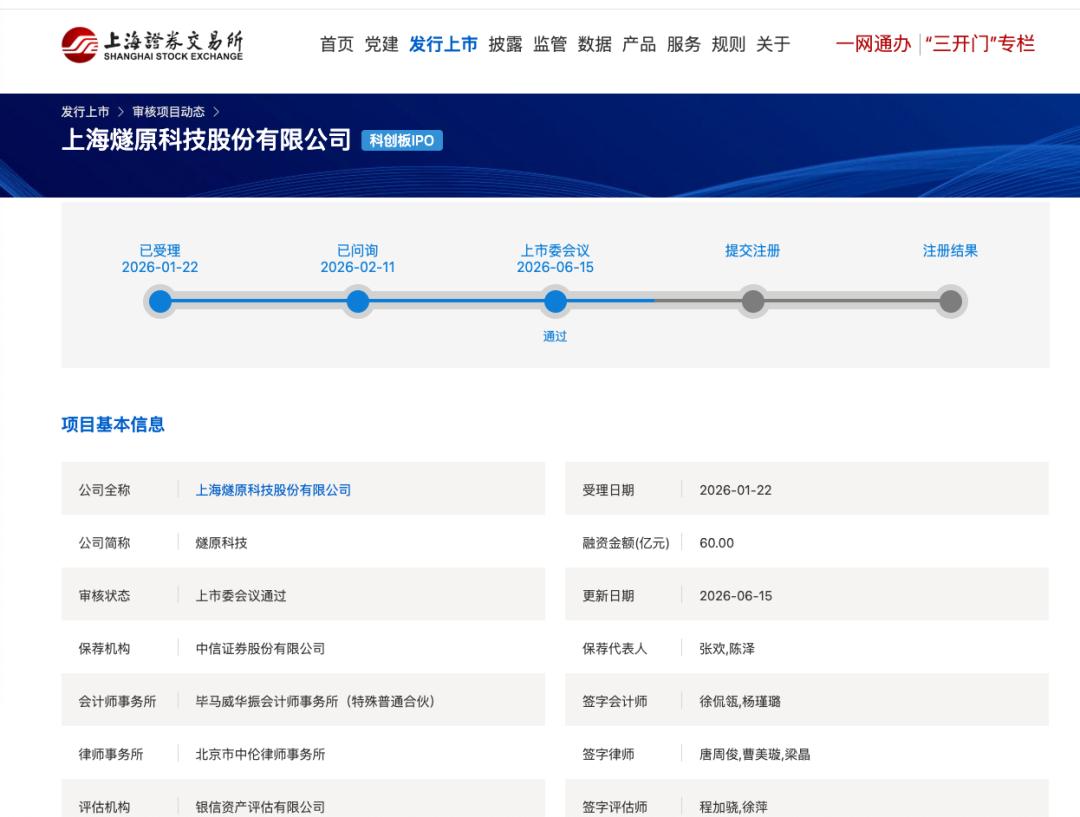
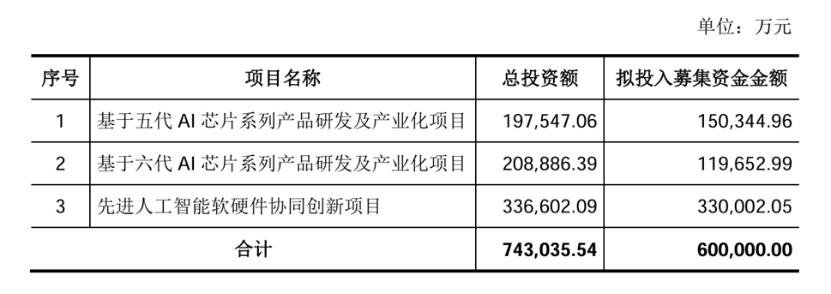
Enflame Technology is a cloud AI chip company. In this IPO, it plans to raise 6 billion yuan. The raised funds will be used for the R & D and industrialization projects of the fifth - and sixth - generation AI chip series products, as well as the advanced artificial intelligence software - hardware collaborative innovation project.
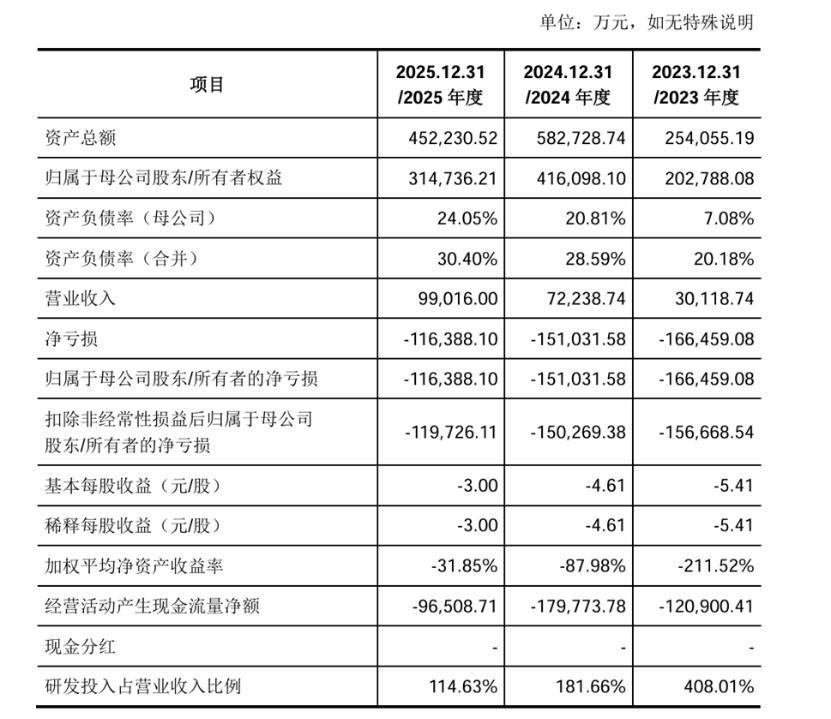
Loss of about 4.3 billion yuan in three years, expected to achieve consolidated statement profitability as soon as this year
According to the prospectus, from 2023 to 2025, Enflame Technology's operating revenues were 301 million yuan, 722 million yuan, and 990 million yuan respectively. After deducting non - recurring gains and losses, the net profits were - 1.567 billion yuan, - 1.503 billion yuan, and - 1.197 billion yuan respectively, and it has not achieved profitability yet. Considering factors such as on - hand orders, product delivery rhythm, employee cost budget, and R & D plan, Enflame Technology expects to achieve consolidated statement profitability in 2026 or 2027.
Regarding why it has not achieved profitability, Enflame Technology believes there are two main reasons. Firstly, the R & D investment is huge. In terms of cloud AI chip hardware, advanced wafer manufacturing and packaging and testing processes are required, and products need to be iterated rapidly on an annual basis. In terms of software, an AI computing and programming software platform needs to be built and continuously improved to ensure in - depth support for the continuously iterated mainstream large AI models. At the same time, joint R & D with supply - chain partners is also required to ensure the stability of the supply chain. Secondly, facing the needs of Internet giants, the company needs to jointly verify and polish multiple generations of products. It is necessary to continuously optimize software adaptation to meet the needs of business scenarios and match product solutions with the commercial value of customers before gradually deploying products in large quantities.
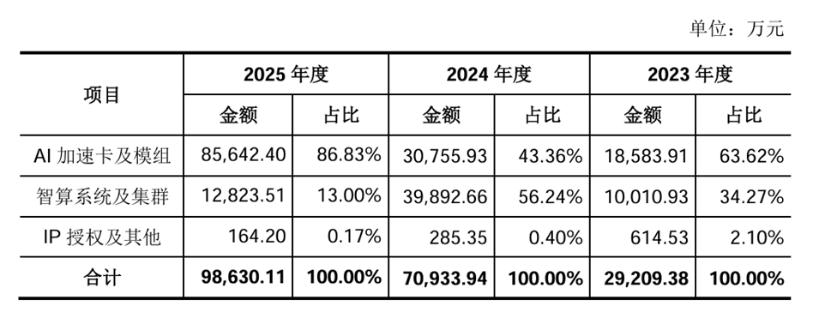
More than 96% of Enflame Technology's operating revenue comes from its main business. Other business revenues mainly come from a small amount of raw material resale and equipment leasing, etc. Among them, AI accelerator cards and modules, and intelligent computing systems and clusters are the company's main sources of income. AI accelerator cards and module products are mainly sold to leading Internet customers. With the iteration of hardware performance and in - depth software adaptation, they are deployed in more and more AI business scenarios, and the sales revenue has increased rapidly. In 2025, the proportion of the main business income of such products has exceeded 85%.
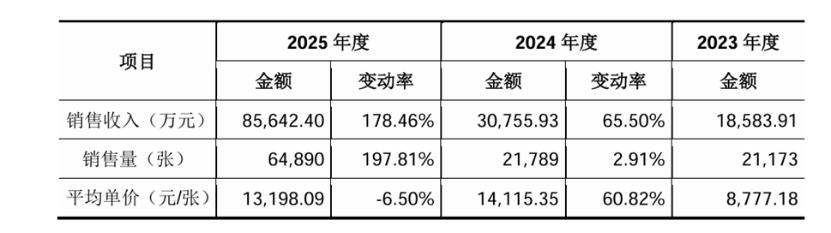
From 2023 to 2025, the sales volumes of Enflame Technology's AI accelerator cards and modules were 21,173, 21,789, and 64,890 respectively. In 2025, the third - generation AI accelerator cards continued to gain popularity in the AI business scenarios of Internet customers, and the sales volume in that year further increased compared with 2024.
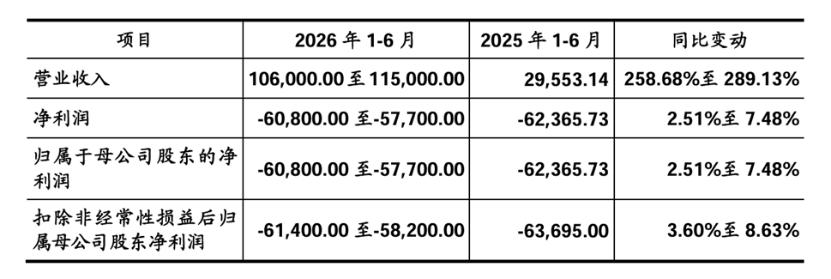
From January to June 2026, Enflame Technology's operating revenue is expected to show a significant year - on - year growth trend. It is expected that the company will achieve the full - year revenue scale of 2025 in the first half of 2026. Due to the company's continuous R & D intensity and the impact of taxes and surcharges generated from advance customer payments and accrued interest expenses, the year - on - year growth rate of the net profit attributable to the parent company is lower than the expected year - on - year growth rate of the operating revenue in the same period.
In addition, due to the company's business expansion and strategic inventory, Enflame Technology's inventory scale has been increasing year by year. The book balances of inventory during the reporting period were 261.429 million yuan, 979.3923 million yuan, and 1074.2783 million yuan respectively. Considering the rapid technological iteration of cloud AI chips, the company prudently provides for inventory impairment losses based on the sales expectations of each period during the reporting period. During the reporting period, the amounts of inventory impairment losses of the company were 127.7516 million yuan, 30.2783 million yuan, and 31.6062 million yuan respectively.
Iterated four generations of architectures and 5 cloud AI chips in 8 years
In the 8 years since its establishment, Enflame Technology has self - developed and iterated four generations of architectures and 5 cloud AI chips, and has built a complete product system covering AI chips, AI accelerator cards and modules, intelligent computing systems and clusters, and AI computing and programming software platforms. According to IDC data and the issuer's sales volume, in 2025, the sales volume of Enflame Technology's AI accelerator cards and modules reached 66,000, corresponding to a market share of about 1.7% in the Chinese AI accelerator card market, ranking among the top domestic AI chip manufacturers.
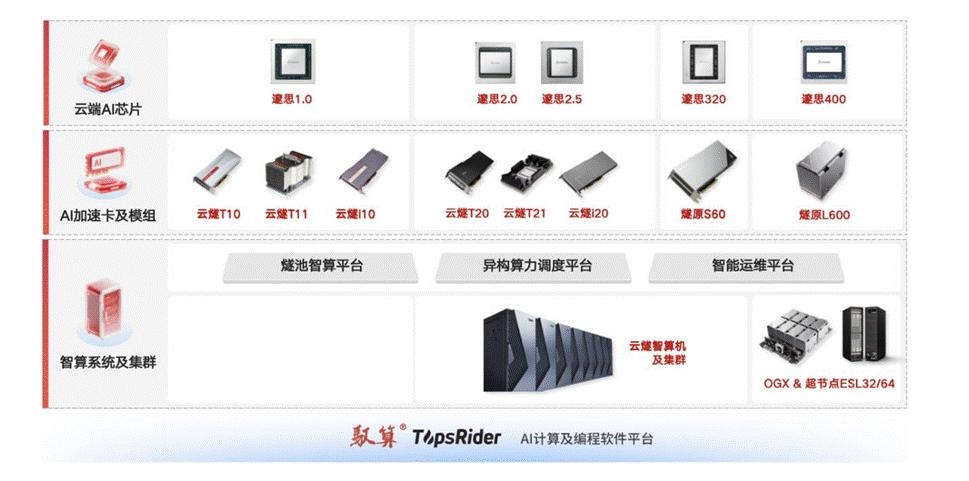
The cloud AI chip is the core underlying hardware of Enflame Technology's product matrix and is not sold separately externally. Different generations of products are applied to the training and inference scenarios of AI models. The products are based on the company's cloud AI chips, integrating supporting storage modules, power and signal management modules, heat dissipation components, and high - speed interfaces on a PCB carrier board or OAM module. Generally, a single AI accelerator card and module contains one cloud AI chip.
Intelligent computing systems and clusters are one of the main product forms contributing to revenue. The brand of the intelligent computing system is CloudBlazer POD, which is a single - cabinet, single - computing - node device for AI model training and inference scenarios, and constitutes the smallest computing unit of the intelligent computing cluster. A CloudBlazer POD is generally composed of 4 - 8 AI - dedicated servers and multiple network switches interconnected by high - speed cables and integrated in a single cabinet. Among them, a single AI - dedicated server is generally based on 8 of the company's AI accelerator cards or modules, and is equipped with hardware such as CPU, DRAM memory, enterprise - level solid - state drives, power and power supply modules, heat dissipation modules, network cards, and system software. A single CloudBlazer POD usually integrates 32 to 64 AI accelerator cards and modules.
An intelligent computing cluster is a computing infrastructure at the computer - room level with multiple computing nodes and multiple cabinets interconnected. The intelligent computing cluster is based on multiple CloudBlazer PODs, and is further equipped with system hardware such as CPU general - purpose servers, high - speed network devices, and independent storage servers, as well as self - developed supporting system software to achieve high - speed interconnection of clusters with a scale of more than 1,000 cards. Currently, Enflame Technology only delivers products to Chengdu Gaoxin Electronics as the project general integrator in the intelligent computing cluster mode.
The AI computing and programming software platform is the core software platform of the product matrix. Enflame Technology provides a unified AI computing and programming software platform, TopsRider, for its self - developed AI chips, AI accelerator cards or modules, and related products to connect artificial intelligence chips with artificial intelligence applications. Currently, the company does not sell the AI computing and programming software platform separately externally.
Zhao Lidong and Zhang Yalin are the joint actual controllers, and the largest shareholder is Tencent Technology
The actual controllers of Enflame Technology are Zhao Lidong and Zhang Yalin. Both of them have the right to vote directly and indirectly to control the company's shares, and the voting rights are equal. The company does not have a controlling shareholder. Shareholders holding more than 5% of the shares include: Tencent Technology holds 19.9493% of the issuer's shares, Zhao Lidong and Zhang Yalin each directly hold 8.9643% of the issuer's shares, and Suiyuan Huizhi directly holds 8.6596% of the issuer's shares.
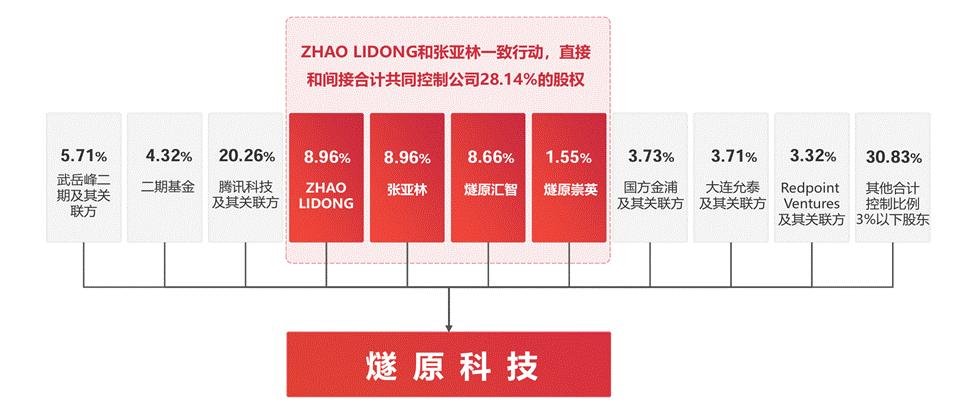
Enflame Technology has a total of 102 shareholders, and its equity structure is relatively dispersed. The largest shareholder, Tencent Technology, and its concerted action party, Suzhou Paiyi, together hold 20.2580% of the company's shares. Their shareholding ratio is 7.8777% less than the voting rights jointly controlled by Zhao Lidong and Zhang Yalin, showing a large difference. Except for Tencent Technology, Zhao Lidong, Zhang Yalin, and Suiyuan Huizhi, the shareholding ratios of other single shareholders of the company are all less than 5%.
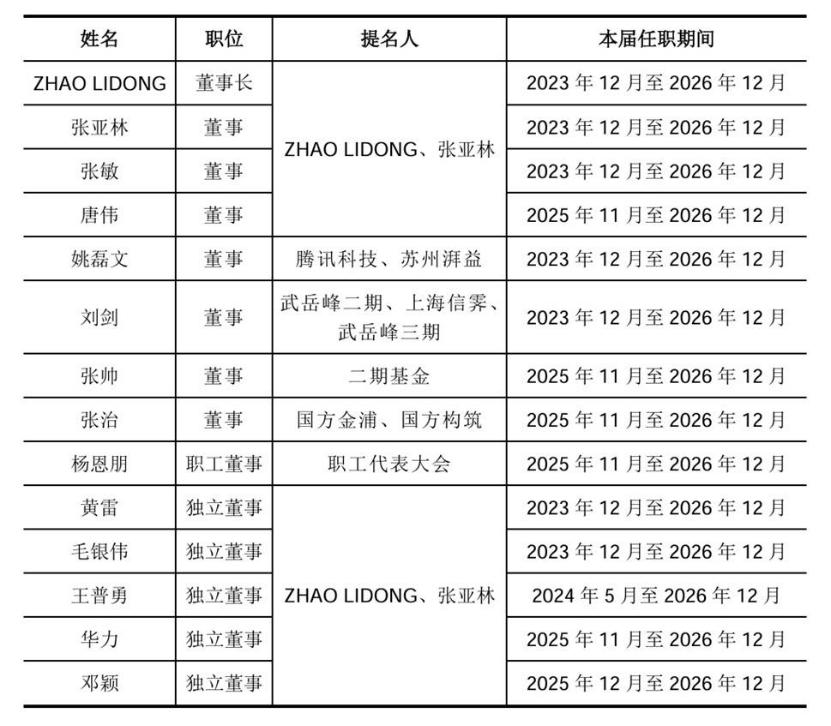
The board of directors of Enflame Technology has a total of 14 directors, including 5 independent directors and 1 employee director. Except for the chairman, Zhao Lidong, who is of American nationality, the rest of the directors are of Chinese nationality and have no permanent overseas residency rights.
The four little dragons are all here! The capital of domestic GPUs is gathering
Moore Threads, Muxi Co., Ltd., Biren Technology, and Enflame Technology are collectively known as the four little dragons of domestic GPUs. After three of these companies completed their IPOs one after another, Enflame Technology successfully passed the review, marking that all four domestic GPU manufacturers are about to gather in the capital market.
On December 5, 2025, Moore Threads was listed on the Science and Technology Innovation Board at an issue price of 114.28 yuan per share, issuing 70 million shares. The total funds raised were 8 billion yuan, and the net amount was 7.576 billion yuan. The funds were mainly invested in the R & D of a new - generation AI training and inference integrated chip, an independently controllable graphics chip, and an AI SoC chip, as well as to supplement working capital. On December 17, 2025, Muxi Co., Ltd. was listed on the Science and Technology Innovation Board at an issue price of 104.66 yuan per share. The total funds raised were about 4.197 billion yuan, and the net amount was 3.899 billion yuan. The funds were invested in the R & D projects of a new - type high - performance general - purpose GPU, a new - generation AI inference GPU, and cutting - edge high - performance GPU technology. On January 2, 2026, Biren Technology was listed on the Hong Kong Stock Exchange at an issue price of HK$19.6. The total funds raised were HK$5.583 billion, with about 85% used for the R & D and technological innovation of the next - generation GPGPU chips, and the rest for commercial expansion and to supplement working capital.
A notable industry phenomenon is that Tsinghua - affiliated enterprises have demonstrated strong technological innovation and commercial implementation capabilities in the fields of GPUs, AI chips, and related computing power. Zhao Lidong, the founder of Enflame Technology, graduated from the Department of Radio Engineering of Tsinghua University in 1985. Chen Weiliang, the founder of Muxi Co., Ltd., graduated from the Institute of Microelectronics of Tsinghua University with a master's degree. Among the large AI model groups, Zhipu AI, Baichuan Intelligence, MiniMax, and Dark Side of the Moon all originated from Tsinghua University. The Tsinghua - affiliated enterprises not only dominate at the underlying hardware (chip) level but also have an absolute advantage at the top - level application (model) level, and can be regarded as the "super incubator" of the Chinese AI industry.
The successive listings of the four little dragons of domestic GPUs mark that the industry has entered a new stage. However, the market situation is still severe. According to the forecast of CIC Consulting and the calculation of NVIDIA's annual report, in 2025, NVIDIA's share of AI accelerator cards was about 70%. According to IDC data statistics, in 2025, international manufacturers represented by NVIDIA occupied nearly 60% of the Chinese AI accelerator card market. Facing such a huge self - sufficiency gap, domestic manufacturers still have a lot of room for improvement and need to continue to make efforts in technological iteration and ecosystem construction.