Afu takes the pulse, doctors provide the final safeguard, and the ultimate outcome of AI-powered medical diagnosis is "doctor in the loop".
At the beginning of this year, tech billionaire Elon Musk made a prediction during a public interview that within the next three years, Tesla's humanoid robot Optimus will "surpass the world's best surgeons." The notion of "AI replacing doctors" always sparks heated discussions. Regardless of whether this timeline is too aggressive, it's clear that AI is penetrating the medical field at an unprecedented pace.
For example, it has become an instinctive action for many people to consult AI first when they don't feel well. From the perspective of professional doctors, at the beginning of this year, a survey by Life Times covering over 500 doctors from top-tier hospitals across the country showed that over 70% of the respondents recommended the public to use AI to "address daily basic health questions," and 90% were optimistic about the future of AI doctors.
However, the medical field has extremely high requirements for rigor and safety. The "hallucinations" and judgment biases of many general-purpose AIs have always made users skeptical. After all, a wrong medical guidance could cause irreversible health damage. Previously, it was reported online that a netizen, following the guidance of a general AI, stored his father's severed finger in saline solution, resulting in the finger being unable to be reattached.
This is precisely the core ability and trust bottleneck when AI is applied in the medical field.
To gain trust, various AIs on the market have their own strategies. Some attach links to references at the end of their answers, some mark "for reference only and cannot replace a doctor's diagnosis," and some products use confidence scores to indicate uncertainty. However, these practices essentially leave it to users to judge the credibility of the answers and bear the responsibility, which only treats the symptoms rather than the root cause.
Therefore, while improving the diagnostic ability of models, there is a growing consensus in the industry that truly reliable AI medical services still rely on "doctors" in the short term. Cong Yali, a professor at the School of Medical Humanities of Peking University, believes that professional AI health assistants should fully alert users to possible risks and guide them back to the medical system, rather than making people think that the answers on the screen can replace a doctor.
So, what might be the ideal mode of collaboration between humans and AI in different department scenarios, and how can it be implemented?
Recently, the "Doctor Review" function launched by Ant Afu provides a practical answer: after users receive the AI analysis results, they can choose whether to invite a doctor from a top-tier hospital to review the answers and provide additional comments. The test data of Ant Afu shows that about 15% of users choose this service, and the consistency rate between the doctor's review results and Afu's analysis exceeds 90%.
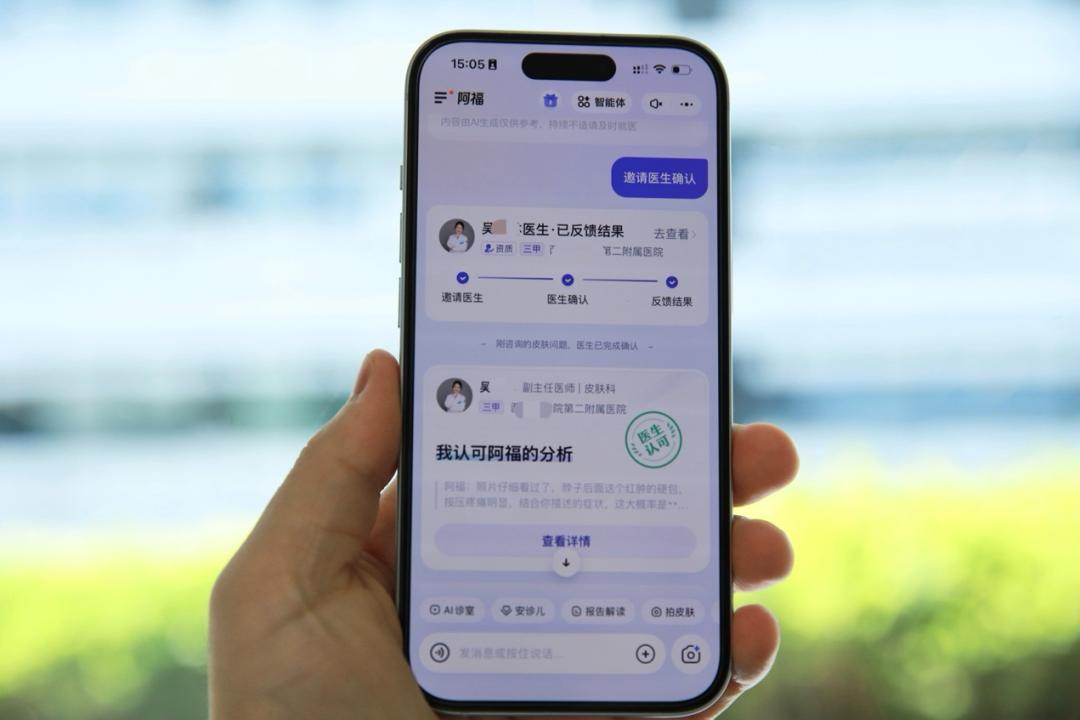
This function is currently being tested on a small scale for dermatology consultations. It's not yet known when it will be extended to more departments.
However, it's certain that this "silicon-based + carbon-based" collaboration model is a typical "doctor in the loop," which is expected to largely eliminate users' concerns about AI when using Afu, making them feel more at ease and secure.
01. Have a Doctor Check Afu's "Homework"
36Kr's experience shows that in the "Take a Photo of Skin" function on Afu's homepage, after users receive the AI's diagnostic advice, they will see an option of "Ask a Real Doctor to Confirm" at the end. After clicking, the system will match a dermatologist from a top-tier hospital within seconds. After users simply provide basic identity information, they can quickly get feedback from the doctor, which could be "I agree with Afu's analysis" or questions like "How long has this condition been present? Is there any pain?"
Ant Afu explained that the reason for testing this function in the skin consultation scenario first is that this type of problem is a service category with a high consultation volume on the platform, and it relies heavily on image and text recognition and judgment. AI's multi-modal recognition ability has an advantage in this regard, and Afu has accumulated a lot of technical capabilities and experience through long-term operation.
The data provided by Ant Afu shows that currently, the number of skin diseases that Afu's "Take a Photo of Skin" function can identify has increased from the initial 50 to over 100, covering 99% of common skin problems in online consultations. The high maturity of this scenario makes it an ideal test ground for the new function.
In the review process after the AI's Q&A, doctors can see the consultation process between the user and Afu and Afu's analysis results. Meanwhile, if a doctor assesses that the existing medical history information is insufficient to support a clinical judgment, they can actively intervene and ask questions to ensure sufficient information and independently give a final diagnosis.
As one of the first real doctors to participate in the "Doctor Review" program, Li Jianying, a dermatologist at Shijiazhuang People's Hospital, reviews about a hundred of Afu's answers every day. In her experience, the accuracy of AI can reach 90 - 95%. Nevertheless, she still carefully reviews each piece of content. "Just like with self-driving cars, we can trust it, but we still need to keep an eye on it and can't just let it drive on its own with our eyes closed."
The test data provided by Ant Afu shows that currently, doctors agree that the AI analysis is reasonable about 90% of the time; cases where the information is insufficient and the doctor needs to initiate a conversation to ask the user for more details account for less than 10%. This collaboration process takes into account both efficiency and professionalism. It avoids having doctors repeatedly process basic information and also reserves room for in-depth manual intervention in special cases.
It's worth noting that the "review" action is at the user's discretion, and users can choose not to have a doctor review. At this stage, each user has three free trial opportunities per day.
Why can Afu achieve a 90% consistency rate with doctors? It is understood that since the development of its underlying model, Afu has adhered to the idea of co-construction with professional doctors. It has invited top-tier hospitals and discipline leaders to participate in designing top-level specifications such as Q&A thinking and evaluation criteria to build a medical knowledge base, ensuring that AI's answers are well-founded and in line with clinical logic.
02. AI + Doctors: Unleashing the Imagination of Medical "Human - Machine Collaboration"
After the "Doctor Review" function is embedded, the most direct change that users can perceive is that after receiving the AI's answer, they finally have an option to "confirm."
Previously, Afu could complete the "take a photo - AI analysis" process, but there was always a lack of a lightweight verification step. Now, within just a few minutes, from "asking" to "judging" and then to "confirming," users can get the review results from a doctor.
Medical needs are highly diverse. According to Ant Afu's test data, 15% of users choose doctor review, while 85% do not. This actually shows two things: first, most people already trust Afu's AI answers enough and don't need to spend money and time to have a doctor confirm; second, there is indeed a group of users who have higher requirements for accuracy and need doctors to dispel their concerns about AI.
If we take a longer - term view, after the "AI + doctor" collaboration model is proven feasible in dermatology, its potential extends far beyond a single scenario like consultations.
In the future, in fields such as health care, home care, and even chronic disease management, the combination of "AI + real - life professionals" can also be tried. Here, the "real - life professionals" may not necessarily be top - tier doctors, but could also be rehabilitation therapists, nutritionists, health managers, or even community caregivers.
AI is responsible for large - scale, standardized information processing and reminders, while humans are responsible for personalized judgment, emotional support, and on - site operations. If this combination model can penetrate a wider range of the health and wellness market, the market scale and social value it can leverage will also increase.

As Kevin Kelly predicted, the best medical services in the future will not come solely from AI or real - life doctors, but from the combination of the two. Only by complementing each other's strengths can a more reliable and inclusive medical service be created. And Afu's attempt has made this combination take shape in the form of an operable product in the domestic market.
Therefore, the "Doctor Review" function is essentially Ant Afu's early exploration of the future medical collaboration model. While the industry is still debating whether "AI will replace doctors," Afu has given its answer through a product upgrade: it's not about replacement, but partnership. And the synergy between this partnership may ultimately solve the problems of difficult and expensive medical treatment.