Colleges and universities have drastically expanded their enrollment.
01
Colleges and Universities Expand Enrollment Madly
Although the college entrance examination has just ended, the scores have not been announced, and the admission process has not started yet, and although candidates are saying that this year's math, chemistry, and biology exams were difficult, one thing is certain: this year's college admission rate will definitely be higher than last year's.
Reasons are as follows: First, the number of test - takers decreased by 450,000 compared to last year.
This year, 12.9 million people took the national college entrance examination. This figure is 450,000 less than in 2025. It is the second consecutive year of decline after a decrease of 70,000 in the number of applicants in 2025.
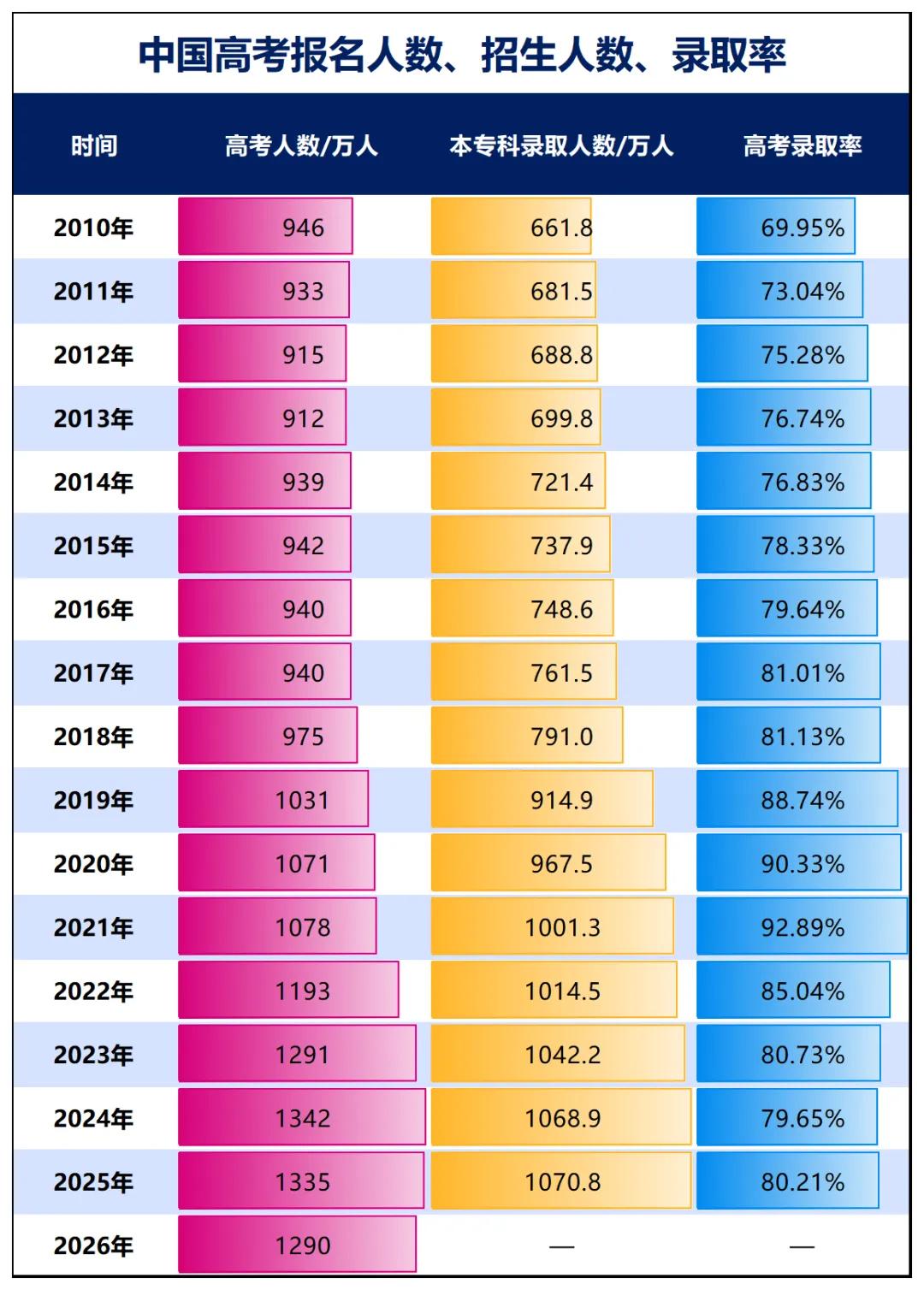
Charting: Urban Finance; Data: Ministry of Education, National Bureau of Statistics
Second, colleges and universities have started to expand enrollment madly.
On June 10, Southeast University officially announced that in 2026, it will add 600 undergraduate admission quotas, with a total enrollment scale of 4,825. The admission quotas for majors in short - supply nationally and the university's advantageous majors will be increased across the board. On June 4, Nanjing University expanded its undergraduate enrollment by 300 in 2026. Compared with 2021, the newly - added undergraduate enrollment scale in 2026 has exceeded 1,000.
In addition, Xi'an Jiaotong University announced an enrollment expansion of 360. Lanzhou University expanded its enrollment by 300. The total undergraduate enrollment scale of Huazhong University of Science and Technology reached 7,505, an increase of 200. Wuhan University of Technology plans to recruit 9,798 students nationwide in 2026, an increase of 218.
Nanchang University expanded its enrollment by 110, Hefei University of Technology by 100, and Zhengzhou University by 150.
Tsinghua University, Peking University, Zhejiang University, Wuhan University, Chongqing University, Central South University, South China University of Technology, Sun Yat - sen University, China Agricultural University, Shandong University, Nankai University, etc. have all announced enrollment expansions.
In addition to these established key universities, Southern University of Science and Technology, which is comparable in strength to 985 - level universities, is expected to recruit more than 1,400 students nationwide, an increase of 30 to 40.
The enrollment scope of Shenzhen Institute of Technology has expanded from 8 provinces to 13 regions, and the number of students has increased from 360 to 600, an increase of more than 60%. The enrollment plan of Beijing Vocational University of Science and Technology has soared from 600 to about 1,800, an increase of 1,200, and 8 new majors focusing on artificial intelligence, low - altitude economy, etc. have been added; Shenzhen Polytechnic University is expected to recruit more than 2,500 students, doubling compared to last year, and plans to add 25 vocational undergraduate majors.
The strength of these two vocational universities is comparable to that of 211 - level universities.
Fuyao University of Science and Technology, established last year, plans to add Shanxi, Gansu, and Guizhou for undergraduate enrollment, and the total enrollment plan has increased from 50 to 100.
Greater Bay Area University recruits undergraduates from five provinces (regions) including Guangdong, Guangxi, Hunan, Hubei, Henan, and the Hong Kong and Macao regions. Compared with the first - year enrollment of only 80 undergraduates in Guangdong, the number of students has increased by 110.
In fact, college enrollment has been expanding in the past few decades. Therefore, the overall growth trend of the college entrance examination admission rate is very obvious. In some individual years, the admission rate fluctuated and decreased due to the rapid increase in the number of college entrance examination applicants.
The undergraduate admission rate has shown a downward trend overall since 2014 because the enrollment expansion speed is lower than the growth rate of the number of college entrance examination applicants.
However, this year, the number of college entrance examination applicants has decreased while the enrollment expansion continues. Therefore, there is no doubt that the undergraduate admission rate will rise.
02
Why the Mad Enrollment Expansion?
Why do key universities start to expand enrollment madly?
In the "15th Five - Year Plan" released at the beginning of this year, the statement regarding education is very clear: Expand the enrollment scale of high - quality undergraduate education... Promote the improvement of quality and expansion of higher education. Expand high - quality higher education resources through multiple channels, increase the construction of high - level research - oriented universities, and strengthen application - oriented undergraduate colleges and universities.
The fundamental reason is to train more relevant talents for the country's industrial upgrading. This is the same as the logic behind the increasing difficulty coefficient of the college entrance examination math in recent years. Mathematics is the foundation of all physics, chemistry, and biology, and it is also the underlying support for strategic emerging industries such as artificial intelligence, integrated circuits, high - end manufacturing, and aerospace.
As the Chinese economy moves from the real - estate era to the era of scientific and technological innovation, the demand for high - level science and engineering talents is increasing geometrically. Whether it is the competition in large models, the breakthrough in chips, or the development of new energy and high - end equipment manufacturing, in essence, what is being competed is not land and capital, but talent reserves.
Therefore, the enrollment expansion of 985 - level universities is not just to allow more people to go to college, but to reserve talents in advance for the industrial competition in the next decade or even two decades. Especially in key national fields such as artificial intelligence, integrated circuits, biomedicine, and new energy, a large number of engineers, researchers, and innovative talents with a solid mathematical and physical foundation are needed.
Therefore, we can see that the students admitted through the enrollment expansion of the above 985 - level universities are basically absorbed into the majors that are in urgent need in society.
Tsinghua University: The key enrollment expansion directions are artificial intelligence, quantum information, and new energy.
Peking University: The key enrollment expansion directions are mathematics, physics, and clinical medicine.
Zhejiang University: The key enrollment expansion directions are marine engineering and intelligent equipment.
Southeast University: Three new majors, Low - Altitude Technology and Engineering, Medical Devices and Equipment Engineering, and Systems Science and Engineering, have been added. As a result, the number of undergraduate majors has increased to 86, and the advantageous majors such as Integrated Circuit Design and Integrated System and Electrical Engineering and Automation continue to expand enrollment.
Xi'an Jiaotong University: The enrollment expansion is mainly concentrated in fields urgently needed by the country, such as embodied intelligence, intelligent manufacturing, energy, energy storage, and electricity. In addition, in response to the country's major strategic needs and aiming at future scientific and technological frontiers and the development of new - quality productivity, the university has added 2 undergraduate majors, Embodied Intelligence and Data Science.
Huazhong University of Science and Technology: Among the 200 newly - added enrollment quotas, 163 are for popular engineering majors such as Interdisciplinary Engineering (Future Technology Experimental Class), Computer Science (School of Computer Science), Electrical Engineering and Automation, Optoelectronic Information Science and Engineering, Electronic Information (School of Integrated Circuits), Robotics Engineering, and Artificial Intelligence.
Lanzhou University: The enrollment expansion is mainly for "Four New" majors, majors urgently needed by national strategies, first - class disciplines, and basic disciplines.
Beijing Vocational University of Science and Technology: Two new undergraduate majors, Integrated Circuit Design and Integrated System and Intellectual Property, have been added. At the same time, the overall enrollment has been expanded by 90, and all the newly - added enrollment plans are allocated to key new - engineering fields such as new materials, computers, artificial intelligence, and integrated circuits.
Southern University of Science and Technology: The key enrollment expansion direction is strategic majors in urgent need, such as artificial intelligence.
From this perspective, the enrollment expansion of 985 - level universities and the increase in the difficulty of the college entrance examination math are actually two sides of the same policy arrangement.
The former is responsible for expanding the scale of talent training, and the latter is responsible for screening and training talents with mathematical and physical potential.
The ultimate goal is only one: to provide a continuous supply of talents for China's industrial upgrading and scientific and technological breakthroughs.
In a sense, the scale of the enrollment expansion of 985 - level universities today may not determine this year's admission rate, but China's position in the global scientific and technological competition in ten years.
This article is from the WeChat official account "Urban Finance". Author: Urban Finance. Republished by 36Kr with permission.