Following the path of Elon Musk, a post-80s Tsinghua genius is about to see his company go public via an IPO.
The brain-computer interface is getting closer to reality.
While the outside world is still debating how far the "brain-computer interface" in China is from ordinary people, a significant IPO has quietly arrived. Recently, according to the official website of the Shanghai Stock Exchange, the application for the IPO of Boraycon Technology (Shanghai) Co., Ltd. on the Science and Technology Innovation Board has been officially accepted. CITIC Securities acts as the sponsor, and the company plans to raise 2.5 billion yuan. If it goes public successfully, Boraycon is expected to become the first truly representative "brain-computer interface stock" in the A-share market.
This company, founded in 2011, has an impressive background. Its leaders, Xu Honglai and Huang Xiaoshan, are two post - 80s academic elites from the Neural Engineering Laboratory of Tsinghua University. In the past fifteen years, they have transformed an unpopular field that no one was optimistic about into a technological frontier that has attracted national attention, and have also brought the Chinese brain-computer interface industry to the forefront of global industrialization for the first time.
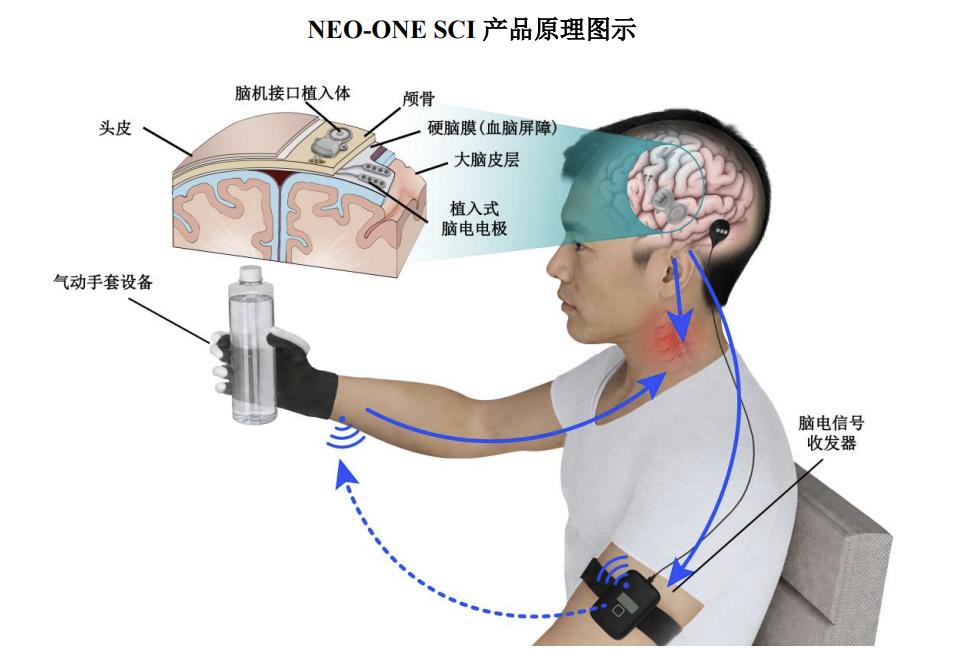
What really excites the capital market is that in March this year, its core product, NEO - ONE SCI, was officially approved for marketing by the National Medical Products Administration, becoming the world's first approved invasive brain-computer interface medical device. This means that a future industry that used to be confined to the laboratory has, for the first time, truly crossed the most difficult threshold between the laboratory and commercialization. Even though the company has accumulated a loss of 328 million yuan in the past three years, it still attracts a number of star institutions such as Sequoia Capital and Songhe Capital to continue to invest.
The brain-computer interface, an ultimate technology that once only existed in science fiction movies, is becoming a reality at a speed far beyond everyone's imagination, quietly rewriting the fates of countless critically ill patients.
1
Two Tsinghua academic elites bet on the most difficult field.
If you were to ask who brought the brain-computer interface out of the laboratory in the past two years, the answer is most likely Elon Musk. From Neuralink's successful human implantation to the widespread dissemination of videos about "controlling a mouse with thoughts" and "paralyzed patients playing games again," the brain-computer interface has become one of the hottest topics in the global tech circle for the first time. Many people have thus developed the illusion that the most advanced company in the brain-computer interface field must be Neuralink.
However, a somewhat unexpected fact is that in terms of product commercialization, it was not Elon Musk who took the lead, but Boraycon founded by two Tsinghua elites. In March this year, the independently developed NEO - ONE SCI of Boraycon was officially approved for marketing by the National Medical Products Administration, becoming the world's first approved invasive brain-computer interface medical device.
Note, it's not the first in China, but the first in the world.
This means that in the history of human exploration of "connecting the human brain to machines," the first invasive brain-computer interface product that has truly obtained regulatory approval and can enter the clinical application system was born in China. This result is a bit surprising. For a long time in the past, the brain-computer interface field has been dominated by Europe and the United States. American companies such as Neuralink, Synchron, and Paradromics of Elon Musk have attracted most of the global attention.
In contrast, Boraycon, founded in 2011, has been extremely low - key. There is no high - profile founder, no extensive marketing, and even many ordinary people first heard of this company because of this IPO. However, it was precisely in this low - key manner that Boraycon completed the most difficult step. Fifteen years ago, the brain-computer interface was still a typical "research project," far from industrialization. Difficulties in financing, a vague market, and unclear business models were almost the common situation across the entire industry. Against this background, Xu Honglai and Huang Xiaoshan from the Neural Engineering Laboratory of Tsinghua University decided to start a business.
Both of them are from the Neural Engineering Laboratory of Tsinghua University and studied under Gao Shangkai, an important scholar in the field of brain-computer interface in China. One is a doctor of biomedical engineering from Tsinghua University, and the other graduated from the same major at the undergraduate level. They are known as the "Tsinghua brain-computer interface twin stars" by the outside world. They didn't choose an easier way to make money but instead plunged into the brain-computer interface field, which is recognized as the most difficult. The reason is simple: If artificial intelligence is about teaching machines to understand humans, then the "brain-computer interface" is an attempt to directly read the human brain.
This is a technological direction that can change the next few decades, but it is also an extremely long - term process. In the past fifteen years, while the Internet has experienced rounds of trends such as the mobile Internet, live streaming, e - commerce, new energy, and large AI models, Boraycon has almost always been doing the same thing - researching the brain. This long - term approach has finally paid off. As of now, the company has formed a complete technology platform covering neural signal acquisition, analysis, and feedback, launched more than 20 products, and entered more than 500 medical institutions and more than 300 scientific research institutions. By the end of 2025, 32 patients in 11 hospitals across the country had completed the implantation surgery. All patients achieved brain - controlled grasping training, and some patients even regained improved hand functions.
This is why the industry generally believes that the real strength of Boraycon lies not in just making a product, but in proving that the "brain-computer interface" has, for the first time, the possibility of large - scale medical applications.
2
Why has the entire "brain-computer interface" field suddenly exploded?
If we go back three years, most investors probably wouldn't have believed that the brain-computer interface would one day become an IPO field. The reason is simple: the technology is still far from practical use, the cycle is too long, and commercialization is too difficult. Over the past decade or so, the brain-computer interface has been trapped in the laboratory. The academic community has been lively, but the capital market has been calm. Because everyone knows a real problem: being able to read brain signals doesn't mean being able to make money; being able to complete an experiment doesn't mean being able to turn it into a product. For any hard - tech industry, there is often a huge gap between scientific research breakthroughs and industrial breakthroughs. Of course, the brain-computer interface is no exception.
However, starting from 2025, this gap has suddenly started to narrow. A landmark change is that more and more products are starting to leave the laboratory. Boraycon's NEO - ONE SCI has been approved for marketing, Strong Brain Technology has been continuously advancing its IPO process, and companies such as Brain Tiger Technology and Ladder Medical have continued to complete financing. For the first time, the entire industry is showing signs of intensive commercialization.
It is said that the capital market is the most sensitive. When there is a glimmer of hope for commercialization, capital always acts earlier than ordinary people. Data shows that in 2025 alone, there were more than 20 financing events in the domestic brain - computer interface field, and the total financing amount exceeded 5 billion yuan. Globally, the cumulative financing scale has nearly reached 10 billion US dollars. Capital is pouring into this field at an unprecedented speed.
But what really causes a qualitative change in the industry is not capital, but demand. Many people think that the greatest imagination space of the brain - computer interface comes from the future. Actually, on the contrary, its greatest opportunity lies in the present. There are millions of spinal cord injury patients in China, a large number of stroke rehabilitation patients, and patients with neurological diseases such as epilepsy, amyotrophic lateral sclerosis, and Alzheimer's disease. These people have long lacked effective treatment methods in the past, and the brain - computer interface has, for the first time, given them new hope.
For capital, this means demand; for hospitals, this means treatment options; for patients, this means hope. When these three forces emerge simultaneously, an industry often experiences an explosion. More importantly, China is becoming one of the most active battlefronts in the global brain - computer interface industry. On the one hand, the United States still has star companies like Neuralink; on the other hand, China has the world's most complete medical system, a large patient base, and rapidly advancing policy support.
In 2025, the brain - computer interface was included in the national future industry layout. Subsequently, seven departments issued a special document, clearly stating that by 2030, China should achieve global leading industrial competitiveness. Policy, capital, technology, and demand have, for the first time, converged within the same time frame. This is why the brain - computer interface, which was still somewhat of an unpopular field in the past few years, has suddenly been favored by the capital market.
For Boraycon, the significance of this industrial explosion goes far beyond an IPO. Because what really determines the value of a brain - computer interface company has never been its financing ability. It's who can first turn technology into products and then turn products into markets.
3
The trend is here, but making money is still a long way off.
The capital market loves to tell stories, but the medical device industry only recognizes reality. If in the past fifteen years, Boraycon has proven that the brain - computer interface can go from the laboratory to the hospital. Then what needs to be proven next is an even more difficult thing: Can it make money? This is a question that all "brain - computer interface" companies cannot avoid.
In the past few years, Elon Musk has made the brain - computer interface a globally popular field. Capital has been chasing it frantically, policies have been continuously strengthened, and start - up companies have been emerging one after another. The entire industry seems to be booming. But if you shift your focus from stock prices and concept sectors, you'll find a thought - provoking reality: Until today, there is still no brain - computer interface company in the world that has truly achieved large - scale profitability.
The reason is not complicated. The brain - computer interface deals with the most complex human organ - the brain, which is destined to be a slow - paced business. From technology research and development to clinical verification, from product approval to market promotion, every step requires a large amount of time and capital investment. The same is true for Boraycon. The prospectus shows that from 2023 to 2025, the company's operating revenues were 75.21 million yuan, 65.97 million yuan, and 108 million yuan respectively. Although in 2025, it exceeded the 100 - million - yuan mark for the first time, with a year - on - year increase of more than 60%, the net profit was still in the red during the same period. The cumulative loss in three years was about 328 million yuan.
Many people will instinctively think it's dangerous when they see losses, but in the brain - computer interface industry, this is exactly the norm for industry development. Because at this stage, all companies are competing for the same thing: the technological high - ground. Whoever establishes a barrier first will have the opportunity to define industry rules in the future. Therefore, compared to short - term profits, capital is more concerned about R & D investment. During the reporting period, Boraycon's R & D expense ratio has long remained above 60%, and in some years, it has even approached 90%. In other words, almost all the money the company earns is reinvested in R & D. This is also the most special thing about the brain - computer interface industry: The money lost today is essentially an investment in the future.
From the perspective of the industrial development law, the "brain - computer interface" is currently in a position similar to that of autonomous driving ten years ago or even earlier stages of artificial intelligence. The technology has been verified, and the demand has emerged, but large - scale commercialization has not been fully achieved. Especially for invasive brain - computer interfaces, product approval is just the first step. There are still a series of challenges to face, such as doctor training, hospital promotion, patient acceptance, and the establishment of a payment system.
More importantly, there is competition. Today, the Chinese "brain - computer interface" field is no longer a one - player battlefield. In addition to Boraycon, other players such as BrainCo, Brain Tiger Technology, and Ladder Medical are accelerating the progress of financing and clinical trials. Everyone knows that a giant will surely emerge in the future brain - computer interface field, but no one knows who it will be.
Boraycon has completed the most difficult leap from the laboratory to the hospital. But the second half, from the hospital to large - scale commercialization, is what really determines the value of the enterprise. For a brain - computer interface company, making a product is just the beginning. Selling the product is the real test.
This article is from the WeChat official account "Investors", author: Duchen. Republished by 36Kr with authorization.