"cabbage-priced" humanoid robots cannot be deployed in factories for screw-tightening tasks
Open the JD.com's hot-selling list of humanoid robots, and you'll find that the top-ranked humanoid robot is available at a price of just over 9,000 yuan. A brand-new humanoid robot from Unitree also has its price dropped to 29,900 yuan.
According to Unitree Technology's prospectus, the unit price of Unitree's humanoid robots has gradually decreased from 593,400 yuan in 2023 to 166,400 yuan in 2025.
That is to say, the price has dropped by about 72% in two years.
By mid-2026, the price drop of humanoid robots seems to be faster and more significant than expected. Many industry insiders interviewed believe that this is the result of the combined effects of factors such as the maturity of the supply chain, the standardization of design, and the manufacturers' efforts to increase market share by expanding production volume.
Most of these humanoid robots appear in a bipedal form and are mainly targeted at entertainment, performance, and other scenarios. They belong to what we commonly refer to as "consumer-grade" products.
In contrast, the prices of industrial-grade humanoid robots are relatively stable.
With the maturity of the general component supply chain, according to data provided by GGII, in 2025, the overall price of industrial robots decreased by about 13% year-on-year, which is much smaller than the decline in the consumer market. In 2026, many manufacturers even raised their prices due to cost pressure.
Cai Bingzhen, the director of GGII's Research Institute, told a reporter from Cailian Press that industrial-grade humanoid robots have higher requirements for force control, precision, robustness, and lifespan, and the R & D cycle is also longer. Therefore, there has been no so - called "price plunge" in industrial - grade products.
Meanwhile, many interviewees said that "wheeled" humanoid robots with better stability are becoming the mainstream for humanoid robots to enter factories.
On the one hand, the price of bipedal robots, which are closer to the real human form, continues to drop, but they have difficulty entering factories. On the other hand, industrial - grade humanoid robots prefer wheeled forms and have truly started to create value.
At this point in time, has there been an answer to the long - debated issues about the form and application scenarios of robots in the market?
The 'Value' of Dancing Robots Drops Sharply
Recently, the prices of humanoid robots in the consumer market are entering a new downward channel.
Many domestic robot manufacturers have successively launched new products, and the prices of many humanoid robot products have dropped significantly compared with last year. Some consumer - grade products have even dropped below 10,000 yuan. For a while, topics such as "humanoid robots entering the 10,000 - yuan era" have become hot - button issues.
In this round of price drops, Unitree Technology has pushed the price of humanoid robots down to 29,900 yuan. According to JD.com's hot - selling list of humanoid robots, as of the time of writing, the Bumi Lite version of Songyan Power, which ranks first on the list, has a final price of 9,118.1 yuan after overlaying government subsidies and platform activities. The platform shows that more than 400 units have been sold. In addition, the prices of other robots in the top 10 of the list are also within 100,000 yuan.
While the prices of new products are dropping and there are 618 promotions, offline robot experience stores have also launched promotional activities.
A reporter from Cailian Press recently visited the first Asian store of Unitree Technology's "Embodied Intelligence Experience Hall". A staff member of the store, when introducing to the reporter who posed as a consumer, said that the Unitree R1 AIR in the store is priced at 29,499 yuan after store - specific discounts. Among the three robotic dogs on display, the GO2 AIR, GO2 PRO, and GO2 - W Standard Edition, the first two are priced at 8,697 yuan and 15,100 yuan respectively after store discounts, while the GO2 - W Standard Edition has no discount and is priced at 59,999 yuan, and it supports secondary development.
When asked about the sales situation, the staff member told the reporter that currently, the quadruped robotic dogs in the store sell better than humanoid robots. "Yesterday, a customer bought three robotic dogs at once." Meanwhile, although there have been sales of humanoid robots, they are mainly used in performance scenarios, such as commercial performances, annual meetings of large companies, or various large - scale events. There are relatively few individual buyers at present.
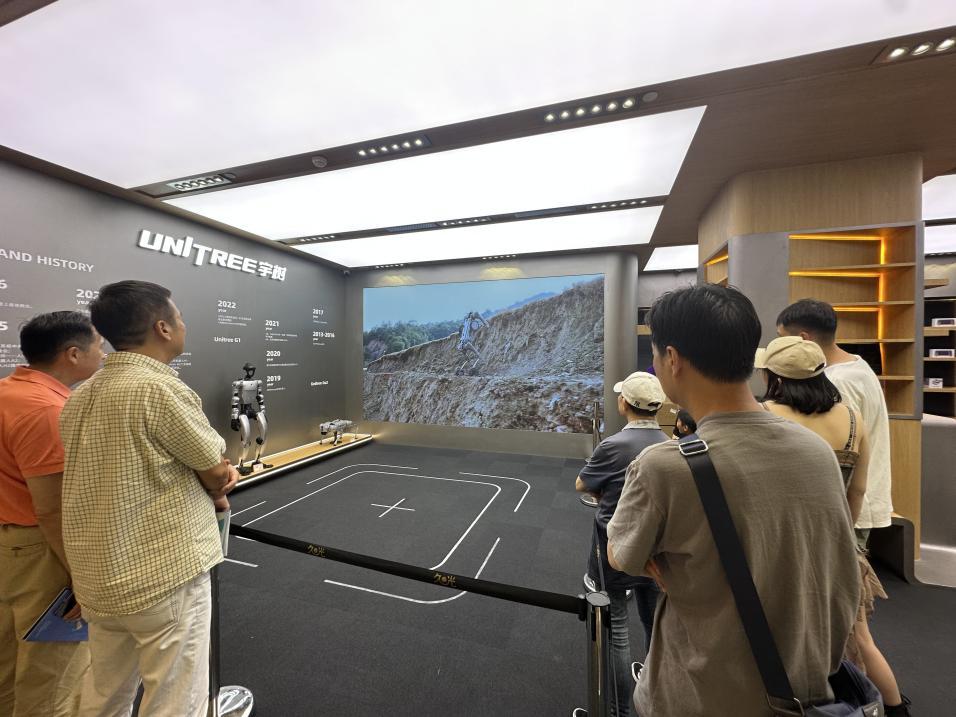
(The "Embodied Intelligence Experience Hall" of Unitree Technology, Photo source: Cailian Press reporter)
The "low prices" in the store are not accidental. According to Unitree Technology's prospectus for listing on the Science and Technology Innovation Board, the unit price of the company's humanoid robots dropped from 593,400 yuan in 2023 to 166,400 yuan in 2025, a cumulative price cut of more than 400,000 yuan in two years. The unit price of quadruped robots also gradually decreased from 38,300 yuan in 2023 to 30,300 yuan in 2025.
Meanwhile, the prices in the rental market have also dropped significantly.
A person from the third - party platform Qingtianzu told a reporter from Cailian Press that at the beginning of last year when robots became popular, the daily rental price of a 100,000 - yuan robot could reach 25,000 yuan, and the cost could be recovered in four days of rental. Now, with more industry players and increased robot production capacity, the prices have naturally dropped after becoming more transparent.
The reporter from Cailian Press also found on the Xianyu platform that the daily rental prices of many humanoid robots are now below 1,000 yuan.
Behind the price drop, many interviewees told the reporter that this is not caused by a single factor but is the result of the combined effects of multiple forces, such as the maturity of the supply chain, the convergence of designs, and market behaviors.
Cai Bingzhen told the reporter that the overall maturity of the supply chain is the primary reason. The standardization of configuration design has effectively reduced manufacturing costs. "After leading manufacturers gradually increase production volume, many components can be mass - produced using molds, and the standardization level of components will also be higher."
He Jun, the co - founder and CTO of Shanghai Spider - Man Robot Co., Ltd., also agrees with this view: "As each component matures and products move from small - scale to large - scale production, it will naturally lead to a price decline." At the same time, he also reminded that the hardware technology of current humanoid robots is not yet fully mature, the overall shipment volume is not large, and the actual cost - reduction effect brought by the supply chain is limited.
However, the cost reduction is not uniform.
Gao Fei (a pseudonym), a person from a domestic humanoid robot manufacturer, told a reporter from Cailian Press that currently, the prices of some general components at the hardware level, such as reducers, motors, some sensors, and the computing platform at the software level, have dropped significantly. Many of them benefit from the supply chains of new - energy vehicles and consumer electronics. What still remains at a high level is the "brain - related" capabilities, including high - quality data, embodied large - model training, real - scene data collection, and the ability of the software - hardware collaboration system.
"Because embodied intelligence is different from traditional hardware, the real difficulty lies in making the robot 'work like a human', which requires long - term data accumulation and model iteration." Gao Fei explained.
In addition to cost, the market behaviors actively taken by manufacturers are another major reason.
He Jun told a reporter from Cailian Press that the price drop of some humanoid robots is not entirely driven by cost. "Some of the price drops seen in the market are also the market behaviors actively taken by whole - machine manufacturers for purposes such as financing needs or opening up the market."
Cai Bingzhen also mentioned that currently, the technical threshold for scenarios such as entertainment and performance is relatively low. Many manufacturers are competing in these scenarios that are close to or have already been implemented in order to seize market share and pursue higher shipment volumes.
It is worth noting that the significant price drop of consumer - grade humanoid robots also means a trade - off in performance.
He Jun admitted that currently, consumer - grade robots priced at tens of thousands of yuan have relatively limited functions. Most of them can only perform some simple actions according to pre - set programs. "If you really buy them back for secondary development, they are actually not cheap. Generally, bipedal robots should cost more than 400,000 to 500,000 yuan."
The Threshold for 'Screwing' is High
As humanoid robots move towards implementation, different technological and price paths are emerging in the consumer and industrial markets.
Cai Bingzhen said that currently, the significant price drops are mainly concentrated in robots for home entertainment, guiding, and performance. Because the overall design architecture requirements for these scenarios are relatively more standardized, manufacturers do not need to conduct new R & D or open new molds, and there is no need to include components that are not relevant to the scenario. For example, they do not need redundant designs such as six - axis force sensors and tactile sensors.
He Jun also confirmed that the phenomenon of price drops does exist, but it mainly occurs in performance - and service - oriented robots in the consumer market, where competition is relatively fierce.
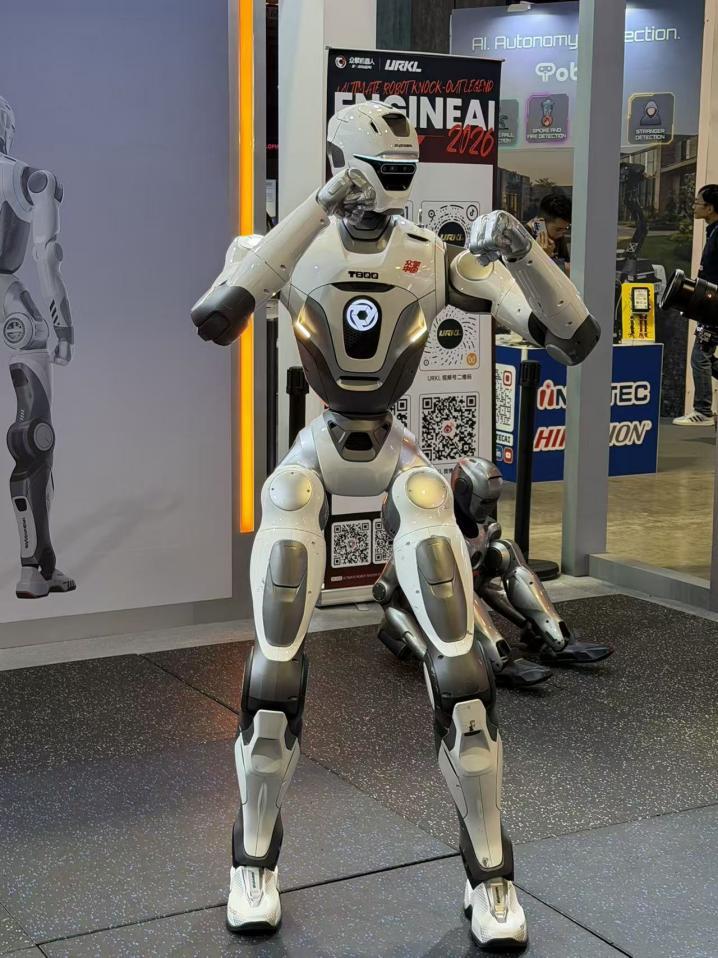
(A humanoid robot is performing, Photo source: Cailian Press reporter)
In contrast to the "price - cutting competition" of performance - oriented robots, there is no sign of a significant price drop for robots in industrial scenarios. According to data from GGII, the average price of industrial robots in 2025 decreased by only about 13% compared with 2024.
Recently, with the rise in the prices of upstream raw materials, many manufacturers have been forced to raise their prices.
At the beginning of this year, Inovance Technology (300124.SZ) issued a price - increase letter, stating that due to the increase in the prices of upstream bulk materials, memory, and other raw materials, the prices of its SCARA robots and multi - joint robots would increase by 5% to 15% starting in March. Recently, Efort Intelligent Equipment Co., Ltd. (688165.SH), a domestic industrial robot manufacturer, also issued a price - adjustment notice, stating that the continuous tension in the global supply chain has led to a significant increase in the costs of core components, raw materials, and logistics. The cost pressure has exceeded the scope that internal optimization can absorb, so it has decided to increase the prices of its full - range of spraying robots and related solutions by 5% - 8% starting from July 1, 2026.
The reason why industrial - grade products cannot follow this "price - cutting trend" lies in the completely different performance indicators for production lines.
Cai Bingzhen told a reporter from Cailian Press that industrial - grade products have higher requirements for performance such as force control, precision, and robustness, and the product lifespan needs to be relatively longer. This results in higher requirements for both hardware and software in industrial - grade products, and the R & D cycle will also be longer.
In addition to the hard constraints of hardware and software costs, the common "bipedal form" of performance - oriented humanoid robots also faces a rational trade - off in terms of engineering practicality when actually entering factories.
The essence of industrial - grade robots is to solve practical production pain points such as difficulties in recruiting workers, personnel management, and high social security costs. When enterprises introduce robots, the core consideration is the return on investment (ROI). However, on actual precision manufacturing production lines, materials, semiconductor chips, and other equipment are extremely expensive.
"Compared with wheeled robots, bipedal robots still have several major problems that have not been fully solved. One is stability, the second is cost, and the third is battery life," a person from Topstar (300607.SZ), an embodied - intelligence robot manufacturer, told a reporter from Cailian Press. In an industrial setting, once a bipedal robot loses power or malfunctions due to a bug, it is very likely to fall. Once it falls, it may damage the materials being transported or even the production - line equipment.
"So, after looking at dozens of suppliers, real industrial customers often choose wheeled robots," Topstar said. Wheeled robots effectively solve the problems of stability and safety. Even if there is a bug, they will just stop in place and will not damage the production line.
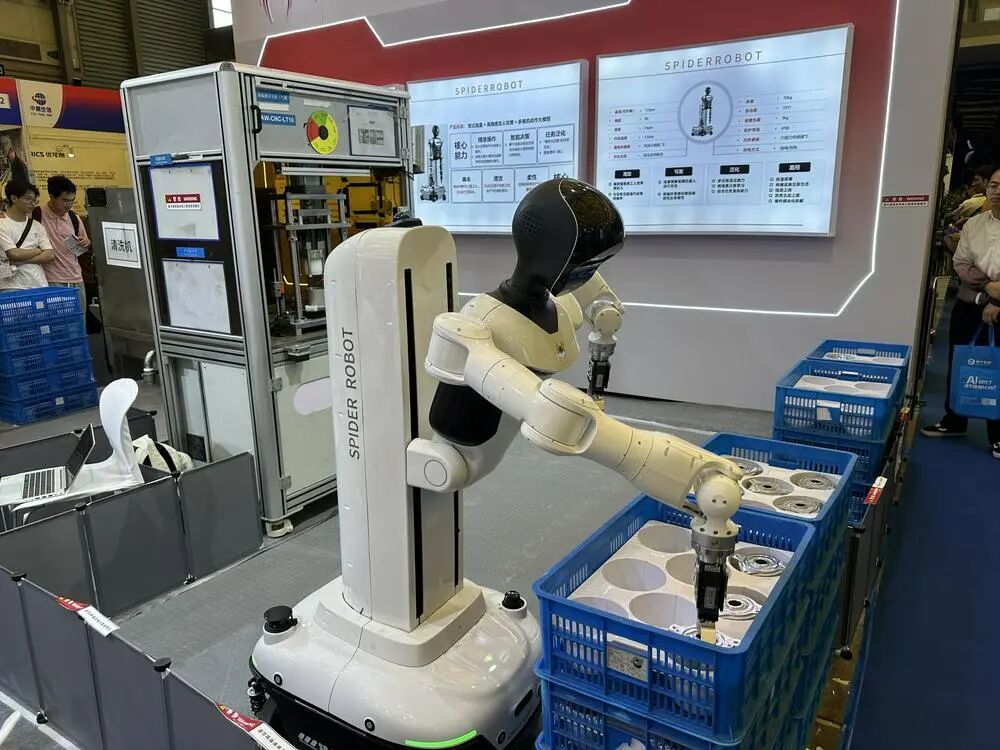
(The wheeled robot of Shanghai Spider - Man Robot Co., Ltd., Photo source: Cailian Press reporter)
This practical consideration of scenarios makes the embodied - intelligence form that does not adhere to a complete human form and chooses a more stable chassis the fastest - growing option in the industrial and warehousing - logistics sectors.
Data provided by Dai Fuquan, the chairman of Banshan Venture Capital, shows that currently, the industrial - manufacturing and warehousing - logistics scenarios, which are standardized, have controllable environments, and clear return on investment (ROI), are the most likely to achieve large - scale production, accounting for 45% of the total shipment volume.
These embodied - intelligence agents selected by industrial customers have already started to replace the positions in harsh environments that originally relied on human labor.
For example, Topstar's "Xiaotuo" has completed various tasks in the highly polluted injection - molding industry, Beijing Foton Cummins has deployed "Tianguang 2.0" for material - box handling, and SAIC - GM has introduced robots for live - working on the battery production line. These implementation cases have verified the task - oriented practical route in the industrial sector.
Yao Maoqing, a partner and senior vice - president of Zhiyuan Robot, recently emphasized in an interview with a reporter that after large - scale mass production and delivery, the core indicator that enterprises are most concerned about is not the price of the whole machine but the actual application of the robot on the customer side. The daily average usage time of a single robot, the registration and activation ratio, and the MTBF (Mean Time Between Failures) figure in industrial scenarios are the hard indicators to measure whether embodied intelligence can truly take root in industrial production lines.
Where to Go?
If 2025 was defined as the "year of mass production" for humanoid robots, then 2026 is regarded as the "year of large - scale implementation" and the "year of commercial verification" for the industry.
Through multiple interviews, the reporter learned that there are two major trends in the humanoid - robot track that are worth noting: one is that the proportion of first - tier market funds flowing to upstream core components has increased, and the other is that robot manufacturers are shifting from competing for order volume to emphasizing implementation.
In terms of investment, Dai Fuquan said that this year, the investment enthusiasm in the humanoid - robot field remains high, but it is shifting from "speculating on concepts and investing in whole machines" to "emphasizing implementation and investing in the supply chain and niche scenarios". Capital is more focused on certainty and cost - reduction capabilities.
He said that in 2025, the industry paid more attention to whole machines and algorithms