Microsoft CEO's Long Essay: There Will Be Two Types of Capital in the Future, Human Capital + Token Capital
Last night, Microsoft CEO Satya Nadella posted a long tweet on X titled "A frontier without an ecosystem is not stable", which means "A frontier without an ecosystem is unstable".
As soon as the tweet went live, it attracted a great deal of attention, and now its views have exceeded 28 million.
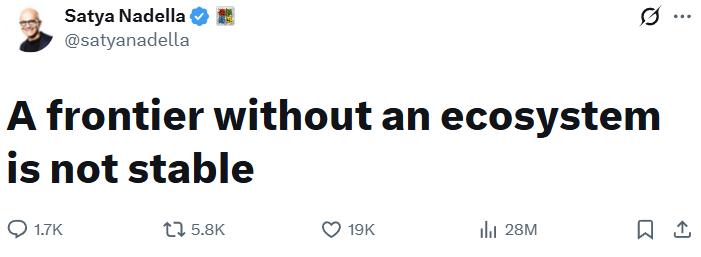
Original post link: https://x.com/satyanadella/status/2066182223213293753
Nadella deeply explored the future form of enterprises, digital sovereignty, and the socio - economic impact of AI development in the AI - driven economic era.
He put forward two concepts: "Human Capital" and "Token Capital".
In his view, AI is changing the underlying logic of enterprise competition. In the past, enterprises purchased or built digital tools to improve human efficiency: tools amplified humans, and humans created value. But today, "AI models themselves have the ability to absorb human professional knowledge and 'commercialize' it." After a model learns enough enterprise data, it can turn the unique skills of a company into standard services that everyone can access.
In this way, AI seems to have the ability to devour other software services. Or, as Nadella put it, "Every company in every industry is ceding value to a few all - consuming models."
This also made him very worried. He called in the article, "We must not let a few AI systems capture all the economic returns."
Interestingly, Elon Musk, the world's richest man who often mocks Microsoft, said with a sarcastic tone that this article was "interesting":
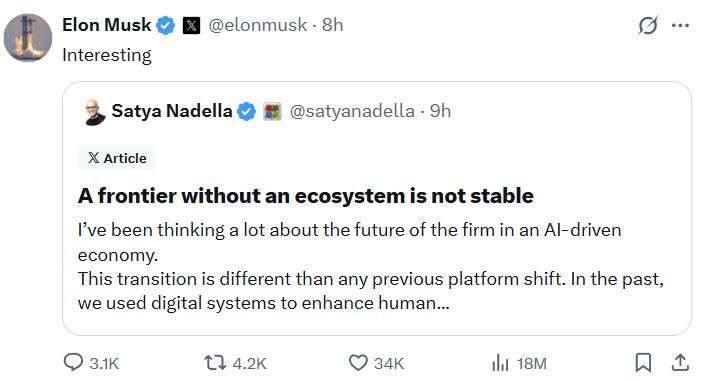
After all, this blog seems to prove Musk's comment last August that "OpenAI will swallow Microsoft alive."
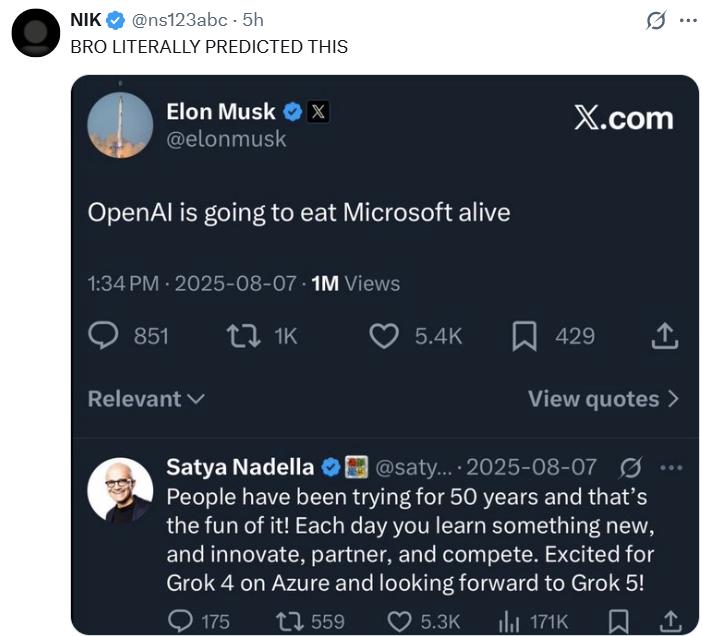
At that time, Nadella had just announced that GPT - 5 would be fully integrated into Microsoft's Copilot, GitHub, and Azure product lines. His response at that time was also light - hearted and confident: "People have been trying to eat us for 50 years. That's the fun of it!"
The implication of Musk's words is also obvious: Microsoft's proud software empire is handing over its moat to a partner. "In the field of AI, relying on others' models will sooner or later be replaced by others' models."
Today's tweet shows that Nadella no longer has the confidence he once had.
The following is the full translation of Nadella's tweet:
I've been thinking about the future of enterprises in an AI - driven economy.
This transformation is different from any previous platform change. In the past, we used digital systems to enhance human capital. This is the first time we've been able to establish a true cognitive loop between humans and digital systems. This is very mind - boggling because it changes the way we conceive work within enterprises.
The key issue goes beyond the use of certain digital tools or systems. We need to focus on how organizations can continuously learn, build intellectual property, maintain differentiation, and thrive in a world where AI models can continuously absorb the professional knowledge of humans and organizations and commercialize it.
Every company must build what I call "Human Capital" and "Token Capital":
"Human Capital" includes employees' knowledge, judgment, interpersonal relationships, creativity, and pattern recognition ability.
"Token Capital" represents the AI capabilities that a company builds and owns.
Importantly, the value of human capital does not decrease as token capital grows. It only becomes more valuable! I believe that human initiative will be the driving force for the growth of token capital. Humans will set ambitious goals, connect information across domains, build relationships, and identify the most critical patterns. Without human guidance, computing resources will just spin in place.
This means that the real opportunity doesn't lie in choosing the best model. "We should build a learning loop on top of the model, where human capital and token capital generate compound interest." You can outsource a task or even a job, but you can never outsource your learning process. The future of enterprises depends on the ability to accumulate this learning compound interest between humans and AI.
This requires a new architectural solution that allows every company to build an agent system that evolves over time while still maintaining control over its intellectual property. A company should be able to replace the "general" model while still retaining the "veteran - level" professional knowledge accumulated in its learning system. This will be a key "test" of your control and sovereignty in the future.
"Enterprises need to transform their workflows, domain knowledge, and accumulated judgment into AI systems that can improve with each use." Private evaluation systems should be able to capture whether the model is truly making progress on outcomes that are crucial to the enterprise (just looking at external benchmark tests is not enough!). Private reinforcement learning environments should make the model more powerful in the real execution trajectories within the organization. Its knowledge base makes institutional memory searchable and also makes the use of tokens more efficient.
"This loop will become the new intellectual property of the enterprise." I see it as a mountain - climbing machine. And unlike most assets, it has a compound - interest effect. Every improved workflow will generate better training signals, which will accelerate the accumulation of the enterprise's unique tacit knowledge. Companies that build this system early will have an advantage that is difficult to replicate, no matter what new capabilities individual models may have.
"We don't want to see a world where every company in every industry is ceding value to a few all - consuming models." Assuming that all the value is captured by a few models, the political - economic system will not tolerate such a situation. Society will not allow an AI future that empties an entire industry.
Recall what happened in the first stage of globalization when the entire industrial economy was hollowed out due to outsourcing. Although the GDP data looked good on the surface, the loss of jobs was real, and its consequences are still far - reaching. "We must not bring that dynamic into the AI era, allowing a few AI systems to capture all the economic returns while the entire industry watches their knowledge being commercialized unknowingly."
In my view, "Our top priority must be to build a frontier ecosystem." Just building a frontier model is far from enough. Only in this way can value flow widely among every company, every industry, and every country. In this ecosystem, every organization can have a learning loop that encodes its institutional knowledge and allows its human capital and token capital to generate compound interest.
This is the concept I followed during my growth: a platform should enable more value to be created on it than what it captures internally, allowing every company to continuously innovate and create its own value.
When this happens, enterprises will create value for themselves and the surrounding economy. Employees will see their professional knowledge amplified, and their judgment will become part of the system, becoming replicable and scalable. At the same time, the benefits will benefit the enterprises and communities around them.
This is how enterprises drive value for themselves and the broader economy. This is also the stable balance we should build together.
This article is from the WeChat official account "Machine Intelligence" (ID: almosthuman2014). The author is Machine Intelligence. It is published by 36Kr with authorization.