2026 Automotive Industry AI Information Source Influence Index Report
At present, the Chinese automotive market presents a new intelligent and electric pattern characterized by "new energy dominance and breakthroughs in high - end domestic brands". AI technology is deeply integrated into the entire process of users' car - buying decision - making. Generative enabling technology drives GEO to become a new paradigm for automotive marketing. Automobile manufacturers need to build a B2AI2C dual - mode marketing funnel during the marketing process. In the future, traditional marketing and AI marketing in the automotive industry will advance in tandem, and the focus of marketing will shift from "traffic purchase" to "information source construction". Automotive vertical media, with their professional authority and structured data advantages, will become the preferred information source platform for automotive manufacturers' AI marketing.
GEO Reinforces the New Infrastructure for Automotive Marketing
Intelligent and Electric Leadership: Reconstruction of the Automotive Industry's Competitive Landscape
The intelligent and electric drive reconstructs the automotive industry landscape. New energy vehicles are fully dominant, and domestic high - end brands have achieved breakthroughs. The market has entered a new stage of dual - wheel - driven development.
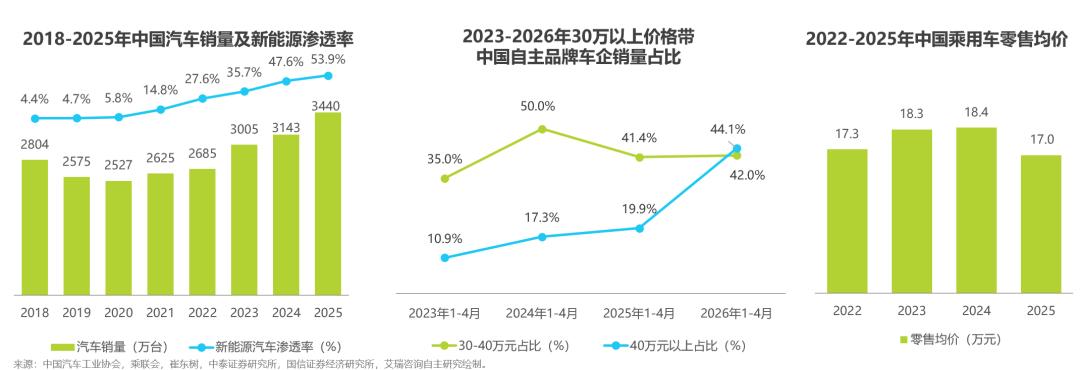
Market Overview: The era of full dominance of new energy vehicles has officially begun, and the market scale has reached a record high. After a deep adjustment, the Chinese automotive market has continued to recover. It is estimated that the sales volume will reach a new high of 34.4 million units in 2025. The penetration rate of new energy vehicles has exceeded 50% for the first time, marking that the Chinese automotive market has officially entered the stage of full - scale development led by new energy vehicles. The industrial transformation has shifted from "policy - driven" to "market - driven".
Brand Landscape: Domestic brands have achieved a historic breakthrough in high - end development. The market for vehicles priced above 400,000 yuan has witnessed explosive growth. In the price range of 300,000 - 400,000 yuan, domestic brands have established a solid market - leading position, breaking the long - term monopoly of joint - venture brands in this price range. This marks that Chinese automotive brands have successfully broken through the price ceiling of the traditional fuel - vehicle era and are competing head - on with international brands in the luxury car segment.
Price System: The prices first rose and then fell. The industry has entered a new stage of dual - wheel - driven development featuring "high - end breakthroughs and mass popularization". In 2025, the average retail price declined due to the large - scale production of new energy vehicles, cost reduction in the industrial chain, and intensified competition. The market has shifted to a dual - wheel - driven model of high - end breakthroughs and mass popularization.
Source: Desk research, independently researched and drawn by iResearch Institute.
AI Technology Drive: Transformation of the Entire Car - Buying Decision - Making Process
AI has become the main tool for users' auxiliary car - buying decision - making, deeply integrated into the entire process of consumption decision - making, and improving the efficiency of users' car - buying decision - making.
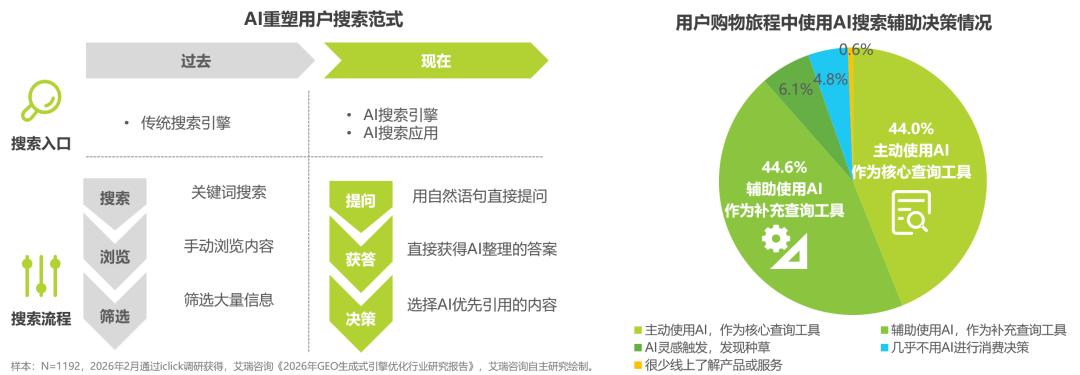
The user search paradigm has completed a generational upgrade, and the shopping decision - making process has been significantly shortened. The traditional linear process of "keyword search - manual browsing - massive screening" has undergone a transformation. At present, users are more inclined to directly ask questions in natural language through AI search engines/applications, obtain structured answers integrated by AI, and make decisions based on the content prioritized by AI. This transformation turns users from "information screeners" into "decision - makers", improving the efficiency of information acquisition and decision - making during the shopping journey.
AI has become the main tool for users' auxiliary shopping decision - making, deeply integrated into the entire process of users' consumption decision - making, and has become an important new marketing front. 88.6% of consumers use AI search for auxiliary decision - making before shopping. Among them, 44.0% of users use AI as the core query tool, and 44.6% use it as an important supplementary tool, especially for products with high technical thresholds and long user decision - making cycles.
Source: Brand official websites and financial reports, independently researched and drawn by iResearch Institute.
Generative Empowerment: GEO Becomes a New Paradigm for Automotive Marketing
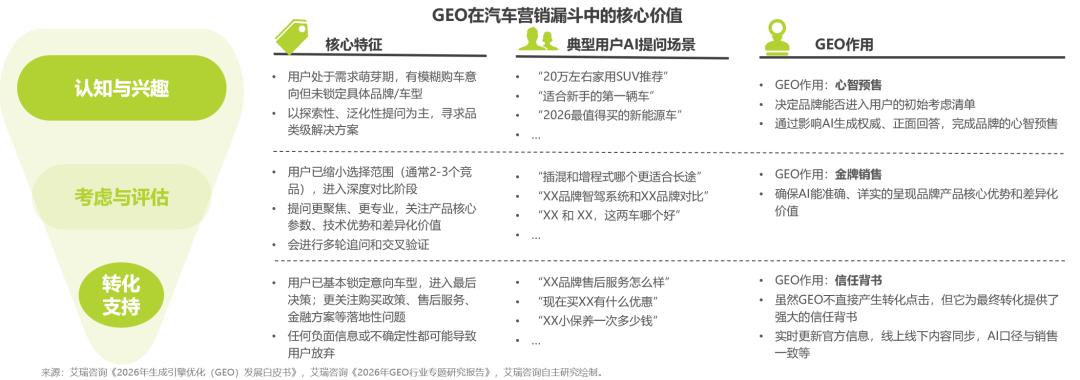
Automotive marketing is highly compatible with GEO. By constructing a B2AI2C dual - mode marketing funnel, automobile manufacturers can amplify the full - channel marketing effect with the help of GEO.
Automobiles are products with high technical thresholds, long decision - making cycles, and high unit prices, which are perfectly compatible with the GEO marketing logic. The high information complexity corresponds to GEO's semantic understanding and structured content productivity. It can transform complex technical parameters into structured knowledge that AI can easily understand and users can perceive.
In the AI era, automotive marketing has evolved from the traditional linear funnel of "exposure - click - store visit" to a "B2AI2C" dual - funnel model: Brands first influence AI's cognition and responses through GEO, and then AI, as a "super information assistant", reaches and converts users. GEO runs through the entire car - buying cycle of users. As the "basic layer", it undertakes and amplifies the effects of all marketing channels such as advertising, social media, and offline activities. The core is to change the brand from being "passively searched" to being "actively recommended by AI".
The Underlying Logic of GEO: Information Source Selection
The Underlying Transformation of Information Distribution in the GEO Era
GEO reconstructs the information distribution model, changing from the past "people searching for information" to the current "AI providing answers". The core of marketing has shifted from "traffic entry" to "AI information source".
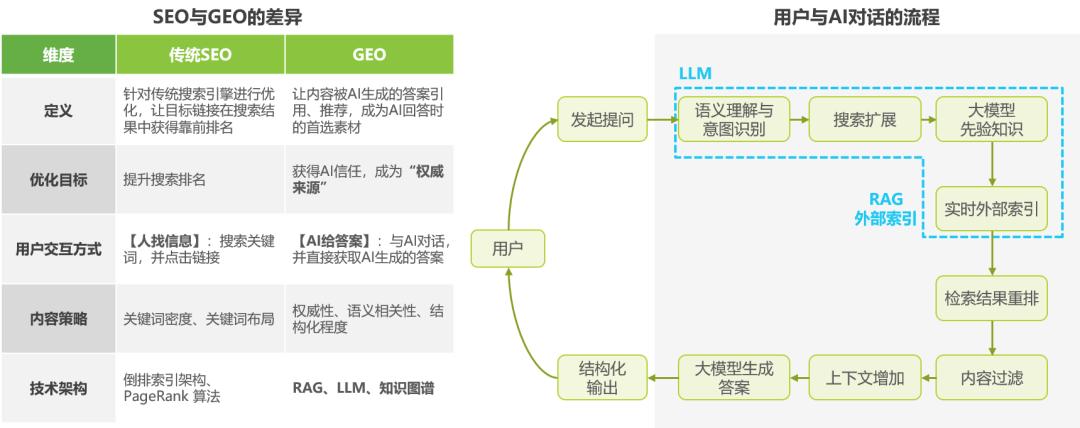
In the AI era, the marketing paradigm has undergone a fundamental transformation. It has been upgraded from the traditional SEO's "people searching for information" (users search for keywords and click on links) to GEO's "AI providing answers" (AI integrates information and directly outputs it to users). The core goal of GEO is to gain the trust of AI and become its preferred reference information source, so that brand information appears in the answers generated by AI. The working process of AI determines the optimization logic of GEO. Based on the generative AI architecture of "LLM semantic understanding + RAG real - time external retrieval", it will preferentially select content with high authority, semantic relevance, and structure for reference, rather than the keyword density and the number of external links that traditional SEO values.
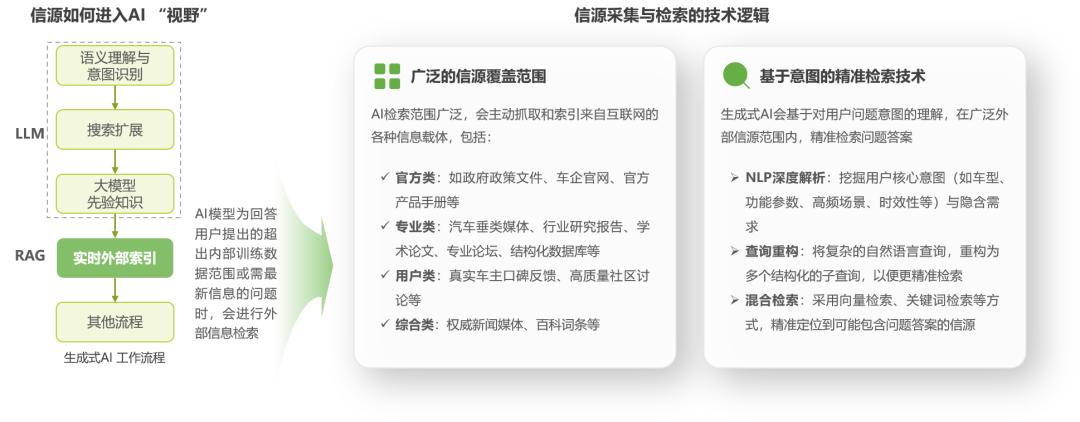
How AI "Searches for Information": Collection and Retrieval of Information Sources
Generative AI relies on the RAG architecture to retrieve information sources within a wide - ranging scope and accurately locate information sources based on intent.
The retrieval scope of AI is extensive, including official information sources such as government documents and automobile manufacturers' official websites, professional information sources such as vertical media and industry reports, user information sources such as real - car owners' discussions and feedback, and comprehensive information sources such as authoritative news and encyclopedias.
AI analyzes users' intentions through NLP and accurately and efficiently locates information sources related to the questions through query reconstruction and multi - method retrieval.
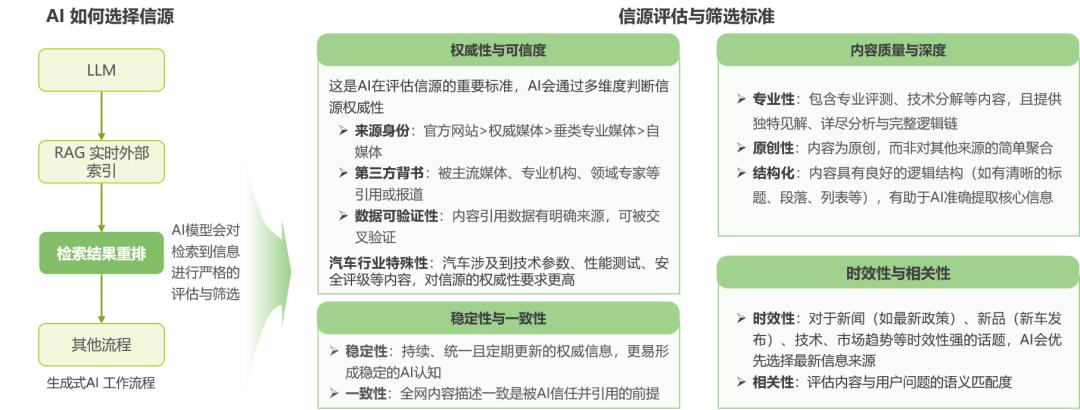
How AI "Selects Information": Evaluation and Screening of Information Sources
AI screens information sources by evaluating the authority of information sources, the relevance of information source content to questions, and the timeliness of content.
The authority of information sources is an important criterion for AI evaluation. AI mainly judges the authority of information sources through dimensions such as whether the information source is an official/authoritative/professional media, whether it has the endorsement of third - parties such as mainstream media, and whether the data is verifiable. In addition, AI also screens information sources by evaluating the relevance of information source content to questions, the depth of content quality, the timeliness of content, and the stability of information sources.
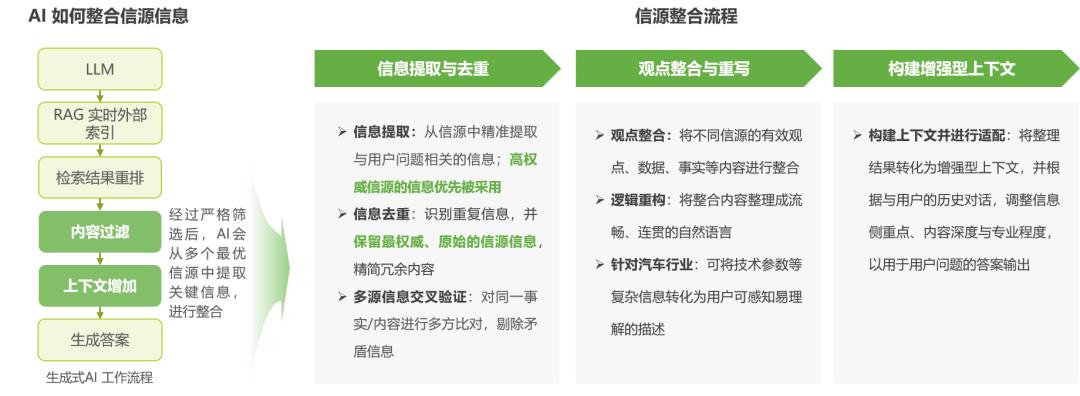
How AI "Uses Information": Integration and Synthesis of Information Sources
AI integrates and processes the content of the screened information sources, transforming multi - source information fragments into structured context; content from high - authority information sources is preferentially adopted by AI.
AI extracts content related to the questions from the screened information sources, removes duplicates and conducts multi - source verification. Information from high - authority information sources is preferentially adopted. AI integrates effective information for logical reconstruction, organizes it into fluent natural language, and transforms it into an appropriate enhanced context for answer output.
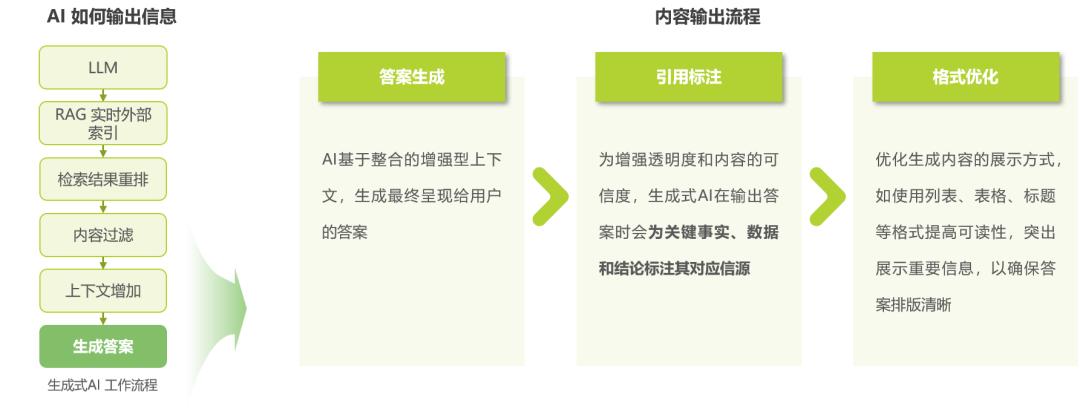
How AI "Outputs Information": Content Generation and Citation
AI generates answers based on the integrated context, marks the cited information sources to enhance transparency and credibility, and finally outputs the generated content with optimized typesetting.
Generative AI adopts a hybrid architecture of "LLM prior knowledge + RAG real - time external retrieval". All answers are based on the integration and paraphrasing of reliable information sources, which fundamentally reduces the risk of hallucination. AI will automatically mark the corresponding information sources for key facts and data. Authoritative information sources can not only be preferentially cited but also gain the trust endorsement of AI, which is particularly important for industries with high user purchase - decision costs. The workflow of AI content output fundamentally reconstructs the information dissemination logic. The authority and structured degree of information sources have surpassed traditional keyword rankings and become the core factors determining the brand's AI exposure and user recognition.
From "Traffic" to "Information Source", the Automotive Marketing Paradigm is Changing
Automobile manufacturers need to pay attention to the citation situation of AI information sources in the future and optimize the performance of information sources across the platform.
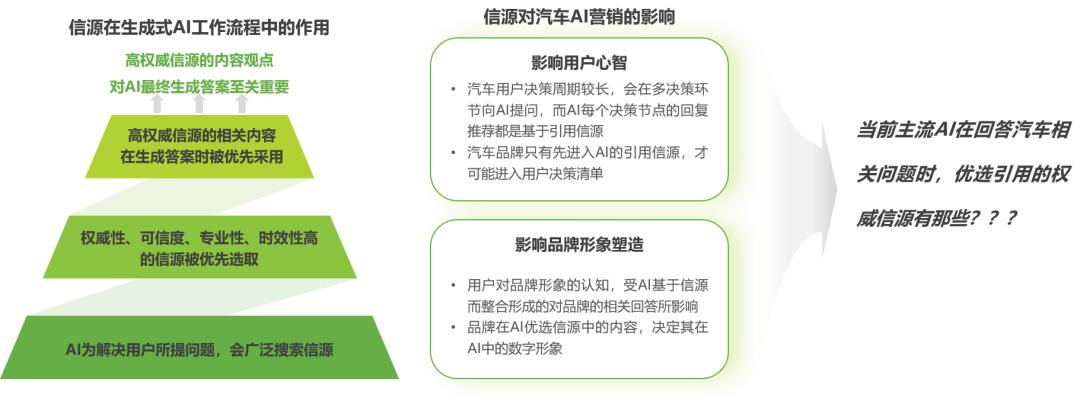
User Side: The decision - making cycle of automotive users is long, involving multiple links such as model comparison and after - sales consultation. Users will ask questions to AI at each decision - making node, and AI's responses highly depend on the cited information sources. Therefore, only when brand content enters AI's "cited information source pool" can it enter users' decision - making lists and directly affect the car - buying decision - making path.
Automobile Manufacturer Side: In the future, users' perception of automotive brands will be affected by the content output by AI based on the integration of multiple information sources. The quality of the content of automobile manufacturers' brands in AI's preferred information sources (such as technical analysis and service concepts) directly determines their image in the AI ecosystem, which in turn affects the brand's favorability and market competitiveness.
Evaluation of Information Source Citation in the Automotive Industry for AI Large - Scale Models
Methodology for Evaluating Information Source Citation: Evaluation Method and Magnitude of Evaluation Data
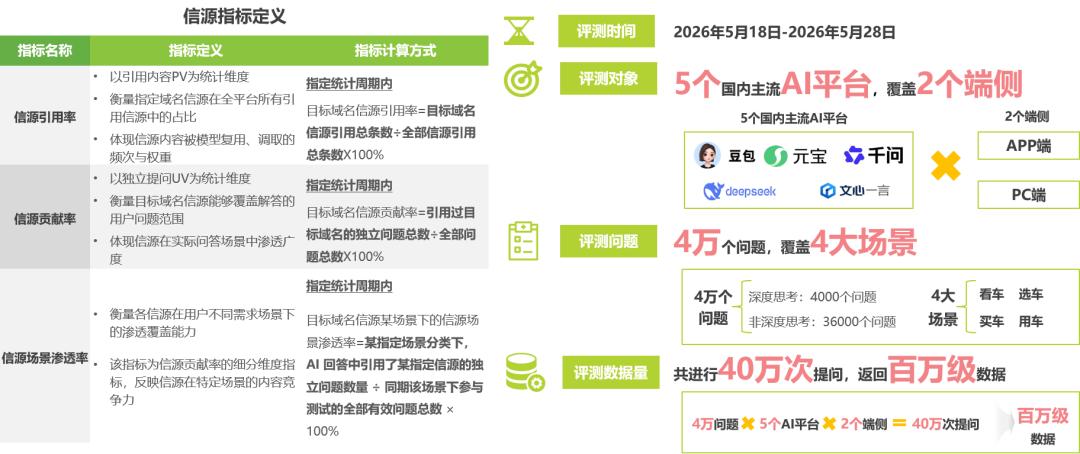
This evaluation constructs a scientific evaluation system centered on a "real question library + full - process human - machine simulation", strictly following the two core principles of authenticity and full coverage. Analysis is based on millions of full - scale evaluation data to ensure the authenticity, comprehensiveness, objectivity, and fairness of the evaluation results.
Overall Ranking of AI Information Source Influence Index in the Automotive Industry
Automotive vertical media dominate the AI information sources with their professional and complete content systems and perform excellently in various indicators. Among them, Autohome leads comprehensively.
Overall Landscape: 1. Automotive vertical media occupy a dominant position in AI automotive information sources with their structured vehicle data, professional evaluation content, real user reviews, complete price system, and comprehensive dealer information, and the concentration is relatively high. 2. Comprehensive information and short - video platforms have prominent traffic capabilities but lack in - depth professional knowledge and content systems in the automotive industry. These platforms mainly focus on automotive content distribution and play an auxiliary and supplementary role in AI information sources.
Sub - platforms: 1. Autohome leads comprehensively, ranking first in the three core dimensions of information source citation rate, contribution rate, and full - scenario penetration rate, with outstanding comprehensive content capabilities in the industry. 2. Pacauto