Tungsten Retreats, Molybdenum Advances — An Inevitable Trend?
Recently, according to a report by South Korean media The Elec, SK Hynix has successfully completed the production verification of its next - generation V10 series 375 - layer 3D NAND flash memory and plans to start mass - producing it at its M15 factory in Cheongju, South Korea by the end of this year.
This product was initially referred to as the "400 - layer" NAND flash memory within SK Hynix. However, due to the technical challenges posed by the ultra - high - layer stacking process, especially the exponentially increasing difficulty of key processes such as channel hole etching, the actual number of mass - produced layers was ultimately revised down to 375.
However, compared with the minor adjustment of the number of layers, the real key change that has caught the industry's attention lies in a detail: This 375 - layer NAND flash memory has introduced molybdenum (Mo) into the word - line metal gate for the first time, replacing the tungsten (W) thin film that has been used for more than a decade.
However, SK Hynix's technological shift is not an isolated case.
Before this, storage giants such as Samsung Electronics and Micron had already laid out products using molybdenum materials. Lam Research, the global leader in semiconductor equipment, has also clearly stated that the technological switch from tungsten to molybdenum is the only viable path for the evolution of high - layer 3D NAND.
As industry giants successively shift from tungsten to molybdenum, the industry is sending a clear signal: The tungsten material system that has been used in the storage chip industry for more than a decade has reached an inflection point of replacement. Molybdenum has emerged as the core key material to support the implementation of ultra - high - stacked NAND flash memory with over 300 layers.
In this semiconductor material revolution, why are global storage giants collectively turning to molybdenum? What irreplaceable advantages does molybdenum have compared with the established conductive metal tungsten? How will this material replacement storm reshape the semiconductor material industry chain and rewrite the global industry competition pattern?
Why Replace Tungsten with Molybdenum?
To understand the reason for "replacing tungsten with molybdenum", we first need to understand the technological evolution logic of 3D NAND.
As is well - known, 3D NAND flash memory increases its capacity by vertically stacking storage units. As the number of layers increases, the number of word lines passing through each layer also surges synchronously, and the line width of the word lines is continuously compressed to the limit size at the nanometer level. The word line is the core circuit that connects the control gates of storage units and is responsible for selecting and operating specific rows of memory units. Its material performance directly determines the signal transmission efficiency and storage density of the chip.
Looking back at the evolution history of word - line materials: The early solution was polysilicon. Due to its relatively high resistance, the mainstream solution shifted to metal tungsten with lower resistivity starting from the 64 - layer and 96 - layer products. At that time, tungsten was a victory at the material level, supporting the golden era of 3D NAND's transition from two - digit to three - digit layers.
However, when the number of layers exceeds the 300 - layer mark, the structural defects of traditional tungsten materials, such as high resistivity, the occupation of conductive space by the barrier layer, and potential long - term reliability issues, are fully exposed.
Therefore, in today's era of over 300 layers, tungsten has completely reached its physical and technological ceiling in high - layer NAND, and the dividends of this generation of materials have been exhausted.
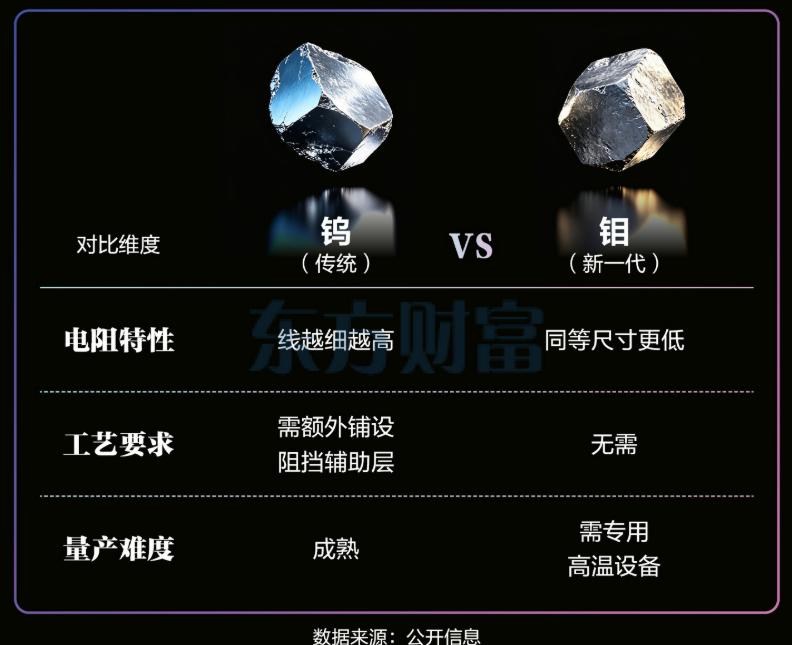
Image source: Orient Fortune
Tungsten Reaches Its Limit, Molybdenum Rises, Triggering a New Round of Material Competition
Meanwhile, molybdenum, which has long existed as an auxiliary material such as sputtering targets and photolithography masks in the semiconductor field, has been a niche metal with extremely low industry attention. Now, with its unique physical and chemical properties, molybdenum is making a comeback from an edge auxiliary material to the core functional material of high - layer storage chips.
It is understood that molybdenum is a refractory metal with a density about half that of tungsten and a melting point as high as about 2623°C. It has a low thermal expansion coefficient and excellent thermal conductivity. These properties make it naturally suitable for the chip manufacturing environment with high density, high heat, and high reliability, and it has been widely used in fields such as metallurgy, special alloys, and photovoltaics. In the semiconductor industry, it has undergone a complete transformation from an edge auxiliary material to a core functional material.
From the perspective of basic physical parameters, both molybdenum and tungsten are highly conductive and high - melting - point metals. The difference in their bulk resistivity is extremely small. Tungsten has a resistivity of about 5.28μΩ·cm, and molybdenum has a resistivity of about 5.34μΩ·cm. Their macroscopic conductive abilities are almost the same. However, at the nanoscale - in the micro - structures of chips such as 3D NAND gates and contact holes - the performance gap between the two is sharply magnified, which is also the core reason for high - layer flash memory to choose molybdenum.
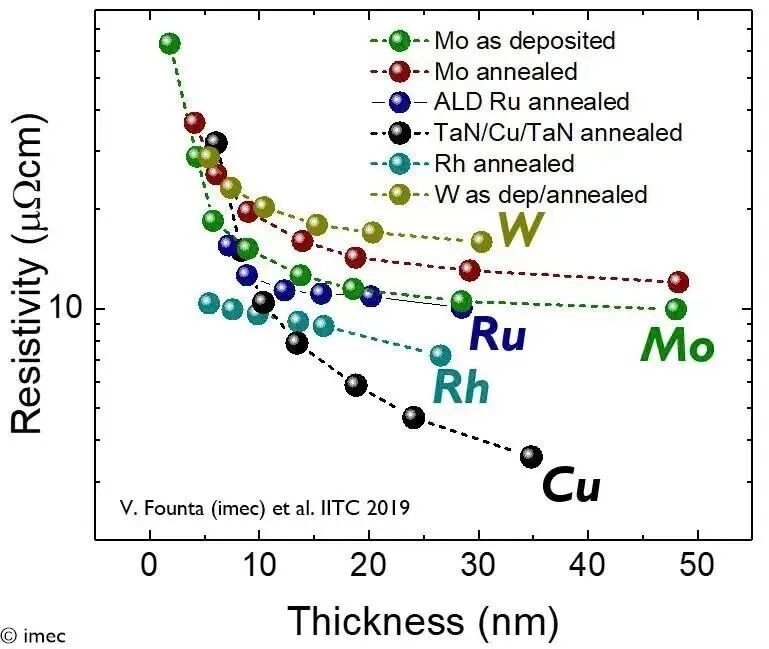
Resistivity of different metals at different thicknesses (Image source: imec)
In the micro - scaled chip structure, the resistivity of tungsten will rise sharply as the line width decreases and the aspect ratio of the structure increases, leading to signal delay, increased chip power consumption, and intensified heat generation. In contrast, molybdenum has a shorter electron mean free path. At the nanoscale, the increase in its resistivity is only about 60% of that of tungsten, and it can maintain stable conductive performance for a long time.
At the same time, as a gate material, tungsten must be paired with TiN (titanium nitride) as a barrier layer to prevent metal diffusion and leakage. This auxiliary layer will continuously occupy the stacking space. In high - stacking architectures such as 375 - layer and 400 - layer, the additional barrier layer added to each layer will continuously squeeze the stacking space, cumulatively occupying 30% - 40% of the effective structure thickness, directly limiting the upper limit of storage density improvement. Molybdenum, on the other hand, does not require an additional barrier layer due to its excellent interface stability. This means that under the same line - width condition, the effective conductive cross - section of the molybdenum word line is significantly larger than that of the tungsten word line, and the improvement in equivalent conductive performance is much higher than the impact brought by the simple resistivity comparison data. In the multi - layer stacking structure, a large amount of vertical physical space can be directly saved, leaving room for the improvement of storage density.
In addition, the difference between the two is also significant in terms of process compatibility. Traditional tungsten metal is mainly formed into a film by the CVD (Chemical Vapor Deposition) process. Facing the high - aspect - ratio pore structures with an aspect ratio of over 40:1 in 3D NAND, CVD filling is prone to defects such as voids and uneven films, directly reducing the product yield. In contrast, molybdenum is perfectly compatible with the ALD (Atomic Layer Deposition) technology, which is the mainstream of current advanced processes. It has strong filling uniformity, higher flatness and fit of the film, and can perfectly meet the manufacturing requirements of ultra - high - stacking architectures. Moreover, molybdenum has stronger adhesion to insulating media such as silicon dioxide and better electromigration resistance, which can effectively reduce the failure risk of chips during long - term use and greatly improve product reliability.
Looking at the application process of molybdenum materials in the semiconductor industry, its development can be roughly divided into three stages:
- In the early stage, molybdenum only existed as an auxiliary material, mainly used in non - core links such as semiconductor sputtering targets, photolithography mask substrates, and packaging heat - dissipation components. The market volume was limited, and the industry attention was relatively low.
- As the ALD deposition process and high - purity metal purification technology gradually matured and the commercial mass production of molybdenum precursors was achieved, molybdenum began to enter scenarios such as contact holes in logic chips and TSV (Through - Silicon Via) in advanced packaging on a small scale, completing the transformation from an auxiliary material to a functional material.
- The real explosion point was the era when 3D NAND moved towards ultra - high stacking of over 300 layers. Traditional tungsten materials reached their physical limits, and molybdenum took over as the preferred solution for word - line metal gates, officially entering the ranks of core semiconductor materials.
A wave of semiconductor material iteration led by molybdenum has already begun, which will not only reshape the technological evolution path of 3D NAND but also is expected to reshape the global semiconductor material industry chain pattern in the future.
Beyond NAND, Molybdenum Opens Up Incremental Space in Multiple Semiconductor Scenarios
NAND is a Definite Explosive Track
As mentioned above, NAND is currently the largest and most certain application market for molybdenum materials. As storage giants successively introduce molybdenum, the demand for molybdenum is increasing rapidly.
According to industry estimates, Samsung's procurement volume of molybdenum materials was about 4 tons last year and is expected to increase to 10 tons this year. According to the continuous advancement of its technology roadmap, it is expected to reach 80 tons by 2030. SK Hynix will start large - scale introduction of the molybdenum process next year, with an initial annual demand of about 4 tons. It should be noted that the above - mentioned procurement volume is only the direct usage in the word - line process. If considering larger - scale applications such as targets, the actual demand is more than that.
DRAM: The Outline of the Next Incremental Market is Emerging
The application prospect of molybdenum materials in the DRAM field is also worthy of high attention. In fact, molybdenum precursor suppliers in the NAND field have already laid out relevant production equipment, and it is highly likely that DRAM will follow suit and introduce molybdenum materials.
The application of molybdenum in the HBM (High - Bandwidth Memory) field is particularly noteworthy. HBM increases bandwidth by vertically stacking DRAM layers, with the number of layers reaching 8 to 12, and the HBM4 specification is even higher. In such a high - density stacking scenario, the shortcomings of tungsten, such as high resistance, fluorine residue, and difficult filling, are extremely magnified.
In contrast, molybdenum has a resistivity 30% - 40% lower than that of tungsten, does not require a TiN barrier layer, and can reduce the contact resistance by about 56%, resulting in a higher yield. According to market information, the consumption of molybdenum targets for a single HBM is about 3 to 5 times that of ordinary DRAM, and the penetration rate of molybdenum in HBM4 is close to 100%. As Samsung, SK Hynix, and Micron fully switch to molybdenum word lines in their HBM3e/HBM4 products, the demand for molybdenum in the DRAM field is rapidly catching up with that in the NAND field.
Long - Term Imagination Space for Logic Chips
From NAND to DRAM and then to logic chips, the application path of molybdenum in the semiconductor field is forming a clear conduction context.
In the field of logic chips, molybdenum is being actively explored as a substitute for copper interconnection. In advanced processes below 10nm, copper interconnection faces the dilemma of exponentially increasing resistivity due to surface scattering and grain - boundary scattering. In contrast, molybdenum has a much shorter electron mean free path than copper, and is less affected by the size effect at the nanoscale. Other studies have pointed out that the performance of molybdenum and ruthenium in a specific structure is better than that of traditional solutions.
The industry expects that logic chips will gradually adopt the molybdenum interconnection solution in the next two to three years, which will push the market space of molybdenum from a niche application to a comprehensive transformation of semiconductor materials.
From an investment logic perspective, the NAND track is currently the most certain opportunity window - the technology roadmaps of storage giants are clear, the demand for molybdenum is growing exponentially, and the process of domestic molybdenum target enterprises entering the supply chains of storage giants is accelerating, with broad space for domestic substitution. In the medium term, the penetration rate of molybdenum in the DRAM and HBM fields is rapidly increasing, which will become the next important demand - driving pole. In the long term, the transformation of the interconnection solution for logic chips will open up greater imagination space for molybdenum.
Global Players are Competing for Market Share, and the Value of the Industry Chain is being Re - evaluated
As "replacing tungsten with molybdenum" becomes an industry trend, the technology roadmaps and product iteration rhythms of global storage manufacturers have begun to diverge, and the upstream supporting industry chains such as materials, equipment, and consumables have also welcomed a brand - new market increment and competition pattern.
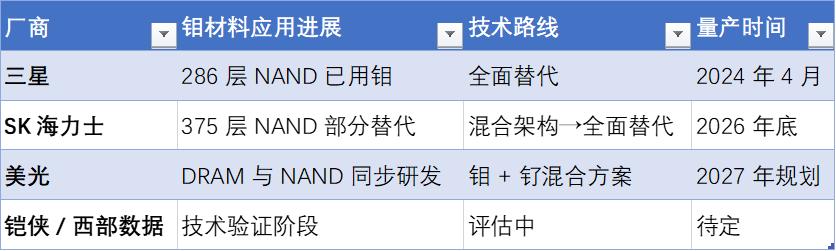
First, looking at storage manufacturers, Samsung's technology roadmap is quite clear: It started to introduce molybdenum into the metal wiring process in its ninth - generation 286 - layer 3D NAND mass - produced in April 2024. The tenth - generation products with over 400 layers will be launched in the second half of this year, and the application scope of molybdenum materials will continue to expand. SK Hynix is following closely behind. Its 375 - layer products are scheduled for mass production at the end of this year, and 480 - layer and 604 - layer products will be launched successively, which means that the penetration rate of molybdenum materials in the NAND field will continue to increase.
Micron is deploying the application of molybdenum materials in both the NAND and DRAM fields, exploring a composite metal technology roadmap to capture the advanced - process market in a differentiated way. In contrast, Kioxia and Western Digital are relatively conservative and are currently in the technology verification stage, with no clear mass - production plan.
Compiled by Semiconductor Industry Observer
Extending to the upstream industry chain, this material revolution is driving the value re - evaluation of the entire semiconductor supply chain.
In SK Hynix's supply chain system, Air Liquide (France), Entegris (USA), and Merck (Germany) have been identified as the main suppliers. South Korean local enterprise SK Specialty is also actively entering the market, and the two parties are discussing a plan for it to build supply capacity by borrowing Air Liquide's distribution infrastructure.
In terms of equipment, according to the report of Science and Technology Innovation Board Daily, after evaluating the equipment of Lam Research and Tokyo Electron (TEL), SK Hynix finally chose TEL's equipment. Lam Research's equipment uses a single - wafer processing method, processing wafers one by one. Tokyo Electron's furnace - type equipment can complete the deposition of about 100 wafers at one time, which is more cost - effective in terms of equipment procurement cost, site occupation, and molybdenum material consumption. Samsung chose Lam Research's deposition equipment to process molybdenum materials.
At the same time, in the target material field, the demand for high - purity molybdenum raw materials and semiconductor molybdenum targets has exploded. As the number of 3D NAND layers continues to increase and the application scenarios continue to expand, the global semiconductor - grade molybdenum material market size is expected to expand by more than 4 times from 2026 to 2028. Data shows that the global