Raised 1.35 billion yuan in financing with a valuation of 6.8 billion yuan, the US factory is starting to panic
The U.S. manufacturing industry is not short of slogans about revival, but what it lacks are tools that can truly be introduced into workshops.
Standard Bots, a company that makes industrial robotic arms, has just received $200 million (approximately RMB 1.35 billion) in Series C financing, with a valuation of $1 billion (approximately RMB 6.8 billion).
Industrial robotic arms are traditional products. The core product of Standard Bots is an AI-native industrial robot designed for factory scenarios, which takes the form of a robotic arm.
The capital behind the $200 million is betting on industrial robots after AI transformation.
01 Enable Foolproof Deployment of Industrial Robots
Standard Bots is headquartered in Glen Cove, New York. The core product of this company is an AI-native industrial robot designed for factory scenarios.
The so - called AI-native does not simply add an AI interface to traditional robots, but changes the way robots are used from the product logic:
In the past, for a factory to make a robot work, engineers usually had to write programs, adjust parameters, make fixtures, and conduct repeated tests. What Standard Bots wants to do is to allow workers to demonstrate actions to the robot like teaching a new employee, and then the robot learns tasks through vision, sensors, and models.
AI-native targets the biggest obstacle to the popularization of industrial robots.
Traditional industrial robots are not new. In automobile factories, processes such as welding, painting, and handling have long been highly automated. The real challenge lies in the "ordinary manufacturing industries" outside the automobile industry: metal processing plants, small parts factories, food packaging plants, fitness equipment factories, medical device factories, and mechanical processing plants run by families for decades.
They also want to automate, but their product batches are small, the processes change frequently, and the on - site environment is not standardized. Buying a robot is just the beginning, and there are still a whole set of costs for integration, programming, maintenance, and line change later.
The reality faced by many small and medium - sized factories is that although the price of the robot body may have come down, the cost of "using" the robot is still high. It may take several months from project evaluation to deployment, and when changing to a new product model, it has to be re - debugged. For large factories, this is an investment in automation; for small and medium - sized factories, it may be a risky venture.
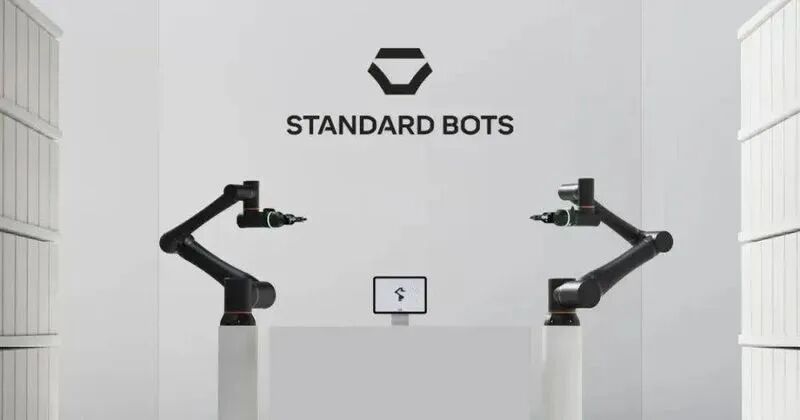
Standard Bots RO1 industrial robotic arm. Source: Public information
Standard Bots is precisely targeting this threshold.
Its robots can be deployed through tablets, templates, vision systems, and demonstration - based learning, reducing the dependence on professional robot programmers.
Standard Bots hopes that through AI, robots will no longer be expensive automation systems for large factories, but more like electric drills, forklifts, and CNC machine tools, which are production tools that ordinary factories can purchase, deploy, and reuse. It aims to enable small factories without robot experts to dare to buy, use, and continuously invest in robots.
It is betting on whether industrial robots can, like SaaS, cloud computing, and CNC machine tools, gradually penetrate from being exclusive to a few large enterprises to a wider range of manufacturing sites.
02 The Great Opportunity for the Reshoring of U.S. Manufacturing
There is a larger industry background behind Standard Bots' $1 billion valuation: the United States is re - understanding the manufacturing industry.
In the past few decades, the most dazzling wealth creation in the U.S. technology industry has occurred in software, the Internet, chip design, cloud computing, and AI model layers. The manufacturing process has been continuously transferred overseas. After the concentrated outbreak of supply - chain shocks, geopolitical conflicts, tariff changes, and national security concerns, the United States has re - emphasized the reshoring of manufacturing, but soon encountered a real problem: factories can be moved back, but there are not enough skilled workers, and the cost cannot be reduced.
This has pushed automation to the forefront.
From a global data perspective, the United States is still an important market for industrial robots, but the gap with China is very obvious. According to IFR data, in 2024, the number of newly installed industrial robots globally was approximately 542,000, which has remained above 500,000 for many consecutive years. In that year, China installed approximately 295,000 units, accounting for 54% of the global total; the United States installed approximately 34,200 units, accounting for 6% of the global total. That is to say, the number of newly added industrial robots in China in a year is about eight or nine times that of the United States.
Behind this gap is not only the larger scale of China's manufacturing industry but also the difference in the speed of automation deployment.
China's industrial robot market has been mainly driven by industries such as automobiles, electronics, new energy, photovoltaics, and lithium batteries in the past. Especially in the new - energy vehicle, consumer electronics, and battery industrial chains, automation has become a basic condition for capacity expansion. Many factories are not discussing whether to use robots but rather discussing robot density, production - line rhythm, yield rate, and flexible switching.
The U.S. manufacturing industry faces a different structure: on the one hand, it has high - value industries such as aerospace, national defense, semiconductor equipment, medical devices, energy, and precision manufacturing; on the other hand, a large number of small and medium - sized manufacturing enterprises still lack cost - effective and easy - to - use automation solutions.
Standard Bots' opportunity is not simply to replace traditional industrial robot giants but to expand the robot market itself.
If robot deployment continues to rely on a small number of professional engineers, complex integrators, and long - cycle projects, its penetration speed will be limited. Conversely, if robots can be deployed more cheaply, more quickly, and more easily retrained, many tasks that were not worth automating in the past will be re - evaluated.
This demand diffusion is also occurring in the North American market. According to A3 data, in 2025, the number of robot orders in North America reached 36,766 units, with an amount of $2.25 billion. The order volume increased by 6.6% year - on - year, and the amount increased by 10.1% year - on - year. More importantly, robot demand is no longer only driven by the automobile industry, and general industries such as food, consumer goods, electronics, and life sciences are becoming sources of growth.
This is the underlying foundation for Standard Bots to tell its story.
The company says its customers include Sunoco, Lockheed Martin, Amazon, NASA, the U.S. Army, and hundreds of small and medium - sized manufacturing enterprises. This customer portfolio is very representative: on one end are national defense, aerospace, energy, and large technology companies, emphasizing reliability and strategic significance; on the other end are ordinary manufacturers, emphasizing ease of use and return on investment.
The former helps it build brand credibility, and the latter determines whether it can truly become a large - scale company.
If it only serves a few large customers, Standard Bots is more like a project - based robot company; if it can standardize and modularize its products and sell them to hundreds and thousands of small and medium - sized factories, it may become part of the U.S. industrial automation infrastructure.
03 Factory Data Is the Biggest Obstacle
What Standard Bots really wants to accumulate may not be the profit from robot hardware but real - world factory data.
Standard Bots CEO Evan Beard mentioned in the financing announcement that the fastest way to achieve full autonomy is to deploy robots, collect real - world data, and iterate quickly.
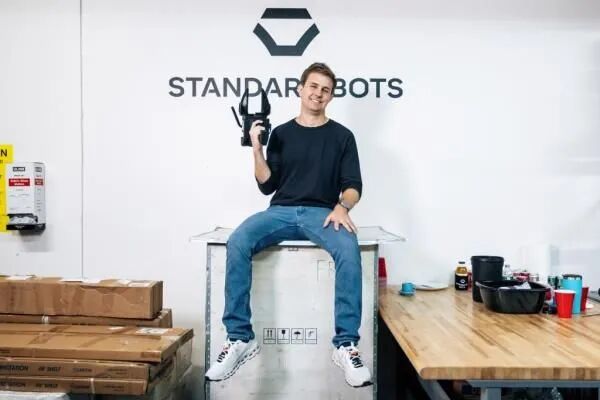
Evan Beard, founder and CEO of Standard Bots. Source: Public information
This means that Standard Bots' growth flywheel may be like this: first, use relatively low - cost and easily deployable robots to enter more factories; the robots accumulate data in real tasks; the data, in turn, trains better robot models; the stronger the model, the more tasks the robot can perform; the more tasks, the more willing customers are to purchase and repurchase.
This is different from the business logic of traditional industrial robot companies.
In the past, industrial robot giants essentially sold high - reliability machinery, electronic control, and system integration capabilities. Their moats come from precision manufacturing, distribution channels, service networks, and long - term industry experience. New companies like Standard Bots are trying to add new variables: models and data.
This is why capital gives it more room for imagination. Hardware companies usually have low valuations because of heavy production, heavy inventory, limited gross profit, and complex delivery. However, if robot hardware becomes the entry point for AI models into the real world, the valuation logic will change. Investors are not just buying the sales volume of robotic arms but an industrial AI platform that can continuously learn.
Of course, this path is not easy.
Industrial robots are not consumer electronics. Factory customers are not willing to be guinea pigs. Safety, stability, accuracy, and maintenance response are all very crucial. Just because a robot can complete actions during a demonstration does not mean it can run continuously on the production line for several months. What small and medium - sized factories care most about is not the concept but the payback period of investment, downtime risk, after - sales speed, and whether workers can really operate the robots.
Therefore, Standard Bots needs to prove three things in the future.
First, whether it can achieve large - scale manufacturing. The company plans to expand its Glen Cove factory to 70,000 square feet and aims to achieve a higher degree of U.S. domestic manufacturing from raw materials to finished robots by 2027. This is not only a supply - chain narrative but also related to delivery capacity and cost control.
Second, whether it can truly turn "demonstration - based learning" into a stable product. The concept of a robot learning tasks through demonstration is very attractive, but in an industrial setting, 99% stability and 99.9% stability are two different things. AI can lower the programming threshold, but it cannot sacrifice safety and consistency.
Third, whether it can penetrate the small and medium - sized manufacturing market. When large customers purchase robots, they often have a dedicated team for evaluation and maintenance; small and medium - sized enterprises need more comprehensive solutions, including pilot projects, training, application templates, fixture ecosystems, financial leasing, and after - sales service. Whoever can streamline these aspects may truly expand the market.
From this perspective, Standard Bots' $1 billion valuation is both an opportunity and a pressure.
The opportunity lies in that the automation of the U.S. manufacturing industry is far from complete. China installs nearly 300,000 industrial robots a year, while the United States only installs more than 30,000 a year. This gap itself shows that there is still a large amount of automation potential in U.S. factories. With the shortage of labor, the reshoring of manufacturing, the reconstruction of the national defense supply chain, and the improvement of AI capabilities, industrial robots will no longer be just equipment in automobile factories but will enter more dispersed manufacturing scenarios.
This article does not constitute any investment advice.
This article is from the WeChat official account “Pencil News” (ID: pencilnews). Author: Huang Xiaogui, Editor: Zhu Zhishan. Republished by 36Kr with authorization.