DJI and Insta360 are bringing the GoPro era to an end
The pioneer of action cameras is standing on the brink of bankruptcy.
Recently, GoPro submitted an 8-K filing to the SEC, stating that there are “substantial doubts” about the company's ability to continue as a going concern. The financial reports show that the company has been incurring continuous losses in recent years. From 2023 to 2025, the total net loss was approximately $569 million (equivalent to about 3.9 billion RMB). In the first quarter of 2026, the revenue declined by 26.2% year-on-year, the net loss widened to $80.82 million, and the cash flow from operating activities was negative.
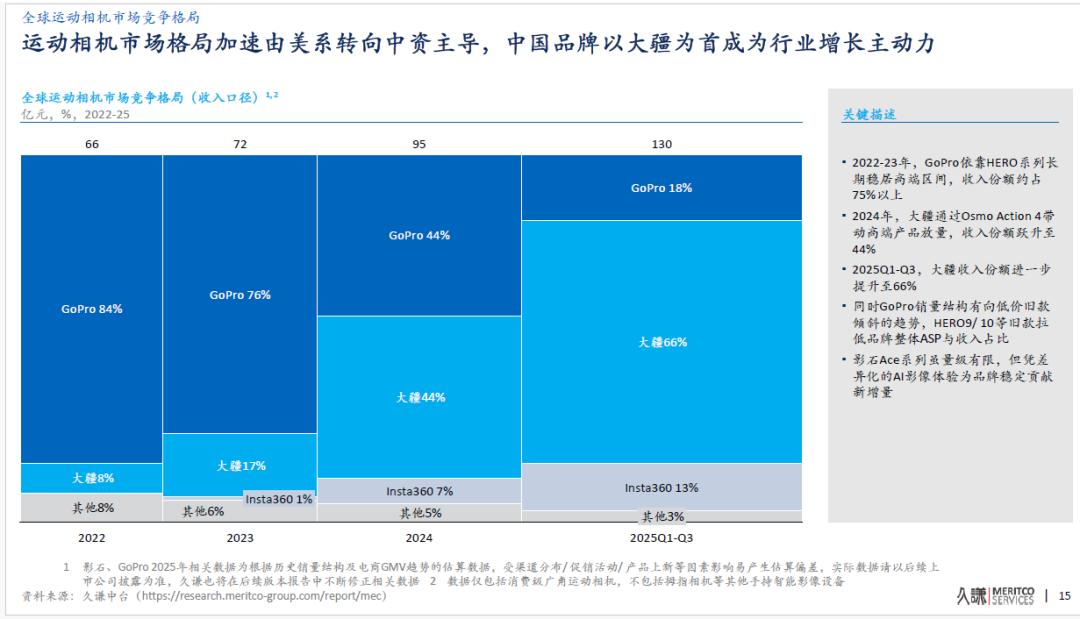
Three years ago, GoPro dominated the action camera market with an 84% market share. Now, its stock price has evaporated by more than 98% compared to its peak in 2014, and its market value is only about $200 million.
Behind this is the pressure from two companies from Shenzhen, DJI and Insta360. They use the imaging algorithms accumulated in the drone industry, the product capabilities developed in the panoramic camera market, and the cost - efficiency brought by the Chinese manufacturing system, squeezing the foundation on which GoPro depends for survival.
The “Global Panoramic and Action Camera Market Research Report” released by Jiqian Consulting last year shows that in 2022, GoPro monopolized the global market with an 84% share. As of Q1 - Q3 of 2025, DJI took the lead with a 66% share, Insta360 accounted for 13%, and GoPro's share shrank to 18%.
The decline of GoPro and the rise of DJI and Insta360 represent a classic battle in which Chinese consumer electronics brands “outlast” the pioneers in the global market with smarter innovation and faster iteration.
Why did GoPro suddenly lose its edge?
If we rewind the clock ten years ago, it would be hard for anyone to believe that GoPro would end up where it is today.
In 2014, GoPro went public and became one of the star companies in Silicon Valley. Its market value once exceeded $13 billion, and its founder, Nick Woodman, was hailed as “the next Steve Jobs in the hardware industry.”
It wasn't just selling cameras; it was selling a lifestyle—skiing, surfing, cycling, skydiving. Every adventure was worth recording. In that era, GoPro was almost the only choice for shooting first - person perspective extreme sports videos.
According to data from market research institutions, as of 2022, GoPro still accounted for as much as 84% of the global action camera market. In a sense, action camera = GoPro, and GoPro = action camera.
However, the good times didn't last long. With the slowdown of product iteration, intensifying external competition, and changes in the consumer group, GoPro's advantages began to weaken, and its leading position quickly crumbled.
In the past three years, GoPro has suffered consecutive losses, with a cumulative loss of nearly 4 billion RMB. Its stock price has evaporated by more than 90% from its peak, and its market share has been rapidly eroded by Chinese brands such as DJI and Insta360. In the first three quarters of 2025, DJI regained the top position with a 66% share, Insta360 accounted for 13%, and GoPro's share dropped to 18%.
This rapid change has plunged the former market leader into an unprecedented crisis. However, simply attributing the reason to the rise of Chinese brands is not enough to explain why GoPro lost so quickly.
The real problem is that when the market demand has changed, GoPro still tries to define the future with the methods that brought it success in the past.
In the early days, GoPro successfully linked extreme sports with social content, creating the “GoPro lifestyle.” Users bought it not just for shooting, but also to identify with an adventurous, free, and boundary - breaking identity.
This narrative was extremely successful. But the problem is that extreme sports are ultimately a niche market.
In the early days, it successfully bundled extreme sports with social content, creating the brand perception of the “GoPro lifestyle.” However, as the market scale expanded, the proportion of extreme sports users was limited, and ordinary consumers may not necessarily be interested in buying the Hero series. GoPro has insufficient penetration in ordinary families and daily recording scenarios, and its product form lacks a user - friendly design for lightweight content creators.
The biggest contributor to GoPro's success was extreme sports, and the biggest constraint was also extreme sports.
In GoPro's strategic DNA, extreme scenarios such as skiing, surfing, and skydiving are the eternal core of its narrative. However, in the era of global content creation, with the explosion of short videos, TikTok, and Xiaohongshu, Vlogs have become the mainstream way of expression, and more and more people are starting to record their travels, daily lives, parent - child activities, store visits, and life fragments.
Action cameras are no longer just equipment for professional players; they are starting to become tools for mass content creation. These mass users don't need an anti - shock shell that can withstand high - altitude falls. Instead, they care about whether the people in the photos look good, whether the night scenes are clear, whether the sound recording is good, and whether they can get high - quality photos with one click.
The dimension of competition in the action camera market has changed from “durability” to “content production efficiency.” However, GoPro didn't make the timely turn. In the past ten years, its product updates have always been advancing in the same direction: higher pixels, stronger anti - shake, and longer battery life. Although it seems to be upgrading every year, it's becoming increasingly difficult for ordinary users to perceive the differences.
Meanwhile, the imaging capabilities of smartphones have been improving rapidly. The video, anti - shake, and wide - angle capabilities of flagship smartphones are constantly approaching those of action cameras, and many lightweight shooting needs are directly replaced by smartphones.
As a result, an embarrassing situation has emerged. Professional players continue to use their old equipment, and mass users directly use their smartphones. The space left for GoPro is getting narrower and narrower.
When ordinary users face the complex editing process, high heat generation, and cumbersome video transfer experience with GoPro, they start to look for new options. On the other hand, a group of Chinese companies that understand content creation and mass needs better have begun to redefine action cameras.
This is when the opportunities for DJI and Insta360 emerged.
DJI and Insta360: Rising from Behind
While GoPro was still immersed in its hardcore world, two Chinese companies, DJI and Insta360, had acutely perceived the shift in the trend of mass image creation.
They didn't struggle within the rules set by GoPro. Instead, they chose to overturn the table directly, redefining what an imaging tool in the new era should be with a new product form and AI technology.
DJI was the first to launch an attack.
In 2019, DJI officially entered the action camera market and launched the Osmo Action. At that time, many people thought it would be a doomed - to - fail challenge because the action camera market seemed to have no room for new players, and GoPro had an absolute brand recognition at that time.
However, DJI forced GoPro to make a significant price cut. According to a report from China Photography News, within less than 48 hours after DJI officially released its first action camera, the Action (officially priced at 2,499 yuan), GoPro's Tmall store reduced the price of its best - performing Hero7 Black standard version from the previous 3,398 yuan to 2,798 yuan.
For DJI, it saw not a mature market but a group of neglected users.
It didn't compete on parameters like traditional camera companies. Instead, it transferred the capabilities accumulated in the drone era to action cameras, including stabilization algorithms, gimbal control, image processing, mobile - end experience, and product design capabilities for mass consumers.
In the following years, DJI almost launched a new action camera every year. For the first time, action cameras started to iterate as quickly as smart consumer electronics, with features such as front - and - rear dual screens, a simpler editing process, a smoother video transfer experience, and a more user - friendly interaction design for ordinary users.
These features may not seem as exciting as pixel upgrades, but they precisely meet the real needs of the short - video era. Action cameras are no longer just devices tied to helmets; they are starting to become tools for travel, cycling, camping, and daily recording.
After that, DJI's global market share gradually exceeded GoPro's. According to data from Jiqian Consulting, in 2024, DJI drove the shipment of high - end products through the Osmo Action 4, and its revenue share increased from about 8% in 2023 to 44%, catching up with GoPro. By Q3 of 2025, DJI's revenue in this field accounted for 66% of the global market share, becoming the number one in the global action camera market with an absolute advantage.
If DJI is challenging GoPro head - on, then Insta360 chose a completely different approach. While others make action cameras, it makes content - creation devices; while others discuss image quality, it discusses expression; while others let users decide the shot in advance, Insta360 lets users choose the shot after shooting.
This is a completely different product philosophy. Traditional action cameras are essentially a form of pre - determined shooting—you have to decide the camera position, angle, and composition in advance, and it's hard to fix it if you shoot off - target. Through panoramic shooting and post - production reconstruction, Insta360 turns shooting into a process of first recording and then creating.
Users don't need to repeatedly adjust the angle, and they don't have to worry about missing a moment. For today's large number of Vlog creators, travel users, and social media producers, this ability is far more important than shock - resistance and water - resistance.
As a result, an interesting change has occurred. In the past, users bought action cameras to record a special experience. Now, users buy action cameras to continuously produce content.
Insta360 has also achieved its own leap. According to its disclosure, in the first half of 2024, the sales volume of Insta360's action cameras exceeded GoPro's for the first time. In the panoramic camera market, Insta360 has maintained the top global market share for six consecutive years. Out of every 10 panoramic cameras sold, 7 are from Insta360. It took a roundabout route and finally reached the core area of GoPro's market.
By now, GoPro has been left behind by the two Chinese companies.
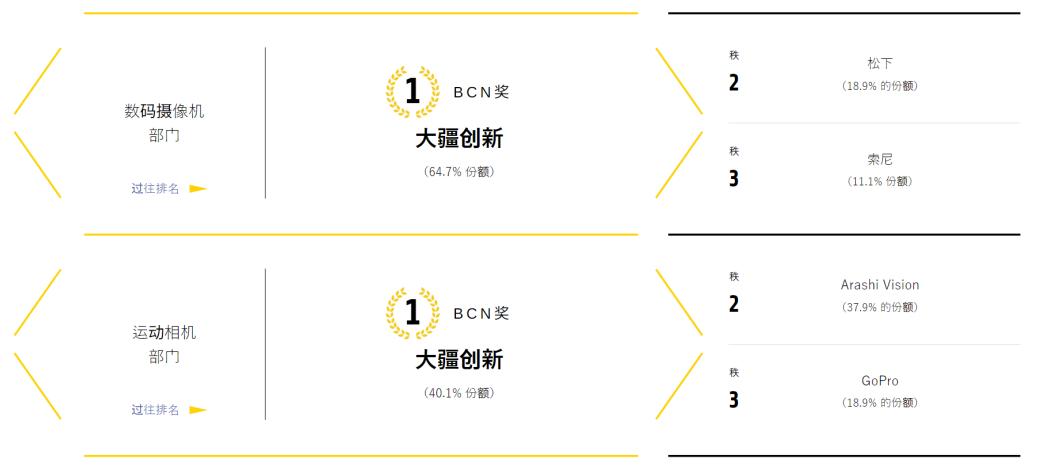
In January 2026, BCN, a leading Japanese retail research firm, released its annual data. DJI won the annual sales championship of action cameras for the first time with a 40.1% share, followed by Insta360 with 37.9%. GoPro's share dropped from 34.3% to 18.9%. The Japanese market has always been regarded as one of the most difficult consumer markets for traditional imaging brands to shake, and GoPro couldn't even hold its ground here.
The rise of DJI and Insta360 represents a typical Chinese approach to consumer electronics. They may not be the first to invent a product, but they are good at re - understanding users and re - defining products after a product category matures. This is the case with drones, sweeping robots, projectors, and action cameras.
This article is from the WeChat official account “Growth Workshop”. Author: Xiang Qing, Editor: Zhao Yuan. Republished with permission from 36Kr.