Global capital has started to acquire stakes in Chinese tech companies piecemeal.
This article is a bit dense with information. I think it's worth delving into it thoroughly.
01
Let me start with something:
On June 10th, ProShares, the largest leveraged ETF issuer in the United States, submitted a document to the SEC, filing for 9 products at once. All the underlying assets are Chinese A-share companies.
ProShares has been in the leveraged ETF business for nearly 20 years. I checked and found that it manages over $90 billion, with 115 leveraged and inverse products under its belt. It's the biggest player in the global market of the same category.
To put it simply, its business is: Select popular stocks, turn them into leveraged trading tools, and sell them to short-term funds looking for a gamble.
In the past two years, it has created products for Tesla, NVIDIA, as well as Palantir and Coinbase, all of which are 2x long positions on single stocks. Last month, it launched a 2x long product on SpaceX, coincidentally on the day of its IPO.
It's not the only one in this business.
I also took a look at etf.com. Goodness, there are now over 450 single-stock ETFs in the US market, accounting for 8% of the total number of US stock ETFs, managing over $50 billion in total.
Guess how many there were two years ago? Less than 200.
This market segment is really booming. As soon as a stock gets hot, someone immediately attaches leverage to it, just like flies to blood. It's no exaggeration.
ProShares has filed for 9 companies this time.
Zhongji Innolight, Xinyisheng, Tianfu Communication, Foxconn Industrial Internet, Luxshare Precision Industry, Contemporary Amperex Technology, GigaDevice Semiconductor, Hygon Information Technology, and Cambricon Technologies.
You can tell how they made their selections at a glance.
Zhongji Innolight has the world's highest optical module shipments, with a market share of over 50% for its 1.6T products. It ranks among the top in daily trading volume in the two stock exchanges. Xinyisheng and Tianfu Communication are also benefiting from the AI computing infrastructure.
Foxconn Industrial Internet is one of the world's largest electronics contract manufacturers. Luxshare Precision Industry is the leading player in precision manufacturing in Apple's supply chain. These two are the backbone of China's manufacturing in the global market.
Contemporary Amperex Technology is the world's leading power battery manufacturer, with a market share of over one-third for several consecutive years. GigaDevice Semiconductor is the leading domestic storage chip manufacturer. Hygon Information Technology follows the domestic x86 server chip route, while Cambricon Technologies follows the AI accelerator chip route, each taking a different path.
The 9 companies cover six sectors: optical modules, optical communication, precision manufacturing, new energy batteries, storage chips, and AI chips. And in each sector, they've selected the strongest company you can think of.
There's a detail that's easy to overlook.
All 9 companies are listed on the A-share market. They're not listed on the Hong Kong stock market or as Chinese concept stocks in the US. Before this, no overseas institution has ever created a leveraged product denominated in US dollars for a single A-share company. This is the first time.
According to the SEC's process, the document will automatically take effect 75 days after submission. Calculating it, the products could start trading as early as August 24th.
However, the products are still in the draft stage. The SEC may raise questions during the review process, and ProShares may postpone, modify, or even abandon the issuance. This is an ongoing application and hasn't been finalized yet.
At this point, you might think: Oh, foreign capital is going to go long on Chinese technology. It's a positive sign. That's not the case.
To understand the significance of this, we need to clarify a premise: What exactly is this so-called "2x long ETF"?
It's very different from the ETFs you usually buy on Tian Tian Fund or Alipay.
02
Have you ever bought an ETF on Alipay or Tian Tian Fund?
To put it simply, it's like a basket. For example, the CSI 300 ETF combines 300 stocks according to their weights. Buying one share is equivalent to holding shares in 300 companies at the same time.
You earn from the overall rise and fall of the basket. If you can hold on, you can keep it for the long term, looking at the net value, drawdown, and annualized return.
The "2x long ETF" created by ProShares also has the word "ETF" in its name, but it's completely different in nature.
It's not a basket but a single-stock fund. One fund is tied to only one company. ProShares Ultra Zhongji Innolight is solely related to Zhongji Innolight. Its performance depends entirely on this stock.
What's more crucial are the words "2x" and "daily".
After the market closes every day, the fund performs a rebalancing operation, readjusting the position to ensure that your exposure to Zhongji Innolight is exactly 2x at the opening of the next day.
That means if Zhongji Innolight rises by 3% today, you earn 6%. If it falls by 3%, you lose 6%. Sounds simple, right?
The problem lies in the word "daily". This 2x leverage only applies to the current day. The fund settles accounts every day after the market closes and starts over the next day. It only guarantees that the daily rise and fall is multiplied by 2, and there's no connection between different days.
Let me do the math for you to show the consequences.
Suppose a stock rises by 10% today and falls by 10% tomorrow. After two days, the stock itself loses 1% (from 100 to 110 and then to 99). But if you hold a 2x long ETF, you earn 20% today (from 100 to 120) and lose 20% tomorrow (from 120 to 96). The stock loses 1%, but you lose 4%.
This is just a two-day example. It gets even scarier in the long run. I looked at a ten-year statistics from Morningstar. From 2009 to 2018, they tracked a group of 2x leveraged ETFs, and the annualized return was -11.1%.
During the same period, what was the annualized return of the underlying indices corresponding to these ETFs? It was +15.7%. The indices were making money, but the 2x long funds were losing money. This went on for ten years, not just a month or two.
This phenomenon is called volatility decay. As long as the market fluctuates, each "daily reset" will eat into your principal. The greater the fluctuation, the more it bites.
Let me give you a more recent example:
You know the CSI 300, right? It's the most mainstream broad-based index in the A-share market. There's an overseas 2x long ETF on the CSI 300 called CHAU.
I checked, and the CSI 300 has fallen by about 5% this year, while CHAU has fallen by over 12%. On June 5th, CHAU plunged by 6.16% in a single day. When the index falls by one unit, it falls by more than two units.
At this point, you might wonder how this fund achieves the "2x" leverage. Does it really buy twice as many stocks? That's not realistic. It mainly relies on a financial contract called a "swap agreement".
To put it simply, the fund signs a contract with a large financial institution, stipulating that: You help me bear the 2x difference in the daily rise and fall of Zhongji Innolight, and I'll pay you a fee.
The fund doesn't necessarily directly hold Zhongji Innolight's stocks. It holds a contract instead.
As for the counterparty of the contract, in order to hedge its own risks, it needs to actually obtain an exposure to Zhongji Innolight's stocks. The registration document doesn't specify whether it's obtained through the Shanghai-Hong Kong Stock Connect, QFII, or over-the-counter derivatives.
So, when you break down this product, its essence is clear. This is a daily-settled gambling tool. If you bet right, you double your money in a day. If you bet wrong, you double your losses. Holding it for a long time will likely result in your principal being eroded by market fluctuations.
Its target users are also clear.
Overseas quantitative funds, day traders, and short-term speculative funds. These people are looking for a compliant, liquid, and fast-in-and-out leveraged tool.
It's completely different from the CSI 300 ETF you're regularly investing in on Alipay.
03
Okay, now that we understand what this thing is. What's the relationship between it and my funds and stocks?
Let me tell you two real stories:
In August 2022, a 2x long fund on Tesla called TSLL was launched. The issue price was $24.13. At that time, Tesla's stock price was around $283.
Since then, Tesla's stock has risen by about 33%. Guess how much TSLL has risen?
It hasn't risen. It has fallen by 50%. The issue price was over $24, and now it's just over $12. The management scale has shrunk from a peak of $8.6 billion to $4.6 billion. The stock has risen by 30%, but the 2x long fund has been cut in half.
Let's look at another example.
In October last year, a 2x long fund on SK Hynix was launched in Hong Kong. You may know SK Hynix, the South Korean storage chip giant that competes with Samsung.
From its listing to May this year, SK Hynix's underlying stock has risen by 208%. According to the 2x leverage, it should theoretically have risen by 416%. But what happened? This fund has risen by 513%, nearly 100 percentage points more than the theoretical value.
Its scale has reached $10.8 billion, surpassing the Tesla fund and becoming the world's largest single-stock leveraged fund.
Putting these two cases together, a pattern emerges.
What has been the market trend for Tesla in recent years? It has been rising and falling, fluctuating back and forth. Every time there's a fluctuation, the daily reset eats into the principal. After more than three years, the volatility decay has consumed all the returns and even resulted in a loss.
What about SK Hynix? It has caught the super cycle of the storage chip market and has been almost continuously rising. In this kind of trending market, the compounding effect of the daily reset has helped to amplify the returns, outperforming the theoretical value.
For the same product structure, one fund has been cut in half while the other has quintupled. The difference lies in one factor: whether the underlying stock is in a fluctuating or trending market.
What kind of market trend will the 9 A-share stocks targeted by ProShares follow? No one can answer this question. So, the judgment that "the launch of leveraged funds is a positive sign" doesn't hold water.
There's also a unique issue in the A-share market: the time difference.
The leveraged funds for Tesla and NVIDIA are traded in the same market as the underlying stocks. The US stock market trades during the day, and so do the funds. The rebalancing occurs before the market closes, affecting the same group of people.
The A-share market is different. The A-share market closes at 3 pm, while the US stock market opens at 9:30 pm. There's a six-and-a-half-hour gap in between. The rebalancing of the leveraged funds, the inflow and outflow of funds, and the hedging by market makers all occur after the A-share market closes.
That means if there's a significant fluctuation in the fund overnight, the A-share market may gap up or down at the opening the next day.
This overnight gap effect doesn't exist for Tesla because they're in the same time zone. But the A-share and US stock markets are completely out of sync, so in theory, this cross-time-zone volatility transmission will be more obvious.
I say "in theory" because the academic community hasn't reached a consensus on the actual impact.
One study found that the end-of-day rebalancing of leveraged funds does increase the volatility of the underlying stocks during the closing period. Another study came to the opposite conclusion: after taking into account the hedging effect of the capital flow, the actual impact is almost negligible in an economic sense.
The core variable in these two conflicting studies is: scale.
If the final scale is only tens of millions of dollars, and Zhongji Innolight has a daily trading volume of over 10 billion RMB, this amount of money won't make much of a splash. But if it reaches the level of SK Hynix's over $10 billion, it can't be ignored.
No one knows how large the final scale will be and how much capital will participate. So, the most prudent judgment at present is: the impact mechanism exists, but the magnitude of the impact is unknown.
There's no need to be overly anxious or excited in advance.
04
Although the impact of the product itself is uncertain, the fact that ProShares has selected these companies already says a lot.
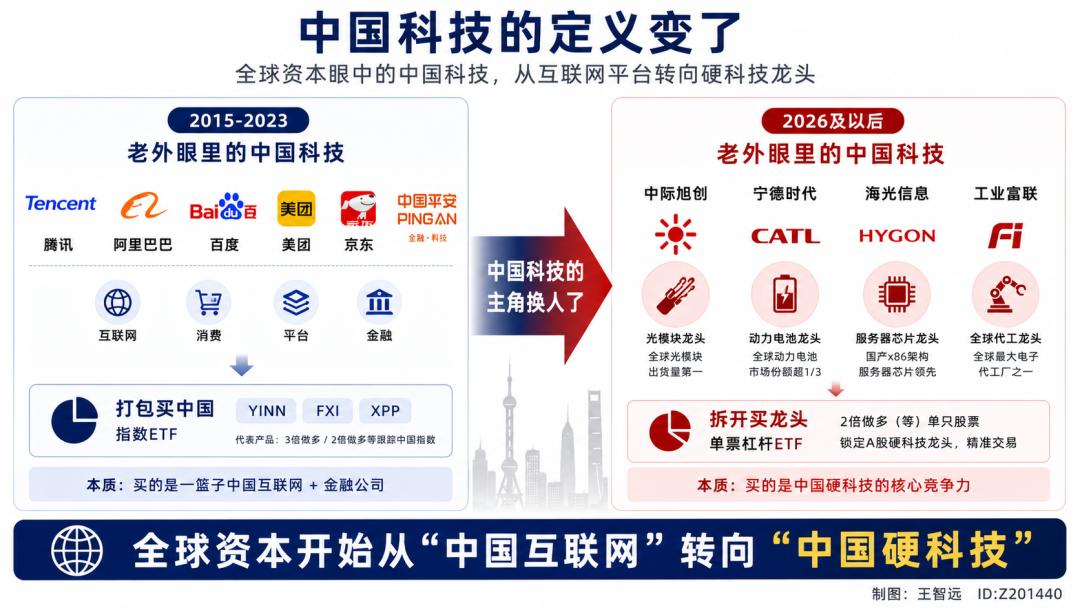
If you've paid attention to overseas funds that "bet on China", you should be familiar with a few names: YINN, a 3x long fund on the FTSE China 50 Index. XPP, a 2x long fund on the same index. FXI, a non-leveraged fund that tracks the index directly.
What are these products targeting?
The FTSE China 50 Index includes companies like Tencent, Alibaba, Meituan, China Construction Bank, and Ping An Insurance, all of which are listed on the Hong Kong stock market or as American Depositary Receipts.
For the past decade or so, in the eyes of foreigners, "China" has been represented by these 50 companies. If you want to go long on China, buy YINN. If you want to go short on China, buy YANG. If you want a more stable investment, buy FXI. There isn't a single A-share company in this pool.
This time is different. ProShares didn't select from this pool but went straight for the A-share market.
From "buying China in a bundle" to "buying individual stocks", from Hong Kong-listed Chinese concept stocks to A-share hard technology. This change is a matter of definition.
In the eyes of global traders, "Chinese technology" used to mean Tencent + Alibaba + a bunch of financial stocks. Now, it's starting to mean the 9 companies on this list.
This trend isn't unique to China.
The leveraged fund on SK Hynix mentioned earlier is listed on the Hong Kong Stock Exchange, with the underlying being the stocks of a South Korean listed company. The logic is the same:
Popular targets are listed in their home markets, and overseas issuers create derivatives in another market to provide trading tools for global short-term funds. South Korean semiconductors and Chinese hard technology are both going through the same process of transforming from domestic assets to global trading assets.
There's another thing worth noting.
I checked ProShares' product strategy, and there's