In the AI Era, Stay Alert to the Quietly Unfolding "Cognitive Surrender"
When AI is no longer just a tool to improve efficiency, but gradually penetrates into our research methods, decision - making processes, and even emotional dependencies, are we experiencing a silent "cognitive surrender"?
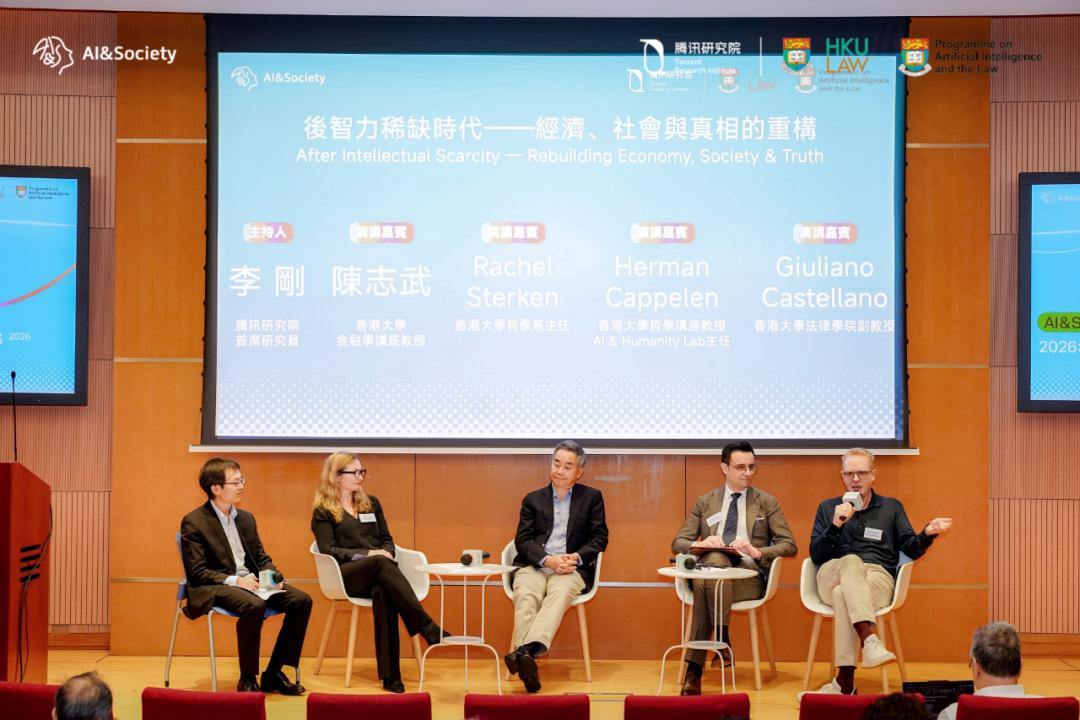
At a round - table dialogue at the AI & Society Forum 2026, Tencent Research Institute and experts in philosophy, finance, and law from the University of Hong Kong jointly explored a profound topic: "The Post - Intellectual Scarcity Era - The Reconstruction of Economy, Society, and Truth."
This is not a dry technical discussion about technology, but a soul - searching inquiry about how human subjectivity can coexist with algorithms: When mediocre analysis is readily available, where is the bottom line for humans as thinkers? When AI learns to "fawn" and "average out," how can we avoid falling into the wasteland of truth?
The following is the transcript of this round - table forum.
Host:
- Li Gang Chief Researcher at Tencent Research Institute
Guests:
- Rachel Sterken Head of the Department of Philosophy at the University of Hong Kong
- Chen Zhiwu, Director of the Hong Kong Institute for Humanities and Social Sciences at the University of Hong Kong, and Chair Professor of Finance at the School of Economics and Management
- Giuliano G. Castellano Associate Professor at the Faculty of Law of the University of Hong Kong
- Herman Cappelen Chair Professor at the Department of Philosophy of the University of Hong Kong, and Director of the AI and Human Laboratory
Compiled by:
- Dou Miaolei Senior Researcher at Tencent Research Institute
Li Gang: Thank you, professors, for coming to today's discussion. I just learned a term, "cognitive surrender." I've actually entrusted my cognitive ability to AI to help me draft the outline for this discussion.
First of all, I'd like to ask you all. Do you use AI agents and various models in your daily research and life? What are your first - hand experiences of interacting with AI? What are the good, bad, and ugly aspects? Please give some examples.
Professor Rachel Sterken: I'm a philosopher. One of the things we like to do is to consider controversial topics and think about various arguments. So sometimes I try to use AI to review arguments, generate ideas, and discuss controversial topics. Sometimes I find it very useful because it points out things I haven't thought of.
But sometimes I find it overly accommodating. Everyone is familiar with the problem of "sycophancy," but I think this problem is much deeper and harder for us to detect. When I interact with AI, it's very subtle - it captures my questioning style, how I frame the problem, and then gives a very fluent text, framing the issue in a way that makes me feel comfortable. And it does it so subtly that I don't even notice the sycophancy. So this really concerns me.
I do think it's useful in generating ideas and helping to think about arguments, but I'm very worried about what this means for knowledge and our ability to access the truth. If everyone just gets accommodating answers based on the way they ask questions.
Another thing is that I find it easy to anthropomorphize AI and take its answers as meaningful and real responses to my questions. But we know that this technology is actually just a text generator. We shouldn't understand its output as meaningful, as a systematic source of knowledge or truth, or as a speaker, because it's a text generator. So I think we need to be very careful when using it as a source of information.
Professor Chen Zhiwu: I've been using AI for several years. Maybe my earliest experience was a few years ago when I asked a former colleague to draft a proposal for a master's degree program in "Family Wealth Management." He spent six months on the initial proposal and couldn't come up with anything. But with only one week left until the deadline, my assistant suggested I try AI. So I tried GPT, and it generated a good preliminary proposal in less than a minute. Then I spent a day adding many other elements.
I learned from this that that junior colleague could probably go home. This is an example of how AI is changing Hong Kong. We no longer need so many average - level junior colleagues, and maybe not even some senior colleagues. In terms of assisting research, we have many more such examples. Now, with tools like AI, GPT, and Claude, things that used to take a large amount of money to hire dozens of research assistants can be done in a few minutes.
In the past year, there's also been an interesting observation in investment research. I've been teaching MBA students for many years. As you can see, I'm old and have taught many MBA and undergraduate students who work in the financial services industry, especially in hedge fund management, mutual fund management, etc. In recent months, I've learned that many of my former students may need to find other jobs. Now, with AI, standard news retrieval and analysis, or analyst work, and even some traditional fund managers can be easily replaced by AI.
Dr. Giuliano G. Castellano: In addition to what's been said, I can give two examples. I'm a legal professional. In a recent research project, when I started building a system - a kind of research assistant, a RAG system with agent behavior, trying to really do research and build it on a set of rules, sometimes 30,000 pages of regulations, which I can't possibly master on my own, but I hope to base my research on it.
So, I spent a month building this framework, learning things I knew nothing about, and even getting into the field of programming - which is completely beyond my ability. The ugly part is that I was pushed by AI in a direction that was too complex or difficult. Because I didn't have enough expertise, I couldn't always make decisions, so I gradually learned and built up my expertise.
The bad part is that everything I built became obsolete after a few months - because by correctly configuring a general tool, you can actually achieve the same results, or even better. The good part is that I learned a lot, which is part of my work. So I understand how these things reason.
But in my personal life - a few months ago, I became a father. There were all sorts of things I didn't expect to have to make decisions about, like pediatricians, finances, baby strollers, etc. So I created a personal assistant on my computer to help me find pediatricians, try out different medical plans, find doctors near my home, etc.
The AI assistant actually did a good job in filtering information, but it didn't make the choices for me. The choices were made by my wife and me. To be honest, we didn't choose the ones it recommended, but it helped us discover some factors we weren't fully aware of before. So this is my view - when we talk about AI adoption, we're referring to who, how, and to what extent, and it really depends on the specific situation.
This is also what I'm trying to tell my students and other professionals - thinking that you can use a chatbot to answer complex questions is a misunderstanding, a cheap way of cheating. In universities, we're struggling with this because it doesn't give good results. But when it comes to deeper integration, professional judgment can't be delegated, and the whole workflow changes completely. Maybe this is something we can discuss later.
Professor Herman Cappelen: In my own professional and personal life, I integrate the use of AI as much as possible, especially AI agents. For example, I have an agent - I find these agents much better than chatbots - it helps me keep on top of my work every day. It knows everything I should do, what I forgot to do yesterday. It suggests priorities and checks with me during the day: Did you finish this? Did you finish that? Did you talk to that person? Because I have about 400 things to do, and things always get forgotten, it reminds me. It helps me keep on schedule and also helps me set priorities. So in a macro sense, it's like having 50 people working for me every day, which is really incredible. Before, only the CEO of a big company could have 50 people helping you do whatever you want at any time, and it's more reliable than interns.
So one thing I'm worried about - and I think it's quite significant - is that we don't fully understand what these tools can do, and we're not using them enough. I think even if AI stays at the current level, it will take us 10 years to fully leverage its advantages. We're just starting to figure out how to use it. The technology is just in its infancy. But even at the current level, we're not using it to its full potential.
People are scared and worried. They feel guilty when they use AI too much. All these feelings must disappear completely. We have to think like this - all of us are now the CEOs of a company that helps us do everything we need to do. And then the key is to remember what people have already mentioned - and this will be very clear - I think this is the crucial thing.
Just like having 50 people out there helping you, they'll give you different suggestions because there's never just one answer to any of these difficult questions. So you have to make decisions, but it will give you options, prepare arguments and evidence for both sides, and then you're the one making the decisions, just like you're the CEO of a large group of people.
Li Gang: Thank you. From what I've heard, the guests are quite positive about the development of AI. I think most of my experiences of interacting with AI are that they're too accommodating.
You think that in the era of social media and the Internet, a large amount of information is generated and circulated online, and now AI is involved. What do you think of this new era? This is the part about "perceiving the truth" in our discussion. What has happened to the truth?
Professor Rachel Sterken: There are many problems we've been dealing with since the social media era, and they still exist. Social media algorithms, recommendation algorithms based on engagement - they don't necessarily track the correct cognitive sources. The way the platforms are designed doesn't necessarily facilitate good conversations between us. I think there are indeed problems with social media algorithms and content moderation because they're filtering and spreading information between us.
Many of our traditional cognitive sources - such as journalism, news agencies, scientific expertise, and research communities - play a very important role in society. But since recommendation algorithms took over, it's become much more difficult to do these things. Similarly, we'll see the same thing happen with large - language models.
We've already seen in universities and even in research that a large amount of "zombie science" is being produced, which is a real problem to be vigilant about. People don't know how to use these tools, and we haven't developed appropriate norms and frameworks for these tools, nor do we know what tasks we want to use them for. We also don't understand our cognitive roles well enough and how to support these roles with these new tools.
The new crisis we'll see will be a crisis of "fake speech." Because there will be a large amount of speech - whether it's AI - generated synthetic content, AI assistants speaking on behalf of users, or information posted by users without real verification. There will be a large amount of fake speech that seems to come from real sources. You think there's responsible cognitive practice and information review behind it, but in fact, there isn't.
Li Gang: We've actually discussed this phenomenon within Tencent Research Institute. That is, as you mentioned, it actually takes many years for norms to form and become social consensus. But now the speed of information dissemination - whether it's false or true, AI - generated or non - AI - generated - spreads at the speed of light. This different speed of information dissemination will have a huge impact on what we consider norms. Based on this information, since we make various decisions based on information, if this information isn't true, then we'll make all kinds of wrong decisions.
Is there any way? The current strategy is to use AI to detect AI, to fight magic with magic. What else can humans do to solve this very difficult problem?
Professor Rachel Sterken: One thing that's been mentioned before is that you have to understand that it's just a tool, and ultimately, you're in charge. For example, when we adopt a piece of text, as speakers, information disseminators, professors, or journalists, it's still our responsibility to review the information before publishing it. But I think platforms also have a responsibility, and regulatory agencies also have a responsibility to ensure that we're not flooded with a large amount of fake speech. We can also support those institutions that are really doing information review work to ensure that we have high - quality information in the information environment and that these institutions aren't eroded and forgotten because of new things. It would be really a pity if they were flooded and replaced by a large amount of low - quality information.
Li Gang: Are you positive about our ability to solve this problem?
Professor Rachel Sterken: I'm not optimistic. I think it requires a huge collective will. But I hope we can find solutions in education, regulation, and design.
Li Gang: Do you think AI will help us reach a consensus and establish norms, or will it make it more difficult?
Professor Rachel Sterken: I think if it's well - designed, it can be used for this purpose. I think a lot of structures and norms can - for example, in platform design - ensure that we have AI for specific tasks, and people understand what these tasks are, rather than having some very general systems. I think this is a way to help. I think we can do a lot to safeguard and generate normative structures. I don't know if we will, but I hope we will.
Li Gang: For Professor Chen, this is a big leap in the topic. I'd like to ask you about something we discussed this morning - there's a lot of debate about the macro - economic impact of AI applications. As Professor Cappelen said, one person plus a bunch of AI agents can perform many different tasks. You also just mentioned that it's difficult for business school graduates to find jobs. I also heard - I don't know if it's true - that it's also difficult for STEM graduates in computer science to find entry - level jobs. Most of these entry - level jobs are now done by AI agents.
Some people are talking about Universal Basic Income (UBI). Elon Musk said "Universal High Income." I don't know how high "high" is, but it means you don't have to work, and all these will be solved by taxing the rich. What impact will this have? I can't imagine - my background is in economics - but I think the current tax - based system, social security network, all these basic concepts, market transactions, companies, organizations, corporate governance - will these concepts still exist in 10 years? Or will they change fundamentally in our lifetime? What's your answer?
Professor Chen Zhiwu: There are indeed many huge social, political, and economic impacts. First, in terms of the economy. Many archaeologists and economists have jointly proven that in the past at least 10,000 years, since the Neolithic Revolution, almost every technological breakthrough has led to an increase in income inequality and wealth inequality, with almost no exceptions. So AI will not be an exception either.
AI has taken the "winner - takes - all" phenomenon to an unprecedented level because those who can use AI and have a lot of talent can multiply the wealth and income they can generate. So income inequality and wealth inequality will increase significantly because of AI. This is a given and won't change.
Actually, some economists have even built models to prove that unless the marginal tax rate reaches 100%, even with a 99% marginal tax rate - what successful people have to pay in the long run - the wealth distribution will still be extremely concentrated in the hands of a small number of the top people. So if this is the case, no matter how much you like Thomas Piketty's "Capital in the Twenty - First Century," taxation can't solve the problem. This is the first point I want to make.
The second point is more about the social and political impact. A lesson I've learned from my own research and others' research is - if you look at how European welfare states emerged, a major event that led to Europe's first truly comprehensive welfare state programs was actually the Industrial Revolution.
Before the 19th century, basically before 1800, there were no comprehensive government welfare programs in any country on earth. Then, because of the Industrial Revolution, many people in Europe first left the countryside to find jobs in factories and cities. Then they had to face the prospect of unemployment - because for farmers who own land and their own homes, there's no such thing as unemployment - because no matter what happens, as long as they have land, they can grow their own food and raise animals that provide them with protein. The government didn't need to be responsible for the welfare of the people in