The buzzword "harness" that everyone in the AI circle is talking about is not as mysterious as you think.
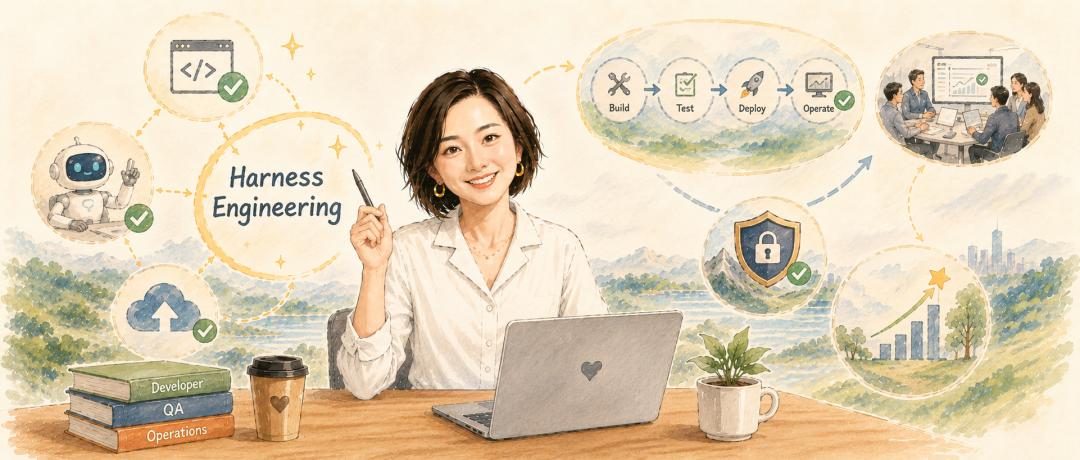
If you're interested in AI, you may have heard a term quite often recently: Harness Engineering.
It's everywhere when you open Twitter or browse WeChat official accounts. OpenAI published an article, Anthropic followed suit, the founder of HashiCorp promoted it in his blog, and Martin Fowler wrote about it in his column. Within two months, this term has gone from being unknown to becoming a core term in the AI industry.
My first reaction when I saw it was: Another concept I've fallen behind on.
To be honest, I'm a bit immune to this feeling. AI has been particularly good at coining new terms in the past two years: Prompt Engineering, Context Engineering, Agent, RAG (Retrieval Augmented Generation), MCP...
Every once in a while, a new term pops up, with an underlying message: "If you don't understand this, you're left behind."
After researching Harness Engineering, I want to tell you:
This term isn't that mysterious. In fact, you've probably been doing it for a long time, you just didn't know it had this name.
In today's article, let's talk about this in detail.
01. Translate this term into plain English
The word "Harness" originally means harness, referring to the whole set of equipment put on a horse: reins, saddle, bit, and bridle.
What are the characteristics of a horse? It's strong and runs fast. If you let it run freely, it might run into your neighbor's vegetable garden, get lost, or run into a wall. But when you put the harness on it, you can make it pull the carriage precisely on the path you want.
Remember this picture because the AI circle is using this analogy now.
People in the industry increasingly like to use a formula to describe today's AI systems:
A truly useful AI assistant = the model itself + the whole set of control systems built around the model
The model is the "horse". For example, GPT, Claude, and Gemini. They provide intelligence, the ability to reason and generate.
And Harness is the "harness", that is, the whole set of things outside the model. Rules, verification mechanisms, available tools, reference materials, and feedback loops when errors occur.
It tells the AI what it can do and what it can't do, makes the AI know if it's doing things right, and enables it to correct itself when it makes mistakes.
The model is responsible for "being able to do", while Harness is responsible for "doing it right".
To put it in a more down-to-earth way: The model is like a very smart intern who is completely unfamiliar with your company. Harness is the "employee handbook + work regulations + automatic checklist + alarm that rings when there's an error" you prepare for this intern.
Just having a smart intern isn't enough because he doesn't know the rules of your company, what he can't do, and no one will remind him when he makes a mistake. You have to set a whole set of rules for him so that he can really do a good job for you.
02. Define it in one sentence
After the introduction, let's define it in one sentence:
Harness Engineering: Instead of putting effort into "making the AI do things right this time", you put effort into "making the AI never make the same mistake again, next time, the time after that, and forever".
Or to be more precise: Write the mistake the AI has made into its operating environment permanently, so that the same mistake can never happen again in terms of mechanism.
There are three key words in this definition, and none of them can be missing.
First, it targets recurring problems, not one-time minor mistakes.
Second, the solution is to modify the environment, rules, and tools, not to tell the AI again.
Third, the effect is permanent and mechanism-based, not just getting it right this time and having to say it again next time.
03. A judgment criterion you can use at any time
The next time you interact with an AI and it makes a mistake, try asking yourself one more question:
"Am I treating this illness or eradicating its root cause?"
Treating this illness = re-explaining, re-prompting, and making it do it again in the conversation. This isn't Harness.
Eradicating the root cause = modifying its working environment so that it will never make the same mistake again. This is Harness.
By now, I guess you've vaguely felt that you've done this kind of thing before?
Yes. Let's see if the following four scenarios seem familiar to you.
Scenario 1: You've written instruction files for an AI tool
You've created custom instructions for ChatGPT, user preferences for Claude, or project rule files for Cursor, where you've written "answer in Chinese", "use English for code variables", "keep answers concise and to the point", "don't use emojis"... The AI reads these instructions every time it starts up. From then on, it will never forget.
This is Harness. You're not reminding it every time on the spot, but writing the rules into its working environment.
Scenario 2: You've equipped the AI with a dedicated knowledge base or a dedicated workflow
You've uploaded a company document, product manual, or style guide to an AI tool so that it can base its answers on this information every time. Or you've set up a workflow in an automation tool so that the AI's output will automatically go through a checking step before being sent to you.
This is also Harness. You're not pasting the information every time or manually reviewing it every time. Instead, you've integrated "feeding information" and "automatic checking" into its operating pipeline.
Scenario 3: You've written a skill, or created an "agent" or an "expert advisor"
You've saved a template for "writing Moments copy" in ChatGPT, written all the brand guidelines into a project in Claude, or set up an AI automation workflow in another tool...
This is the most complete form of Harness. Every time you update the template, you're essentially adjusting your "harness". You're permanently solidifying a lesson into the AI's working environment so that it won't make the same mistake next time.
Scenario 4: You've been let down by the AI and then did something to prevent it from doing so again
The simplest version is like this: The AI always changes your Chinese quotation marks to square brackets 「」. You've told it three times in the conversation to "use curly quotation marks", but it didn't work. Later, you directly wrote "all quotation marks must be full-width Chinese quotation marks, and other forms of quotation marks are prohibited" into the system prompt.
This is also Harness. Upgrading from "reminding every time" to "writing into the environment" is the core action of Harness Engineering.
So you see, you're not unfamiliar with Harness, you just didn't know its name.
05. Why has this term suddenly become popular?
The timeline is quite interesting.
In February 2026, Mitchell Hashimoto, the co-founder of HashiCorp and the creator of Terraform, published an article on his personal blog called "My Journey with AI".
In the article, he used the term Harness Engineering to describe a working habit he'd developed: As long as the AI makes a mistake, he'll spend time engineering a solution to ensure it will never make the same mistake again.
Instead of feeding new prompts every time there's an error and hoping it will get it right this time, he writes the lesson of this mistake into the environment permanently.
Is it simple? Extremely simple. But this statement hit the pain point of everyone working on AI applications.
Within two weeks, OpenAI, Anthropic, and LangChain all followed up with articles. A small term that was originally only used privately by engineers suddenly became the common language of the industry.
There are three reasons for its rapid popularity.
First, it gives a name to something that everyone has been doing but has never had a common language to describe.
Think back to the four scenarios above. Everyone working on AI workflows has been doing these things, but there was no unified term to summarize them in the past. Now that this term has emerged, everyone has found the right words.
Second, the dividend period of "writing good prompts" is over.
In the past two years, everyone has been competing on "how to write more sophisticated prompts", but now the success of the most expensive AI applications no longer depends on single prompts.
Their success depends entirely on how well the peripheral environment is set up. Programming assistants, research assistants, and workflows that can run autonomously for hours... All are like this.
Third, there's a memorable number.
A joint study by Stanford University and Tsinghua University found that for the same model, the performance gap can reach up to 6 times due to different designs of the peripheral environment (that is, Harness).
The model remains the same, only the scaffolding has changed, and the result has gone from "almost useless" to "close to human level".
6 times. All outside the model.
06. What does this mean?
It means that there's a shift in the focus of the AI industry.
From "competing on whose model is stronger" to "competing on whose Harness is set up better".
In the past, saying "I use GPT - 4 / I use Claude" was a status symbol. In the future, everyone will use similar models. They'll be cheaper, have similar capabilities, and be more replaceable.
What really makes the difference is the "harness" you put on the model.
The model itself is becoming more and more like a public resource that anyone can use. But Harness is something private to you that can make a difference.
The core competitiveness of a company, a team, or a one - person company is gradually shifting from "what model I use" to "what kind of working environment I've set up around the model".
And this is something anyone who uses AI for work can start doing. You don't need to know how to code or understand the principles of the model. You only need to do one thing:
The next time the AI makes the same mistake twice, you can stop and think about how to solve this mistake instead of just correcting it again?
Harness Engineering may sound like a new term, but what it does is actually an old saying for ordinary people:
Don't let me fall into the same pit twice.
The only difference is that in the past, this sentence was for yourself. You learned from experience, remembered it, and were more careful next time. Now you need to tell this to the AI.
That is, you need to write the "experience" into its working environment in a way that the AI can understand and apply automatically.
Prompt Engineering teaches you how to ask.
Harness Engineering teaches you how to make the AI not need you to ask every time.
The greatest efficiency improvement in the AI era is to prevent the AI from making the same mistake repeatedly.
This article is from the WeChat official account "Kelly Peng". Author: Kelly Peng. Republished by 36Kr with permission.