Tuopu Group: When Concentric Circles Hit the "Efficiency Wall"
In 2016, there were two companies in Ningbo that made auto parts. Zhongding Co., Ltd. had a revenue of 8.38 billion and a net profit of 900 million. Tuopu Group had a revenue of 3.94 billion and a net profit of 620 million - less than half of Zhongding's.
In 2025, Zhongding's revenue was 19.8 billion, and its net profit was 1.589 billion. Tuopu's revenue was 29.581 billion, and its net profit was 2.779 billion.
Nine years later, Tuopu Group achieved an overall overtaking. However, the costs Tuopu paid for these nine years are gradually emerging in 2026: when the revenue reached a new high, the profit declined for the first time, the gross profit margin fell below the industry average, and the annual income of the 300,000 - unit robot production capacity was only 13.59 million yuan. In the first quarter of 2026, the gross profit margin continued to drop to 19.26% - lower than the whole - year figure in 2025.
This article attempts to explore: Is the wall that Tuopu Group's "concentric circle" expansion model has hit temporary, or is it thickening? More importantly - in Q2 of 2026, Tesla's Optimus started mass - production. Will this be a door that can push the wall open?
From Rubber Gaskets to Robots
Tuopu Group started in Ningbo in 1983. Its founder, Wu Jianshu, was 19 years old at that time, and the company made rubber shock - absorbing pads and sealing strips. Every car needs these two products, but each car only requires goods worth dozens of yuan.
In the following twenty years, Tuopu did two crucial things. In 2000, it took the NVH shock absorber as the technological breakthrough direction - upgrading from a "general store at the entrance of the auto factory" to a "specialized shock - absorbing store". In 2004, it entered the chassis system. Both shock absorption and chassis are long - term businesses - it takes two years for model positioning and two years for mass production, and it takes four years to see returns. However, the advantage is that once you enter, customers would rather let you reduce the price by 3% every year than redo the verification.
Entering Tesla's supply chain in 2016 was the first watershed. Tuopu started with the lightweight aluminum alloy chassis structural parts of Model 3 and was then gradually brought into interior and thermal management by Tesla. Tesla's procurement logic is different from that of traditional automakers - "find the fewest suppliers to do the most things". If you are in charge of the chassis, then all things on the chassis belong to you, including thermal management which you haven't done before but must learn to do.
Thermal management is a typical example. Tuopu accumulated electronic control and precision manufacturing capabilities in the IBS line - controlled braking system. Coincidentally, Tesla needed a heat pump assembly supplier. Tuopu didn't actively choose thermal management. It held a card called "electronic control ability" and caught the thrown - over opportunity. It started in 2021 with a revenue of 1.285 billion that year, and the revenue rose to 2.091 billion in 2025.
The same logic continues to extend along the chassis: air suspension - which was exclusive to luxury cars worth over 600,000 yuan in the past and has penetrated into 300,000 - level models after localization; line - controlled braking IBS → line - controlled steering EPS → intelligent cockpit, all of which are based on the combination of motor and electronic control. In 2025, the revenue of automotive electronics was 2.769 billion, with a growth rate of 52.11%.
By 2025, the supporting amount per vehicle of Tuopu had reached 30,000 yuan. Its nine major product lines cover the core components of the whole vehicle from shock absorption to chassis, thermal management to automotive electronics, and then to robot actuators.
This is not "diversification". A typical example of diversification is that you make tires today, batteries tomorrow, and real estate the day after tomorrow. Each new line of Tuopu has a common foundation: the precision machining accumulated from shock absorbers, the electronic control ability accumulated from IBS, and the system integration accumulated from the chassis. Each expansion is not a cross - border start from scratch, but a migration of the existing technological foundation outward.
Zhongding took another path - expanding its scale through overseas mergers and acquisitions. Mergers and acquisitions are fast, but the profits are repeatedly eaten up by integration costs and goodwill write - downs. In 2025, Zhongding's net profit margin was 8.0%, and Tuopu's was 9.4%. However, note a change - in 2025, Zhongding's net profit increased by 27%, while Tuopu's decreased by 7.38%. The leading margin is narrowing.
Hitting the "Efficiency Wall"
Let's first look at two curves.
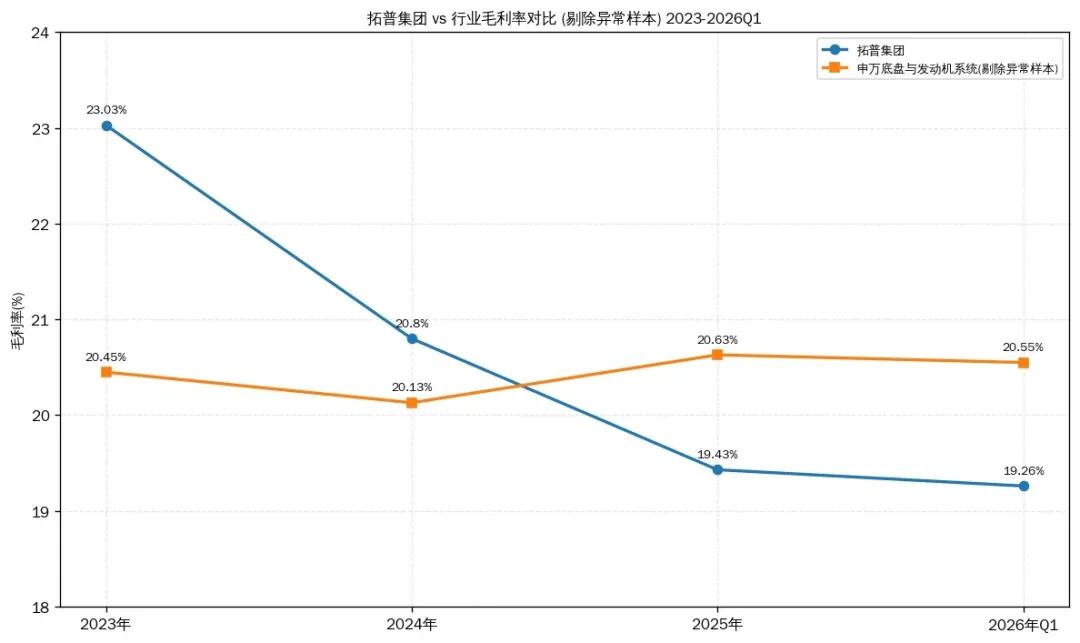
2025 was the dividing point. In this year, Tuopu underperformed the industry for the first time.
What is getting worse?
First, it's the customers. Tesla's global delivery volume in 2025 decreased by about 13.3% year - on - year. As Tuopu's largest customer (accounting for about 30 - 35% of the revenue), the decrease in volume directly led to stronger price pressure. In the automotive supply chain, the fewer the customer's volume, the fewer your negotiation chips.
Second, it's the production capacity. The first - phase project in Mexico was fully put into production in 2025, but the production capacity was not fully utilized - the ratio of depreciation and amortization to revenue rose to 6.1%. However, in the second half of 2025, it developed customers such as General Motors and Ford, and the gross profit margin in Q4 rebounded to 19.97%, showing some improvement.
In 2025, the operating cash flow was 4.482 billion, a year - on - year increase of 38.5%, and the cash content of net profit exceeded 160%. "More and more investment is needed to earn each yuan" - capital expenditure and depreciation are eroding the profitability efficiency.
The customer structure is improving. Tesla's share has dropped from about 49% in 2023 to 30 - 35%. Seres, Xiaomi, and Chery (it is expected to contribute 3 billion - level revenue in 2026 after the acquisition of Wuhu Changpeng) are becoming new growth poles.
Comparing Zhongding's latest data will make it clearer. Zhongding's net profit increase of 27% in 2025 once made people think it was catching up - but in Q1 of 2026, its revenue plummeted by 9.78% year - on - year, and the net profit plummeted by 20.01%. Zhongding's gross profit margin of 25.78% in Q1 was much higher than Tuopu's 19.26%, indicating that Zhongding's gross profit structure is better, but its revenue has encountered more severe fluctuations. The "walls" of the two companies are in different forms: Tuopu's is the "efficiency wall", and Zhongding's is the "scale wall".
A Variable in Q2
In May 2026, Tesla announced a piece of news that might be the most important one for Tuopu throughout the year: the mass - production of Optimus Gen - 3 humanoid robots started in Q2, and the first batch has been offline at the Texas factory and entered internal testing. Tesla also disclosed that the super factory dedicated to Optimus has started construction, with a planned annual production capacity of up to 10 million units; the Fremont factory has stopped producing Model S/X and has been transformed to produce Optimus.
Tuopu is the core supplier of Optimus actuators. In October 2023, Wu Jianshu revealed in a brokerage research that Customer T required Tuopu to supply all 26 actuators (including linear and rotary) for Optimus, claiming that "the 80 - billion - yuan market value does not include the robots, which is like getting them for free". Two and a half years later, the mass - production of Optimus is no longer just on paper - but Tuopu's stock price has actually fallen by 17% this year.
The problems lie in two aspects.
How many orders are there exactly? In 2025, the delivery volume of Optimus was less than 500 units, and Tuopu's robot revenue was only 13.59 million. After the Q2 mass - production news came out, investors asked about the mass - production time and order scale at the performance meeting on June 1, 2026. The management's answer was "it involves business secrets, please refer to the announcements". This answer itself doesn't indicate a problem - Tesla is notoriously strict with its suppliers' confidentiality requirements - but it leaves an information vacuum. In this information vacuum, the optimistic expectations implied by the 37 - 40 times PE are flawed.
How much production capacity can the market absorb? Tuopu has built an annual production capacity of 300,000 sets of robots, and the Thai factory is also preparing for the goal of 1 million units. However, TrendForce predicts that the global humanoid robot shipments in 2026 will be only 50,000 units, and UBS expects 30,000 units. Based on 50,000 units, if Tuopu gets a 40% share, it corresponds to a revenue of about 800 million. Based on 30,000 units, it's about 480 million. For a company with an annual revenue of nearly 30 billion, this is still only 1.6% - 2.7%. What can really make robots the "second growth curve" is Tesla's mass - production plan in 2027 - but that's next year's business.
Another variable is liquid cooling. In the first half of 2025, it received 1.5 billion in orders, with customers including Huawei, NVIDIA, and Meta. However, a recent media investigation found that "no public information can be found to indicate whether these orders have been fully delivered or the revenue has been recognized". The Q1 2026 financial report did not separately disclose the liquid - cooling revenue. The management's answer to the question "whether there are new orders" at the performance meeting was: "Please refer to the company's subsequent official announcements and regular reports."
There is a real logic behind liquid cooling - the technology can be migrated from automotive thermal management to data - center liquid cooling, and the market is booming (the penetration rate has increased from 3% to 20% and is expected to reach 37%). The 1.5 - billion - yuan order is not small in the 21.8 - billion - yuan Chinese liquid - cooling market. However, there are two uncertainties: the delivery schedule and the gross profit margin. If there is no obvious revenue recognition in the first half of the year, the narrative of "liquid cooling supporting the profit recovery in 2026" needs to be postponed to the second half of the year.
Conclusion
Tuopu Group has a technological foundation accumulated over forty years. From shock absorption → chassis → thermal management → air suspension → liquid cooling → robots, each expansion is to output the existing capabilities to adjacent scenarios.
However, this engine is consuming more and more fuel to maintain operation. The gross profit margin has dropped from 23% to 19.26%, and this has continued for more than three years without hitting the bottom yet.
The key points this year are: after the Mexican factory fills its orders, can the erosion of depreciation be narrowed? Can the delivery of the 1.5 - billion - yuan liquid - cooling orders in the second half of the year inject real marginal increments into the income statement? And there is also something that everyone is watching - how far is it from "mass - production in Q2" to "increased volume in Q3" for Tesla's Optimus. The good news is that Tuopu is not short of money. In 2025, the operating cash flow was 4.482 billion, and the debt - to - asset ratio in Q1 dropped to 40.77%.
The second half of 2026 will give a preliminary answer.
This article is from the WeChat official account “Cheyun” (ID: cheyunwang), author: Yuan Zhou. It is published by 36Kr with authorization.