Are major Chinese cities turning into culinary deserts?
Eating is the most primitive desire of human beings; delicious food is also one of the things that can best soothe the tired souls of modern people. In recent years, internet-famous foods have emerged one after another, and food documentaries have become popular wave after wave. Whether the food is "tasty" can even determine the tourism attractiveness of a city or even a province - Zibo barbecue, Cha Yan Yue Se... are all examples.
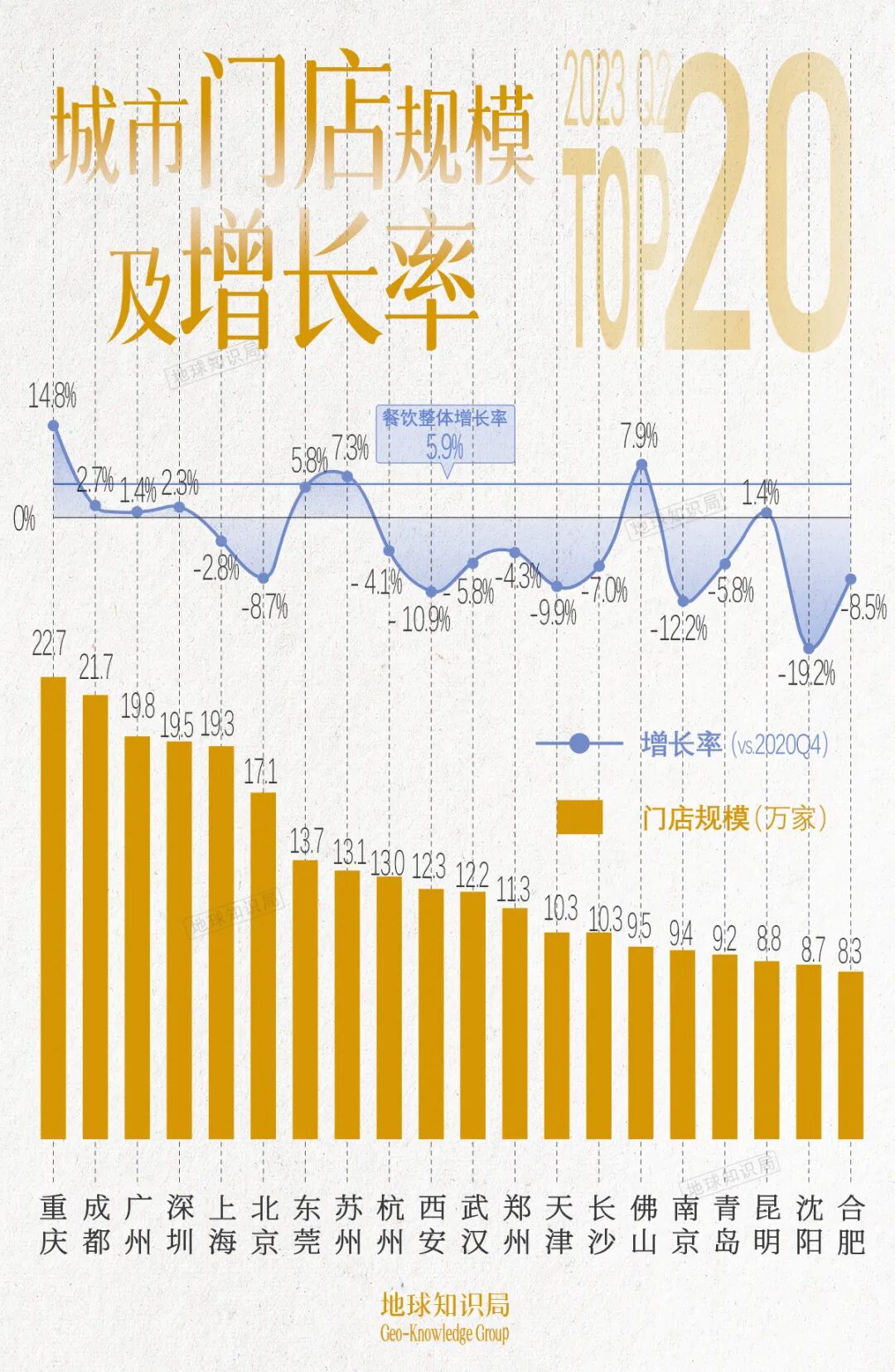
However, beneath the prosperous appearance of the food industry, the claim that "Chinese cuisine is becoming a desert" is gaining momentum. Beijing, Hangzhou, and Shenzhen, which rank among the top ten in terms of the number of catering stores, are all regarded as cities without good food.
How did these "food deserts" come into being?
The "Maligned" Food Deserts
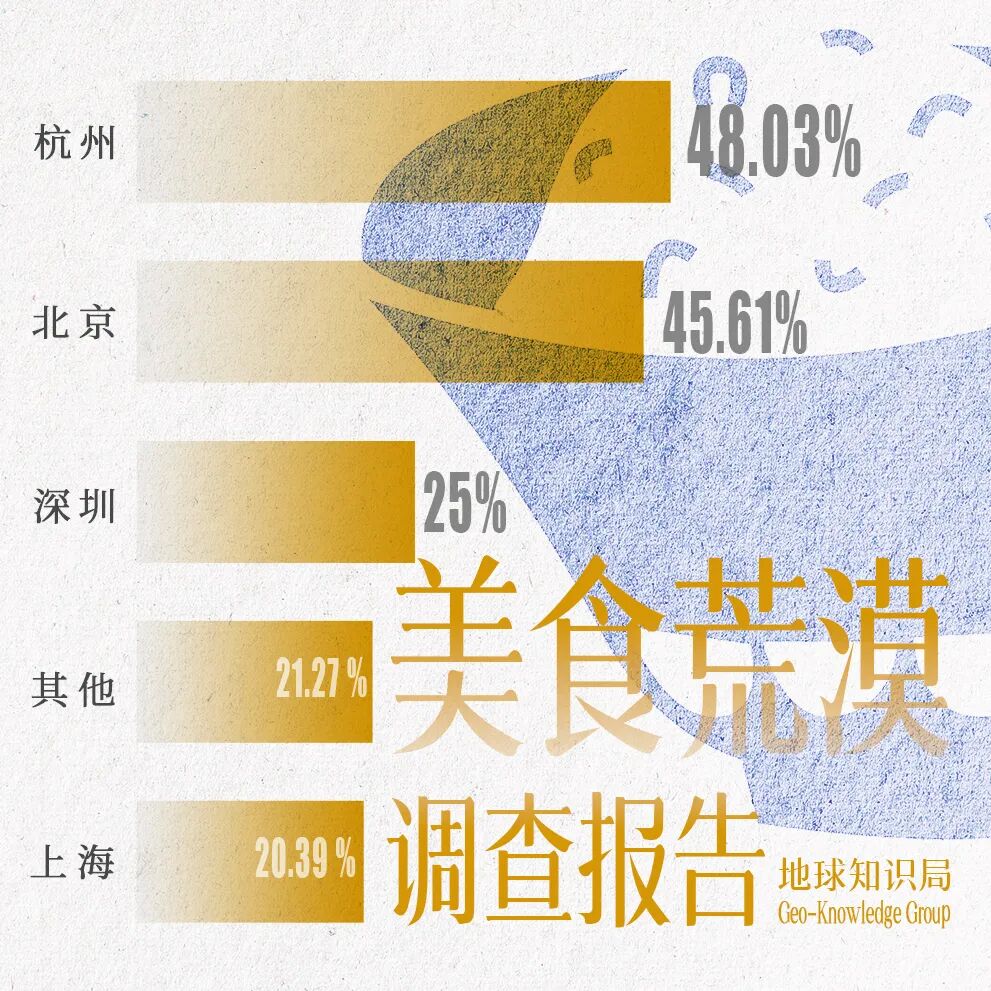
In our questionnaire survey about "food deserts", unsurprisingly, Hangzhou topped the list with a vote rate of 48.03%.
How "deserted" is Hangzhou? As a "land of fish and rice", Hangzhou was once famous for Hangzhou cuisine. However, currently on the food list of Hangzhou, almost all the top ten are Western and Japanese and Korean cuisines, while Hangzhou cuisine rarely makes it onto the list, reflecting the fact that local Hangzhou specialties are gradually "declining".
In 2023, the Hangzhou Municipal Bureau of Commerce held a meeting, proposing to formulate standards for Hangzhou cuisine, encouraging research and innovation in Hangzhou cuisine, and offering a reward of up to 1 million yuan. For a while, Hangzhou offered a 1 million yuan reward to get rid of the label of "food desert" and it made it onto the hot search, seemingly confirming the government's "recognition" of this label.
Beijing, which comes second after Hangzhou, is not much better. A popular comment on Weibo said: "After working the 996 schedule to the bone and wanting to order a takeaway casually, the probability of getting something terrible is over 80%." This is exactly the personal experience of many young people in Beijing: it's hard to find affordable and delicious restaurants, and the taste of ordinary restaurants is also hard to satisfy...
Hey, Liang Shiqiu, who once lived and worked in Beijing and later moved to Taiwan, said about Beijing that "occasionally, out of homesickness, I talk about delicious food to amuse myself".
In the capital where cuisines from all over the country gather, the name "food desert" is really thought-provoking. Theoretically, Beijing has rich catering resources of the eight major Chinese cuisines, and there are also many Beijing snacks that carry regional culture such as douzhir and stewed pork intestines. It's incredibly "deserted".
After Beijing, Shenzhen, which is adjacent to the three food capitals of Guangzhou, Hong Kong, and Shunde, is also often joked about as a "food desert". To be fair, Shenzhen really doesn't have any outstanding local specialties - when I asked my friend who is a Dianping V8 to recommend some food in Shenzhen, she was actually stunned. "I've been to Shenzhen three times and eaten a lot of different things... emm, I really can't think of anything to recommend."
The remarks about food deserts are not limited to the above big cities. When you search on social platforms, you can find that there are also quite a few second-tier cities carrying the "bad reputation" of being food deserts.
What is "Deserted" in Food Deserts?
Saying that Beijing is a food desert is more like saying that it lacks affordable and delicious food.
It's true that the catering industry in Beijing is of a high level. There are well-known restaurants like Xinrongji and Chaoshangchao. These restaurants can provide relatively the best ingredients and hire first-class chef teams, bringing together cuisines from all over the world. In terms of the catering industry level, it far exceeds that of second and third-tier cities. So in this regard, the statement that Beijing is a "food desert" doesn't make sense.
However, the level of a city's catering industry and the level of local food are two different concepts.
In Beijing, the above-mentioned high-end restaurants often cost over a thousand yuan per person, and the more affordable and well - reputed restaurants also cost one or two hundred yuan per person per meal. The per capita disposable income of the city's residents is 81,752 yuan, with an Engel coefficient of 21.3%, and the per capita daily food expenditure is about 44 yuan. The vast majority of people can't eat out every day. If they want to eat affordable, high - quality, and authentic local food, there are indeed not many options.
Moreover, the cost of commercial land in Beijing is relatively high, and the catering industry is a heavy - operation industry. The high costs of rent, raw materials, and labor lead to generally high prices in restaurants. In such an environment, small - scale and affordable food stores face difficulties in survival and often struggle to operate in the long term.
As for local snacks, most outsiders don't like them. In the eyes of outsiders, the "Four Heavenly Kings" of Beijing's so - called "dark cuisine": douzhir, stewed pork intestines, tripe, and stir - fried liver are definitely the first in the list of things to be ridiculed. But actually, there is no fixed standard for taste, and what is delicious to local residents may be "dark cuisine" to tourists. Of course, this is a matter of taste preference.
In contrast, Hangzhou, as a representative of southern food culture, faces disputes over being a "food desert" mainly because of the characteristics of its cuisine.
Take "Dongpo Pork" as an example. Although it is a well - known dish in Hangzhou, its sweet and oily taste is hard for many outsiders to appreciate. The sweet food and relatively light taste characteristics of Hangzhou create a sense of gap in taste adaptation for outsiders, leading them to label Hangzhou's food as a "desert".
Of course, many restaurants may also "fail to cook" authentic Hangzhou cuisine well.
This is a very delicate cuisine that uses a lot of vegetables, bamboo shoots, and river fresh ingredients. There are no birds, beasts, snakes, or insects in the recipes, and there is no heavy - flavored and greasy taste. It focuses on the original taste of the food. Not only are the ingredients precious, but it also requires a high level of cooking skills. In dishes that are not known for their heavy and salty flavors, the selection of ingredients, control of the cooking heat, and thickening of the soup are particularly crucial.
As for the West Lake Vinegar Fish, which is often criticized and people don't want to try it a second time, it was once served on the state banquet during Nixon's visit to China along with Moutai. Now it is so sour that it stings the nose, so sweet that it cloyes the throat, and it is fishy and full of thorns. It's more likely because what is served is a simplified version.
Nowadays, most restaurants that claim to serve Hangzhou cuisine can't master the best cooking heat, can't make the authentic soup, and some even use perch instead of the original grass carp.
Therefore, one reason why there seems to be no good food in Hangzhou is that modern people's taste buds and fast - paced lives don't give these "original - taste" foods many chances. And those authentic Hangzhou cuisines that are made with great care are often hidden deeply and hard for ordinary people to taste.
The Food Assembly Line in the Fast - Food Era
In addition to the differences in the tastes of outsiders and the problems with the cooking skills of chefs, the chain - operation of the catering industry is also an unavoidable topic when discussing food deserts.
Both Beijing and Hangzhou are large population - receiving areas. For example, Beijing is the city with the largest population flow in the northern region, with 8.418 million permanent residents from other provinces, accounting for nearly 40% of the permanent population.
The influx of a large number of "Beijingers drifting" and "Hangzhounese drifting" has increased the market demand for "fast food". A large proportion of the large number of outsiders prefer fast food, takeaways, and other efficient ways to solve meals, and fast - food chains have flourished.
At the same time, in order to improve the efficiency of food serving and reduce costs, some chain stores rely more and more on pre - made dishes, which directly affects people's expectations for the quality of catering.
People drifting in Beijing can especially feel the "sameness" of chain restaurants: the taste is not authentic, the texture is simplified, and it even presents a rigid "assembly - line" style. The popularization of pre - made dishes further reduces people's expectations for the food in these cities, creating the impression of a "food desert".
Similarly, the poor taste of the West Lake Vinegar Fish can also be blamed on the chain - operation of Hangzhou's catering industry. Louwailou, an old - fashioned restaurant, started opening branches in 1988 and began to set up a food factory to research vacuum - packed dishes in 1995. In 2003, the West Lake became free of charge, and tourists from all over the country flocked to Louwailou. At its peak, a single Louwailou store had to sell thousands of servings of the unpalatable pre - made West Lake Vinegar Fish every day.
The catering business and West Lake tourism developed side by side, and Hangzhou's catering bosses took the opportunity to start chain - operation and pre - made dishes. Louwailou alone has opened more than 40 branches and takeaway chain stores in Hangzhou.
The rise of commercial real estate has further promoted this trend. In 2008, the Hangzhou Municipal Government announced that it would build 100 urban complexes, which shocked the entire real - estate industry. In 2009, Hangzhou Tower was comprehensively upgraded, stacking four single - body shopping malls to a height of nearly 30 floors, becoming a benchmark for shopping centers.
As an industry with high - frequency consumption and significant customer - attracting effects, catering naturally became the "favorite" of these commercial complexes and enjoyed decoration subsidies and rent discounts. A group of new - style Hangzhou cuisine brands took the opportunity to enter the shopping malls, and the "Five Tigers of Fast - Fashion Catering" - Waipojia, Lvcha, Xinbailu, Nongtangli, and Laotouyoubaoxia emerged.
These restaurants, with a low consumption of "50 - 60 yuan per person" and a high table - turnover rate, broke the high - end positioning of traditional restaurants and met the needs of family customers visiting shopping malls. They all rely on central kitchens to reduce costs and have also promoted the local pre - made dish supply chain, such as Maizima and Yanzhoufu Food, making Hangzhou the "Capital of Pre - made Dishes".
In addition, the ranking on the food lists also "contributes" to "suppressing" special - feature dishes.
Catering review and takeaway platforms are the main tools for people to find delicious food. However, there is a bidding phenomenon in the food lists of popular cities, resulting in the fact that the restaurants at the top of the list may not be the ones with the best actual experience and taste, but rather the chain brands with high - bidding rankings and high - traffic internet - famous stores.
This limits users' choices to expensive and unaffordable internet - famous or chain restaurants, leading to a "scarcity of delicious food". With less customer flow, the delicious and special small stores that would not have disappeared are also bound to decline gradually...
Ultimately, whether a city's food is "desertified" is the result of the combined effects of multiple factors: the level of economic development, the scale of population flow, the development level of the catering industry, etc. In addition, the degree of attention a city receives is also a reason. As large population - absorbing cities, Beijing, Shenzhen, and Hangzhou are under more scrutiny and are more likely to be labeled.
So, what kind of city is not a food desert? Food lovers may look for cities according to the opposite criteria of what is mentioned above: a large variety of snacks, good word - of - mouth, a relatively low consumption level, not a large - scale tourist city, and emphasis on the inheritance of local culture.
It's not easy to find delicious food, and it's also not simple to run a food business. I hope all people away from home can find the delicious food they long for.
(Text | Yogurt)
This article is from the WeChat official account "Earth Knowledge Bureau", and is published by 36Kr with authorization.