Wanda, CapitaLand and Jinbo are bound to stage a showdown in Guangzhou Baiyun New Town
In the commercial landscape of Guangzhou, Baiyun New City may not be the most eye - catching, but it is the most worth exploring in detail.
Parkson Plaza, as a representative of local in - depth development, has long ranked among the top in terms of regional passenger flow. Baiyun Wanda Plaza, one of the first - generation commercial leaders in Baiyun, took the initiative to build the first - generation imagination of a modern commercial district in the region. The rising star, CapitaLand Yun Shang, has become a long - term benchmark in the Baiyun New City commercial district with its asset management thinking and refined operation.
Then, in 2025, Baiyun Mixc entered the market, injecting the quality and style of China Resources into the area in a light - asset way.
Now, another regional king is entering the game. According to the latest news, Jinbo Commercial is gearing up to enter Baiyun New City with the status of the king of local cost - performance ratio, serving as the first strategic anchor point for its high - end product line "Core Park".
Behind this competition and cooperation intertwined with multiple commercial logics lies the unique background of Baiyun District, the district with the largest number of migrant population in Guangzhou. Among the nearly 3.74 million permanent residents, more than two - thirds are from other places. They bring diverse consumption demands and high sensitivity to cost - performance, which also makes the commercial competition in Baiyun New City never lack traffic, but always involves a game in brand improvement.
It is particularly noteworthy that CapitaLand Yun Shang in Guangzhou is about to become the first project among the listed consumer infrastructure REITs to face a brand - new and powerful opponent head - on. This means that the competition is no longer just a struggle for store spaces and passenger flow, but also a direct confrontation of efficiency and asset operation ability.
Instead of only focusing on the gains and losses of a single project, we should also see the deep - seated logic of the changes in the commercial district and the iteration of business. The Research Center of Winshang conducted in - depth research on the Baiyun New City commercial district, trying to disassemble the underlying laws of commercial changes and the reusable iteration logic from the competition and cooperation of projects and the evolution of customer groups.
01.
Baiyun District, an underestimated fertile ground for business in Guangzhou
When it comes to business in Guangzhou, Tianhe District is the benchmark, and Panyu District has the strongest development momentum. In contrast, Baiyun District, one of the "old seven districts" in Guangzhou, rarely appears in the spotlight, but it has several "number - one in the city" labels:
Largest population: By the end of 2025, the permanent population of Baiyun District reached 3.7319 million, nearly 600,000 more than that of Panyu District, which ranks second. Largest scale of urban renewal: In 2026, Baiyun District plans to promote 460 urban renewal projects with a total investment of over 350 billion yuan. Both the number of projects and the investment scale rank first in the city. Largest number of existing commercial projects: Baiyun District has 47 shopping malls, which is comparable to the number in Tianhe District. Largest number of commercial districts: Baiyun District has a total of 9 commercial districts, tying with Panyu District for the first place in the city.
These four sets of data respectively correspond to the four major advantages and characteristics of the commercial market in Baiyun District: a large consumer base, broad space for consumption upgrading, a good commercial foundation, and a strong commercial agglomeration effect.
There are both bustling urban commercial districts and a large number of urban - rural fringe areas here, showing the characteristic of "interweaving of the old and the new", which together constitute the complex urban texture of Baiyun District. Although the population and business are very dense, the commercial grade in Baiyun District is not high. There are no luxury brands (luxury goods or high - end cosmetics) in shopping centers, and most of them are popular brands.
This commercial appearance is closely related to the industrial development path of Baiyun District. Baiyun District is an important transportation hub in Guangzhou, adjacent to Baiyun Airport and Guangzhou Railway Station, and has Baiyun Station and Guangzhou International Port. The "air - rail intermodal transport" efficiently gathers global human, material and commercial flows here.
This hub advantage has given rise to professional markets and industrial clusters of "commerce + wholesale". Relying on extremely low logistics costs and efficient goods distribution capabilities, light industries such as textile and clothing, beauty and daily chemicals, and luggage and leather goods took root here in the early years.
The beauty industry is particularly prominent. As the "Beauty Capital", Baiyun District accounts for about 19% of the national production volume of domestic cosmetics in terms of filing. It has the most complete R & D, production and sales chain in the country. "One out of every three cosmetics in the country is made in Baiyun." Well - known domestic beauty and daily chemical brands such as Caror, Hanhoo, Winona, Danzi and Adolph all come from Baiyun District.
On the one hand, the prosperity of professional markets has brought a continuous stream of migrant workers to Baiyun District. Baiyun District has the largest number of migrant population in Guangzhou. Two - thirds of the population are migrants, and only one - third are local household - registered residents.
On the other hand, there is a polarization of residents' income. There are many invisible billionaires living in the top - class mansions at the foot of Baiyun Mountain, but there are more migrant workers from other places under the lights of the urban villages.
Therefore, the unique industrial and population structures of Baiyun District determine its commercial background.
First, the market capacity is large and the iteration is rapid. The continuous inflow of population brings continuous consumption vitality, driving the high - frequency renewal of business. However, high mobility also leads to low brand loyalty and high store replacement rate, posing extremely high requirements for the operators' ability to understand customer groups and active management ability.
Second, there is a preference for rigid consumption. Catering, children and parent - child activities, life services and basic entertainment are the core demands, especially sensitive to the "first - store economy" and internet - famous catering. The retail format as a whole tends to be in the category of rigid demand and is highly sensitive to price.
Third, mass consumption is dominant. Brands with high cost - performance ratio have a better survival environment, and local enterprises (such as Jinbo Commercial) focusing on mass consumption have emerged. At the same time, the lack of high - end consumption niche leads to the spill - over of high - end consumption demand to areas such as Tianhe.
Fourth, consumption is active throughout the day and the night economy is developed. The passenger flow on weekdays is stable, strongly supporting instant - consumption formats such as convenience stores and fast - food restaurants. At the same time, the night - time consumption habit is well - developed, and the catering night economy is particularly active, forming a full - time consumption pattern.
02.
Baiyun New City Commercial District, the "must - fight area" for business in Baiyun
Baiyun District is the largest administrative district in the suburban main urban area of Guangzhou, with a total area of up to 795.79 km², nearly 8.3 times that of Tianhe District. Although the district area is very large, the core GDP creation in Baiyun District is mainly concentrated in the area south of the North Second Ring Expressway, and the economic aggregate accounts for about two - thirds of Baiyun District.
This high - degree of economic agglomeration has a profound impact on the commercial pattern of Baiyun District. Currently, the business in Baiyun District is mainly concentrated in the southern part of the region, and the commercial districts are very densely distributed and relatively mature in development. In the north, only a new commercial district has been formed near Baiyun Airport, and the remaining mature commercial districts are all distributed south of the North Second Ring Expressway.
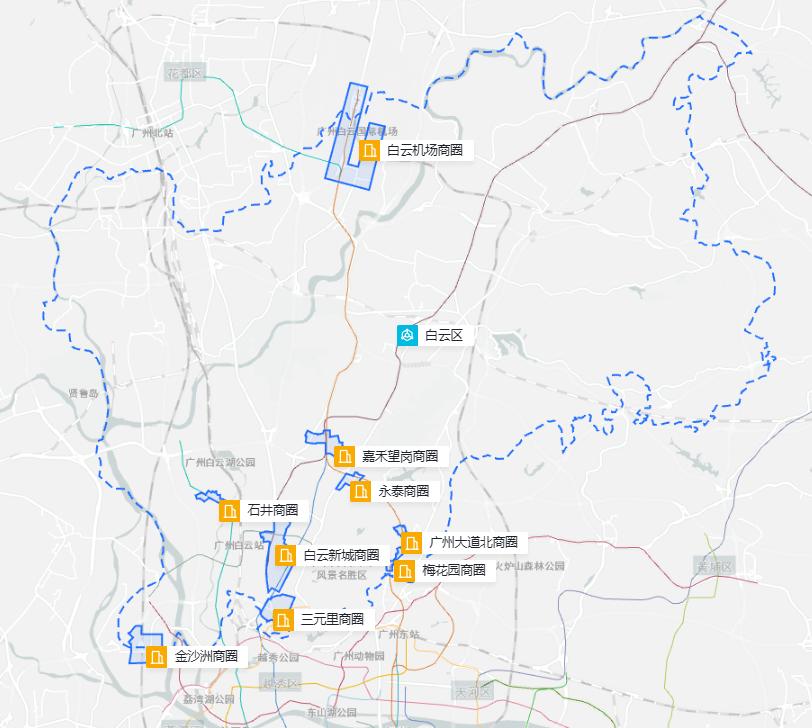
Image source: Urban Commercial Map Investment Research and Strategy System
Commercial districts closely follow the flow of people and transportation hubs and are formed around large - scale transportation nodes. The commercial districts in Baiyun District are mainly distributed along the subway lines, and the level of the commercial districts is highly related to the density of the rail transit network. The commercial districts with better development and the densest passenger flow are all located above transfer stations or along Line 3, which has the densest passenger flow in the Guangzhou subway.
Among them, the Baiyun New City Commercial District is the starting point of business in Baiyun District and is currently the commercial district with the largest number of projects and the best passenger flow performance in Baiyun District. The Baiyun New City Commercial District covers three subway lines and 6 subway stations, including a double - line transfer station, which can attract a large number of distant customers. Both the per - capita commercial area and the ability to siphon passenger flow far exceed those of other commercial districts in the region.
As a witness to the development of Baiyun's business from its start to its leading position, the evolution context of the Baiyun New City Commercial District is the best entry point for interpreting the business in Baiyun District.
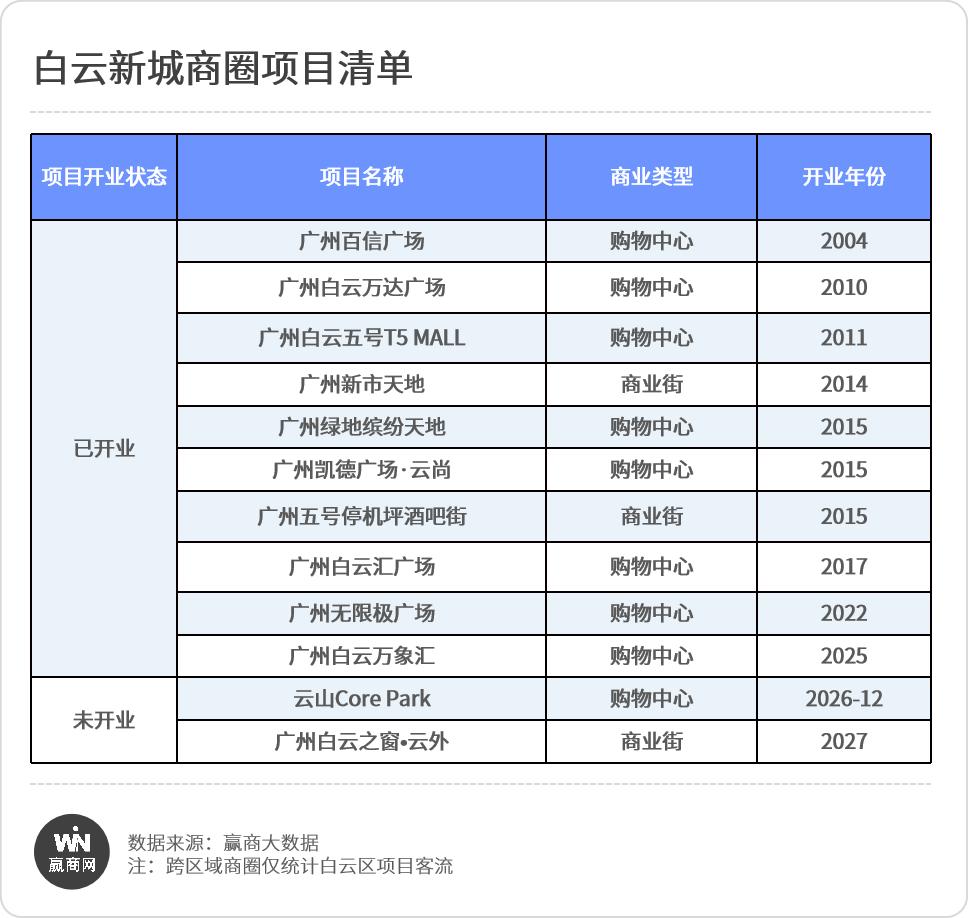
Development process and competitive pattern of the Baiyun New City Commercial District
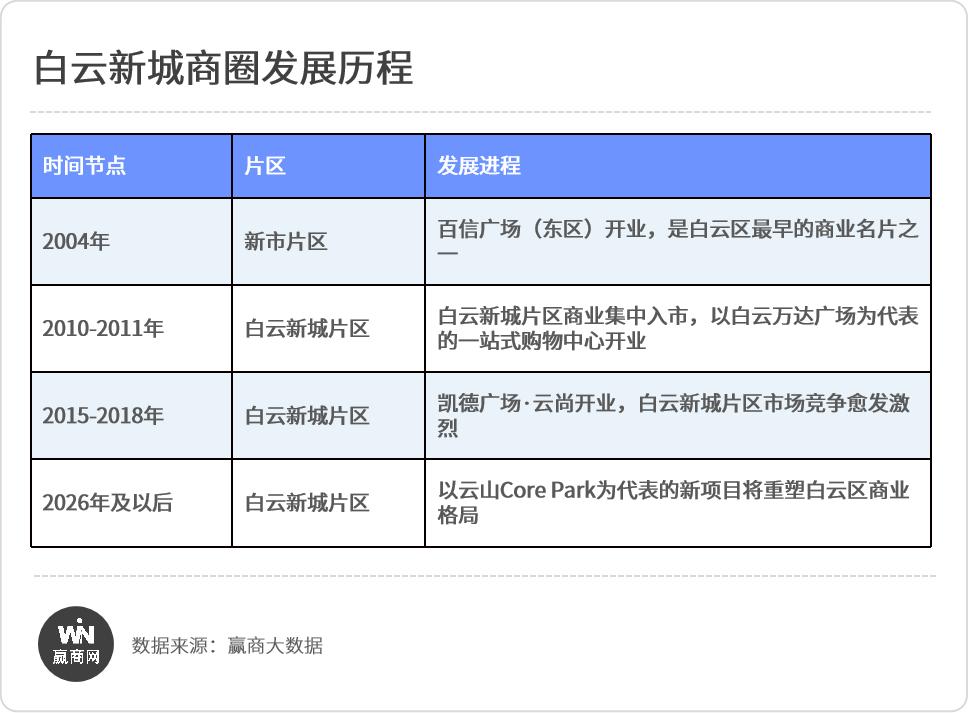
The commercial evolution of a region is the result of the interweaving and co - existence of the traction of population flow, the expansion of the commercial map, and the precipitation of consumption memory. Looking at the long - term, the Baiyun New City Commercial District was the main incremental market in Baiyun District before 2018; the growth has stagnated from 2018 to the present; and in terms of future increments, it has returned to the public's attention.
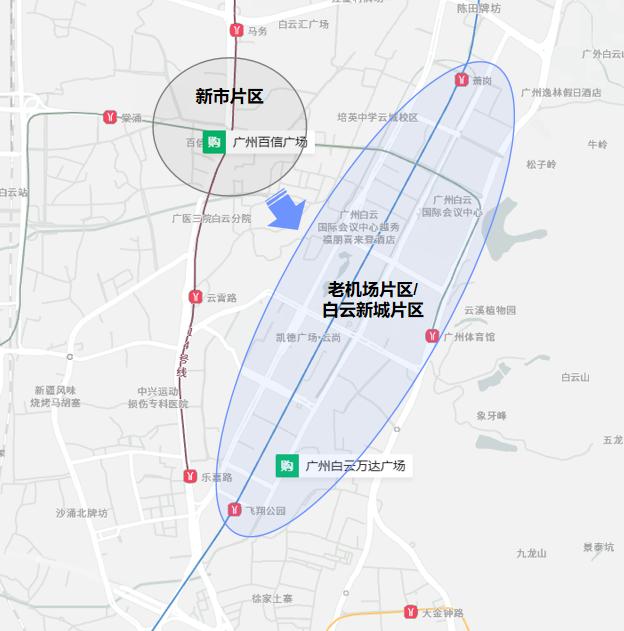
From the perspective of the project entry rhythm in the commercial district, the incremental explosion in the Baiyun New City Commercial District is mainly concentrated in four time periods, and geographically, it has developed from the Xinshi area in the north of the commercial district to the former airport area (i.e., the Baiyun New City area) in the south:
To this day, the above - mentioned commercial complexes still rank among the top in terms of passenger flow in the Baiyun New City Commercial District. From the product dimension, the Baiyun New City Commercial District has undergone several iterations. We have selected three of the most representative shopping malls to answer three questions respectively:
First generation: Baiyun Wanda Plaza - What kind of product should be developed when the market is blank?
Second generation: CapitaLand Plaza Yun Shang - What kind of product should be chosen when the market competition becomes fierce?
Third generation: Yunshan Core Park - How should late - comers adjust their product strategies when the market is saturated?
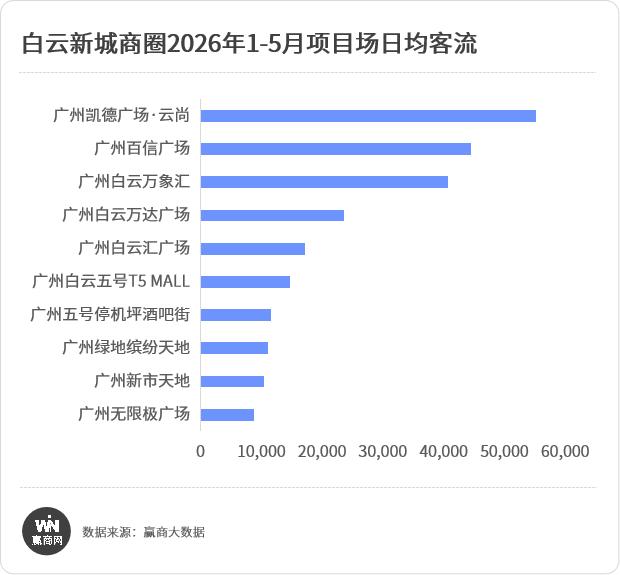
The commercial evolution of Baiyun New City: evolving in sync with urban planning
■ Baiyun Wanda Plaza: A product to fill the market gap, with its first - mover advantage squeezed by subsequent competition
Baiyun Wanda Plaza is the first one - stop shopping mall in the former airport area. This was once the starting point of China's aviation dream and one of the busiest airports in China. The "August 1st Inaugural Flight" was launched here in 1950, kicking off a new era of civil aviation.
In 2004, Baiyun Airport was relocated to Huadu District, and the airport function ceased. The original site was planned as "Baiyun New City" - a future super CBD rising at the foot of Baiyun Mountain. However, at that time, Guangzhou was fully developing the Zhujiang New City CBD, and the urban interface of the former airport site was rather chaotic, so the development of Baiyun New City was very slow.
It was not until 2010 that Line 2 of the Guangzhou subway was fully opened, with four stations - Feixiang Park, Baiyun Park, Baiyun Cultural Square, and Xiaogang - set up at the former airport site. As the development of the central urban area of Guangzhou was approaching saturation, some urban functions gradually overflowed, and the former airport area attracted more market attention. The first Wanda Plaza in Guangzhou by Wanda was located here. Before that, the business in the commercial district was mainly concentrated in the Xinshi area.
Urban Commercial Map Investment Research and Strategy System, compiled by the Research Center of Winshang
Baiyun Wanda Plaza consists of a large - scale commercial complex, Grade A office buildings, a hotel, and an outdoor pedestrian street, with a total construction area of 563,000 square meters and a commercial operation area of 96,000 square meters. It is the first Class A benchmark project of Wanda Group in Guangdong. Baiyun Wanda Plaza opened in just 11 months. For Baiyun New City, which was still in the early stage of development at that time, it played the role of a pioneer in population and industry introduction, aiming to quickly gather popularity in the new city.
After opening at the end of 2010, Baiyun Wanda Plaza was once in a slump due to inconvenient transportation and a consumption positioning that was out of touch with the surrounding area. After more than a year of cultivation, the Wanda Golden Street (Skylight Pedestrian Street) in Baiyun Wanda Plaza was re - positioned and renovated, and the renovated street quickly activated the passenger flow. In addition, there were no direct competitors in the area at that time, so Baiyun Wanda Plaza siphoned the surrounding passenger flow and became the most popular entertainment and leisure destination in Baiyun New City.
The turning point came in 2015 when Greenland Binfen Tiandi and CapitaLand Plaza Yun Shang in the same area as Baiyun Wanda Plaza opened one after another, intensifying the market competition. During this period, the Baiyun District government continuously improved the public cultural facilities in the new city, building supporting facilities such as the Guangzhou Children's Park and the Guangzhou Urban Planning Exhibition Center, further enhancing the popularity of the area.
The opening of CapitaLand Plaza Yun Shang intercepted a large number of family customer groups north of Baiyun Wanda Plaza. Since then, due to Baiyun Wanda Plaza's failure to effectively respond to the adjustment and renovation in a timely manner, with the continuous entry of competitors and the influence of external factors such as the pandemic, the passenger flow has been continuously declining.
It is reported that Baiyun Wanda Plaza will carry out a