There is no incremental market left globally. How far can the high-end transformation of mobile phone consumption in Africa go?
In the first quarter of 2026, the smartphone market in Africa grew by 3% year-on-year to 19.9 million units. Compared with the past, mobile phone consumption in some regions of Africa has started to show a "high-end" trend this year. In the first quarter, the average selling price of smartphones in South Africa increased by 4% year-on-year.
As the price of mobile phone memory has risen, global mobile phone consumption has been forced into a round of "upgrading" journey. The low-end mobile phones that were originally the most popular in the African market have been particularly severely impacted. Even if consumers don't want to give up, mobile phone manufacturers can't afford to wait.
Currently, the smartphone product line in the African market is gradually shifting to higher price ranges. The price range of $300 - $499 has increased by 43% year-on-year. Specifically, the strategies of major brands in Africa are no longer solely focused on the "low-end". Samsung is accelerating the layout of its high-end ecosystem, and Honor has launched the Magic series, continuously expanding in the mid - high - end market.
Moreover, Transsion and Xiaomi are also reshaping the "high - end ecosystem" in Africa.
In 2025, Transsion increased its R & D expenses by 17.23% overall, reaching as high as 2.95 billion yuan, aiming to break through in the mid - high - end market. In 2026, Xiaomi plans to shift its focus from the $80 - $150 price range to the mid - high - end $200 - $450 price range, with the Redmi Note series and Poco series as the main products.
However, apart from the common industry reasons such as the rising supply - chain costs and the involution in the low - end market, are there other factors driving the "upgrading" of smartphone consumption in Africa? And how long can this phenomenon last? The answers are far more complex than we think.
Are African young people "aspiring" to global mainstream consumption?
In our impression, the African continent is often associated with terms like "backwardness", "poverty", and "low consumption power". But in fact, in recent years, two key changes have been taking place in the African market: youthfulness and the rise of the middle class. Perhaps it is these two points that have changed the underlying ecosystem of the African consumer market.
In the future, higher - priced and brand - based consumption will become the mainstream trend on this continent.
Let's first look at the number of young people in Africa. Data released by the African Union and the African Development Bank show that the total number of Africans aged 15 to 35 exceeds 400 million, and it is expected to exceed 830 million by 2050. According to a report by the Global Times in November 2023, the average age of the population on the African continent is 19 years old.
With the popularization of smartphones and the mobile Internet, the living habits of these young people are gradually becoming similar to those of the global Generation Z. They also love short - videos and are easily influenced by online influencers. Facebook, Instagram, TikTok, WhatsApp, YouTube... have all "crowded" into the lives of African young people.
It is reported that young people in South Africa are as dependent on social media as those in any other continent.
According to the "Global Digital Marketing Insights" jointly released by We Are Social and Meltwater, South African users lead the global Internet usage list with an average daily online time of 9 hours and 24 minutes. Their highly sticky digital ecosystem has even become a key breakthrough for personalized applications and short - video apps to enter overseas markets.
Almost all - day digital living has increased the consumption desire of African young people. Taking TikTok as an example, public data shows that more than 60% of shoppers will make an immediate purchase after finding interesting products on TikTok, and more than 70% of South African consumers have increased their shopping expenditure because of TikTok.
At the same time, online life has also transformed smartphones from simple communication tools into the core carriers for African young people to access global civilization and build their social identities. For some African young people, a mobile phone represents their entire digital life: watching short - videos, social interaction, remote work, mobile payment, entertainment consumption...
They have different evaluation criteria for the performance, photography, and design of mobile phones. As a result, higher - priced smartphones are replacing feature phones. Even if their consumption ability is insufficient, the widespread consumer finance products can meet their upgrading consumption desires. It is reported that currently, Africa is one of the regions with the fastest - growing online lending markets in the world.
According to public data, the digital credit scale in Africa was about $50 billion in 2025, and the compound annual growth rate (CAGR) of the market from 2025 to 2030 is generally over 20%. "Yibencaijing" reported that in the African market, motorcycle installment plans, car installment plans, 3C electronics installment plans, home decoration installment plans... are emerging one after another.
It is quite normal for African young people to buy mobile phones on loan.
Of course, in addition to young people whose consumption level is not proportional to their desires, the rise of the "middle class" in Africa is the main force promoting consumption upgrading. As for how to define the "African middle class", especially in South Africa, the Institute of Free Strategic Marketing at the University of Cape Town states that a South African family earning about 22,000 rand (about 10,000 yuan) is considered to be part of the South African middle class.
In recent years, with the influx of overseas immigrants, locals entering government departments, and the disappearance of the color - based class system... the "new middle - class" group in South Africa is larger than expected. In 2022, the South African Statistics Bureau released data showing that the average monthly salary in South Africa was 26,032 rand (10,444 yuan), a 4.5% increase from the previous quarter's 24,813 rand.
This has continuously strengthened the user stickiness and high - end market dominance of high - end manufacturers such as Apple, Samsung, and Huawei in South Africa.
In addition, according to the predictions of Deloitte and the United Nations, by 2060, the proportion of the middle class in Africa is expected to rise to 42%. For many brands and merchants that are expanding overseas, this data means that African consumers will continuously promote the upgrading of consumption from basic daily necessities to brand - based and high - quality products.
Is this really the case? This seemingly global - integrated consumption spree actually has a hint of inexpressible bitterness.
Those shining life snippets on social platforms and those brand symbols regarded as the standard by online influencers are essentially a unified template tailored for global young people by consumerism. African young people have unknowingly become the last link in the global capital harvesting chain.
A destined - to - be - difficult "high - end transformation"
Anyway, the mobile phone manufacturers under increasing pressure have finally noticed the emerging high - end trend in African consumption.
Let's take a look at the goals and actions of major manufacturers in the African market:
Samsung's mid - high - end layout showed signs as early as 2024. In the fourth quarter of that year, Samsung's average selling price (ASP) in the African market increased by 9%, ranking first among Android brands. It is reported that Samsung is eager to become the "status symbol" for African consumers and capture the urban middle - class in Africa.
Xiaomi and Honor basically adopt a product - category strategy. While holding on to the low - end market, they vigorously promote their high - end product series in the African market. For example, in order to increase its popularity in Africa, Honor's Magic series launched a bundled plan of mobile phones and call minutes in cooperation with telecom operators MTN and Vodacom.
Transsion, known as the "King of Africa", focuses on technology and R & D for its high - end transformation on the basis of its existing market and brand recognition.
It is reported that foldable phones and AI phones have successively become Transsion's development directions, which has also led Transsion, which has long had R & D investment far lower than its peers, to increase its R & D costs. In 2026, the company plans to increase its R & D expenses by more than 10% year - on - year, with no less than 400 new patent applications and no less than 200 new authorized patents.
Of course, in 2026, global mobile phone manufacturers have to transform towards high - end products. As the price of global memory chips has soared, it has become difficult for low - end models to maintain profitability. Taking Transsion as an example, in the third quarter of 2025, Transsion's gross profit margin dropped to 19.47%, falling below 20% for the first time in nearly 10 years.
However, compared with other regions, building a high - end ecosystem in Africa is far more complex than expected, and purchasing power is just one aspect. There are still many obstacles for brands to overcome. Even if they increase R & D efforts, promote high - end product series, and increase the proportion of mid - high - end products, it is difficult to reverse the brand image in a short time.
It is reported that in the minds of the few high - end consumer groups in Africa, only Apple and Samsung are considered high - end mobile phone brands. For other brands to go high - end in this market, it will be a long - term process to cultivate consumer awareness. A typical example is Transsion, which grew up in the low - level African consumer market.
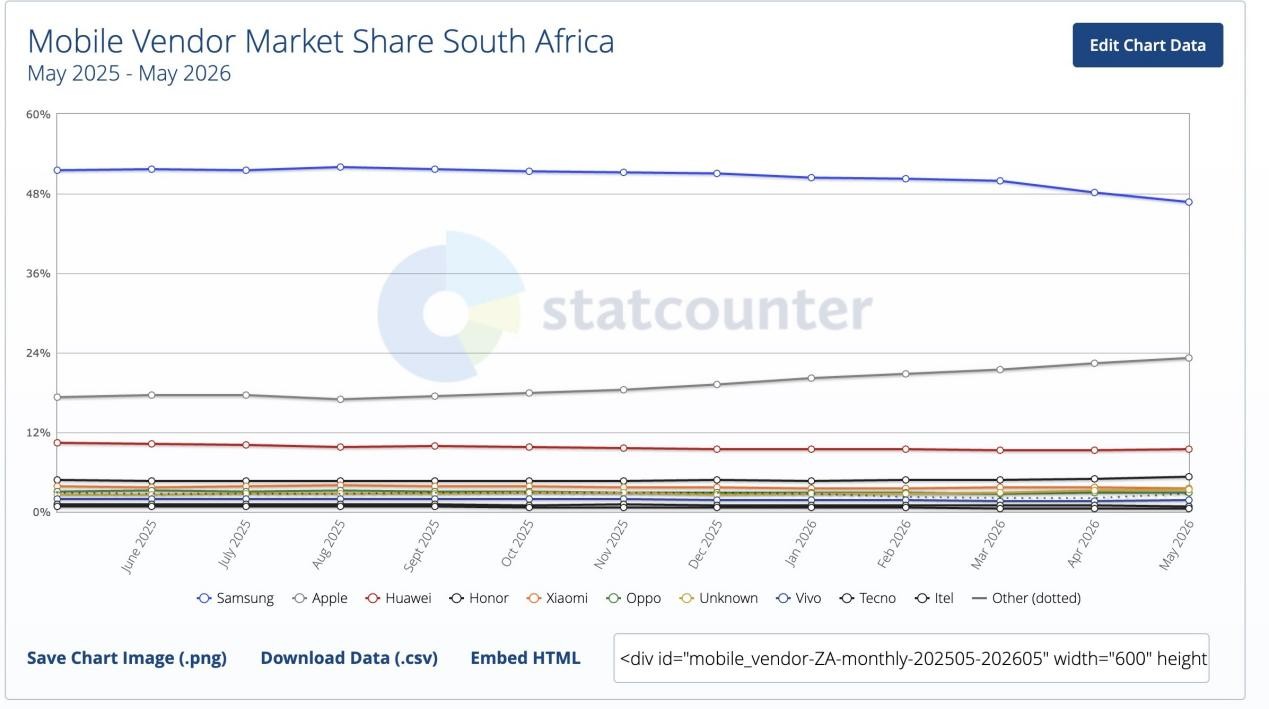
Surveys show that among African middle - class consumers, Transsion's "high - end brand recognition" is only 12%, compared with 45% for Samsung and 38% for Apple. From May 2025 to May 2026, Apple was the only brand with explosive growth in the South African mobile phone consumer market. From the trend chart, its growth rate was even faster than that of Samsung.
The "2026 Global Smartphone Industry Market Size, Market Share and Ranking of Leading Enterprises at Home and Abroad" by the Zhongyan Puhua Industry Research Institute shows that the market share of high - end models priced above $600 in the global market has exceeded 35%. Apple, Samsung, and Huawei dominate the high - end market. In the first half of 2025, Apple alone accounted for 62% of the global high - end mobile phone market share, and Samsung accounted for 20%.
In mature markets that have been dominated by Apple and Samsung for more than a decade, emerging brands can still find a place. However, in the African continent where consumption upgrading has just begun, the so - called "identity recognition" currently only belongs to traditional high - end brands.
When African middle - class consumers only recognize Samsung and Apple, other manufacturers' high - end transformation is destined to require more efforts. For example, in order to narrow the image gap with Apple and Samsung, Transsion has to further increase its marketing efforts. In the first quarter of 2026, Transsion's sales expenses reached 1.317 billion yuan, a 15.36% increase year - on - year.
It is worth noting that in the context of rising raw material costs, this money may not be wasted.
In the first quarter of 2026, Transsion's operating income was 16.2 billion yuan, a 24.58% increase year - on - year; its net profit attributable to shareholders was 700 million yuan, a 42.90% increase year - on - year; its gross profit margin was 22.00%, a 2.74 - percentage - point increase year - on - year and a 3.84 - percentage - point increase quarter - on - quarter; its net profit margin was 4.58%, a 0.76 - percentage - point increase compared with the same period last year.
The question is, how much more money does Transsion need to spend in the future to establish a true high - end image in the minds of African middle - class consumers?
What is happening on this continent may be the most absurd and cruel paradox in the global mobile phone industry.
Is there no "emerging market" for mobile phones globally?
In 2026, the global smartphone shipment volume is bound to be an ugly figure.
In May, Counterpoint released a new report showing that the global smartphone shipment volume in 2026 is expected to plummet by 13.9% year - on - year, shrinking to about 1.08 billion units. This figure not only sets a new annual low since 2013, but also the decline is further expanded compared with the 12.4% predicted in February.
More importantly, the emerging markets that were previously highly anticipated by major manufacturers have also underperformed.
Let's first look at the Middle East, where the wealthy gather.
According to Omdia's research data, in the first quarter of 2026, the smartphone market in the Middle East (excluding Turkey) decreased by 6% year - on - year to 11 million units. During the same period, the smartphone shipment volume in India decreased by 5% year - on - year to 30.9 million units; the total shipment volume of the Southeast Asian smartphone market was 21.6 million units, a 9% year - on - year decline.
In Africa, although the shipment volume in the first quarter of 2026 was one of the few growing in the global emerging markets. Considering the industry situation, the bottom - level consumption in Africa will surely be affected, and the "high - end" consumption is not yet fully mature. Therefore, Omdia predicts that the African smartphone market may decline by 28% in 2026.
In 2026, can't the global smartphone industry find any emerging markets?
Judging from the overall sales trend, the answer seems to be yes. Mobile phone manufacturers can only find solutions from the "product categories" again.
First of all, getting rid of low - cost mobile phones is the first step. Data shows that in the first quarter of 2026, the market share of new mobile phones priced below 1,000 yuan in China dropped sharply from 22% in 2023 to 2.7%. The same is true globally. Although the shipment volume is decreasing, the average wholesale price of global smartphones has increased by 14% year - on - year.
Secondly, continuing to follow the "high - end route", foldable phones and AI phones have almost become the choice of all mobile phone manufacturers.
Especially foldable phones, after being popular for two years, are making a comeback. In 2026, Chinese mobile phone manufacturers are increasing their investment in foldable phones again. According to the prediction of TrendForce, in 2026, the shipment volume of foldable phones in China will reach 12 - 13 million units, a 20% - 30% increase year - on - year.
But can the "product - category" path help manufacturers find a way out? In fact, the market sales of foldable phones have not been good in the past two years.
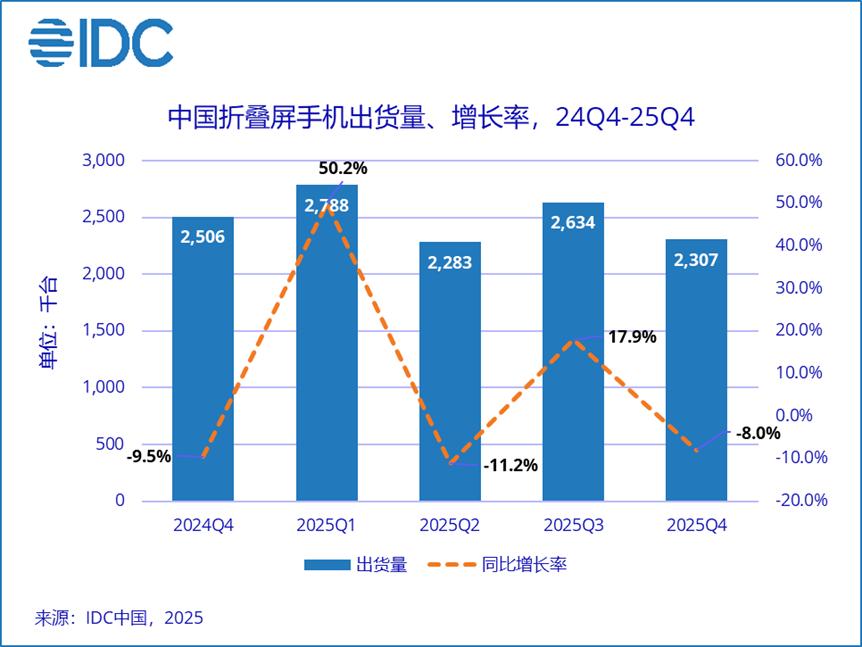
According to IDC data, from 2022 to 2025, the year - on - year growth rates of the shipment volume of foldable phones in China were 118%, 114.5%, 30.8%, and 9.2% respectively, showing a continuous decline. However, brands have no other choice because the high price of foldable phones can better buffer the cost pressure.
Compared with foldable phones, AI phones are at the peak of their novelty.
According to a report by the Economic Information Daily, more than 80% of consumers in the Chinese market mentioned that when considering their next mobile phone, most of them are paying more and more attention to the AI experience. Some institutions predict that in 2026, the new - generation AI phones will become the mainstream, with an expected shipment of 147 million units, a 31.6% increase year - on - year, accounting for 53% of the overall market.
But no one knows