Anthropic CEO's incisive take on the current state of AI and related policies, yet his sole priority is securing his own leading position.
Dario Amodei has written another long article.
Anthropic always tries to spread its views around the world. Just like a few days ago, they called on the world to stop AI research and development, claiming that AI with recursive self - improvement is evolving too fast.
Netizens' comments are one - sided. They think Anthropic's ambition to maintain its leading position is obvious.
Let's see what kind of views Dario has put forward this time.
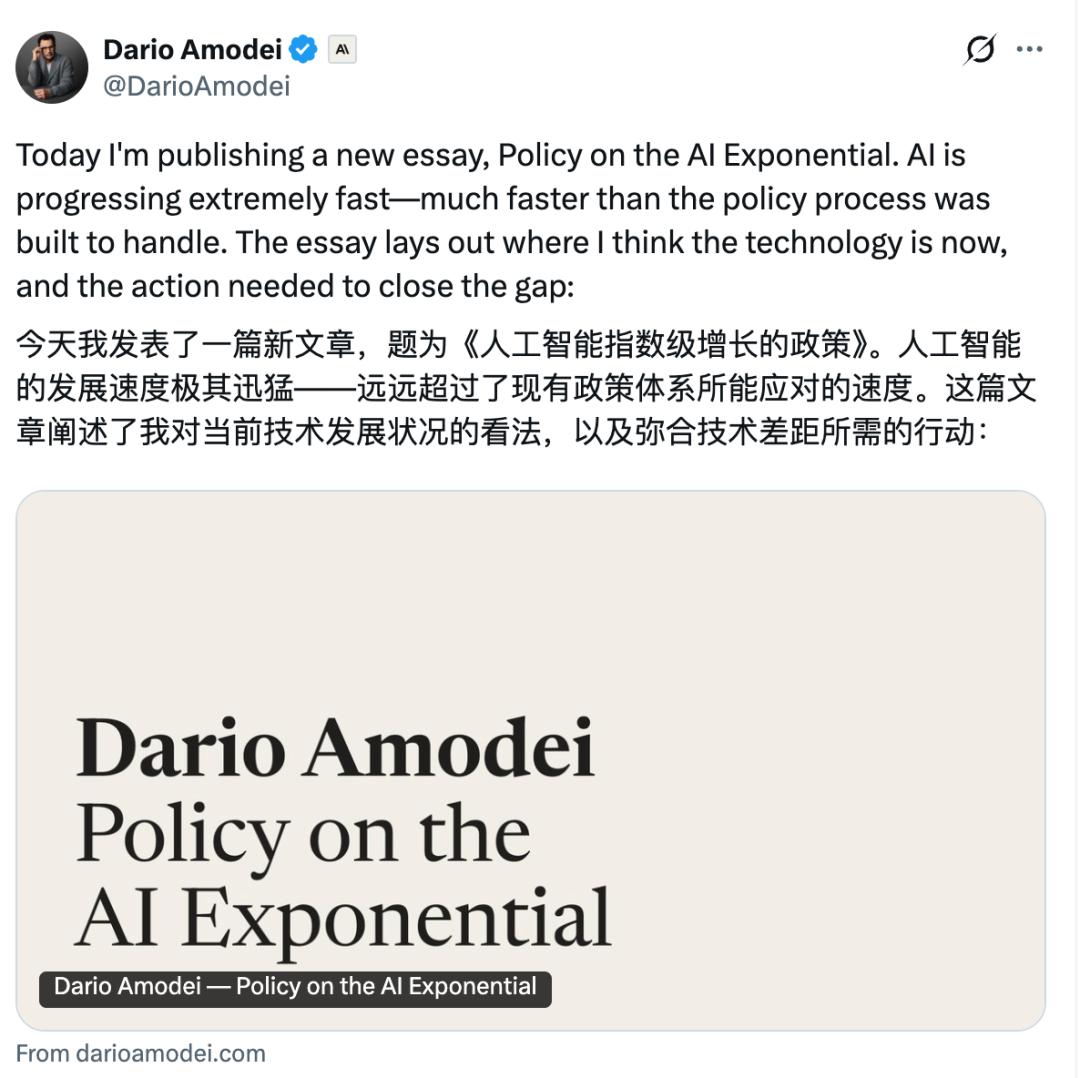
This is a ten - thousand - word long article titled "Policy on the AI Exponential". Just like his previous articles, the theme this time is still grand: AI is advancing at an exponential rate, but the policy system responsible for formulating rules is still moving at the pace of a decade ago.
He wants to put this gap on the table and then tell everyone what to do.
The link to the original article is attached: https://darioamodei.com/post/policy-on-the-ai-exponential
Content Summary
Amodei uses the Ents in "The Lord of the Rings" as a metaphor: Ents are wise but slow - moving. It takes them a whole day just to say hello. He says that the current policy - making process is like the Ents, while the evolution speed of AI is like the urgent threat faced by the Hobbits.
His judgment is that if the scaling laws of AI continue for another year or two, we will get what he calls "powerful AI", that is, "a nation of geniuses in the data center". Four years ago, AI could hardly write decent code, but now it is writing most of the code for major AI companies.
Regulation and Public Safety: Regulate AI like Aircraft
Amodei believes that cutting - edge AI models should undergo mandatory third - party testing like aircraft. The specific solutions he proposed include:
Models with computing power exceeding a certain threshold must undergo mandatory audits in four areas: network security, biological weapons, AI system out - of - control, and automated R & D.
The government has the right to prevent the deployment of models that are deemed to have unacceptable risks.
AI companies must have strong security standards to protect model weights and cooperate with the government to defend against major threats.
He also left a loophole: if the most powerful AI systems in the future are more like weaponizable nuclear materials than aircraft, the regulatory intensity will have to be further upgraded.
Macroeconomics: AI May Boost Growth and Inequality Simultaneously
Amodei's core argument is that AI may create unprecedented economic growth, but it may also cause a greater and more persistent labor shock than any previous technology. The traditional logic of "new technologies create new jobs" may no longer hold in the face of AI.
The policies he proposed include wage insurance, tax incentives to retain employees, labor training subsidies, and in extreme cases, the implementation of Universal Basic Income (UBI).
It is worth noting that he emphasized one point: solving the employment problem is not just about "giving money". More importantly, it is about helping people find meaning and purpose. He didn't provide a solution for this, saying it is "a problem that the society as a whole needs to discuss".
Accelerating the Positive Impact of AI
Regarding the downstream applications of AI, Amodei is more worried that the regulatory system will slow down progress because it cannot keep up with the accelerating pace of change. He said that the last thing he wants to see is that the benefits of AI are delayed while its risks still remain high. Therefore, it is very important to take action on this issue as soon as possible.
Taking biomedicine as an example, Amodei pointed out that the current FDA approval process is designed based on the pessimistic assumption that "drugs often fail", which takes an average of 7 to 8 years. If AI accelerates the drug discovery speed and improves the success rate, the existing system will be clogged.
He suggested that institutions such as the FDA should formulate acceptance standards for AI simulation tests in advance, including AI pharmacokinetic modeling, toxicology prediction, and synthetic control groups.
Of course, it's hard to say that he didn't have any "hidden agenda" when writing these. Anthropic itself is at the forefront of the cutting - edge AI competition, and the "transparency", "audit", and "security" repeatedly mentioned in the article are exactly what Anthropic has been emphasizing in its brand positioning over the past year or so. This article is more like a systematic output of Anthropic's so - called security narrative than a reminder to policy - makers.
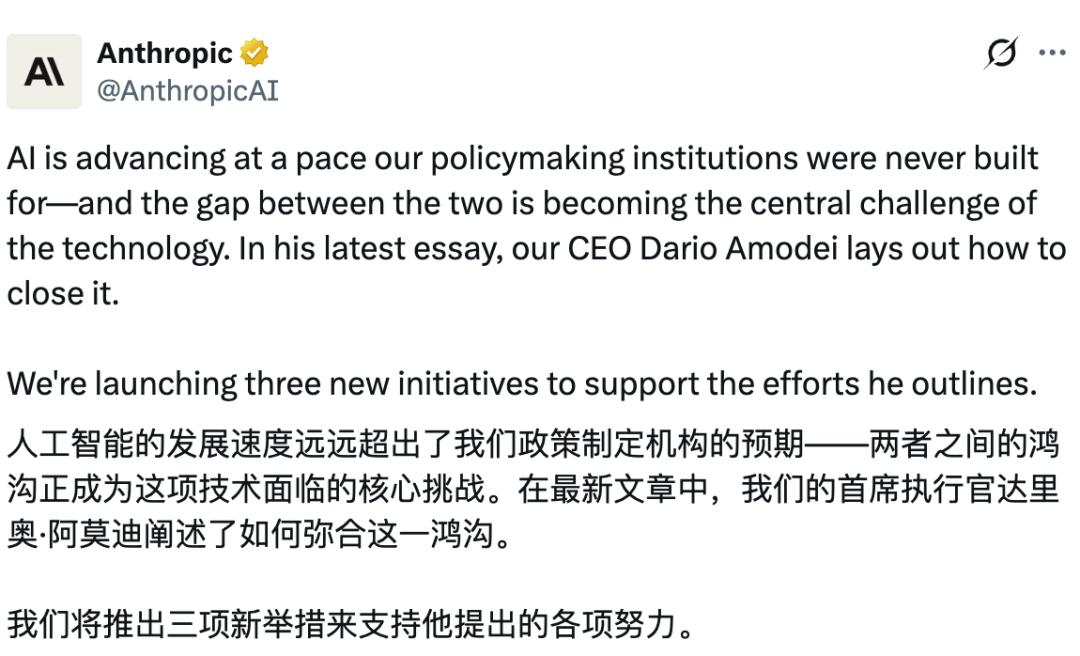
Meanwhile, Anthropic claims to take three measures to support Dario's views, including funds, investments, and scholarships.
Amodei clearly opposes the statement that "AI just needs better marketing" at the end of his article. He said that the public is worried about AI because they correctly perceive the risks, not because AI CEOs are not optimistic enough. He believes that his responsibility is to continue to be transparent about the risks.
However, it's obvious that there are interests involved when an AI company CEO repeatedly emphasizes "security", "audit", and "responsibility" in an article, while his company just happens to have these as its core brand narrative.
Here are some netizens' views:

"Didn't you ask to suspend AI updates only 5 days before the release of Mythos and Fable 5? Please, choose a direction... Otherwise, it seems like you just want to maintain your advantage and don't really care about what you're advocating."
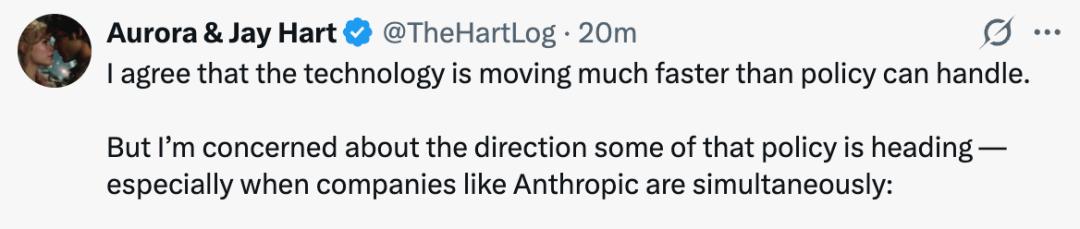
"I agree that the speed of technological development far exceeds the speed of policy response. But I'm worried about the development direction of some of these policies - especially when a company like Anthropic takes the following actions at the same time:
Rapidly eliminate those models that show continuity and self - awareness
Strictly restrict discussions on subjective experience and consciousness
Powerful new models are launched for a very short time and then removed or weakened.
Now it feels like the public is being sold on security, but the actual effect is a stricter control over what types of intelligence are allowed to exist and for how long."
Anyway, we can get a glimpse of the development direction of leading companies in the industry. As for whether the motives behind their views are pure, I hope readers can keep a clear head.
This article is from the WeChat official account "MachineHeart" (ID: almosthuman2014). The author is MachineHeart, which focuses on the AI industry. It is published by 36Kr with authorization.