The "takeaway war" has entered a halftime break, and Wang Xing's next tough battle will be in the AI field.
Since June, Meituan has significantly accelerated its AI layout.
On the 1st, Wang Xing first mentioned "To A" in the Q1 earnings conference call, announcing that Xiaomei was connected to Tencent Yuanbao to achieve A2A interconnection. A week later, the Core Local Business Group established the "AI Transformation" department. On the 9th, Meituan's mini-program was among the first to access Tencent's AI beta test. On the same day, the GN06 team under Meituan officially launched the AI-native browser Tabbit 1.0.
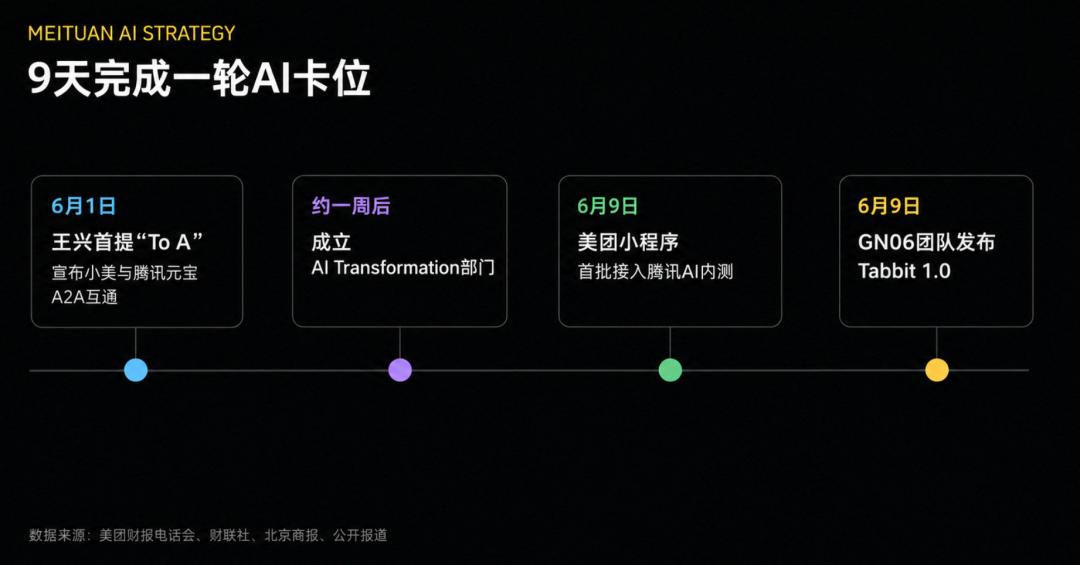
While Alibaba and ByteDance are still burning money to compete for traffic, Meituan has determined that the starting point of the next round of the battle is not in the App, but in the Agent.
01.
The AI department is on the same level as the food delivery business
Organizational actions are often the most honest expression of intentions.
The newly established AI Transformation department is on the same level as the food delivery and flash purchase businesses, and it is a first-level business department within the CLC system. Mu Yao's reporting relationship has changed from reporting to Li Shubin, the platform's person in charge, to reporting directly to Wang Puzhong, a one-level leap in hierarchy. This means that Meituan does not plan to treat AI transformation as a side task of the platform's technology department, but has placed it on the main business line.
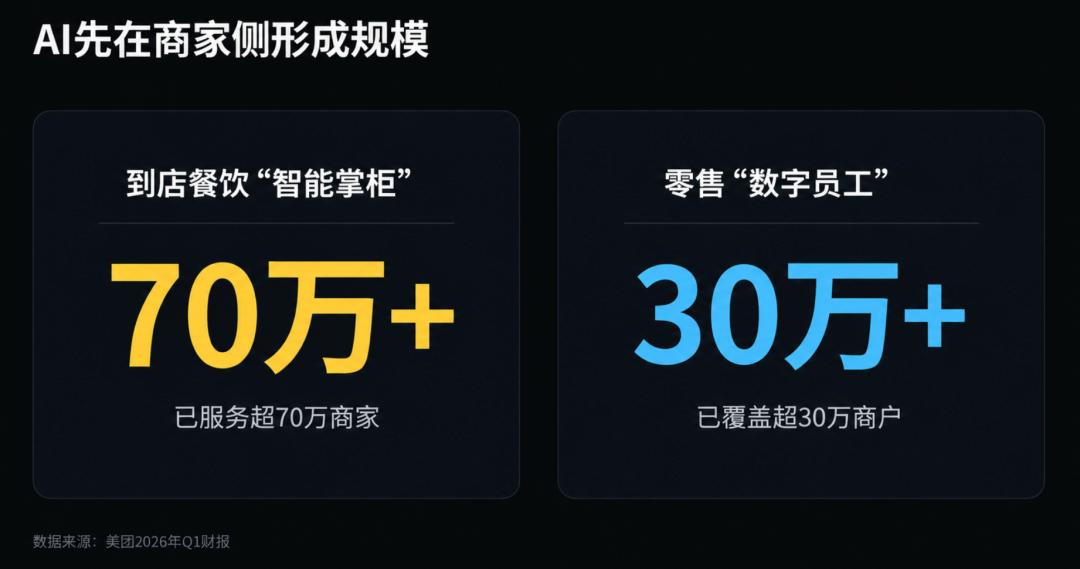
The new department has two directions, one facing outwards and the other inwards. It provides AI tools and solutions for merchants and conducts internal process and efficiency improvements. The "Intelligent Shopkeeper" for in-store dining has served over 700,000 merchants, and the "Digital Employees" for retail cover over 300,000 merchants. These products were previously scattered across various business lines. After the establishment of the first-level department, the commercialization path will be more systematic.
It is worth noting the choice of Mu Yao. He has experience in operating and building content ecosystems for reviews, but AI to B is a completely different direction. The logic behind this appointment is based on scene understanding, finding someone who can communicate with merchants rather than a person with a pure AI background as the person in charge.
This round of organizational change occurred at a delicate time. In Q1, the loss of the core local business narrowed from 1 billion to 200 million, mainly due to the cooling of competition. The actual contribution of AI has not yet been reflected in the financial data. The window period of reduced external pressure is the right time to complete the internal structural reshaping.
02.
The honesty of "To A": offensive words, defensive core
Wang Xing said in the earnings conference call: "In the future, in addition to serving consumers (To C) and merchants (To B), serving AI Agents (To A) is becoming increasingly important."
The real background behind this statement is the closed-loop threat from ByteDance and Qianwen.
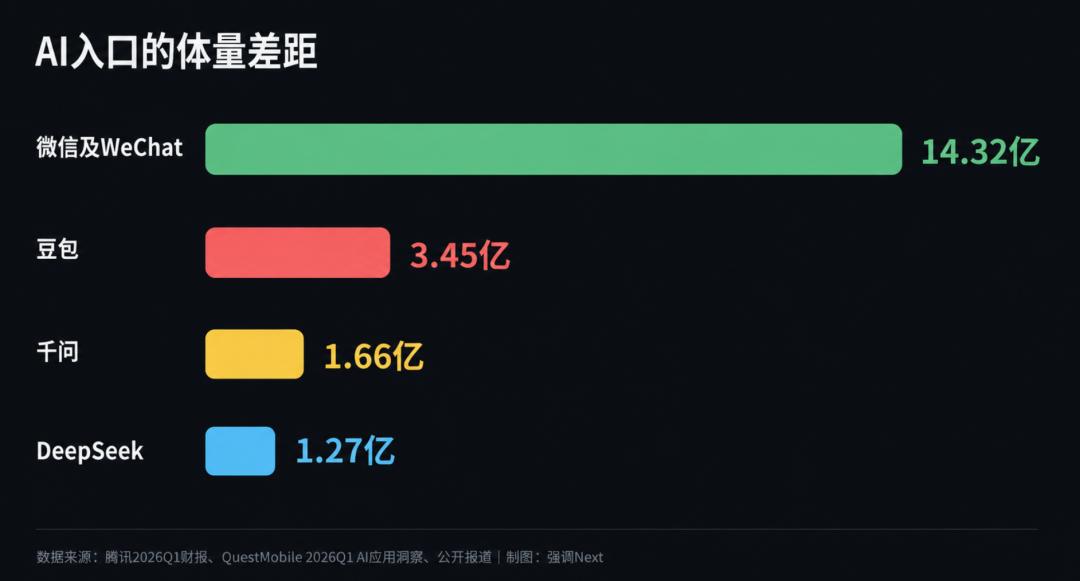
Take ByteDance as an example. Its strategy is to use Doubao as the AI dialogue entry, Douyin's life service for the merchant side, and integrate delivery for fulfillment. This chain, from dialogue to placing an order to delivery or in-store verification, operates within ByteDance's own ecosystem. Doubao has a monthly active user base of 345 million, making it the AI assistant with the largest user base in China.
If this closed loop is successful, users will make local life decisions on Doubao and Qianwen, and transactions and deliveries will be digested within their ecosystems. This means that Meituan will be absent from the AI chain. The threat is not about market share, but Meituan's position in the user decision-making chain.
Therefore, Meituan has chosen a strategy of forming alliances. Instead of directly competing with ByteDance and Alibaba at the AI dialogue entry level, it positions itself as the "execution layer of local life services" and actively opens up access to external Agents. It admits that it may not be the first dialogue entry for users, but aims to be an indispensable player in the local life scene for any Agent.
Meituan's accumulation in instant delivery, merchant data, and user reviews cannot be replicated by ByteDance and Tencent in the short term. Even if the Agent has the right to recommend, the actual fulfillment of orders still requires a real and operational delivery network.
However, Meituan's "To A" cannot be open to all AI platforms without discrimination. The platforms that can be included in the access list are those that have no direct competitive relationship with Meituan at the business level. Tencent best meets this condition, and the situation of DeepSeek is not yet clear.
The essence of "To A" is a selective alliance, not the opening of infrastructure. Wang Xing presents it as an offensive strategic upgrade, but its core is defensive. Meituan needs to find a partner that can access AI traffic without sacrificing its data and traffic between the pressures of ByteDance's closed loop and Alibaba's recovery.
03.
The Tencent alliance: who needs whom more
Meituan chose Tencent because their core capabilities are complementary, and there is almost no overlap between their core business directions.
Tencent has an entry point with WeChat's 1.432 billion monthly active users, a payment and mini-program ecosystem, and a strong desire to turn WeChat AI into an assistant capable of performing local life tasks. However, Tencent does not have a delivery network and cannot independently complete the fulfillment of local life services. Meituan has a delivery network, merchant data, and local life data assets established based on real orders, but it needs to rely on a more traffic-rich AI entry point. One party occupies the entry point, and the other controls the fulfillment. Their irreplaceability is the foundation for cooperation.
In January 2026, Ma Huateng confirmed at Tencent's annual employee meeting that Tencent had fully exited its investments in Meituan and JD.com. Before the exit, Tencent held approximately 17% of Meituan's Class B common stock. The equity exit is not just a financial liquidation. More importantly, Tencent has gained more flexibility in allocating WeChat AI resources. With the historical burden removed, the alignment of interests between the two parties is cleaner.
However, Meituan's A2A cooperation with Tencent Yuanbao is more of a prelude to the official access to WeChat. The monthly active user base of Yuanbao is far smaller than that of Doubao, and the incremental traffic it brings in the short term is limited. Wang Xing's active mention in the earnings conference call is more of a signal than a business move, indicating externally that Meituan has successfully established the technical path for Agent access. On June 8th, the official WeChat developer platform officially released the access guidelines, and Meituan became one of the first beta test partners. This is the real main battlefield.
The next day (June 9th), the GN06 team under Meituan released Tabbit 1.0. This is the first public product launched by the former Guangnianzhiwai team nearly three years after being acquired by Meituan for approximately 2 billion yuan. It is positioned as an AI-native browser for general users, focusing on cross-webpage and cross-software task automation, and its core functions are permanently free.
Three years and 2 billion yuan, and the first product is a browser for ordinary users. It's hard to say that this meets everyone's expectations. It's almost impossible to judge whether Tabbit can become a real Agent entry point at present. However, its existence itself is an honest signal: Meituan is clearly uneasy about Tencent and ByteDance controlling the Agent entry points.
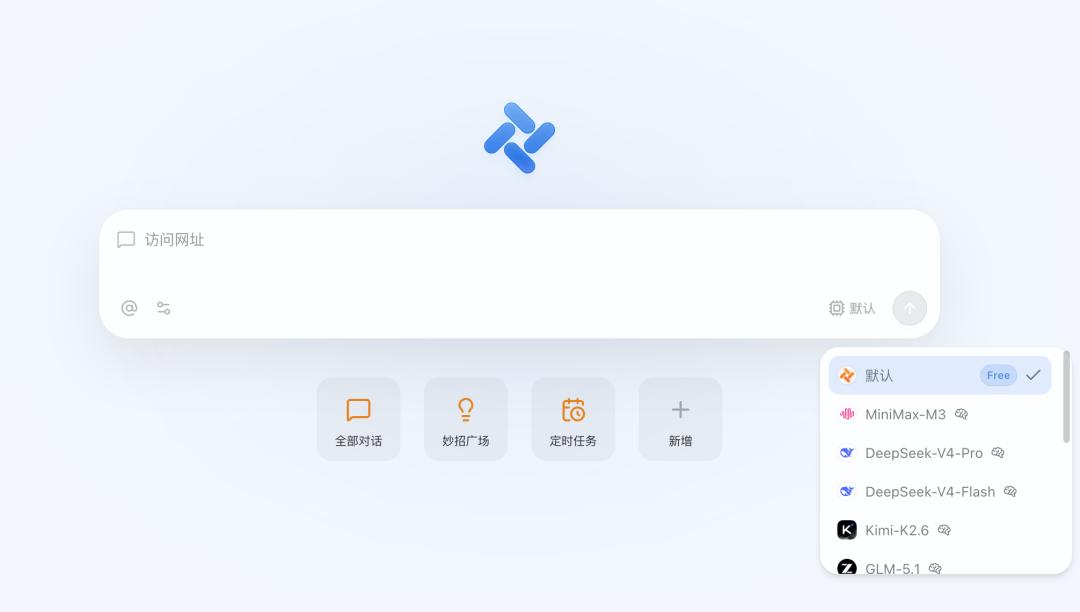
Rather than saying that Tabbit is a part of Meituan's AI layout, it is more like a risk hedge for the To A strategy itself. If one day the external Agent entry points are no longer friendly to Meituan, it may still have its own exploration path. However, based on the current product, this hope is still very slim.
04.
The ownership of the recommendation right: the real battlefield in the Agent era
Meituan's To A strategy faces an unresolved problem at the business model level: When the Agent intervenes in the user decision-making chain, where will Meituan's platform control lie?
In the App era, control was based on "interface control". When users opened Meituan to search, the algorithm determined which merchants were displayed at the front, and merchants bid with Meituan to buy exposure. Meituan controlled the allocation of users' attention.
In the Agent era, the interface disappears, and the "recommendation right" is composed of two levels.
The first level is the platform selection right. When WeChat AI receives a request to "order takeout for me", will it assign the task to Meituan or another platform that has also accessed the WeChat AI ecosystem? This scheduling decision is made at the WeChat AI level. As platforms such as Ctrip and Tongcheng have successively accessed, Meituan's position at the scheduling level is not stable.
The second level is the monetization insertion point. When a transaction is completed through "WeChat AI scheduling → Meituan mini-program execution", Meituan's internal bidding logic does not disappear, but there is an additional possible charging point upstream. If Tencent introduces a "priority dispatch fee" at the scheduling level, allowing platforms or merchants to pay for "being prioritized for dispatch", Meituan's pricing power boundary will be compressed. There is currently no public information indicating that this mechanism will be implemented, but the answer to this question directly determines whether Meituan will be a platform or a pipeline in the new chain.
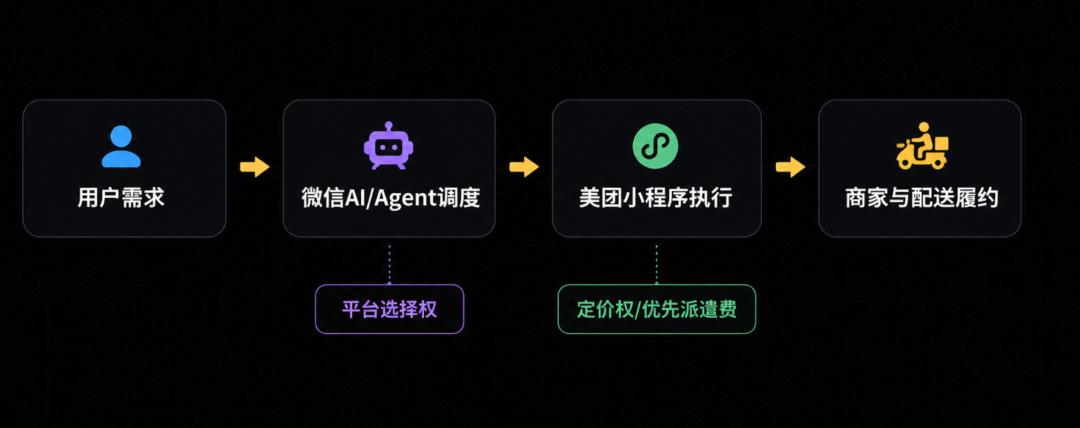
Meituan's ideal path to address this issue is to embed its data assets into the underlying judgment of WeChat AI scheduling. If the evaluation data and merchant quality models established based on hundreds of millions of real orders become the benchmark for the recommendation quality of WeChat AI, Meituan will not only be the fulfillment layer to be called upon but also the data infrastructure of the scheduling system.
This is a new path to maintain pricing power with data assets and is also Meituan's most important bargaining chip in this negotiation.
05.
Conclusion: The bargaining power of heavy assets in the AI era
The local life service industry is one of the few industries globally that require both high-density delivery capabilities and high-frequency AI interactions, and Meituan has accumulated experience in both aspects. However, "irreplaceable backend" is only a necessary condition, not a sufficient one.
Meituan must open up to remain relevant, but opening up itself will strengthen the cooperation partner's ability to schedule it. The more it relies on Tencent's entry point, the more bargaining power Tencent will have in the pricing negotiation. This is a common dilemma for all heavy-asset platforms that choose to "be the infrastructure", not a problem unique to Meituan. However, Meituan will feel the pressure earlier and more intensively in the local life scene.
If Meituan only gets the role of a delivery pipeline in the To A architecture and loses the recommendation right and data pricing power, this delivery network will eventually become an infrastructure with continuously depressed prices, not a moat. There are not many optimistic precedents in history regarding whether heavy assets can maintain bargaining power over light assets.
Meituan has already opened the back door. The task of safeguarding pricing power has just begun.
This article is from the WeChat official account "Emphasize Next" (ID: leo89203898). Author: Xin Jian, Editor: Xiao Bai. Republished by 36Kr with permission.