NPO, soars into the spotlight
Recently, a research report by SemiAnalysis bearish on CPO has stirred up waves in the optical communication market. The report points out that the large-scale commercialization of CPO will be postponed to 2028 - 2029. The bottlenecks lie in the low packaging yield, high integration difficulty, and unobvious cost advantage.
Subsequently, Morgan Stanley echoed, predicting that the global optical engine shipments in 2027 will only reach 6 - 7 million units, far lower than the market - expected 20 - 30 million units. It also judged that the real explosive growth of CPO may start from 2028. The period from 2026 to 2028 is a transition period when plug - gable modules, NPO, and copper interconnections coexist. NPO is exactly the "middle way" between CPO and traditional solutions.
The discussions between the two major institutions from afar may have shaken the market's fantasy of the short - term rapid popularization of CPO. However, behind the differences, a more fundamental understanding is accelerating to take shape: the full - scale roll - out of CPO may take more time, but the demand of AI clusters for high - bandwidth optical interconnection has not decreased at all.
Against such an industrial background and under the game of expectations, NPO has quietly stepped into the center of the stage.
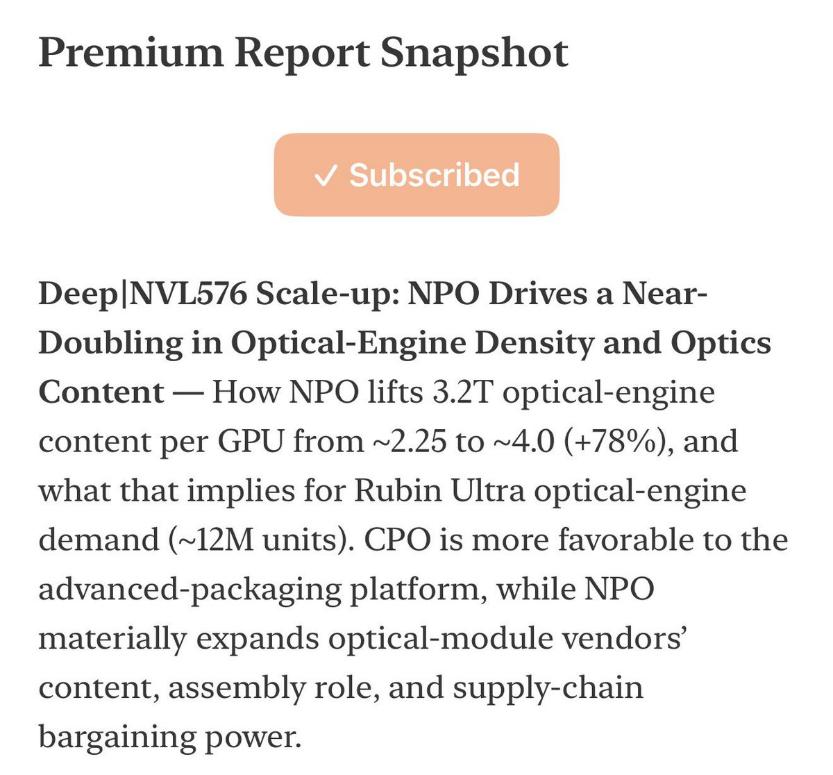
In NVIDIA's newly launched Rubin Ultra NVL576 design, the usage of NPO optical engines has nearly doubled. The content of 3.2T optical engines per GPU has increased from about 2.25 to about 4.0, a significant increase of 78%. At the 2025 Huawei Connect Conference, Huawei announced its Ascend roadmap, clearly stating that it will introduce its self - developed Hi - ONE silicon optical engine in the Ascend 960 super node, with a single - module bandwidth of 8Tb/s, achieving all - optical interconnection within the super node.
Meanwhile, TSMC's silicon photonics integration platform COUPE officially entered mass production in 2026, and huge orders from NVIDIA, Broadcom, Google, etc. have landed one after another.
These choices from leading players indicate that NPO may have become the standard configuration for leading AI architectures. They also prove that NPO is not a cheap substitute for CPO, but the most accessible and commercially logical technical path in the current evolution process of AI clusters from "copper interconnection" to "optical interconnection".
This phenomenon makes people think deeply: Why is CPO highly sought after but progressing slowly, while NPO has successfully completed the last - mile journey from the laboratory to the computer room? What kind of industrial logic and game pattern are hidden behind the evolution of this optical interconnection technology route?
Why NPO?
The expansion of AI cluster scale and copper cables approaching physical limits
As is well - known, the exponential growth of AI chip bandwidth is pushing traditional copper interconnections to the physical limit.
From Blackwell to Rubin, the single - chip bandwidth has increased from hundreds of gigabits to the terabit - per - second level. The effective transmission distance of copper cable SerDes has been significantly shortened from the traditional 100cm to 5cm. When the communication rate increases to multiple terabits per second per chip, copper cables have lost ground comprehensively in multiple dimensions such as distance, power consumption, heat dissipation, and wiring density - the transmission distance of SerDes has been sharply compressed, the cables have become overly bulky, panel installation has become infeasible, and the margins for heat and power transmission have been exhausted.
Under this trend, the upgrade from copper to optical within the rack has become an irreversible industrial evolution route.
Taking NVIDIA's Rubin Ultra NVL576 architecture as an example, the system does not adopt a radical all - optical interconnection scheme but chooses a "copper - optical hybrid" architecture that balances cost and performance, which is also the most mainstream implementation form in the current industry.
Inside a single NVL72 cabinet, the short - distance interconnection between GPUs still uses copper cables. Relying on the advantages of low cost, low latency, and flexible wiring of copper cables, it ensures the communication efficiency of high - density computing units within the cabinet. The NVL576 is composed of 8 NVL72 cabinets. For long - distance and high - bandwidth interconnection across cabinets, optical interconnection schemes such as NPO and CPO are fully adopted, completely breaking through the attenuation bottleneck of long - distance copper cable transmission and supporting the stable operation of a super - large - scale cluster of 576 cards.
This means that optical interconnection has entered the rack - level Scale - up scenario from the data - center - level Scale - out scenario for the first time, and the industrial boundaries are gradually being broken.
Looking at the entire industry, the upgrade from copper cables to optical interconnection within the rack is an irresistible trend. When the cluster scale exceeds hundreds or thousands of cards, the three major shortcomings of copper cables in terms of power consumption, bandwidth, and distance are infinitely magnified, and the replacement process of optical interconnection continues to accelerate, which creates a broad application foundation for NPO.
Demand resonance and the "position - grabbing war" among industrial chain manufacturers
On the other hand, global AI computing power giants have simultaneously bet on NPO, forming a strong demand resonance. At the same time, cloud providers at home and abroad such as Google, Alibaba, and Tencent have followed suit, turning NPO from a single - enterprise solution into an industry - wide consensus.
As a vane in the field of AI computing power, NVIDIA's NVL576 architecture mentioned above has become the core engine for the large - scale application of NPO. This architecture continues the copper - optical hybrid design, and the number of 3.2T NPO optical engines carried by a single GPU has increased by 78%, and the overall usage of optical engines has nearly doubled.
Combined with the prediction data of securities firms, the shipment volume of NVL576 complete machines is expected to reach 8,300 sets in 2027. After conversion, it corresponds to a huge demand of 21.6 million FAUs (Fiber Array Units), which will directly drive the full release of the production capacity of upstream optical devices. And Jensen Huang has clearly stated that the next - generation architecture Feynman will debut in 2028. Each upgrade of the architecture means a further increase in the density of optical engines.
Huawei is also accelerating this process.
At the 2025 Huawei Connect Conference, Huawei announced the roadmap for its Ascend AI chips in the next three years, planning to launch a series of products such as 950PR, 950DT, 960, and 970 between 2026 and 2028, with the goal of releasing a new generation almost every year and doubling the computing power.
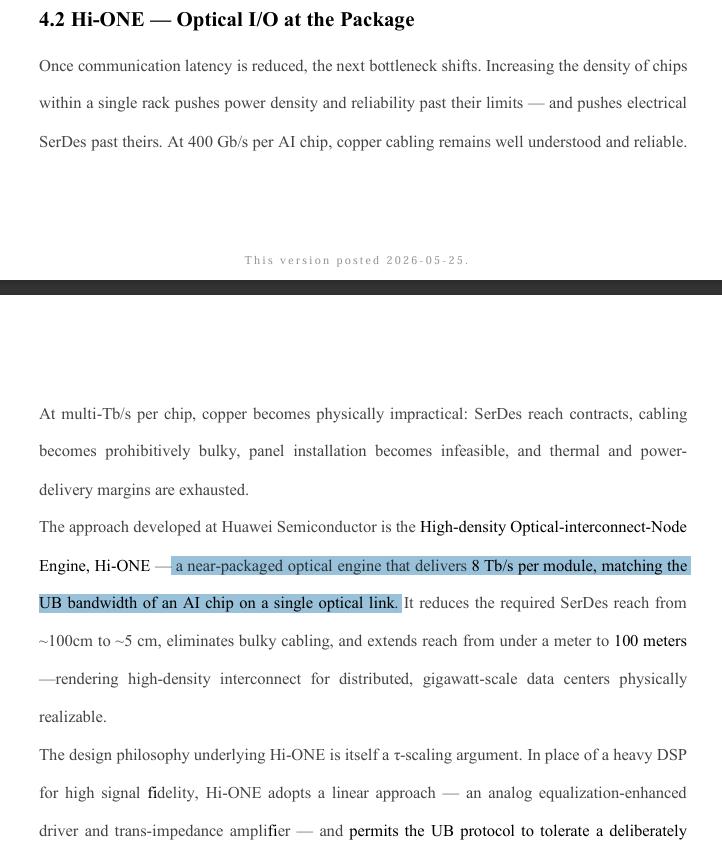
The Hi - ONE optical engine is exactly designed to support this continuously expanding cluster scale - it shortens the required SerDes transmission distance from about 100cm to about 5cm, and at the same time extends the transmission distance from less than 1 meter to 100 meters, making the distributed, GW (gigawatt) - level super - large - scale data centers across cluster deployments physically possible.
During the upgrade process of the Ascend 950 and Ascend 960 series chips, Huawei is equipped with the Hi - ONE NPO optical engine, with a single - module bandwidth of 8Tb/s, ranking among the top echelon in the industry. According to the roadmap, the scale of the Ascend cluster will gradually expand from the Ascend 910C SuperPod (2024) with only 384 NPUs to the Ascend 950 SuperPod (2026) with 8,192 NPUs, and the bandwidth will increase from 301TB/s to 16.3PB/s. The implementation of the ten - thousand - card - level super - computing cluster will continue to drive the iteration and shipment of high - specification NPO products.
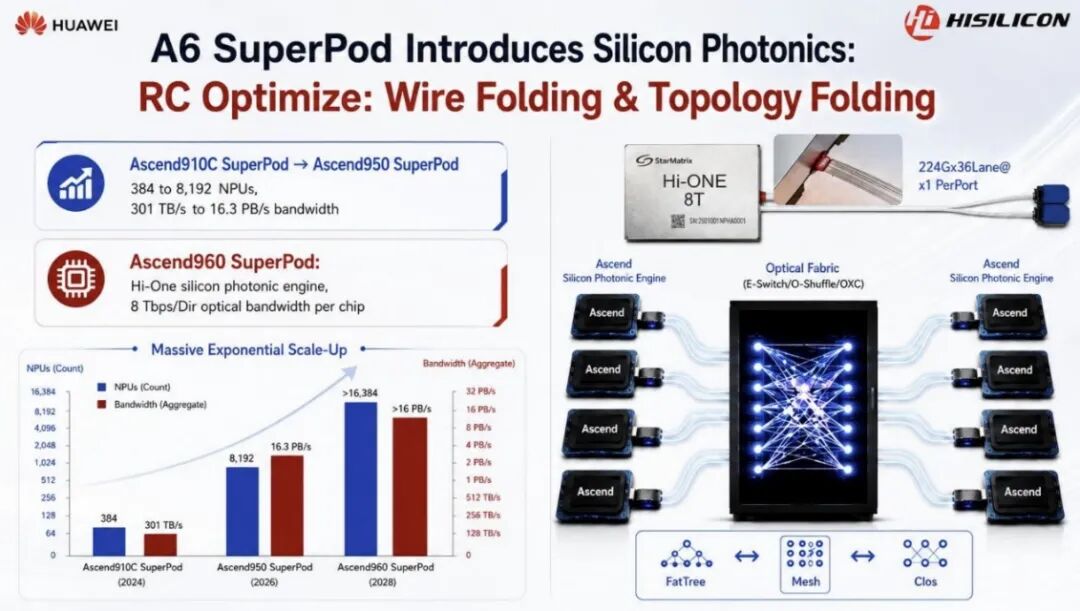
At the same time, Huawei's Hi - ONE solution innovatively adopts a DSP - free + all - optical expansion architecture, streamlining the signal processing unit, further reducing transmission power consumption and latency, and creating a differentiated technical route different from overseas manufacturers.
Driven by the two leading companies, key players in the global industrial chain have entered the market one after another, accelerating their position - taking.
TSMC's COUPE silicon photonics integration platform officially entered mass production in 2026. It integrates electrical ICs and optical ICs and is paired with advanced packaging technologies such as CoWoS and SoIC, becoming the "key foundation" of the CPO/NPO industrial chain.
At the beginning of 2026, Google officially placed an order for 12 million NPO optical modules for the construction of the next - generation TPU v7/v8 computing power cluster, with the delivery period concentrated from Q3 2026 to Q2 2027. Cloud providers such as Alibaba, Amazon, Microsoft, and Tencent are also promoting the in - cabinet optical interconnection transformation in their new - generation server clusters. The layout direction of the entire industry around the Scale - up high - density architecture tends to be consistent, the industry penetration rate of NPO is increasing rapidly, and at the same time, the demand for upstream core components such as InP lasers and silicon photonics chips continues to rise.
Lightmatter officially announced in early June 2026 that it would join the NVIDIA NVLink Fusion ecosystem and launch Passage CPO and NPO products. It is said that these products can reduce the demand for optical fibers and connectors by 50%, thus solving the bandwidth bottleneck that limits the expansion of AI clusters. This cooperation marks that optical interconnection technology has become an official part of NVIDIA's AI factory architecture. By joining the NVLink Fusion ecosystem, Lightmatter will help customers' semi - customized XPUs directly connect to NVIDIA's switching chips through its CPO and NPO products, achieving high - bandwidth and low - latency links between cross - vendor chips within the ecosystem.
Broadcom also launched the industry's first 3nm 400G/channel optical PAM - 4 digital signal processor Taurus™ BCM83640 in 2026, supporting 1.6T transceivers and various linear optical devices. More notably, Broadcom launched a VCSEL - NPO engine solution for the AI Scale - up network, which has an extremely high energy efficiency of about 1pJ/bit and an outgoing bandwidth density of over 0.6Tbps/mm. At the same time, it is expected to achieve cost - effectiveness comparable to that of active copper cables, providing a highly competitive optical interconnection solution for the next - generation AI infrastructure.
In addition, the Israeli Fabless manufacturer NewPhotonics has also launched an NPO solution, further enriching the NPO industrial ecosystem.
It is worth noting that the demand resonance has gone beyond NPO itself. Citigroup predicts that Scale - up side CPO switches will start to be deployed by the end of 2027, and the demand in 2027 will reach 169,000 units. NPO is giving rise to a larger - scale optical interconnection ecosystem, rather than just the replacement of a single product.
The explosion of terminal demand has opened up short - term growth space for the NPO track.
From the perspective of single - product demand, the typical power consumption of an NPO module is about 9W, which has an obvious energy - efficiency advantage compared with traditional plug - gable optical modules, meeting the core demand of data centers for cost reduction and efficiency improvement. This also makes 2026 - 2027 the period of explosive deployment of NPO. Just the NVIDIA NVL576 product line alone will create a demand for tens of millions of optical engines, becoming the core pillar of the track's growth.
In terms of the global market scale, the global NPO market scale reached $3.8 billion in 2025. Institutions predict that from 2026 to 2034, the compound annual growth rate (CAGR) of the NPO market will reach 19.3%, and by 2034, the overall market scale is expected to climb to $18.6 billion, achieving nearly a five - fold increase in ten years, with considerable growth space.
It can be seen that the investment and industrial value of the NPO track have been recognized by the entire market. The rise of NPO is not only a switch of technical routes but also a systematic reconstruction of the industrial chain value distribution. Optical engine manufacturers gain higher added value, the penetration rate of silicon photonics increases rapidly, the packaging platform becomes a strategic position - taking link, and overseas giants are accelerating their entry... All these changes point to the same conclusion: NPO is promoting the optical communication industry to upgrade from the standard component model to the high - value system integration model.
The key to NPO's victory in the technical route game
In the evolution process of AI optical interconnection, multiple routes such as plug - gable optical modules, NPO, CPO, and OCS are developing in parallel, and the technical paths are far more fragmented than the market imagines. In this long - term route game, NPO has become an intermediate solution connecting traditional solutions and ultimate technologies with its precise positioning, balanced performance, and implementation advantages.
In terms of technical form, the evolution of optical interconnection shows a clear gradient of integration: plug - gable optical modules → NPO (Near - Package Optics) → CPO (Co - Packaged Optics). The three form obvious gradient differences in the position of the optical engine, integration difficulty, and operation and maintenance ability. Each level of leap sacrifices a certain degree of maintainability in exchange for higher bandwidth density and lower power consumption.
Traditional plug - gable optical modules place the optical engine on the front panel of the device. The electrical transmission path is the longest, and the power consumption and latency are relatively high. However, they have the advantages of high standardization, convenient hot - plug maintenance, and a mature supply - chain ecosystem, and are the mainstream solution in current data centers.
NPO places the optical engine in a relatively independent area on the same substrate as the ASIC, significantly shortening the electrical transmission path, reducing power consumption and latency, and at the same time retaining the independent plug - gable feature of the optical engine. It also finds a practical compromise solution among integration degree, thermal management, maintenance cost, and the industrial chain ecosystem.
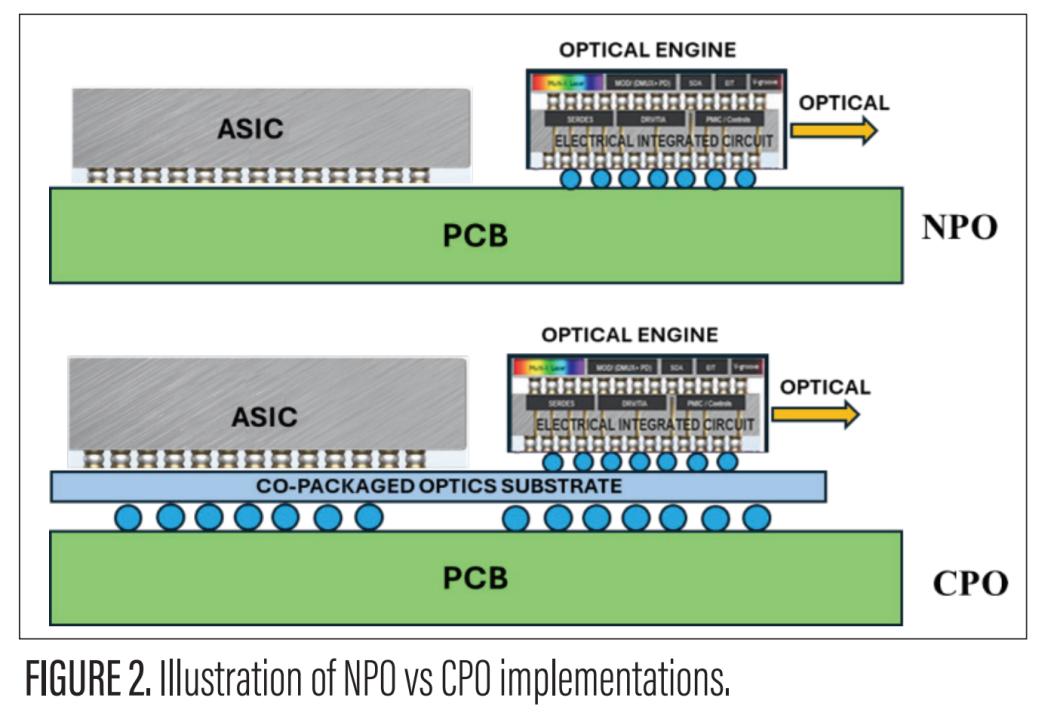
Image source: AI God's Talk
CPO completely integrates the optical engine and the ASIC in the same package, compressing the electrical path to the micron level and achieving the optimal signal integrity. However, the cost is a closed ecosystem, non - hot - pluggability, and difficult heat dissipation. The difficulty of large - scale mass production is extremely high, and it faces the "impossible triangle" of being unable to balance reliability, cost, and maintainability.
The definition given by industry experts is clear: the essential difference between CPO and NPO lies in whether the optical engine and the ASIC share the same substrate.
For a long time, the market has believed that CPO will eventually replace the NPO solution. However, from multiple dimensions such as technical form, commercialization process, and implementation scenarios, the relationship between NPO and CPO may not be a simple substitution relationship, but rather which one is more suitable for the current industrial stage.
Analyzed from the aspects of technical form and commercialization process, although CPO has an advantage in theoretical performance, it currently faces multiple industrial