Chinese automobiles are dominating overseas markets, and the era of "the winner takes all" is approaching.
This year, there were early signs of how tough the overall environment in the automotive market was.
Although the number of new cars emerging in the market far exceeded expectations, the harsh situation exposed in the terminal market was still too tangible. A large number of dealers went under one after another. Consumers' attitudes towards buying cars were greatly affected by external policies, and the entire automotive market was shrouded in a depressive atmosphere.
Many thought that the accelerated market penetration of pure electric vehicles could fill the sales gap caused by the sharp decline of fuel - powered vehicles. However, the consecutive decline in domestic terminal sales from April to May was extremely eye - catching. In such a situation, where should Chinese car companies go?
When everyone's attention quietly turned to overseas markets, I believe the answer is obvious. The vast overseas market has a larger capacity than the domestic market and strong profit points, and no one can ignore it.
Since the automotive industry has rapidly transformed towards electrification, the continuous improvement of China's automotive industry around three - electric technologies has shown early signs. However, the situation from 2026 to now is more remarkable than at any previous time.
In May, China exported 930,000 vehicles (passenger vehicles + commercial vehicles), a month - on - month increase of 3.1% and a year - on - year increase of 68.7%. It has remained above the level of 900,000 vehicles for two consecutive months. From January to May, a total of 4.059 million vehicles were exported, a year - on - year increase of 63%.
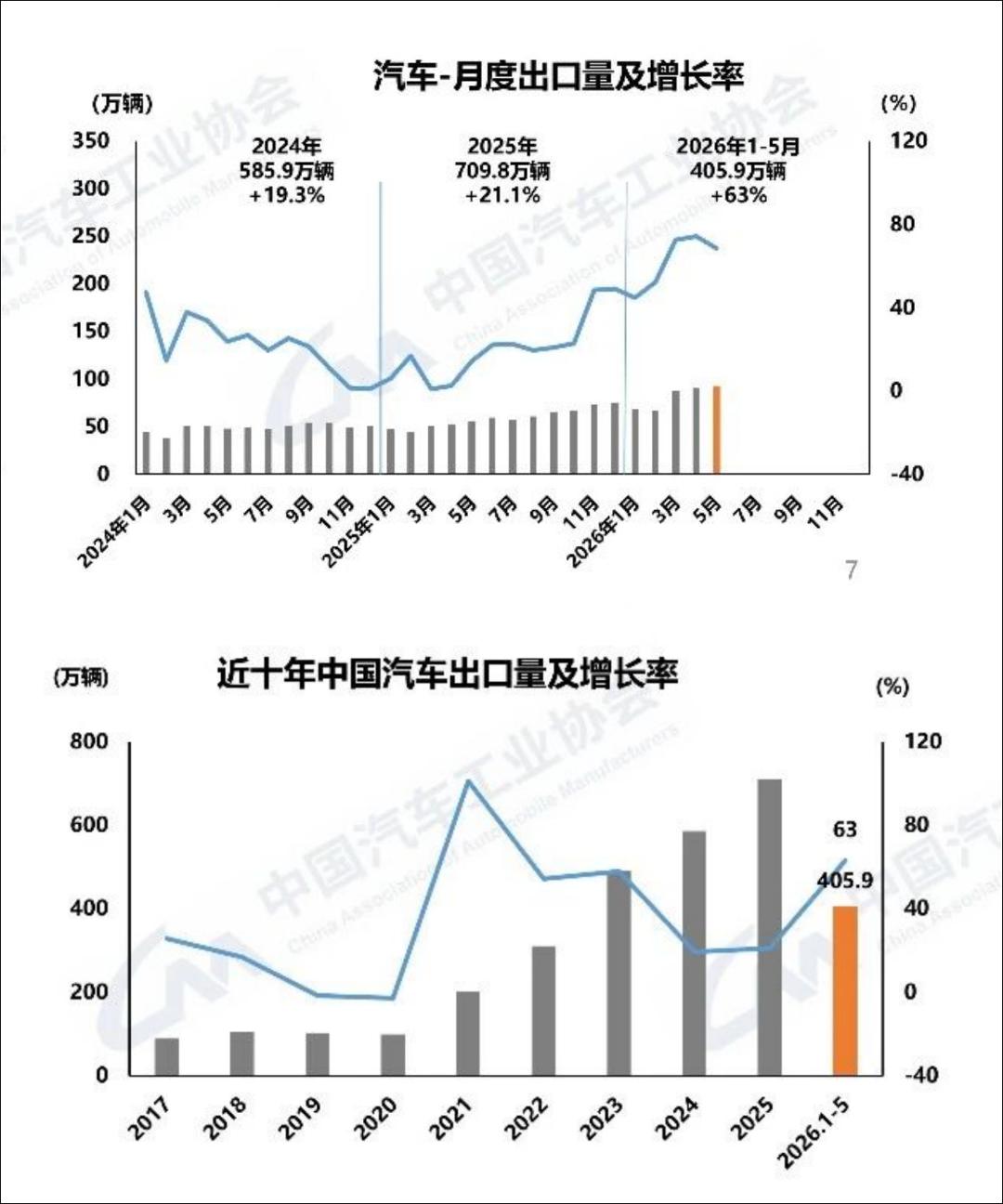
This is the latest export data released by the China Association of Automobile Manufacturers. From this, we can clearly see that for Chinese automobiles, vehicle exports have been upgraded from a "supplementary channel" to one of the main engines driving the industry's growth. Chinese car companies will also step out of the role of "pure trade export" and make great strides towards "localized production + ecological expansion overseas".
Without accident, as the vehicle export volume in the first half of this year is infinitely close to 5 million, the annual export volume of 10 million has become an obvious result.
This era is the heyday for Chinese automobiles. Of course, when Chinese automobiles create history in such a short time, it means that the situation of the winner - takes - all will occur soon. Whether in the domestic or overseas markets, after several powerful car companies divide up the market, the existing pattern of the automotive industry will undergo another major change.
01
The Outbound Expansion of Chinese Automobiles Is Irresistible
Since this year, facing multiple impacts such as insufficient domestic demand, high costs, and tightened policies in the entire industry, we are well aware that the Chinese automotive market generally shows the characteristics of "pressured domestic demand and strong foreign trade". In other words, when the growth rate of the domestic market slows down and profits decline simultaneously, the efforts of automobile exports will be more intense than in previous years.
Last year, data showed that China's annual vehicle export volume reached a new high again, with 7.098 million vehicles, a year - on - year increase of 21.1%. Compared with 5.859 million vehicles in 2024 and 4.91 million vehicles in 2023, it achieved continuous leap - forward growth, showing strong resilience in the industry's development early on.
With such changes, the export volume in 2026 will always excite the entire industry again. However, no one expected that under the continuous influence of black - swan events such as the Middle East conflict, the momentum of China's automobile exports would be so crazy.
Of course, seeing that the domestic passenger vehicle market declined by 23.4% year - on - year in May, from January to May, the domestic sales volume of passenger vehicles decreased by 23.8% year - on - year to 6.791 million vehicles. Among them, only 497,000 traditional fuel - powered vehicles were sold in May, a year - on - year decrease of 41.8%. The cumulative sales data so far this year has also decreased by 1.243 million vehicles compared with the same period last year, to 3.203 million vehicles. All signs indicate the difficult situation of Chinese automobiles in the domestic market.
To relieve this dilemma, "export" is the only and best solution.
Excluding commercial vehicles, 809,000 passenger vehicles were exported in May, a year - on - year surge of 73%. From January to May, the total export volume reached 3.528 million vehicles, a year - on - year increase of 69.6%. Meanwhile, whether it is the export volume of new - energy passenger vehicles reaching 435,000 in May or the export volume reaching 1.792 million from January to May, both have more than doubled year - on - year.
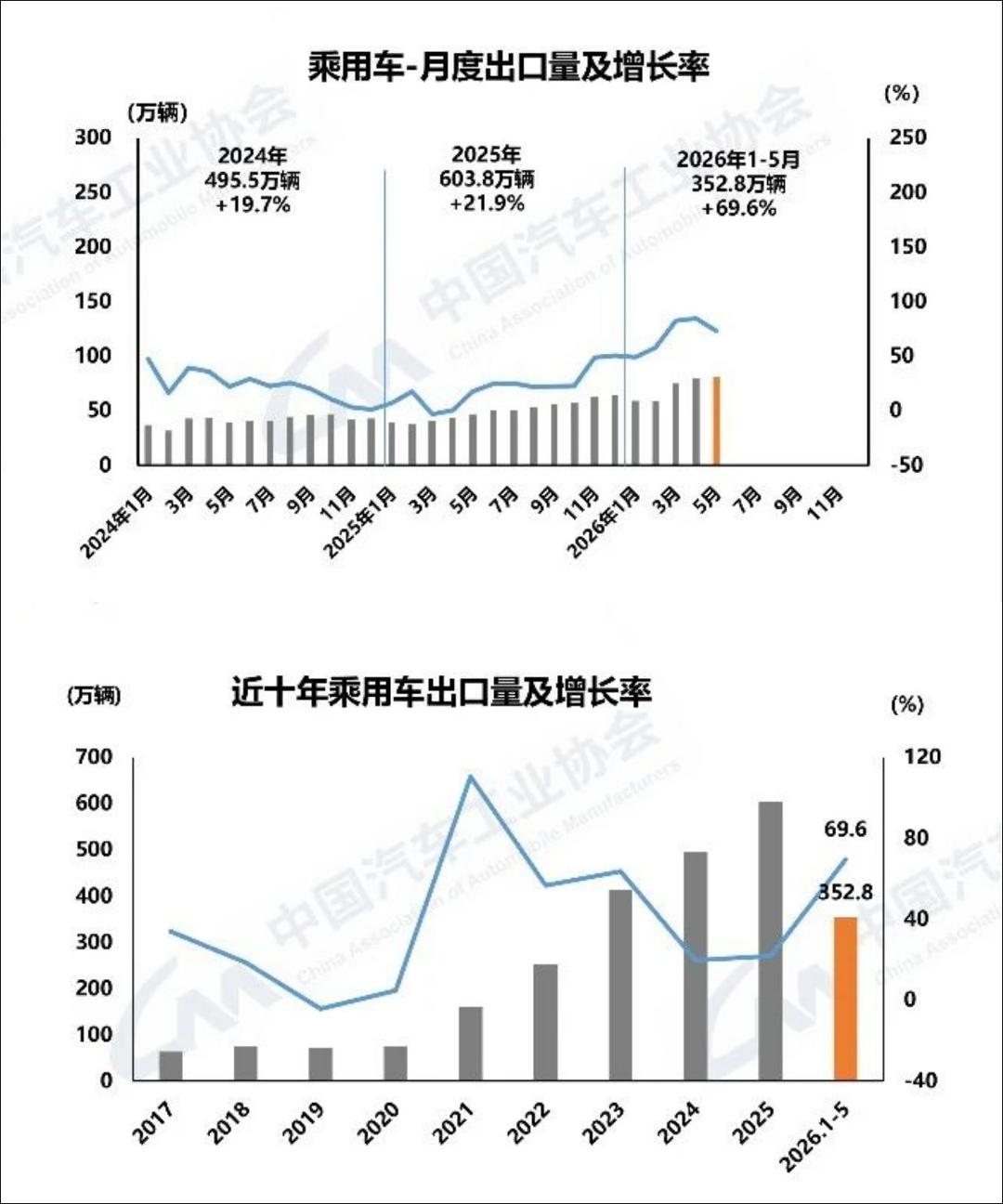
If the sharp increase in such data is a market harvest by Chinese automobiles riding on the wave of the new - energy industry's development, then relying on this momentum, Chinese automobiles collectively go overseas to acquire, revitalize, or seek cooperation. After completing a systematic "shopping spree", what they need to do is to transplant the entire automotive industry ecosystem overseas and replicate as much as possible the path that Japanese and South Korean enterprises have taken.
In this process, BYD plans to negotiate with European automakers such as Stellantis Group to take over idle or under - utilized factories in Europe; Geely intends to acquire the BODY 3 assembly line of Ford's Almussafes factory in Valencia, Spain; Dongfeng is discussing with Stellantis Group the possibility of localizing the production of Dongfeng Group's new - energy models at its factory in Rennes, France; XPeng may use Volkswagen's idle production capacity to build cars through Volkswagen...
To put it simply, different from the impression of large and rapidly expanding enterprises being wealthy and impulsive, all that Chinese automobiles are doing for exports at present is no longer a scattered capital impulse, but a series of pre - meditated structural embeddings in the global automotive production capacity.
Once these form combat effectiveness in the near future, the situation where Chinese automobiles dominate the overseas market is bound to be quickly formed. At that time, regardless of how chaotic the domestic market is now and what kind of "mutually - damaging" competition situation it will develop into, as long as the overseas market is in hand, the blood - transfusion ability will only increase and not decrease. It is imaginable what kind of impact leading Chinese car companies including BYD, Geely, and Chery will have on those traditional large manufacturers.
02
BYD Will Completely Change the Export Pattern
Regarding the future of automobile exports, even with the current international situation, we don't need to worry too much about the resistance that Chinese automobiles will encounter. Because this is an industry trend with a set direction, and the development of all processes only depends on the length of time.
In contrast, as the speed and depth of automobile exports increase, for Chinese enterprises themselves, differentiation is inevitable. That is to say, whoever takes the lead in this period of rapid expansion has a high probability of leading in the subsequent overseas market competition.
In May, BYD's total sales reached 383,453 vehicles; among them, the sales volume of passenger vehicles was 376,990, a month - on - month increase of 20%. Against this background, its overseas sales reached as high as 160,644 vehicles, a year - on - year surge of 80.4%. The monthly export volume exceeded 160,000 vehicles for the first time, setting a new record and accounting for more than 40% of the total sales volume.
Similarly, Chery, which has been very successful overseas, has also been on a roll in terms of exports this year. In May, the group exported 181,871 vehicles, a year - on - year increase of 80.5%, breaking the single - month export record of Chinese automobiles for three consecutive months. From January to May, the cumulative export volume was 752,755 vehicles, a year - on - year increase of 69.5%. So far, the total number of global automobile users of Chery Group has exceeded 19.62 million, among which overseas users exceed 6.59 million.
Following BYD and Chery, Chinese car companies such as SAIC, Geely, Changan, and Great Wall also show no sign of weakening in their export momentum, and it is very easy for them to exceed 50,000 vehicles in monthly exports.
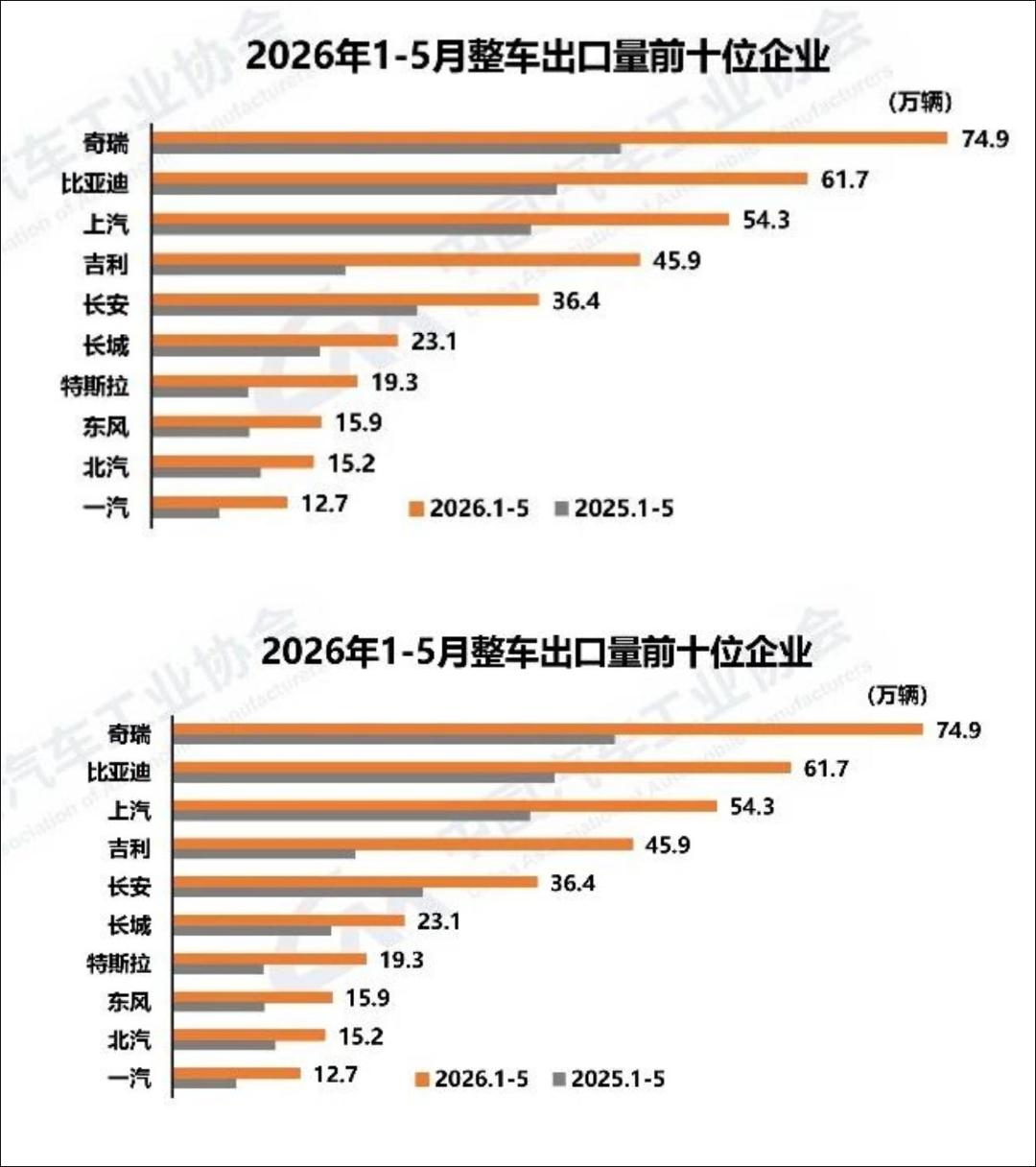
In fact, following this trend, Chinese automobiles will surely expand and strengthen their export business. However, in this landscape, when leading groups led by BYD and Chery firmly hold the core areas of the overseas market, other Chinese car companies can only survive in the cracks, getting a little bit of the leftovers. It can even be said that nearly 80% of Chinese car companies will become very passive in foreign exports.
Moreover, you may ask, will there be no reshuffle among the leading groups? The answer is obviously not fixed.
In May, it is true that the export of new - energy vehicles soared. Among them, 269,000 pure - electric vehicles were exported, a month - on - month increase of 3.2% and a year - on - year increase of 94.3%. 178,000 plug - in hybrid vehicles were exported, a month - on - month increase of 4.9% and a year - on - year increase of 1.4 times. From January to May, the total export volume of pure - electric vehicles reached 1.125 million, a year - on - year increase of 1.1 times, and the export volume of plug - in hybrid vehicles was 708,000, a year - on - year increase of 1.2 times.
That is to say, as new - energy vehicles account for the majority in foreign exports, enterprises that originally led in the overseas traditional fuel - powered vehicle field, especially Chery, will be overtaken by BYD sooner or later if they don't respond to the market quickly and make adjustments.
It should be noted that BYD is aiming for annual sales of 5 million vehicles this year. Coupled with the relatively weak domestic retail market, accelerating the export of new - energy vehicles has almost been placed at the center of BYD's business development.
In the domestic market, Chery has fallen behind Geely, Changan, and even Great Wall in various market segments. If one day BYD completely dominates all core global markets and the surge in new - energy users allows competitors such as SAIC to move forward, the current overseas ranking will ultimately be completely disrupted.
This article is from the WeChat official account "Automobile Community" (ID: iAUTO2010). Author: Cao Jiadong, Editor: He Zengrong. Republished by 36Kr with permission.