"AI + Dietitian" Secures RMB 1.45 Billion in Financing, 94% of Patients Pay Zero Out-of-Pocket: A US Platform Has Established a New Closed-Loop for Elderly Chronic Disease Management
In the field of elderly chronic disease management, a long - standing paradox exists: the medical system allocates the vast majority of resources to expensive in - hospital treatments, while neglecting the more cost - effective nutrition and behavioral interventions in out - of - hospital scenarios. This "emphasis on treatment, neglect of prevention" model not only subjects patients to the pain of repeated hospitalizations and multiple medications but also places an overwhelming burden on medical insurance and commercial insurance.
Meanwhile, the consumer - oriented nutrition market is often trapped in the marketing logic of "selling health supplements" and has difficulty gaining the genuine trust of payers and the medical system.
The US digital nutrition platform Nourish has spotted this gap. It deeply integrates professional metabolic management with AI technology and insurance payment, enabling 94% of patients to achieve "zero out - of - pocket expenses." In May 2026, Nourish announced the completion of a $100 million Series C financing, with a total financing amount of $215 million (equivalent to approximately 1.45 billion RMB).
Nourish's business success indicates that against the backdrop of an aging population and high medical costs, high - frequency out - of - hospital health management represented by metabolic management is upgrading from self - paid consumption to a part of the medical payment system with its verifiable cost - control value.
PART 01
High prevalence of chronic diseases + Insurance cost control
Nutrition management ushers in development opportunities
In the past two years, concepts such as "anti - inflammatory diet," "nutritional intervention," and "metabolic management" have gradually entered the domestic dietary supplement market. On the other side of the ocean in the United States, there is a company that empowers dietitians with AI to solve the chronic disease management problems of the elderly through metabolic management.

Nourish's concept of metabolic management. Image source: Nourish official website
As the baby - boomer generation as a whole enters old age, the number of chronic diseases among the elderly population in the United States has reached a peak. According to data from a research institution under the US Department of Health, nearly 93% of people over 65 in the United States have at least one chronic disease, and the proportion of co - occurrence of multiple diseases is as high as 78.8%. When the age reaches over 85, only 7.4% of the elderly have no underlying chronic diseases.
For the elderly, metabolic problems caused by age and lifestyle can lead to a higher risk of diabetes and cardiovascular diseases. Some chronic diseases such as hypertension, type 2 diabetes, hyperlipidemia, and fatty liver have highly consistent underlying pathological bases, which are insulin resistance and chronic systemic inflammation.
Breaking away from the traditional medical approach of "treating the symptom rather than the root cause", metabolic management takes place in the daily "three meals a day" and home scenarios of the elderly, directly intervening in the two fundamental problems of insulin resistance and chronic systemic inflammation. It can often improve multiple chronic diseases simultaneously and resolve them outside the hospital.
For the elderly, metabolic management saves them from the trouble of repeated hospitalizations and taking medications; for medical insurance and commercial insurance, investing a few hundred dollars in nutritional metabolic management can save tens of thousands of dollars in future hospitalization and rescue costs.
The US Federal Medicare (Medicare) has also gradually expanded the reimbursement scope for "medical nutrition therapy," opening the green light for digital nutrition to enter the market in a compliant manner.
Under Medicare Part B (a part of the US Federal Medicare), medical nutrition therapy for specific diseases is listed as a preventive service. As long as elderly patients over 65 are diagnosed with chronic diseases such as type 2 diabetes and chronic kidney disease within 36 months and have a referral letter from their attending doctor, the medical insurance can fully reimburse the nutrition consultation fees provided by registered dietitians.
Driven by market demand and policies, a large number of virtual metabolic management platforms have emerged in the US market, and Nourish is one of them.
Nourish was founded in New York, the United States in 2021. All three founders have experiences of successfully solving health problems through nutritional intervention and deeply understand the crucial role of dietitians in out - of - hospital chronic disease management.
At that time, the US metabolic management market was facing a dilemma of supply - demand matching: patients did not know that relevant services could be reimbursed or could not find matching dietitians, while dietitians wasted a lot of time on administrative work and were exhausted dealing with the cumbersome medical insurance reimbursement process.
Nourish seized the matching link, built a digital consultation platform to connect patients and dietitians, and solved medical insurance compliance and bill settlement through algorithms and AI, achieving zero out - of - pocket expenses for 94% of patients.
From 2021 to 2023, Nourish received support from the top Silicon Valley incubator Y Combinator and attracted investments from well - known early - stage venture capital firms such as Thrive Capital and BoxGroup. Relying on the early - stage financing, Nourish established the path for commercial medical insurance to reimburse virtual dietitian consultations and began to expand its dietitian network across all states in the United States.
In the following three years, Nourish received three more rounds of investment:
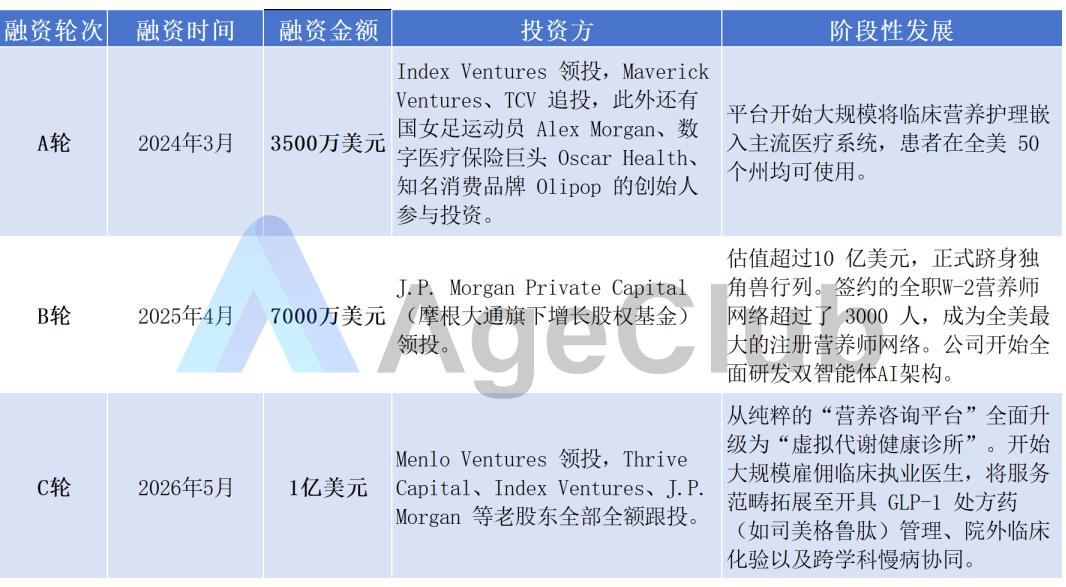
Currently, Nourish's services cover all 50 states in the United States, with tens of thousands of dietitians and serving over 500,000 people. It can save each patient over $2,000 in medical insurance costs per year.
PART 02
94% of patients with "zero out - of - pocket expenses"
Closed - loop of customer acquisition, service, and payment
Metabolic management is an extremely personalized service. Nourish uses algorithm matching to find a suitable dietitian for each patient and customize a metabolic management plan.
Behind this model is Nourish's value proposition for the three core roles:
For elderly patients, relying on medical insurance and commercial insurance, Nourish provides low - threshold, highly customized remote metabolic management services, which can be fully reimbursed by medical insurance, achieving zero out - of - pocket expenses;
For dietitians, Nourish provides them with customer sources, AI clinical assistance tools, and a fully automated medical insurance compliance checkout system, allowing dietitians to focus only on delivering metabolic management plans;
For insurance companies and the medical system, Nourish controls the deterioration of high - risk chronic diseases such as diabetes and chronic kidney disease through daily, high - frequency out - of - hospital behavioral interventions, helping insurance companies cut huge emergency and hospitalization compensation expenses at the source.
In terms of customer acquisition, Nourish's channel strategy does not rely on traditional advertising but deeply embeds itself in the medical ecosystem or cooperates with other digital medical platforms.
At the beginning of 2026, Nourish reached a strategic cooperation with the large - scale comprehensive medical group Community Health Network, directly embedding its virtual nutrition care into the hospital's electronic medical record system. When doctors in the geriatrics or cardiovascular departments diagnose abnormal blood sugar or blood lipids in patients, they can refer the patients to Nourish with one click, achieving seamless rehabilitation at home after leaving the hospital.
Wisp is an AI platform focusing on women's (especially menopausal women's) health management. It reached a cooperation with Nourish in early 2024. Wisp's female patients can receive Nourish's nutrition consultation services, which are also reimbursed through medical insurance and commercial insurance.
Meanwhile, patients participating in Wisp's new weight management program can combine medical weight - loss treatment with Nourish's personalized nutrition consultation. Nourish uses AI behavioral intervention to improve the elderly's medication compliance, showing long - term cost - control effects far beyond the industry average.
In the service delivery link, Nourish cooperates with meal delivery partners to bridge the last mile from prescription to the dinner table.
Nourish cooperates with the medical customized meal service provider ModifyHealth. After the online dietitian issues a diet prescription (such as low - sodium, low - phosphorus, low - GI), ModifyHealth is responsible for delivering the matching clinical - grade healthy meals directly to the patients' homes, solving the cooking problem for elderly people who live alone or have limited mobility.
All of this can form a closed - loop thanks to the unique insurance payment mechanism in the United States.
In addition to traditional Medicare, more than 50% of elderly Americans choose to purchase Medicare Advantage (hereinafter referred to as "MA") managed by commercial insurance companies as a supplement, which directly includes medical meal customization and healthy fresh food meals in the reimbursement scope.
This completes the commercial closed - loop for the cooperation between Nourish and ModifyHealth — the dietitian issues a nutritional intervention prescription, and MA directly pays for the matching clinical - grade healthy meals and delivers them to the elderly's homes. Insurance companies use this to reduce the high - cost compensation caused by the deterioration of the elderly's conditions and subsequent hospitalizations.
It can be seen that Nourish's business model is inseparable from medical insurance and commercial insurance throughout, attracting payers to participate through effective cost control. Currently, Nourish is fully connected to mainstream commercial insurance companies such as UnitedHealthcare, Anthem, and Aetna, and is deeply and compliantly connected to Medicare (US Federal Medical Insurance).
PART 03
"AI + Dietitian"
Technological narrative attracts capital investment
The $100 million Series C financing completed by Nourish this time will be fully used for the expansion of the clinical network, the R & D and upgrade of AI health agents, and the expansion of the metabolic health diagnosis and treatment system. At the same time, it will deepen cooperation with insurance companies, employers, and the medical system to make further progress in the field of chronic disease management.
Its first AI - native virtual medical model is also one of the secrets for Nourish to maintain high - speed growth.
Different from other similar enterprises that use AI as a replacement for human labor, in Nourish's concept, AI serves as an assistant to dietitians, mainly focusing on administrative and data processing, allowing dietitians to focus on communicating with customers.
On the user side, AI significantly lowers the participation threshold for elderly patients.
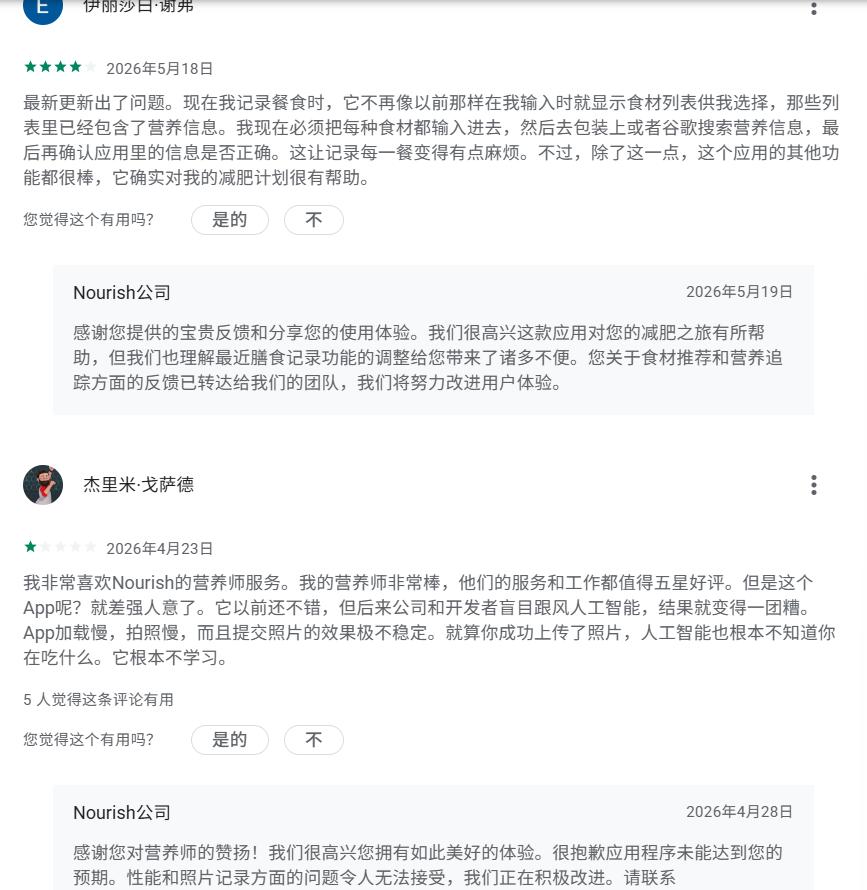
Traditional diet recording requires users to manually enter the grams of food and query calories, resulting in extremely low compliance among elderly patients. In Nourish's App, the elderly do not need to manually enter complex calorie or nutrient information. They only need to take a photo of the meal, and AI can automatically identify the ingredients and calculate the calories and GI value. However, according to user feedback, the current AI function has not reached the ideal state.
At the same time, Nourish seamlessly cross - compares the AI meal - recognition data with the data from continuous glucose monitoring devices, smart body fat scales, and wearable devices such as Apple Health worn by the elderly. AI will observe in the background to see how the blood sugar fluctuation curve changes after the patient eats a specific combination of lunch, so that dietitians can further adjust the patient's metabolic management plan.
For dietitians, Nourish's AI assistant liberates them from heavy paperwork. During remote video consultations, with permission, AI will conduct real - time dictation and context understanding, automatically generating a draft of a medical clinical record that meets medical insurance compliance standards. Dietitians only need to check and sign it.
Before dietitians meet patients, the AI assistant will also analyze the patient's photo - check - in records and blood sugar trends in the past week in advance, automatically outputting the patient's metabolic trends and recommended nutritional intake for the week as a reference for dietitians' clinical decision - making.
In summary, Nourish empowers both sides through AI, lowering the patient participation threshold and improving dietitians' work efficiency, and building a scalable and highly compliant chronic disease management service chain. This is one of the core logics for it to receive continuous capital investment.
Conclusion
By examining the overseas market, it can be found that the combination of medical customized meals and medical insurance is in the industry's explosive growth stage. Companies such as Fay Nutrition (which just received a $50 million Series B financing led by Goldman Sachs in February 2025) and Foodsmart (which received a huge $200 million financing from TPG in 2024) are all betting on this track.
Nourish's model can be summarized as: deeply binding professional nutritional intervention with medical insurance payment, using AI to improve service efficiency and reduce the total cost of chronic disease management, allowing patients to enjoy services with "zero out - of - pocket expenses" and making payers pay for the "saved hospitalization fees."
Turning our attention to China, similar needs and opportunities are emerging. China has the world's largest aging and chronic - disease population, and the demand for chronic disease management is urgent. The domestic silver - haired market is also transforming from blindly buying health supplements to scientific nutritional intervention, and capital is more concerned about enterprises that are transforming towards "precise intervention."
Upstream, the domestic dietary supplement raw material R & D company New Bond Biotech completed a Series C financing of over 100 million RMB in March, claiming to build technological advantages with the standards of "innovative drugs," and its products cover precise health fields such as anti - aging, brain health, blood sugar control, and immunity enhancement;
Mid - stream, digital chronic disease management platforms such as Fangzhoujianke have connected doctors and patients through the "AI + H2H" model, serving tens of millions of users;
On the payment side, "health insurance + health management" has become an important direction for insurance product innovation, and chronic disease insurance for single diseases such as hypertension and diabetes is emerging continuously.
In addition, domestic digital medical enterprises should also actively explore local breakthroughs with commercial chronic disease insurance and long - term care insurance to establish a B2B2C payment closed - loop. Age - friendly AI (such as voice and image recognition) is one of the bridges to cross the digital divide, especially prominent in online platforms.
This article is from the WeChat official account "mx814765531" (ID: AgeClub), author: Wei Yuanqi, published by 36Kr with authorization.