Behind the "AI Factory" of Elon Musk and Jensen Huang, an invisible "freshwater plunder battle" has already begun.
You may not imagine that every time you ask ChatGPT to write a 100 - word weekly report or ask Claude to modify a few lines of code, about 500 milliliters (equivalent to a bottle of Nongfu Spring) of pure fresh water in the cooling pipes in some corner of the earth will turn into white steam and evaporate out of thin air.
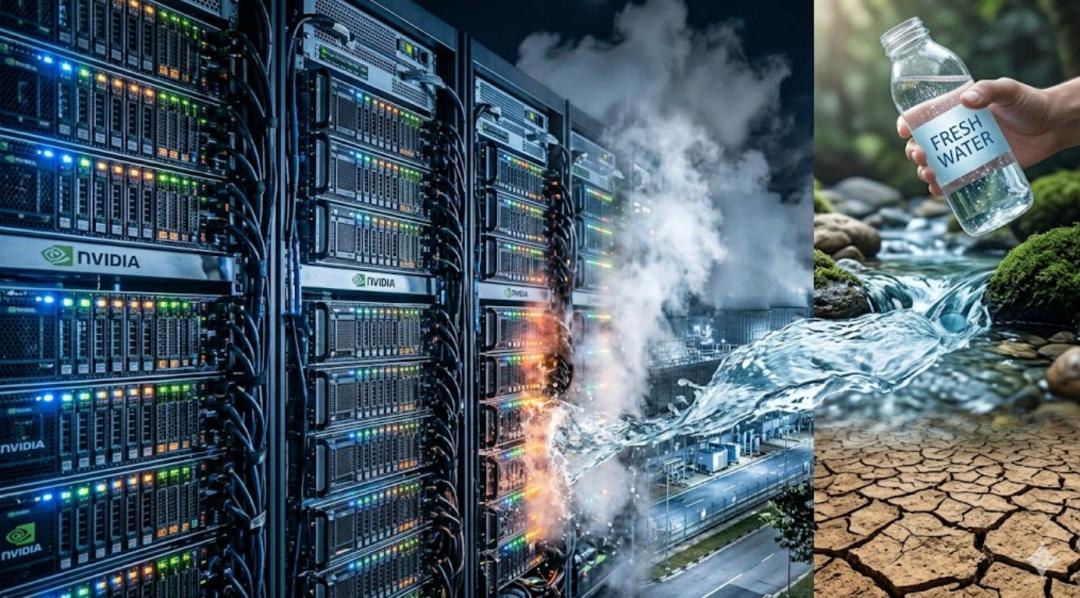
In the past two years, the grand narrative about the AI arms race has been firmly locked in the logical loop of "chips, computing power, and nuclear power".
Jensen Huang publicly boasted about the terrifying computing power of clusters with thousands or even hundreds of thousands of graphics cards at the Taipei Computer Association show. Elon Musk has been busy acquiring land and building facilities day and night in Silicon Valley. In just 122 days, he built Colossus, the largest supercomputer in human history (with a throughput of up to 230,000 NVIDIA GPUs).
The capital market is going crazy betting on these "silicon - based myths". However, everyone seems to have selectively forgotten a most fundamental and cruel physical limitation - these scalding silicon - based brains need water, and it's the fresh water on which human beings depend for survival.
The latest global AI environmental cost research report released by the United Nations University (UNU) tears off the warm - hearted veil of AI's virtual and low - carbon image with a set of cold data: the number of Prompts processed by global AI every day has soared to 2.5 billion times.
It is estimated that by 2030, the annual water consumption of the global AI infrastructure will reach an astonishing 9.3 trillion liters (9.3 megaliters).
This figure is just enough to meet the basic daily water needs of 1.3 billion people on Earth for a whole year.
From the supercomputer rooms along the Mississippi River in Memphis, USA, to the severely drought - stricken areas in Europe, a "freshwater plunder war" forced by Physical AI and the computing power of large models officially started in the summer of 2026.
I. Silicon - Based Entities Devouring Carbon - Based Ones: The "Gluttony" of Super Computing Power Factories
Why has the large - scale AI model become an insatiable "water - absorbing behemoth"? The answer lies in the cooling architecture of data centers.
Currently, high - end GPUs with the latest NVIDIA Blackwell architecture and even the next - generation Vera Rubin architecture have a power consumption of 700 to 1,200 watts per chip when running at full load.
When thousands of such chips are densely packed into a computer room, the entire data center is essentially a huge "high - heat boiler". If the heat cannot be removed within milliseconds, chips worth hundreds of millions of dollars will burn out instantly due to overheating.
To pursue the optimal cost - effectiveness, more than 70% of the world's data centers use the "Evaporative Cooling" system.
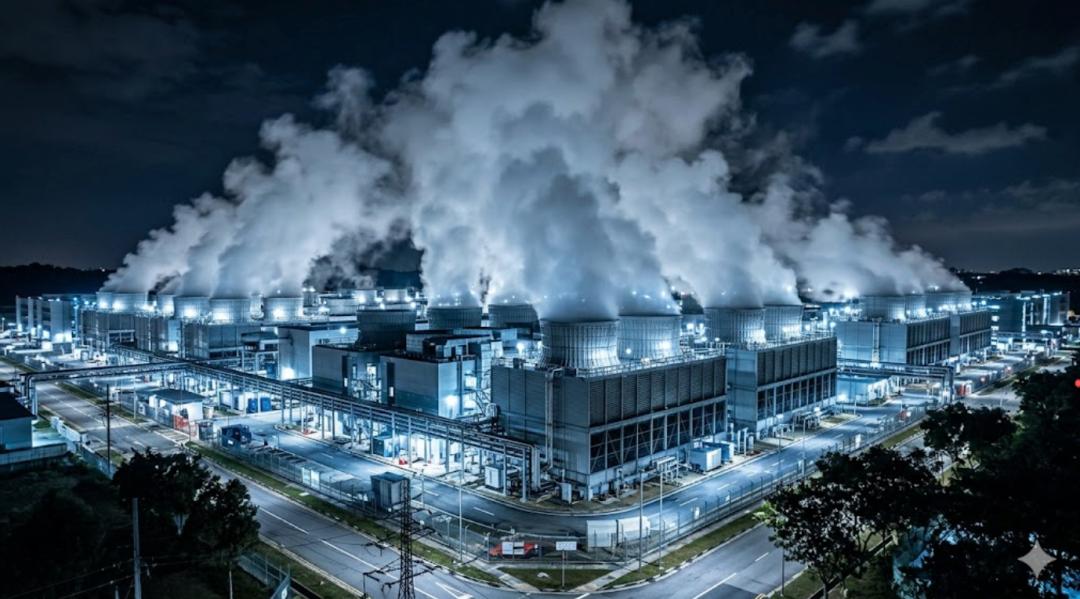
The principle of this system is extremely primitive and brutal: a large amount of cold fresh water is pumped into the computer room to absorb the heat emitted by the chips, and then about 80% of the water is turned into water vapor and directly discharged into the atmosphere.
This means that most of the consumed water cannot be recycled locally and simply "disappears" from the local groundwater and public water supply systems.
Let's take a look at the real bills hidden in the sustainability reports of large companies:
OpenAI (GPT series): According to the tracking of independent scholars and investment banks, just one "training" session of GPT - 4 in the virtual world consumes about 600 million liters of pure water, which is enough to fill 237 Olympic - standard swimming pools. And for the next - generation flagship large model currently in closed - door training, due to the exponential explosion of computing power, its water footprint for a single training session will directly exceed 1 billion liters.
Google and Microsoft: In the latest environmental data disclosure, Google's annual water consumption has exceeded 8.1 billion gallons (about 30 billion liters), a sharp increase year - on - year. In its large - model training hubs in places like Westman and Iowa, Microsoft's water consumption has nearly doubled in the past three years. Local residents in Iowa have started to protest because Microsoft's five computer room parks are competing with local farmlands for groundwater at a rate of millions of gallons per day.
The bottomless pit of large - scale models is evolving into a physical squeeze on the real - world Earth's resources.
II. The "Watergate Incident" in Memphis: Elon Musk, Jensen Huang, and the Angry Residents
The most intense direct conflict in this "freshwater plunder war" took place in Memphis, Tennessee, USA, this year.
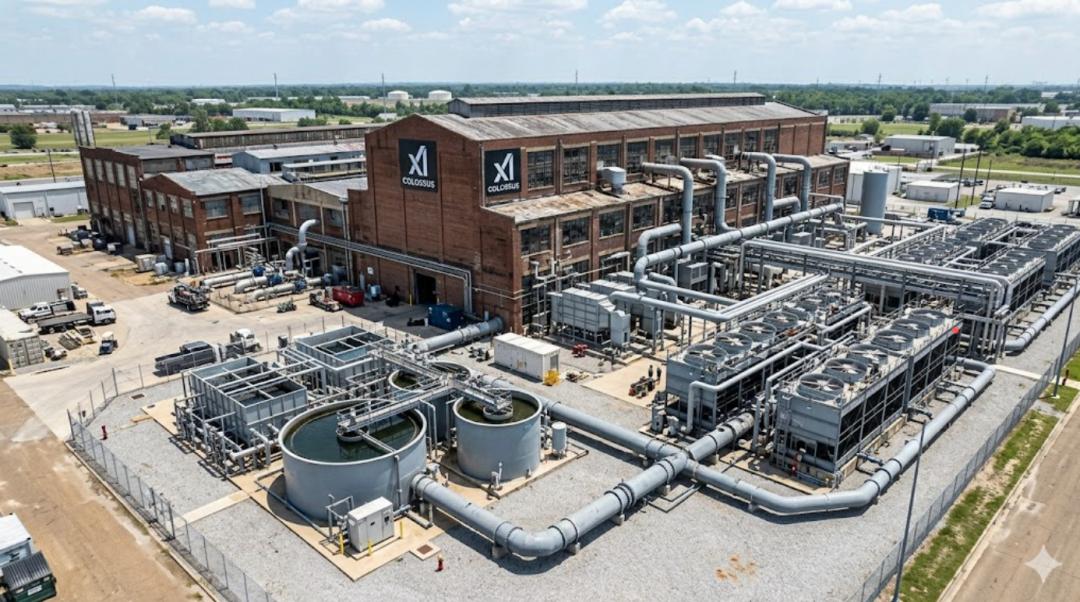
In 2024, Elon Musk's xAI team built the supercomputer cluster Colossus in Memphis in just 122 days at a typical Silicon Valley speed to train the Grok large - scale model. To keep this behemoth with 230,000 chips running, Colossus needs to extract up to 1 million gallons (about 3.8 million liters) of local residents' drinking water from the local groundwater reservoir in Memphis every day.
Since Musk adopted an aggressive strategy of "acting first and reporting later, bypassing the environmental hearings" during the construction, when the residents of Memphis suddenly found their water bills skyrocketing and the groundwater level dropping abnormally in the summer of 2025, public resentment exploded. Environmental organizations and local communities sued xAI and the local government, accusing the technology giants of "robbing the next mouthful of clean water from children's mouths".
Facing a huge judicial and public relations crisis, Elon Musk and Jensen Huang were forced to make an extremely rare compromise in the spring of 2026: xAI urgently announced an investment of $80 million to build a "reclaimed water recycling plant" (Colossus Water Recycling Plant) overnight next to the computer room.
Musk's solution is: Since the residents' drinking water is off - limits, my AI has to "drink wastewater". The plant plans to secondary - filter the industrial wastewater and domestic sewage discharged from the Memphis sewage treatment plant to replace pure fresh water to feed the cooling towers of Colossus.
The "Watergate Incident" in Memphis is a landmark turning point in the global development history of Physical AI. It proves to all fanatical technology investors that starting from 2026, the ultimate bottleneck restricting the expansion speed of AI is no longer the production capacity of TSMC, nor the dollars in Altman's hands, but the "right to obtain water sources" approved by local governments.
III. The "New Anxiety" on Wall Street and the "Zero - Water Lie" of Technology Giants
Facing the increasingly intense protests from the public and the severe drought that hit nearly 63% of the North American land in 2026, the CEOs of technology giants have started to tell "new stories" in financial reports and technology summits to appease Wall Street.
At the just - ended Microsoft Build 2026 conference at the end of May, CEO Satya Nadella dedicated a ten - minute segment to explain Microsoft's "zero - water revolution".

Nadella claimed in his speech: "Microsoft's latest super - large data centers have completely abandoned evaporative cooling and switched to a new 'closed - loop cooling' system. We fill the cooling pipes with water once during construction, and then it circulates infinitely between the servers and condensers like a household refrigerator. The average annual daily water consumption is 'only equivalent to that of an ordinary restaurant'."
But is this really the solution? In the eyes of self - media and the academic community, it seems more like a "power - consumption smokescreen".
The cost of closed - loop cooling: The closed - loop system indeed doesn't evaporate water, but its cooling efficiency is much lower than that of open - water evaporation. To achieve the same cooling effect, the computer room must be connected to giant fans and freezers with extremely high power, which will cause the power consumption of the data center to soar by 20% to 30%.
The transfer of indirect water footprint: The sharp increase in power consumption means that power plants must operate at full capacity. Whether it's coal - fired, gas - fired, or nuclear power plants around the world, their turbines also require an astronomical amount of cooling water for power generation. According to the calculation of the Lawrence Berkeley National Laboratory, if the direct water evaporation consumption of a data center is 17.4 billion gallons, then its indirect water footprint due to power consumption is as high as 211 billion gallons!
Microsoft saves water in the computer room, but causes more water to be evaporated in power plants in another state. This kind of "treating the foot for a headache" green lie cannot cover up the fact that AI is becoming an ecological disaster.
IV. Conclusion: The Key to Breaking the Deadlock for Chinese AI, Smart Homes, and Embodied Intelligence
While the supercomputer rooms in the West are being blocked and forced to slow down by environmental organizations and laws due to water resources and carbon emission indicators, this cruel physical common sense about "fresh water" has sounded an alarm for the rapidly developing Chinese AI industry, but also provided a very clear roadmap for counter - attack.
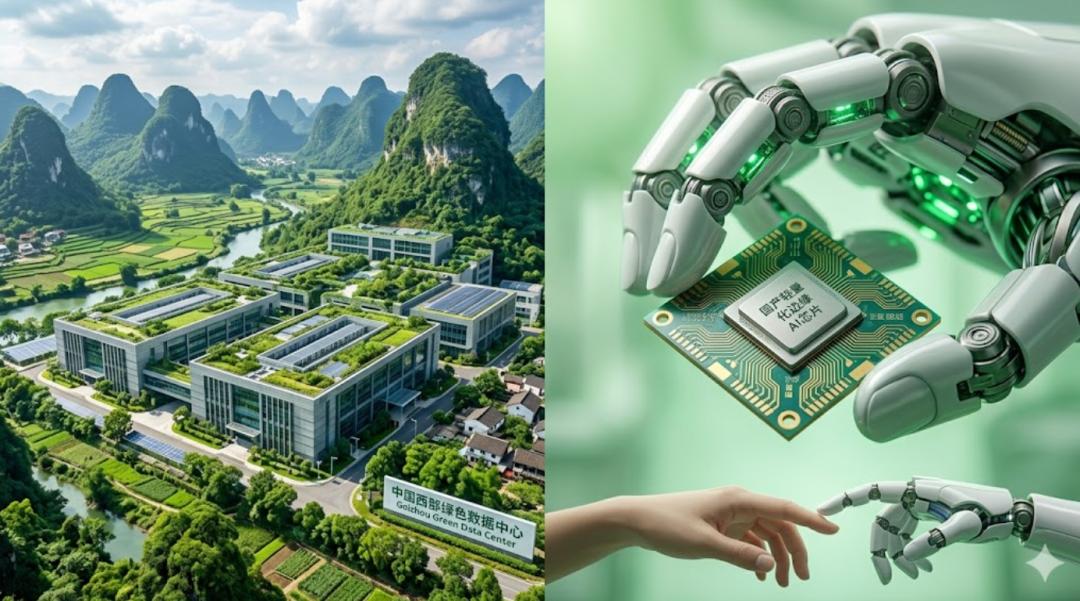
China's AI industry must not blindly copy the "heavy - industry monster model" in Silicon Valley, which piles up hundreds of thousands of graphics cards in the cloud and consumes millions of gallons of fresh water every day. At the node of 2026, we should see more practical and sophisticated solutions:
First, it is the natural geographical hedging of computing power layout. China naturally has the forward - looking national policy of "Transferring Data from the East to the West for Computing". Large - scale training computer rooms that require a large amount of cold water should be located in regions such as Guizhou and Inner Mongolia, which have natural karst underground rivers or extremely low average annual temperatures and can use natural air - cooling, to hedge the water resource anxiety with geographical advantages.
Second, and the most core technological breakthrough point, lies in the hybrid computing power reconstruction of "the cerebellum at the edge and the brain in the cloud", which we have repeatedly mentioned before.
Smart home brands represented by Haier Casarte, and Chinese embodied intelligent robot manufacturers such as Agibot and Unitree are comprehensively promoting the R & D of lightweight edge - side chips.
If our sweeping robots, in - vehicle intelligent cockpits, and industrial screw - tightening workers can solve 90% of the physical interaction problems locally with a ten - watt - level edge chip and a lightweight "spatial world model", without sending a high - energy - consuming multimodal Prompt to the cloud thousands of kilometers away every time they move a finger, then we will have cut off 90% of AI's water and power consumption at the root.
Leave the soul of AI to the algorithm and leave the burden of AI at the edge.
This "freshwater plunder war" that Elon Musk and Jensen Huang have run into is forcing global AI to shed its impetuous cloak.
Is AI a ladder for human civilization to reach a higher dimension, or a silicon - based monster that will eventually compete with humans for the last drop of pure water on Earth? In the summer of 2026, the answer is becoming clearer as the water vapor evaporates.
This article is from the WeChat official account "New Mang xAI". Authors: Green and Dong Yizhen. Republished by 36Kr with permission.