Secured $55 million in Series C financing, 3.2 million talent gaps fuel the boom of US medical vocational training
Recently, Stepful, a US medical vocational training platform, announced the completion of a $55 million Series C financing round, led by Oak HC/FT.
In the past two years, Stepful has successively completed a $31.5 million Series B financing round and a $55 million Series C financing round. Compared with the more prominent AI tools, learning platforms, and corporate training companies in the education technology industry, the business of this vocational education company is not complicated: it trains medical assistants, pharmacy technicians, and surgical technicians. Why do investors keep betting on such a company?
A shortage of 3.2 million medical talents leads to a $55 million financing round
This financing round was led by Oak HC/FT, with participation from institutions such as Foresite Capital, Hearst Ventures, and Citi Impact Fund. Existing investors like SemperVirens, Y Combinator, ECMC Education Impact Fund, and Intermountain Health continued to follow - on invest.
This is the second consecutive time that Oak HC/FT has led the financing for Stepful. In 2024, the institution led Stepful's $31.5 million Series B financing round.
Behind the two consecutive financing rounds is the long - standing talent shortage problem in the US medical industry.
The American Hospital Association predicts that by 2026, the US medical system will face a shortage of approximately 3.2 million medical - related practitioners. At the same time, US medical institutions spend approximately $97 billion annually on contract workers and temporary staff.
While the demand continues to grow, the expansion speed of the medical talent training system is relatively limited. For a long time, a large number of medical support positions in the US have been mainly trained by vocational schools and community colleges. However, affected by factors such as enrollment scale, venue resources, and training cycles, these institutions find it difficult to rapidly increase the supply.
For medical institutions, the impact of the talent shortage is constantly expanding. On the one hand, hospitals need to continuously recruit new medical practitioners; on the other hand, the expenditure on temporary workers to fill the positions is also increasing.
In this context, medical talent training has gradually become a new area of interest for investment institutions. As an investment institution that has long been focused on the medical and health field, Oak HC/FT said in the financing announcement that Stepful is one of the few companies it has seen that can combine online education with artificial intelligence to solve the problem of medical talent supply on a large scale.
Stepful doesn't sell courses but supplies talents to hospitals
Different from traditional vocational schools, Stepful does not position itself as a pure educational institution that only provides courses.
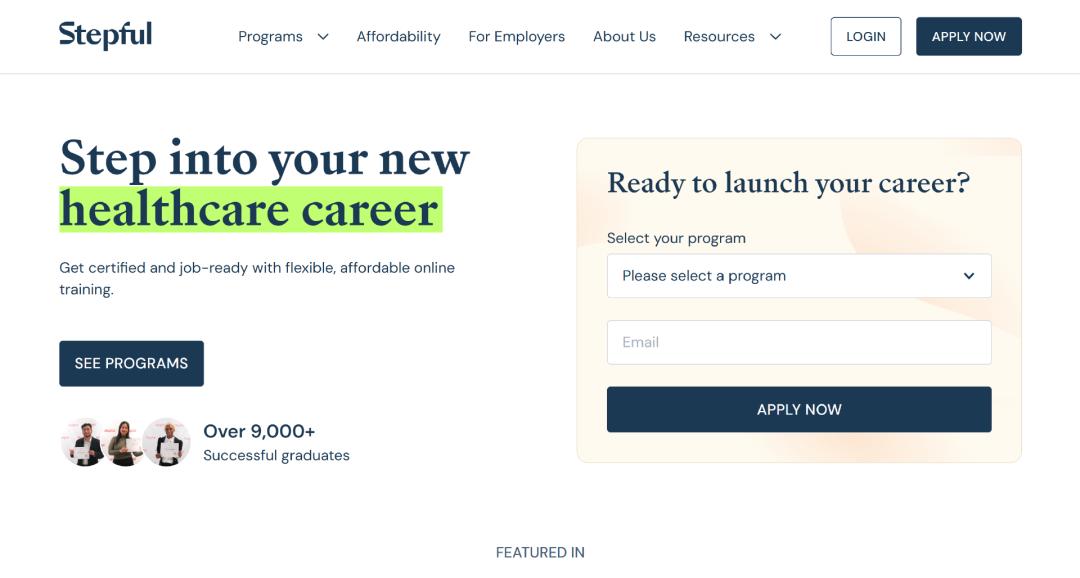
The company adopts the "School - as - a - Service" model. It integrates vocational training, qualification certification, clinical practice, and employment placement into the same system. Compared with traditional vocational education institutions centered on enrollment and teaching, Stepful conducts its business more directly in response to the talent needs of hospitals and medical systems.
Currently, the platform mainly provides training for positions such as medical assistants, pharmacy technicians, and surgical technicians. These positions are in high demand in the US medical system and are important components of the normal operation of the medical service system.
Stepful's training is mainly online. Take its medical assistant course as an example. Students can usually complete the training and obtain relevant certifications in about four months. Compared with the traditional vocational school model that requires long - term on - campus learning, online courses reduce time and geographical restrictions, allowing more adults to participate in vocational training.
In addition to recruiting individual students, Stepful has also launched an employer - sponsored program. Hospitals and medical institutions can directly participate in employee training and provide debt - free certification programs for in - service personnel. Students do not need to leave their jobs but can gradually earn credits and certification qualifications by completing online interactive learning modules.
This model also clearly differentiates the platform from traditional vocational schools. For hospitals, training is no longer an independent link outside the employment system but is connected to recruitment, position filling, and employee development; for students, the learning goals are more clear, and they can directly enter the corresponding professional positions after completing the training.
As of now, Stepful has helped more than 32,000 medical professionals enter relevant positions. More than 35 large - scale medical networks, including Mount Sinai Health System, Ochsner Health, and Providence, are using its platform.
In terms of business structure, Stepful connects multiple links in the medical talent training chain: students receive training and obtain certifications through the platform, while medical institutions obtain the required talents through the platform. Rather than simply selling courses, the company hopes to become a talent training partner for hospital systems.
How does AI enter medical vocational training?
For medical vocational training, theoretical knowledge can be acquired through online courses, but clinical communication and practical training have always been difficult problems in remote learning.
To solve this problem, Stepful has introduced artificial intelligence and virtual simulation technology into the training process. The platform provides simulated patient interaction scenarios for students through a high - fidelity virtual patient system. Students can complete training related to patient communication, information collection, and diagnosis in a digital environment, practicing their communication and judgment skills in clinical scenarios.
For skills training that requires actual operations, such as blood drawing and measuring vital signs, Stepful has adopted another solution. The platform will send customized medical toolkits to students. After students complete the practice at home, they will receive remote guidance and evaluation via video.
In this process, its self - developed AI system will continuously track the learning progress and training performance. When the system detects that a student has a misunderstanding in a certain knowledge point or skill, it will automatically send a reminder and trigger a real - life coach to intervene and provide targeted guidance to the student.
In addition to serving learners, this system is also applied in the talent training and management of medical institutions. The platform continuously records various data during the learning process, providing more real - time talent training information and ability evaluation basis for hospitals.
The $55 million financing obtained this time will also be mainly invested in two directions.
On the one hand, Stepful plans to further integrate the "School - as - a - Service" model into hospital systems, providing more comprehensive talent recruitment, training, and skill improvement services for medical institutions. On the other hand, the company will expand the coverage of courses and certification programs.
Currently, Stepful's training programs are mainly focused on positions such as medical assistants, pharmacy technicians, and surgical technicians. According to the information disclosed by the company, the new funds will be used to launch certification programs in areas such as registered nurses (RN), respiratory therapy, and advanced medical imaging, entering the higher - level medical vocational training market.
From training medical support positions to entering the fields of registered nurses and professional medical technology, Stepful's development direction is not only to increase the number of courses but also to continuously extend deeper into the medical talent training chain. For this vocational education company, the next step after the $55 million financing still revolves around the same goal - to train more talents who can directly enter the medical system.
For the US medical industry, the talent shortage problem is still difficult to alleviate in the short term; for Stepful, how to continuously expand the training scale, improve training efficiency, and meet the increasing talent needs of medical institutions will be the focus of its next - stage development.
Original article link:
Stepful Completes $55 Million Series C Financing for Expanding AI Healthcare Training Business
https://ventureburn.com/stepful-raises-55m-series-c-to-expand-ai-healthcare-training/
This article is from the WeChat official account "Duojing" (ID: DJEDUINNO). The author is Duojing's compilation. It is published by 36Kr with authorization.