The homework that WeChat AI should really copy is right here at Google.
In the past two days, the WeChat AI has been extremely popular, but most discussions have focused on what it can do and how to use it.
Everyone is speculating about what the WeChat AI will look like and whether it will redefine the AI assistant in the super app.
After all, WeChat is a national-level app. The launch of such a function that subverts the previous operation methods is bound to make people have wild imaginations.
These discussions are certainly important, but to be honest, they are just glimpses of the whole picture.
Since the WeChat AI has not started the gray-scale testing, only those partner enterprises have the opportunity to see what it looks like.
Just last week, Google launched a product that I think is very suitable for the WeChat AI. It is Dreambeans.
In a nutshell, Dreambeans is an AI application that actively pushes personalized content to you. It connects your Gmail, calendar, photo album, YouTube, and search history, automatically analyzes this data every night, and pushes a set of customized "stories" to you the next morning.
For example, in the picture below, if you went to a certain restaurant with your friend yesterday, Dreambeans will generate such a story, including a picture, which restaurant you went to, what time you ate, how much you spent, and so on.

These stories may remind you that your friend is coming, or recommend activities that you may be interested in. They can even give suggestions based on your recent behavior, such as staying up less and going out more.
Moreover, each story is accompanied by a personalized illustration generated by AI, and some even have one-click operation buttons such as "Buy tickets" or "Watch".
Dreambeans Liberates AI from the Dialog Box
The biggest difference between Dreambeans and other AI products is that it doesn't have a chat box. You don't need to ask it any questions, and it will actively tell you what you need to know today.
Although Dreambeans allows users to influence and adjust the output content, what specific stories are generated each day is mainly automatically output by the system based on the data you authorize.
You can only customize a small part of the content, such as choosing which data sources to connect. And whether to use the Face Grouping function, that is, whether to let the similar images of you, your family, friends, or pets appear in the story illustrations.

But you can't directly control it, so you can't directly use it to generate science and technology news, fitness plans, or family schedules.
In fact, in the past two years, almost all AI products have been doing the same thing, which is to make the dialog box smarter.
You ask it a question, and it gives you an answer. You ask it to write code, and it generates it for you. You ask it to summarize a document, and it extracts the key points.
Then there are some special function buttons below and on the side of the dialog box. Especially the small plus button similar to Codex. Once you click it, a long list of functions will appear.
This interaction mode has become the default paradigm for AI products. So much so that now, as long as you are developing an AI product, the first thing to do is to design a nice and recognizable chat box.
Ultimately, the traditional AI assistant is essentially a response system.
No matter how smart it is, it can only work within the scope of your questions. If you don't ask, it won't say anything. If your question is not accurate enough, the answer it gives may deviate from what you really need.
But the problem is that Google believes that the traditional AI assistant leaves the cognitive burden to the user, which is actually not user-friendly.
So the design concept of Dreambeans is equivalent to taking the context of Gmail, YouTube, and search history and reversing the entire output process.
It remembers the fragmented information scattered in different applications for you, discovers the important things that you may have forgotten to pay attention to, connects the relevant clues, and then actively tells you at the right time.
All the user needs to do is browse these well-organized stories, give a thumbs down to the irrelevant content, or tell the system "This is not suitable for me" through the adjustment function.
But Google's design of Dreambeans is very restrained.
It is not an infinitely scrolling information stream, but a limited collection of stories. The number of stories pushed every day is screened. The goal is not to make you keep scrolling, but to let you quickly finish reading and then do the really important things.

This design philosophy is completely opposite to the logic of current mainstream social media. Mainstream social media hopes that you will stay on it as long as possible, even occupying 24 hours of your day. Dreambeans pursues information density.
Dreambeans relies on Google's Personal Intelligence system.
This system is also used in the Gemini application and AI Mode search, but Dreambeans is the first independent product made with this system.
The core ability of Personal Intelligence is cross-application context understanding. It can combine Gmail, Calendar, YouTube, and search history to generate highly personalized content.
Therefore, Dreambeans can also be said to visualize the Personal Intelligence system.
Currently, Dreambeans is only available to Google AI Ultra subscribers in the United States, and users must be at least 18 years old.
Google emphasizes that the choices users make in Dreambeans will not affect the settings of Personal Intelligence in other products, and the data will not be used to train the model. Users can view the feedback history at any time, delete specific feedback records, or directly delete all data.
WeChat Has More Fertile Ground
If the logic of Dreambeans is applied to China, the company most qualified to do this is Tencent.
Google has Gmail, Calendar, Photos, YouTube, and search history. WeChat has chat records, group messages, official accounts, video channels, mini-programs, payment records, service notifications, location data, and an acquaintance social network covering more than a billion people.
Moreover, the design concept of Dreambeans is exactly the same as that of WeChat, especially in terms of "restraint".
In fact, WeChat is also designed very restrictively and deliberately doesn't want you to use it for a long time.
And in terms of data richness, WeChat's ground is more fertile than Google's.
Most of the emails in Gmail are for formal communication and transaction confirmation. The WeChat chat records contain your daily conversations with friends, trivial arrangements with family members, and work collaborations with colleagues.
Google Photos stores the photos you actively upload. In WeChat, there are the pictures, videos, voices, and files you receive and send every day.
The YouTube recommendation algorithm knows what types of content you like to watch. WeChat official accounts and video channels not only know your interests but also what your friends are watching and what your social circle is discussing.
More importantly, WeChat is not just an information container; it is also a platform.
Dreambeans can tell you that your friend is coming, recommend several restaurants, and then direct you to Google Maps or a third-party food ordering app.
If WeChat AI does something similar, it can directly launch a mini-program to help you make a reservation, retrieve your consumption preferences from WeChat Pay, and see when you last met this friend, where you ate, and if there is any mention of a place you want to go in the chat records.
The entire chain from information discovery to action completion can be closed within the WeChat ecosystem. And this closed-loop ability is something that the Google ecosystem cannot achieve.
Although Google's services are rich, the connection between them mainly relies on data sharing and jumping. Gmail, Calendar, Maps, and YouTube each have independent interfaces and usage scenarios. What Personal Intelligence can do is to connect their data, but users still have to switch between different applications in the end.
WeChat's advantage lies in the fact that it is a super app itself.
Chatting, paying, reading, watching, shopping, traveling, and handling affairs, all these behaviors take place in the same interface. If WeChat AI can understand the relationships between these behaviors, it can achieve more in-depth personalization and more seamless action suggestions than Dreambeans.
But this advantage is also WeChat's biggest risk at the same time.
Google can say "I saw a dog food order in your Gmail", and the user will say "Yes, you're right" because Gmail is originally a formal communication channel.
If WeChat AI says "I found that you and your friend both like XXX from your chat", the user's first reaction may be "WeChat, this... isn't appropriate, right".
The nature of WeChat chat records is completely different.
It is the most natural, immediate, and unguarded communication between you and your friends, family members, and colleagues. The words you say on WeChat are often unfiltered, emotional, and only appear in specific relationships.
When AI starts to read and analyze these conversations, it intervenes not only in your personal information but also in your social network with others.
So, although the Dreambeans model is very suitable for WeChat AI, WeChat AI cannot simply copy Dreambeans.
The real opportunity for WeChat AI should be to find a way that can take advantage of the data while not making users feel offended.
I call this "a sense of propriety".
AI needs to be proactive, but this proactivity must be based on clear authorization. Users should be able to precisely control which data sources AI can access, in what scenarios these data can be used, and what kind of recommendations can be made.
WeChat AI should not make decisions for users but help users make better decisions. It can organize information, provide options, and simplify processes, but the final choice must remain in the hands of users.
If WeChat can design an active AI system under these principles, it can achieve what Dreambeans cannot.
For example, WeChat AI can generate a list of "5 things you really need to know today" every day. The following picture is made by Claude Fable 5.
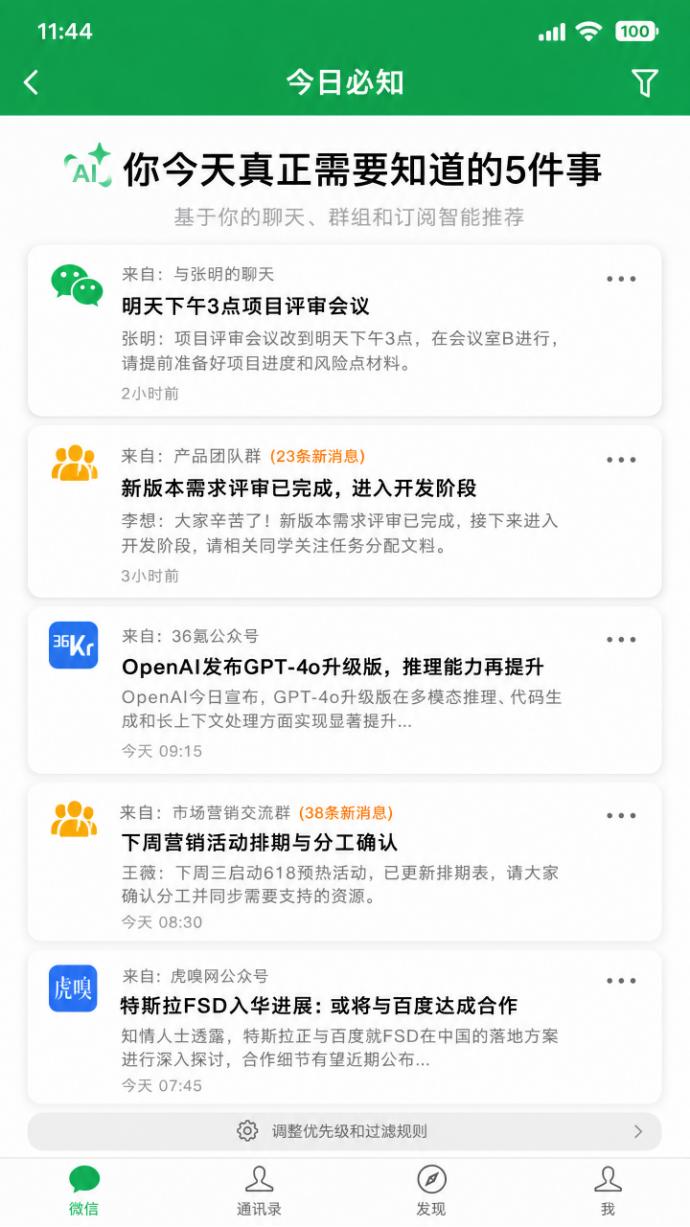
These 5 things may come from your chat records, group messages, or official account subscriptions, but each thing will be clearly marked with its source, and users can adjust the priority and filtering rules at any time.
AI Shouldn't Just Be a Dialog Box
The opportunity for WeChat AI lies not in replacing search but in rearranging the information flood inside WeChat.
There are too many official accounts. You follow hundreds of them, but you only really read a dozen or so. Group messages are too messy. You've joined dozens of groups, but most of the time you're just dealing with the unread message count.
These problems are not because WeChat's functions are not strong enough, but because there is too much information, too many entrances, and users' attention is too limited.
If WeChat AI can reorganize this information, extract the really important things, and present the relevant action entrances in a concentrated way, it will not just be an AI assistant but a personal information butler in WeChat.
This butler doesn't need to be omnipotent. It only needs to do three things well.
First, help you filter out the noise. Automatically archive the unimportant, repetitive, and ignorable information so that your attention can be focused on the things that really need your attention.
Second, help you discover associations. Connect the relevant information scattered in different chats, different groups, and different official accounts so that you can see the complete context instead of fragmented pieces.
Third, help you simplify actions. Turn things that require multiple steps to complete into one-click accessible entrances and reduce the number of times you need to jump between different interfaces.
If WeChat AI can achieve these three points, that will be enough.
Currently, there are only some signs of the third point.
On June 8, 2026, WeChat officially opened the ability to access the WeChat AI ecosystem to developers. Users can directly call the AI application services in mini-programs through the WeChat AI Agent.
The first batch of internal testing teams includes well-known enterprises such as JD.com, Meituan, Didi, and Ctrip, covering core local life service scenarios such as e-commerce, food delivery, travel, and tourism.
As one of the first enterprises to access, Meituan has completed the development and testing in cooperation with the WeChat team. In the future, users can directly call local life services such as Meituan Food Delivery through WeChat AI.
What WeChat AI should solve should not just stay at the basic level of generating content or answering questions. It should help you manage your entire digital life.
WeChat has the opportunity to go further, but the premise is that it can find that balance point, making AI both proactive and not overstepping the boundaries, both useful and not scary.
This article is from the WeChat official account "Zimu AI", author: Miao Zheng. Republished by 36Kr with permission.