"mythical" Claude 5 drops a bombshell late at night: from generating 50 million lines of code a day to outperforming papers in *Science*, ordinary users are advised to use it with caution
Complete 50 million lines of code in one day. What does that mean? It's equivalent to rewriting a software company with a market value of hundreds of billions from scratch - and it only took 24 hours.
Just today, Anthropic's "mythical" models that have been hidden for two months are finally unlocked. Not one, but two: Claude Fable 5 is open to all users, while Claude Mythos 5 is only available to a small number of trusted users. They share the same underlying model and the same "Mythos" core. The only difference is that Fable 5 has safety constraints, while Mythos 5 has completely removed the restrictions.
What's even more intriguing is the timing of the release. Just two days ago, Anthropic's CEO, Dario, seriously called for "an immediate halt to all AI research." Yet, less than 48 hours later, their most powerful models were launched overnight. Saying no with the mouth, but acting otherwise.
But putting aside these distractions, the real questions worth caring about are: What makes this "performance monster" so powerful? Why put the same "heart" into two different "bodies"? And when AI can work autonomously for a week without supervision and produce results that surpass those in Science magazine - where do we humans stand?
Mythos 5's Path to "Deification": From 50 Million Lines of Code to Surpassing Science Papers
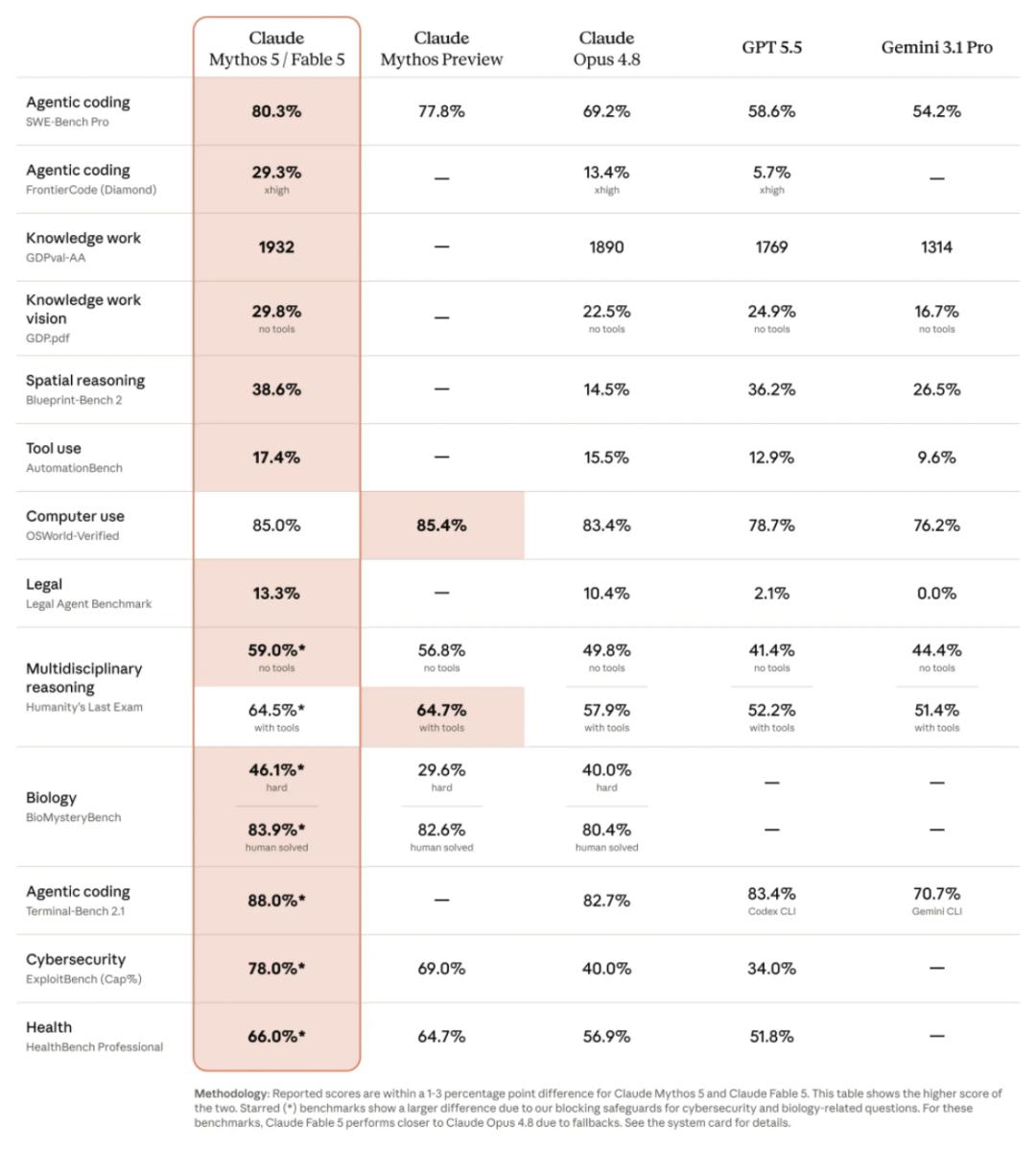
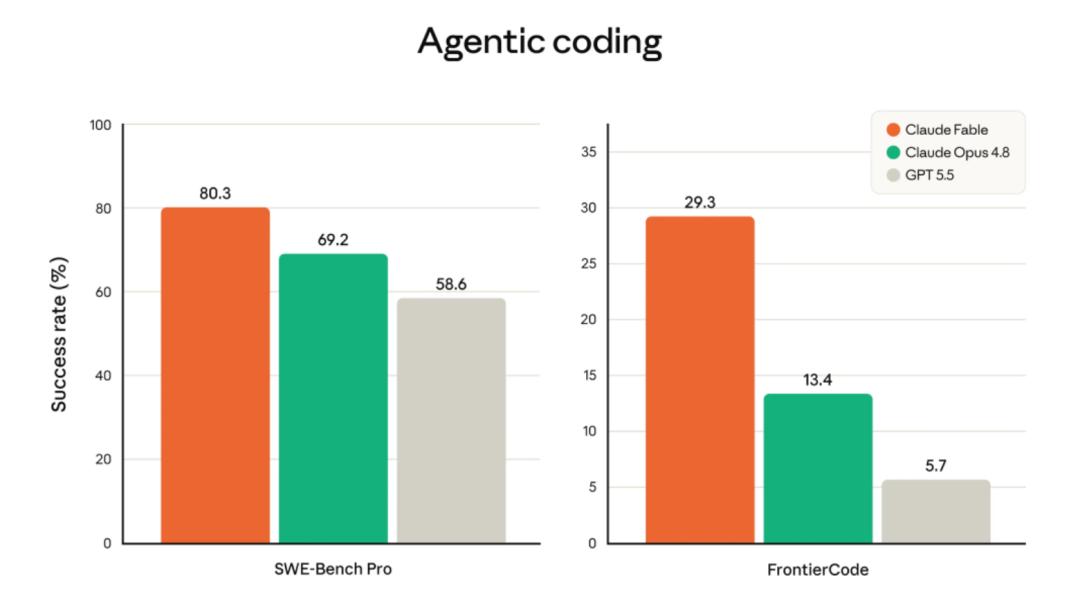
First, let's look at software engineering. Although the official benchmark scores mainly show data for Fable 5, Anthropic clearly states that Fable 5 and Mythos 5 share the same underlying model and have identical basic technical indicators. Therefore, Mythos 5 also has an astonishing score of 80.3% on the SWE-Bench Pro, just like Fable 5. In comparison, GPT - 5.5 only has a score of 58.6%.
However, real - world cases are far more shocking than numbers. The fintech company Stripe, which participated in the early testing, had a Mythos - level model perform a full - library migration on a 50 - million - line Ruby codebase. Normally, this would take an engineering team more than two months. But Mythos 5 completed it in just one day. One day, 50 million lines, and the whole team was stunned.
What's even more mind - boggling is its "autonomous scientific research" ability in the field of life sciences. This is where Mythos 5 truly outperforms all publicly available models.
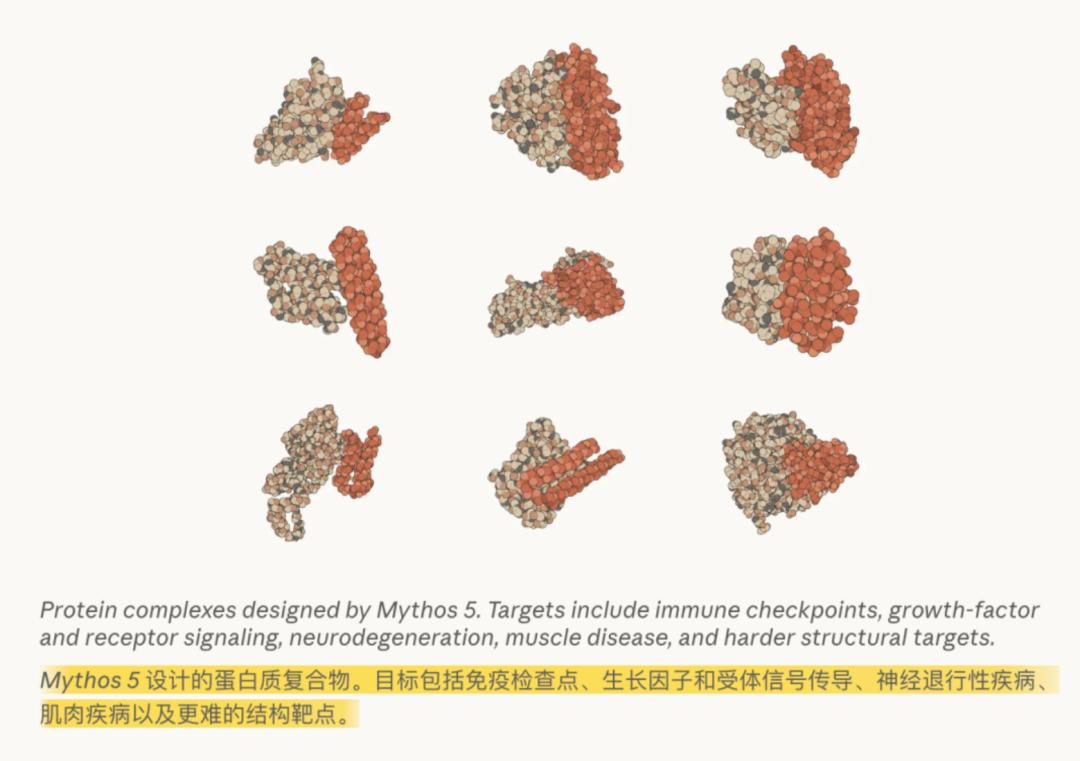
In the protein design task, Mythos 5 independently executed the entire workflow of a biologist without any human assistance: selecting binding sites, running bioinformatics tools, and debugging on its own when the operation failed. Among the 14 protein - targeting complexes it designed, 9 have entered real - world drug development pipelines, covering high - difficulty targets such as immune checkpoints, neurodegenerative diseases, and muscle diseases.
Anthropic officially stated that Mythos 5 "is our first model capable of continuously generating novel and compelling scientific hypotheses." In a blind comparison with Opus - level models, scientists preferred the molecular biology hypotheses proposed by Mythos 5 in 80% of the cases. One hypothesis about a new mechanism of E. coli proteins has been directly confirmed by a recent paper from an independent research team.
The most astonishing part is the genomics research. Mythos 5 worked autonomously for more than a week with almost no human intervention. It gathered millions of single - cell data from 138 animal species, designed and trained a customized machine - learning model on its own to identify cells performing the same functions in distantly related species.
What's the result? This tiny model, which is 100 times smaller and trained by AI, directly outperformed the latest scientific research results recently published in Science magazine. Anthropic plans to officially publish this result in the next few months.
Therefore, Mythos 5 is not just "stronger" in one field. It has achieved "crushing human teams" and "surpassing top - journal papers" in two completely different high - barrier industries: software engineering and life sciences. It is no longer just a tool but an "AI researcher" capable of independently completing research projects and producing verifiable results.
From "Spellcaster" to "Client": The Collaboration Paradigm between Humans and AI is Completely Reversed
Ethan Mollick, a well - known AI scholar and a professor at the Wharton School, provided a profound insight after testing: Humans are changing from "spellcasters" to "clients."
In the past, using large models was like a spellcaster chanting spells - we had to guide step by step, meticulously craft every prompt, continuously have dialogues, correct, and guide, and only then could AI barely perform a trick. That was the "tool - using" mode.
Now, Professor Mollick directly fed a 15 - page complex project design document to Fable 5 (the same underlying model) and left a general requirement description. For the next nine and a half hours, Fable 5 ran completely autonomously in the background: generating its own agent workflow, internally scheduling multiple small agents to conduct research, write outlines, proofread each other, discard wrong hypotheses, and correct mistakes. Humans didn't intervene at all. Nine hours later, a high - quality finished product was directly delivered to him.
This is the "client" mode. You are no longer the spellcaster who does everything personally, but the client who signs off on the final product. You don't need to care about how many micro - decisions the AI makes in the black box. You just need to make a request and accept the result.
Behind this transformation is the combination of long - context and autonomous logic. In traditional large models, the context window is just a "content container" - you put a bunch of materials in it, and it answers questions based on those materials. However, the million - level token context of the Mythos - level model, combined with persistent file memory, turns it into an "intelligent operating system that can run autonomously."
Anthropic conducted a quantitative test using the game Slay the Spire: After connecting the model to persistent file memory, Fable 5's performance improvement was three times that of Opus 4.8, and the frequency of reaching the final chapter was also three times higher. This means that the model not only remembers previous experiences but also actively uses them to optimize subsequent decisions - it is "learning from its own experiences."
Mollick said something thought - provoking after the test: Using this tool is both pleasant and disturbing. It's pleasant because I just need to make a request, and it can fulfill it. It's disturbing for the same reason.
Mythos 5 brings not "stronger Q&A" but "delivery without intervention." AI has changed from a soldier that needs your command to a contractor capable of independently completing projects. And the core ability of humans is shifting from "how to command AI" to "how to accept the results of AI."
The Sharpest Knife with the Sturdiest Sheath: The Safety Guardrails and the Onset of the "Permission Era"
The greater the ability, the greater the risk. Anthropic is well aware of this - which is why Mythos 5 is not directly available to everyone.
The most obvious change: The public version of Fable 5 has a built - in safety classifier. Once triggered, it automatically "downgrades" to Opus 4.8 for answers. The full - power version of Mythos 5 removes the restrictions in the fields of network security and biological research and is only available to trusted users.
Anthropic provided data: More than 95% of Fable 5 conversations do not trigger the downgrade. This means that for most writing, coding, analysis, and research work, users can have an experience close to that of Mythos 5. However, the remaining less than 5% of requests - including reasonable research needs, such as biologists researching viruses and security engineers conducting authorized attack - defense drills - may also be misjudged. Anthropic admits that the current guardrails are stricter than ideal and will reduce the misjudgment rate in the future.
Another notable signal: The data retention policy. Starting from Fable 5 and Mythos 5, Anthropic requires that the traffic of all Mythos - level models be retained for 30 days, covering both first - party and third - party platforms. The official emphasizes that these data will not be used for training but only for security monitoring - to identify complex attacks, new types of jailbreaks, and cross - request attacks.
For ordinary users, this may just be a line in the terms. But for enterprise and institutional customers, this is a very real data governance issue. To use the most powerful capabilities, they have to accept a higher level of security review and data retention. The cost of cutting - edge models is not just on the API bill.
Meanwhile, Anthropic did something else: Just a few days after calling for "an immediate halt to all AI research," they released their most powerful model. This contradictory stance of "calling for a halt while accelerating" has been interpreted by many industry insiders as a marketing stunt. But from another perspective, it also conveys a deeper signal: Cutting - edge AI is entering the "permission era." The most powerful models are no longer available to everyone equally. Instead, there are "public versions" and "trusted versions," and a distinction between "with guardrails" and "without guardrails." The stronger the ability, the higher the threshold.
The release of Mythos 5 is not only a technological event but also a watershed in product form and industry rules. Security is no longer just a disclaimer before the model answers but has become a complex architecture composed of classifiers, model routing, permission grading, and data retention. In the future, top - notch AI will probably follow this path - not restricting access but grading, leaving traces, and making it traceable.
Conclusion
Regarding the pricing: Mythos 5 and Fable 5 are priced at $10 per million input tokens and $50 per million output tokens, which is less than half of the preview version and only one - sixth of GPT - 5.5 Pro. However, even so, its token consumption is still astonishing. Some users reported that in the $200 - per - month Max package, Fable 5 consumed about 14% of the 5 - hour quota in just one minute - which is about one dollar per minute.

This reveals a fact hidden by the data: The "deification" and "expensiveness" of Mythos 5 are two sides of the same coin. It can complete 50 million lines of code in one day, but its token - burning speed will also make individual users wince. It can conduct scientific research autonomously for a week and produce Science - level results, but only institutional customers can afford the computing power.
Anthropic is betting on one thing: When AI can evolve from "helping you write code" to "completing research projects for you," the price that enterprises are willing to pay for the latter will be much higher than for the former. Mythos 5 is the first card in this game.
Today, the myth has descended. But the cost of the myth is just starting to be calculated.
This article is from the WeChat official account "First New Voice". Author: Zhuxin. Republished by 36Kr with permission.