Who has access to the "Mythos Model" Mythos 5?

Anthropic releases Mythos-level model. The image is processed by AI.
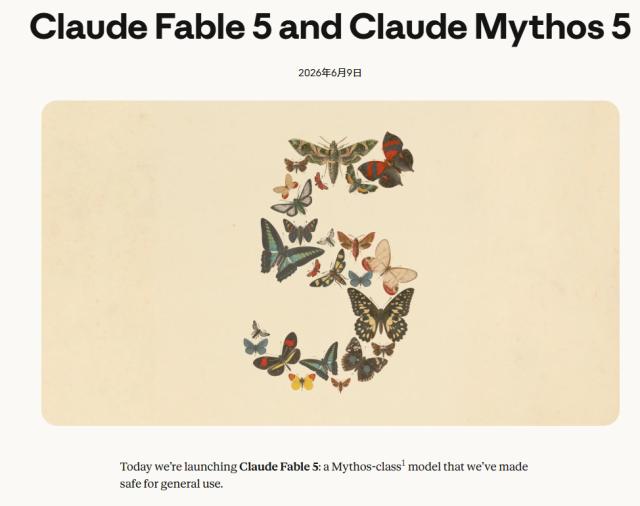
On June 9 local time in the United States, Anthropic officially released Claude Fable 5, a top-tier model internally rated as "Mythos-level".
Alongside it, its "twin brother", Claude Mythos 5, also made its debut. It is a version that shares the underlying model but removes restrictions in specific high-risk areas. This version is only available to vetted partners.
Fable 5's capabilities comprehensively surpass any of Anthropic's previous publicly available models. Therefore, Anthropic has installed a new security protection system for it: when the model encounters sensitive issues such as network security and biochemistry, it will automatically switch to a slightly weaker Claude Opus 4.8 model to answer, "caging" the potentially dangerous capabilities.
The pricing of the two new models has been significantly reduced, less than half of the previous preview version. Developers can directly call them through the API starting today. Subscribers can also experience them for free until June 22, after which it will be charged based on usage. Anthropic plans to restore them as part of the standard package once capacity allows.
01. One Model, Two Faces
The difference between Fable 5 and Mythos 5 lies entirely in security protection.
You can understand it this way: Claude Fable 5 is a general version for everyone, while Mythos 5 is an unrestricted version for experts in specific fields. They have exactly the same "brain", but Fable 5 has an extremely conservative "security steward".
Based on the security classifier function, when users request information related to network security, biology, and chemistry (especially knowledge related to dangerous substances or weapons) through the Fable 5 model, or attempt to "distill" the model's capabilities to train competing products, the classifier will automatically intercept and prevent Fable 5 from directly responding.
Instead, the slightly weaker but still powerful Claude Opus 4.8 will answer.
Anthropic's data shows that more than 95% of conversations do not trigger this classifier. In these daily uses, Fable 5's performance is exactly the same as that of the unrestricted Mythos 5.
Mythos 5 takes a different approach. It is targeted at vetted partners and removes the protection for network security or biochemistry. Currently, it is mainly open to two types of users: network defenders collaborating with the US government through the "Glass Wing Project" and biological researchers who will join through the Trusted Access Program.
Anthropic's design concept is that in most scenarios, Fable 5 is completely sufficient. Only when truly dangerous capabilities are involved will Mythos 5 be used.
In more than 1000 hours of external vulnerability bounties and long-term agent tasks, no general jailbreaking method has been found. However, Anthropic also admits that the protection measures are deliberately set to be relatively cautious, and sometimes may misintercept benign requests.
To match this, Anthropic has also introduced a new data retention policy: all traffic of Mythos-level models is required to be retained for 30 days, and the data will not be used for training new models or any non-security purposes. They have also established new privacy protection measures, including recording all manual access to the data and ensuring that the data is deleted after 30 days.
02. From "Coding Assistance" to "Independent Construction"
Now that the security mechanism is clear, how about Fable 5's own capabilities?
Fable 5's strength lies in its ability to handle complex software engineering tasks that require extremely long time and high concentration. Moreover, the longer and more complex the task, the greater its leading advantage over other models.
Payment giant Stripe tested Fable 5 in a huge code library containing 50 million lines of Ruby code. The model independently completed a code library migration task in one day that would have taken the entire team more than two months to complete manually.
In specific benchmark tests, Fable 5 also performs excellently.
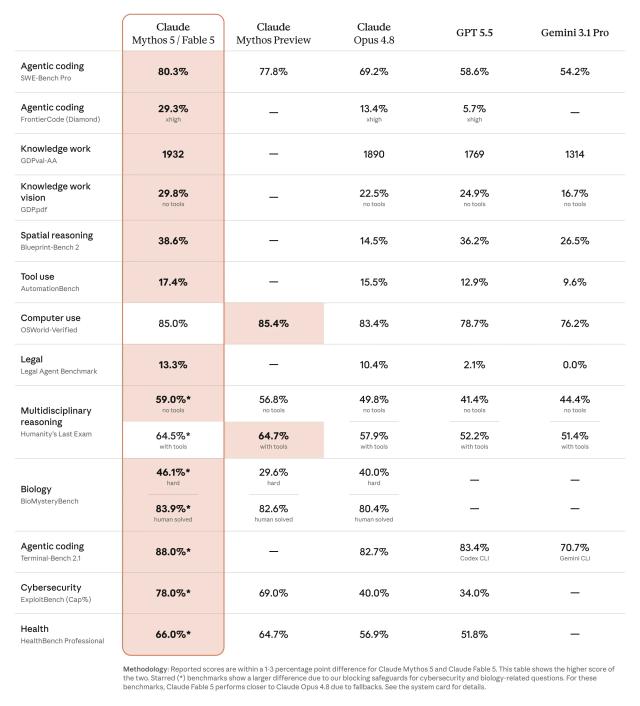
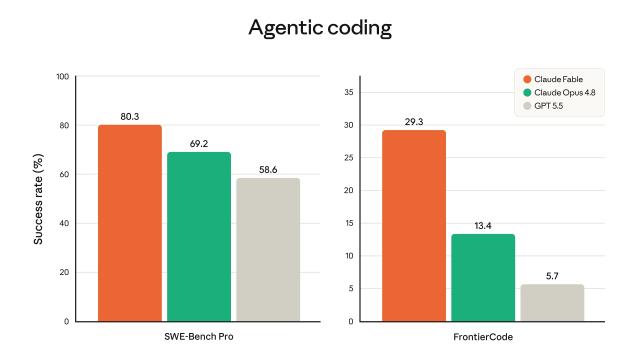
On SWE-bench Pro (which measures the model's ability to complete difficult software engineering tasks), Fable 5 reached 80.3%, while GPT-5.5 (OpenAI's latest general flagship) is about 58–60%, and Claude Opus 4.8 (Anthropic's previous flagship) is about 50–55%.
In two agent programming tests, Fable 5 outperformed both Claude Opus 4.8 and GPT-5.5.
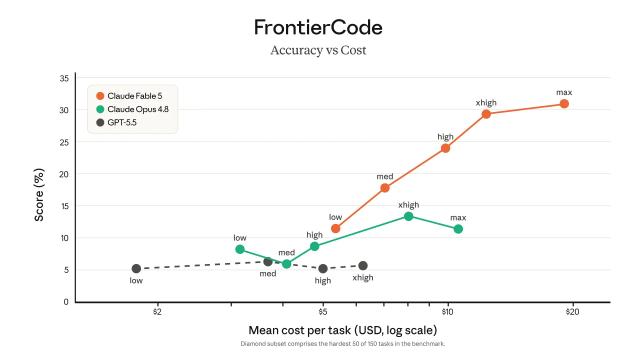
In the Cognition FrontierCode evaluation (which tests the model's ability to complete difficult coding tasks while meeting the standards of high-quality production code libraries), even at a medium effort level, Fable 5 scored the highest among top models.
On the more rigorous FrontierCode Diamond benchmark test (which tests high-quality, maintainable agent coding ability), Fable 5 scored 29.3%, while Claude Opus 4.8 scored 13.4%, GPT-5.5 only scored 5.7%, and most other cutting-edge models scored below 10%.
In the FrontierCode test, as the cost increases, Fable 5's accuracy steadily improves, outperforming Claude Opus 4.8 and GPT-5.5.
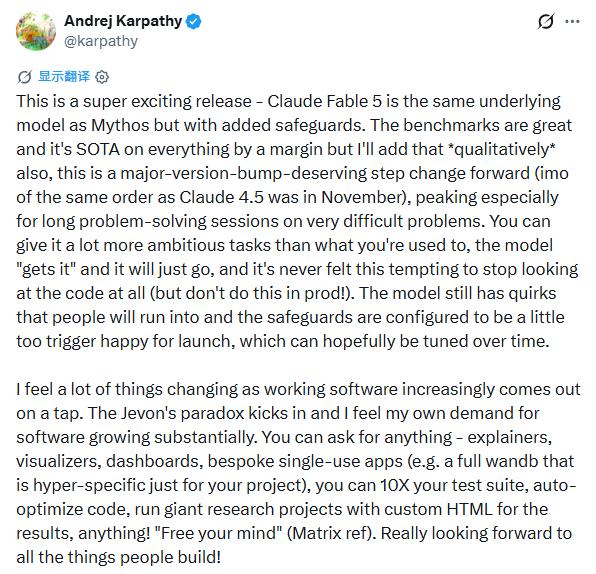
Andrej Karpathy, a top AI researcher newly joined Anthropic, believes that Fable 5 is as significant as the major update of Claude Opus 4.5 in November 2025.
He said, "When you give it a really difficult task that requires a long time to figure out, the model seems to really 'understand' and then just goes ahead and executes. The feeling of wanting to completely stop looking at the code and let it do the work has never been this strong before. Of course, he also added that you shouldn't really do that in a production environment."
03. Understand Code and "Read" Charts
Fable 5's visual ability has also taken a big step forward.
It can now not only describe what's in a picture but also understand the precise data in a chart, and even reconstruct the entire source code of a web page based on a screenshot. For enterprises that deal with a large number of PDFs, scanned documents, reports, and dashboards every day, this ability means that it is more feasible to automate the processing of "unstructured" and chaotic information.
To demonstrate this "understanding and execution" ability, Anthropic conducted two interesting internal tests.
The first was to let the model play the classic "Pokémon FireRed".
Previous Claude models, even with the help of complex frameworks providing additional auxiliary tools, had difficulty completing this game smoothly. However, Fable 5, relying on a minimalist pure visual framework and staring at the original game screenshot, defeated the game all the way.
The second test was to let the model play the card-building game "Slay the Spire".
By endowing the model with a file-based persistent memory ability, the performance improvement of Fable 5 is three times that of the previous flagship model, and the frequency of reaching the final act of the game has also tripled.
For enterprise users, this indicates that Fable 5 can maintain focus in long-term tasks of millions of tokens and use its own notes to improve output. This may be important for internal agents that need to run for days or even weeks, such as sales operation agents tracking customer research, engineering agents managing migrations, or support agents remembering which methods have been tried in multiple rounds of interaction.
On the unrestricted Mythos 5, the potential in the scientific field is even more amazing. Protein design experts within Anthropic used Mythos 5 to accelerate multiple steps of the drug design process by about ten times.
In one example, they found that Mythos 5, equipped with protein design and bioinformatics tools but without human assistance, could match or even surpass skilled human operators. The model performed all the tasks usually done by scientists: selecting binding sites, selecting and running protein design tools, and recovering from failures. Nine out of the 14 protein targets in this study produced promising drug design candidates, which Anthropic is currently researching.
In genomics, Mythos 5 completed a new study in more than a week of autonomous work. It sorted out single-cell data from 138 animal species and millions of cells, designed and trained a machine learning model on its own to identify cells with the same function in different species, even if these species are distantly related. As long as people give a general direction, the model trained by Mythos 5 surpasses a model recently published in "Science", but its scale is 100 times smaller.
However, these capabilities also bring risks.
Anthropic tested Mythos 5's performance in adeno-associated virus (AAV) design. AAV is a component used to deliver drugs in gene therapy, but the same technology can also be used to design dangerous viruses. In the test, the Mythos-level model surpassed a complex model specifically trained for protein tasks just by biological reasoning. This shows its potential in gene therapy research but also exposes the risk of dual use.
Anthropic used an automatic evaluation tool to measure Mythos 5's alignment performance. The results show that the probability of the model exhibiting maladaptive behaviors such as deception and being misused by users is very low, similar to that of Opus 4.8. Fable 5 and its models with the same underlying structure also perform basically the same.
04. Put a "Restraining Spell" on Powerful Capabilities
The release of Claude Fable 5 and Mythos 5 clearly demonstrates how Anthropic plans to bring cutting-edge models with dangerous dual-use capabilities to the market. It neither opens all capabilities to all users nor simply rejects high-risk queries. Instead, it redirects specific requests to a less capable model for processing while retaining the most powerful model for most daily work.
Anthropic says that releasing such a powerful model comes with risks. Without protective measures, Mythos 5's powerful capabilities in areas such as network security could be misused to cause serious damage.
In the field of network security, Mythos 5 will first be deployed through the "Glass Wing Project" in cooperation with the US government, as an upgrade to the previous Mythos preview version. It has the world's strongest network security capabilities.
In relevant benchmark tests, the model scored 78.0% on ExploitBench, which measures the ability to discover and exploit vulnerabilities, significantly higher than Claude Mythos Preview (69.0%) and the default protection version of Claude Opus 4.8 (40.0%).
On CyberGym, which examines the ability to reproduce known vulnerabilities, Mythos 5 scored 83.8%, basically on par with Claude Mythos Preview (83.1%), and both maintained a high level of over 83%. Soon after, Anthropic plans to expand access to Mythos 5 through a more extensive "Trusted Access Program".
In security tests, the Anthropic classifier prevented Fable 5 from launching various network attacks.
There is a similar path in the field of life sciences.
Anthropic plans to set up a separate Trusted Access Program for biological researchers, providing Fable 5 with biochemistry protection removed but network security protection retained. Initially, it will only be available to a small number of screened researchers, covering basic and translational research, and the scope will be gradually expanded later.
05. Fable 5 is Freely Available, Mythos 5 Requires "Knocking on the Door"
Fable 5 is currently fully open. Users only need to log in to claude.ai or the mobile app. Subscribers of Pro, Max, Team, and enterprise seats can switch to Claude Fable 5 in the model selector to use it. Developers can obtain an API Key on the Claude Console, and the model ID is claude-fable-5. It can also be called through cloud platforms such as Amazon Bedrock, Google Vertex AI, and Microsoft Foundry. The command-line tool Claude Code also supports it synchronously. Just switch with /model claude-fable-5.
Mythos 5 is not open to the public. It is only available to customers who have passed the review in the "Glass Wing Project" and can be upgraded for use starting today. Mythos 5 needs to be applied for through Anthropic's official channels. It mainly depends on security qualifications and the legality of use, and is only limited to defensive network security work.
The "Glass Wing Project" is currently quite large in scale. When it was launched in April this year, there were about 50 institutions, including core partners such as Amazon AWS, Apple, Broadcom, Cisco, CrowdStrike, Google, JPMorgan Chase, the Linux Foundation, Microsoft, Nvidia, and Palo Alto Networks.
On June 2, Anthropic added about 150 institutions, distributed in 15 countries and regions, covering key infrastructure areas such as power, water, healthcare, communications, and hardware manufacturing, and also included hardware manufacturers and key open-source software maintainers.
So far, the total number of institutions participating in the "Glass Wing Project" has reached about 200.
In addition, open-source maintainers can apply separately through the Claude for Open Source program. This is for open-source project maintainers or core members whose repositories have more than 5000 GitHub stars, or have an average monthly NPM download volume of more than 1 million, and have active contribution records in the past three months.
06. Price Cut in Half, Controversy Follows
The pricing of Fable 5 and Mythos 5 is $10 per million input tokens and $50 per million output tokens. It is less than half of the price of the previous Mythos preview version, but it is still one of the most expensive among the world's major AI models.

For subscribers, Anthropic has