Has the market peaked, and can Token no longer sustain its momentum? This could be the most crucial chart in the entire market.
The growth of Token spending is showing signs of fatigue, and the market's core focus on AI is rapidly shifting from "whether the technology is feasible" to "whether the cost is affordable."
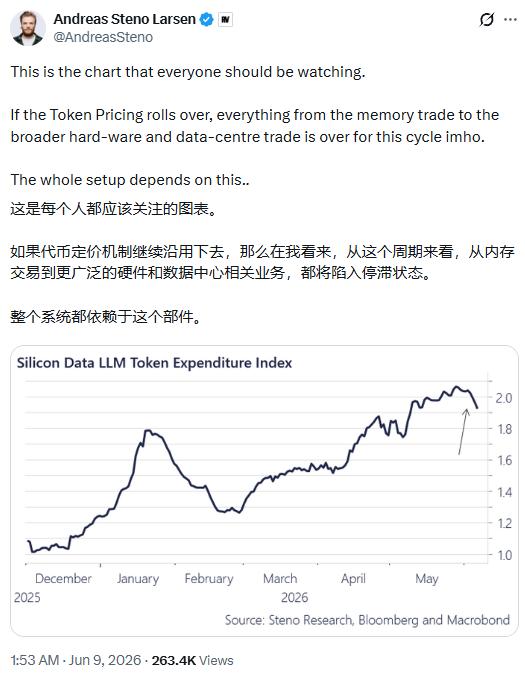
On June 9th, macro strategist Andreas Steno Larsen said on social media that the trend of the Silicon Data LLM Token spending index is the most important chart for the entire market to focus on at present.
This index has more than doubled since last December and soared significantly before May 2026, but it has recently declined. Andreas Steno Larsen warned that if the Token pricing continues to weaken, the transactions from memory to a wider range of hardware and data centers in this cycle may come to an end.
Meanwhile, technology giants are urgently curbing the out - of - control AI computing power consumption within their organizations.
As previously mentioned by Wall Street Insights, Amazon and Microsoft are cutting back on internal AI tools or halting projects that track usage to combat the "Tokenmaxxing" (maximizing token usage) behavior of employees, who ineffectively consume computing power to improve their internal rankings.
On the server side, GitHub Copilot switched its billing model from per - request charging to per - Token charging on June 1st, causing some users' monthly bills to soar more than ten times, triggering widespread doubts in the market about the sustainability of the AI subsidy model.
These series of signals are reshaping investors' risk judgments on AI infrastructure transactions. The marginal changes in Token spending directly affect the capital expenditure expectations of NVIDIA, memory chip manufacturers, and cloud service providers through the transmission chain of GPU computing power, DRAM memory, and data center demand.
01
Peak of the Indicator: The Logic of Hardware Transactions is Under Test
The Silicon Data LLM Token spending index is a spending - weighted indicator that measures the payment price per million LLM Tokens in the entire market and is regarded as a substitute indicator for the market's marginal willingness to pay for AI.
Since major suppliers such as OpenAI, Anthropic, and Google mostly charge customers based on Token consumption, Token spending directly links AI usage to the demand for GPUs, DRAMs, and data centers.
The recent stagnation of this index has raised concerns in the capital market about the hardware cycle. A comment from Silicon Data pointed out that the recent decline may indicate that the speed of migration to high - end closed - source models is slowing down. If Token spending remains weak, the marginal revenue for funding incremental GPU, DRAM, and data center purchases will weaken, which will change the risk profiles of companies that have formulated capital expenditure plans based on Token - driven growth.
Although a single decline does not constitute an absolute trend, as a leading indicator of the hardware cycle, this data suggests that enterprises' dependence on high - cost cutting - edge models may face a systematic decline.
02
Bill Crisis: Technology Giants Halt "Ineffective Consumption"
The corporate AI boom is facing its first real bill crisis.
According to Axios, citing an AI consultant, one of his corporate clients recently spent $500 million on Claude in a single month, simply because there was no upper limit set on employee usage.
Within enterprises, the practice of using AI usage as an assessment standard has also backfired. It is reported that Kiro, a developer platform under Amazon, once had an internal leaderboard called "Kirorank." A similar situation also occurred within Meta, where employees tried to increase Token consumption to gain an advantage in the rankings.
Dave Treadwell, the senior vice - president of Amazon, admitted that employees were making AI perform meaningless tasks to boost their rankings, which pushed up the company's operating costs. He clearly instructed employees "not to use AI just for the sake of using it," and the beta dashboard was subsequently taken offline. Amazon has now switched to using the "normalized deployment" indicator to replace Token consumption and track the actual value of AI - generated code.
03
Pricing Rebound: The Era of Subsidies is Coming to an End
On the supply side, the long - standing business model of the AI industry, which uses subsidies to drive growth, is approaching its limit.
On June 1st, GitHub Copilot officially switched to charging based on Token usage. Some users on the Reddit community said that their monthly fees are expected to skyrocket from less than $45 to more than $847.
Mario Rodriguez, the chief product officer of GitHub, previously said that with the rise of agent - based AI, the old pricing model is no longer sustainable. Arun Chandrasekaran, an analyst at Gartner, pointed out in an interview with Business Insider that as advanced reasoning models drive up computing power consumption, more enterprises will switch to usage - based charging.
Investor Tommy Shaughnessy warned of the systemic risks of this subsidy model. He pointed out that currently, the profit margins of major AI companies are deeply negative. Once enterprises face the real price of usage - based charging, the actual consumption speed will far exceed expectations. For example, Uber exhausted its annual AI budget within four months in 2026. If investors lose confidence in the return expectations, the capital flow supporting GPU purchases and model training will face a reversal.
04
Cost Reconstruction: Low - cost Models May Dominate the Market
Facing the high inference costs, the market is looking for low - cost alternatives.
Rich Privorotsky, the head of the One - Delta department at Goldman Sachs, believes that as DeepSeek reduces its pricing by 75% and Xiaomi's MiMo has a price cut of nearly 99%, the alleviation of infrastructure bottlenecks is triggering a price war.
As previously mentioned by Wall Street Insights, Brian Armstrong, the CEO of Coinbase, predicts that 80% of AI workloads will be migrated to models with 99% lower costs within 12 to 18 months, and only 20% of tasks that require extreme intelligence will remain on cutting - edge models. He pointed out that energy and computing power will become the real bottlenecks.
Clement Delangue, the CEO of Hugging Face, cited data from Stanford University to confirm this trend: the accuracy of local models in real - world queries has jumped to 71.3%, and the cost is extremely low. Ali Ansari, the CEO of Micro1, regards this as a "healthy swing" from over - use to rational use.
There is currently a serious divergence on Wall Street regarding the real return on AI investment. According to Jim Schneider of Goldman Sachs, by 2030, agent - based AI will drive a 24 - fold increase in Token consumption, and the gross profit margin of cloud service providers will turn positive in the short term. Economic research from JPMorgan also shows that the jump - style growth of Python packages on PyPI proves the improvement of real productivity.
However, the bear camp is also firm in its attitude. Jim Covello, a semiconductor analyst at Goldman Sachs, pointed out in a report that the current prosperity of the industrial chain comes at the cost of upstream consumption, and almost all the value flows to semiconductor companies, which is unsustainable.
Josh Pantony, the CEO of Boosted.ai, emphasized that enterprises' concerns about data openness have weakened the effectiveness of AI agents. Considering multiple factors such as cost, return, and security, how much real value the next AI bill can generate will be the final judgment of the market on this technology investment.
This article is from the WeChat official account "Wall Street Insights," written by Ye Zhen, and is published by 36Kr with authorization.