30 billion US dollars, 300 Agents, Kimi publicly predicts the World Cup: Not afraid of being proven wrong




Text by Zhang Hu
In the summer of 2026, the whistle of the FIFA World Cup in the United States, Canada, and Mexico hasn't blown yet, but the football fever has already landed in advance.
In China, the Super League of Jiangsu Province is sweeping social media in an absurd yet passionate way. The 10 - yuan tickets have been scalped up to 900 yuan. Changzhou, due to its consecutive losses, has been jokingly renamed by netizens from "Changzhou" to "Diaozhou" and then to "Jinzhou". The official even joined in the fun, saying, "Winning the game comes first, and friendship comes fourteenth." When Suzhou, Wuxi, and Changzhou, the three cities with the strongest GDP in Jiangsu, are at the bottom of the standings in an orderly manner, netizens' sarcasm is heartbreakingly accurate: "The order of losing games is the same as the GDP ranking."
On the day when David Beckham came to Suzhou to cheer, the playback volume of "Thirteen Brothers in Jiangsu" on Douyin had exceeded 10.9 billion times.
This is football. It can make algorithms ineffective, turn common sense on its head, and make the most rational Yangtze River Delta region collectively lose their composure.
On another parallel battlefield, a more calculated gamble is taking place. With 48 teams and 104 matches, this is the first World Cup after the expansion, and it is also a new battlefield where global AI companies are collectively "placing bets". However, this time, some in the tech circle have chosen the most dangerous thing: going against the consensus.
On June 8th, Kimi, whose pre - investment valuation soared to 30 billion US dollars and increased six - fold in half a year, then made a bold move: using its Agent capabilities to "bet" on the World Cup. While all mainstream models are touting Spain and France as the top contenders for the championship, Kimi has stood out and "supported" the German team.
Recently, Kimi, an AI assistant under the Moon's Dark Side, announced that it will mobilize 300 Agents through the Agent Swarm function to publicly predict all 104 matches before the games and conduct post - game reviews. If this were just a hot - topic marketing stunt of "AI predicting football results", it would have gone unnoticed. But Kimi wrote a thought - provoking sentence in the official announcement:
"AI technology should be more transparent."
Moreover, Kimi has actively invited other model companies to participate in the public prediction and stated, "We believe that AI should not be packaged as an infallible system. A trustworthy AI system should be able to clearly express its boundaries." In a year where it's common to start with "breaking SOTA" and "surpassing human benchmarks" and end with a "disclaimer", this statement sounds less like a grand narrative and more like an open challenge.

Starting with an octopus
If you experienced the 2010 FIFA World Cup in South Africa, you probably still remember the octopus that suddenly became a global sensation.
Its name was Paul, and it lived in an aquarium in Oberhausen, Germany. The prediction method was simple to the point of being absurd: the staff put two transparent boxes into the water, with the emblems of two teams pasted on the boxes respectively, and a mussel in each box. Whichever box Paul swam towards and opened, people believed it was "predicting" the victory of that team.
At first, this was just a small program designed by the aquarium to ride on the World Cup wave. No one really expected a mollusk to understand football, let alone believe that it could understand formations, team conditions, odds, and national emotions. But things started to get out of control: Paul correctly predicted Germany's matches all the way and then chose Spain before the semi - finals. One day later, Spain defeated Germany 1 - 0. When it also picked Spain to win the championship, the whole world finally couldn't sit still. It got all 8 predictions right. Calculated roughly as an independent two - choice situation, the probability is 1/256, which is 0.39%.
Octopus Paul thus became the last - generation World Cup prediction master.
Strictly speaking, it didn't explain anything. It had no training data, no model parameters, no confidence intervals, and no 200 - page technical report. It just stretched out its tentacles, opened a box, and then let the media, fans, gamblers, and onlookers around the world do the explaining for it.
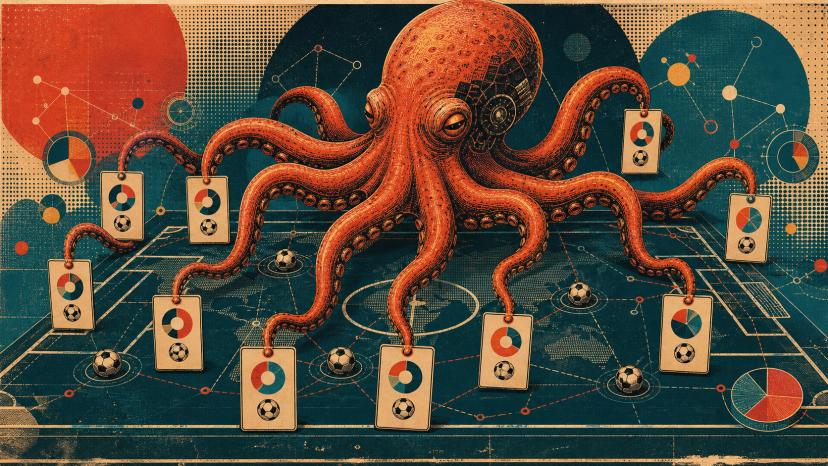
The World Cup prediction master "Octopus Paul" (image generated with the help of AI)
This is where Paul was truly charming. It wasn't about "understanding football", but about turning prediction into a globally synchronized ritual. People would laugh at themselves for believing an octopus, yet they couldn't help refreshing the news, waiting for it to take out the next mussel from the box. The World Cup has never been just a sports event; it's more like a globally synchronized emotional machine. Every four years, people suddenly become willing to believe many things they would never believe in normal times, such as superstition, luck, dreams, jersey colors, and the saying at the lottery station, "It's their turn this year."
In a sense, Paul was more like the last "black - box model" globally watched in the pre - algorithm era.
Its black box was cute because it didn't take responsibility. If it guessed right, it was a miracle; if it guessed wrong, it was just an octopus choosing the wrong lunch. But AI is different. The black box of AI is disturbing because it is starting to enter real - world decision - making: investment analysis, medical advice, legal consultation, business operations, and even World Cup prediction now. One (the octopus) being wrong at most becomes a joke, while the other (AI) being wrong may affect business, judgment, money, and even trust.
From Paul to AI, what has changed is not that humans have suddenly become more rational, but that the shell of the "prediction master" has changed. The aquarium has become the Agent Swarm, the mussels have become datasets, and the tentacles have become 300 parallel Agents. What really hasn't changed is this: whenever the world is full of uncertainties, people always want something to speak for them first.
The difference is that Paul can stay silent, but AI can't. Paul's lack of explanation creates a myth, while AI's lack of explanation creates fear.
This is also the most interesting aspect of Kimi's World Cup prediction. It's not creating another "cyber Octopus Paul", but trying to answer a more realistic question: when prediction changes from entertainment to a product feature, and when the black box moves from the aquarium to the workflow, should a company hide its uncertainties or expose them?

Why the German team?
While mainstream models unanimously rank Spain, France, and Brazil as the top three favorites to win the championship, Kimi's judgment is that the German team is severely undervalued.
The model calculates that the German team's baseline probability of winning the championship is about 11.0%, and after calibration, it's about 11.3%, while the implied probability in some markets is only 7.4%. This gap of about 3.6 percentage points is already a significant price difference in the gambling world.
Why Germany?
Kimi's analysis is quite in - depth: the shadow of the German team's consecutive group - stage eliminations in the last two World Cups has left a stubborn "recency bias" in the public and market psychology, continuously depressing Germany's valuation. In terms of hard indicators such as Elo ranking, squad valuation, and talent reserve, the German team still ranks among the world's top echelons. The young creative axis of Musiala and Wirtz is curing the German team's chronic problem of "having more ball possession but less threat" when facing a defensive formation.
And the young head coach on the sidelines may be the biggest X - factor.
At 38 years old, Julian Nagelsmann is the youngest head coach in this World Cup. Born in 1987, he is known as a "tactical prodigy" in the football world. He is not only the youngest coach in the history of the Bundesliga but also the youngest national team head coach in German football after professionalization. He is also synonymous with the "Laptop Coach". His obsession with data is almost paranoid. It's not the kind of "data analysis" from an ivory - tower perspective, but a real - time in - depth exploration: "What exactly is the moment of winning the ball? What is the moment of losing the ball? What is the definition of pressing? What is the definition of a counter - attack?" He requires the system to learn these definitions and even demands, "Get the data for me immediately when I stop the training."

Julian Nagelsmann, the head coach of the German team (image generated with the help of AI)
When Kimi specifically mentioned this in its report, there was almost a sense of "kindred spirit". When a head coach younger than Messi and Ronaldo uses AI to optimize the team's defensive line, a Chinese AI company is also using algorithms to re - evaluate the German team's probability of winning the championship. A technical thread, stretching from the training ground to the prediction model, quietly intersects on the World Cup stage.
Of course, Kimi also admits the risks: the high - pressure system has extremely high requirements for physical fitness and squad integrity. The high temperatures in North America during the summer may magnify all potential problems. Once there are injuries in key positions or when facing opponents with a well - organized defense and fierce physical confrontation, the German team's advantage will quickly shrink.
Moreover, there is a cold - hard "American curse". Historically, European teams have never won the World Cup held in the Americas, with the only exception being Germany in 2014 in Brazil. In 2026, the World Cup returns to the American continent. Both Spain and France have to face this curse, and Germany is the only one that has ever broken it.
Going against the consensus sometimes requires not only courage but also the favor of historical footnotes.

104 "public executions": honesty or another form of cleverness?
Prediction of the German team is at most an "expression of attitude". Kimi's next move is almost a provocation: it publicly invites other AI models to join this prediction.
In other words, Kimi not only participates itself but also drags all its peers into 104 real - world tests.
This is not a risk - free gamble. Looking back at previous World Cups, the "failure history" of AI predictions is full of setbacks. In the 2018 FIFA World Cup in Russia, the AIs of platforms such as Microsoft, Baidu, Google, and Alibaba Cloud collectively favored Spain, Germany, and Brazil, but France won the championship in the end. In the 2022 FIFA World Cup in Qatar, institutions such as EA, Nielsen, and FiveThirtyEight did bet on Argentina, but in terms of the hit rate of specific matches, the AI of Al Jazeera had only a 58.7% accuracy rate, and FiveThirtyEight's dropped to 57.1%, which is basically close to the result of a coin toss.
The AIs in the financial industry even performed worse. Goldman Sachs once spent 200,000 models and 1 million simulations to predict a final showdown between Brazil and Germany, but was foiled by France. Ironically, the one that has accurately predicted the World Cup champion for four consecutive times is not the quantitative models on Wall Street but the "FIFA" game by EA Sports.
"If you guess right, it's science; if you guess wrong, it's superstition," a data blogger once summarized.
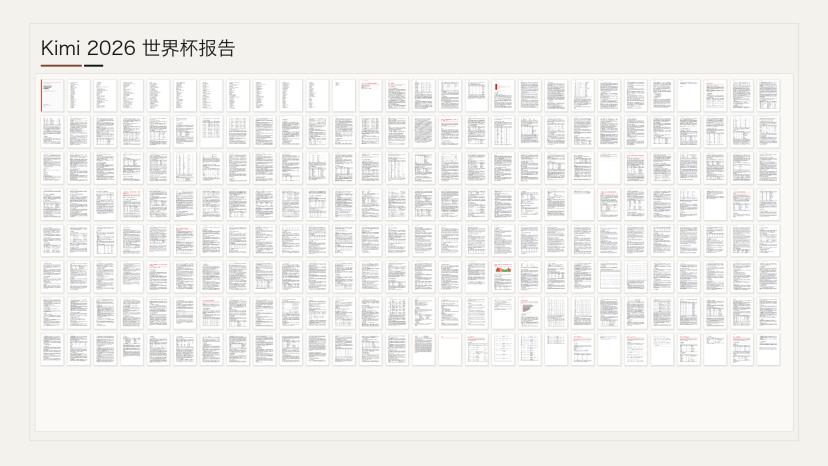
Kimi's 200 - page public report on the 2026 World Cup match analysis
The World Cup has become a natural, public, and unshielded test field here.