Is Keep Running to Blame for Local Cultural Tourism? It's Not That Simple
01
In the past couple of days, the news that "Keep Running" received tens of millions of yuan in publicity fees from local cultural and tourism departments has hit the hot search.
The incident started with a bit of black humor. In the recently aired Anyang special episode of "Keep Running", some sharp - eyed netizens noticed that the program crew had mistakenly included footage of Handan's Congtai Park and used it as a landmark of Anyang for promotion.
For a national - level variety show that uses cultural inheritance as a gimmick, such a low - level error is clearly a sign of perfunctory. Even though the program crew apologized afterwards, it couldn't make up for the mistake.
After that, as netizens from both places started to mock, the Anyang Internet Information Office quickly stepped in to refute the rumor. They denied the online claim that "Anyang spent 800,000 yuan to cooperate with the recording", clearly stating that Anyang really didn't pay this money.
However, just as one wave subsides, another rises.
Netizens dug deeper and found the "sky - high" cooperation bills of "Keep Running" on local government procurement platforms: Jiangshan spent 8.5 million yuan, Chongli 8.5 million yuan, Xinchang 9.495 million yuan, and Taizhou even paid 19.8 million yuan.
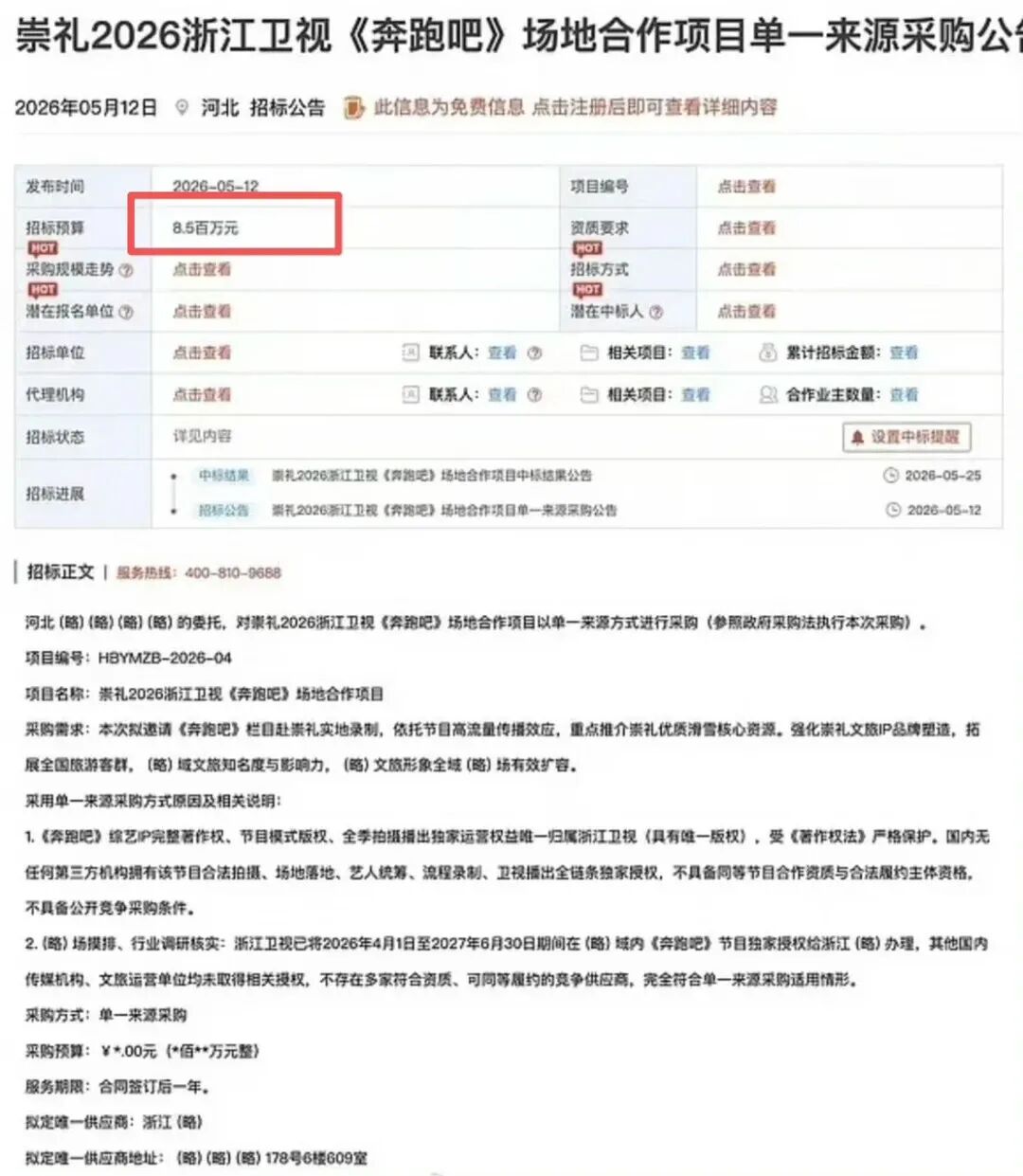
Seeing these huge bills in black and white, netizens were in an uproar. People suddenly realized that the "Keep Running" team, which they naively thought was going to the grass - roots to spread warmth, was actually engaged in such an expensive traffic business.
After the public opinion fermented, I had a chat with Ms. X, a well - known domestic film and television producer.
In response to the phenomenon that netizens concentrated their firepower on scolding local cultural and tourism bureaus for being "suckers", she gave a sharp industry perspective, saying that in fact, during the implementation process of variety shows and film and television projects, cultural and tourism bureaus often don't have that much power and may even just be taking the blame.
In Ms. X's view, the publicity departments of local governments are coming up with various strategies. When they go to each place to shoot, if they have relevant connections, things will be much easier. They can just issue an official document, and then it will be smooth sailing for them to negotiate about the shooting location and find sponsors.
Specifically regarding the investment promotion and implementation of such top - tier satellite TV variety shows, she and "Travel Industry" pointed out that the programs often rely on the strategic cooperation or resource docking between provincial satellite TV platforms and higher - level local authorities. Compared with ordinary film crews where producers have to work hard on relationships everywhere, front - line production teams only need to focus on the specific shooting and execution.
In fact, it is a common practice in the variety show and film and television industry for them to ask local governments for money and policies.
Ms. X smiled bitterly and revealed the current survival rules of film crews to me: "We go wherever there are policies. For example, Xiamen recently introduced support policies for the film and television industry, and immediately four or five dramas in the industry flocked there to shoot."
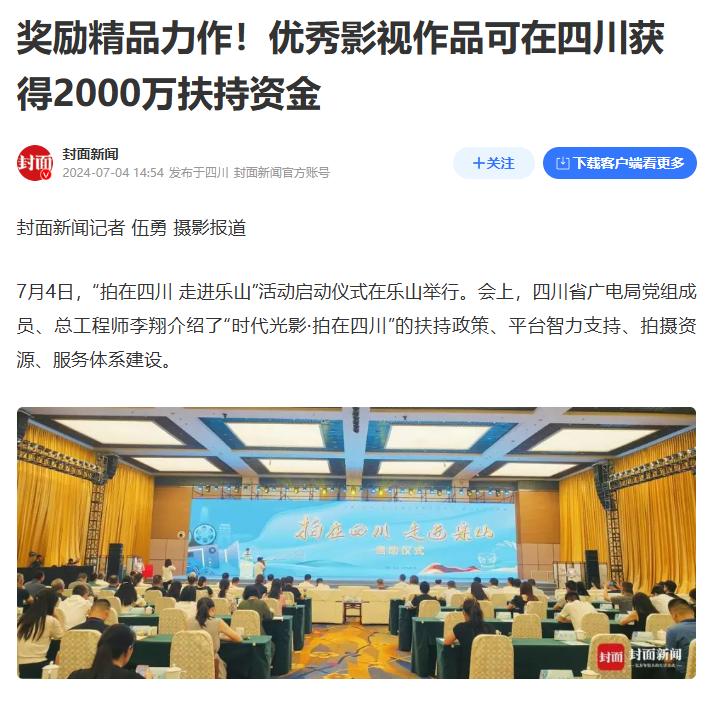
Following her words, I looked through the public documents. Taking Sichuan as an example, in recent years, it has clearly allocated real money. The provincial finance arranges hundreds of millions of yuan every year to support film and television projects. A TV series can get a maximum of 20 million yuan. Xiamen also updated its film and television support measures in 2025, and even variety shows are included in the reward scope.
In contrast, the model of "Keep Running", which often gets nearly tens of millions of yuan and takes the money directly through single - source procurement before recording, is a complete game - changer.
Based on the long - standing impression of "Keep Running" donating running shoes and building tracks in the early years, the public may still think they are doing public - interest promotion. But in fact, as a trump card of Zhejiang Satellite TV, finding stable G - end (government - end) funds has long been the core business model for this kind of established variety show to survive.
This fiasco in Anyang and the exposed tens of millions of cooperation fees are just the tip of the iceberg of this huge To - G business model.
02
Many netizens feel sorry for the hundreds of millions of yuan spent by local cultural and tourism departments. They think this money probably goes into the pockets of the stars, but the reason is not that simple.
To figure out this account, we first need to see how big a burden Zhejiang Satellite TV, the backer of "Keep Running", is carrying.
According to Xinhua News Agency, when Zhejiang Satellite TV introduced this IP from South Korea, it was a heavy - asset project. Not only did the copyright holder, South Korea's SBS TV station, earn about 30 billion won (about 180 million yuan), but SBS even paid off its debts at once.

Buying overseas reality show copyrights used to be a common practice for domestic TV stations.
The South Koreans made the money, but Zhejiang Satellite TV had to handle the project. From the day Zhejiang Satellite TV bought the copyright of "Running Man", "Keep Running" was destined to make up for this deal continuously. The pressure of whether the program could make a profit was all on its own shoulders.
But after the early glory, according to a report by "Guangdian Dujia" in 2020, Zhang Peiguo, a member of the "Keep Running" production team, admitted at that time that even for a top - tier variety show like "Keep Running", the profit margin was squeezed very thin.
Because a large - scale variety show with a mature operation system involves far more than just a few stars in front of the camera.
Behind the camera, there is a mobile system of nearly 500 people. A production team of about 50 people is responsible for the accommodation, transportation of all these people, and they also need to connect with the publicity department of the recording location and coordinate various guarantees such as public security, transportation, electricity, communication, and medical services.
So the question is, the production cost has been rising, and someone has to pay for it. The expenses for supporting the stars and the program crew of "Keep Running" mainly come from two sources.
One source is commercial sponsorship. "Entertainment Capital Theory" once revealed that during the heyday of "Keep Running", the total sponsor, Amway Yogurt, paid up to 600 million yuan in annual sponsorship fees. This is really the major source of profit for a variety show.
The other source is streaming media. After the copyright distribution of video platforms such as iQiyi, Tencent Video, and Youku, there are membership revenue sharing and peripheral authorizations, squeezing every last bit of the long - tail value of a program.
But the problem is that these two sources, which used to support the program stably, have both weakened in the past two years.
As the economy tightened and enterprises cut their budgets, variety show investment promotion entered a cold winter. By 2026, after Wanglaoji took over the sponsorship of "Keep Running", the rumored sponsorship fee was only in the hundreds of millions. Nowadays, it's already good if a variety show can cover 60% of its costs through sponsorship.

The streaming media side is also in a difficult situation. Taking iQiyi as an example, in January 2026, it issued new regulations on revenue - sharing content cooperation, covering eight major sectors such as TV dramas, variety shows, and movies. The revenue is calculated by multiplying the platform's income by a stepped ratio. The era when producers could have a stable income may be over, and risk - sharing has become the new normal.
The variety show and film and television industry has entered a cold winter. Ms. X complained to me that the public relations director of her company recently jumped to a big AI company.
When both the advertisers and the platforms are running out of resources, the importance of local governments to a variety show has quietly increased. Asking the G - end for money and resources has changed from being a bonus to a cornerstone.
It's worth mentioning that the reason why "Keep Running" can expand this G - end business with local cultural and tourism departments is also related to its program format.
Each episode of the program is filmed in a single city or scenic area. Landmarks like Jianglang Mountain and Nianba Du take turns as the backdrop. The whole episode is almost like a city promotional video.
Therefore, every time the program crew arrives at a place, they have the confidence to use the post - broadcast exposure as a bargaining chip to negotiate resource exchange with the local area.
Before going to Kaifeng for recording, Zhang Peiguo admitted that the "Keep Running" production team had calculated for the Qingming Riverside Landscape Garden how many tourists the program could bring after its broadcast.
Finally, the scenic area was convinced by the program crew and provided more than 200 extras for free. Leveraging the top - tier IP to exchange for local resources has become a standard action for "Keep Running" in every recording location.
For local cultural and tourism departments, the one - city - one - recording structure of "Keep Running" is naturally suitable for their communication needs. The money they pay for the program is for the exposure of a whole episode. If there hadn't been a problem with the self - shot episode in Anyang, it would probably have continued to make money smoothly.
Once we understand this, we can probably understand the misalignment of public opinion. Netizens are angry about the huge amount of money spent on local cultural and tourism marketing, but the real operating logic is hidden deeper.
03
After the public opinion storm, the atmosphere in both the domestic cultural and tourism circle and the variety show and film and television industry has become a bit delicate.
Ms. X shows deep concern in her words. She thinks this incident will probably dampen the enthusiasm of local governments to sponsor variety shows and films.
In the past few years, inviting big IPs to record in local areas was often regarded as a safe project for political achievements within the system. As long as the local scenery was shown on TV, the year - end summary report could be written beautifully.
But now, what seemed like a safe operation has suddenly become a public - relations bomb that could explode at any time.
Just like Anyang, which tried its best to clarify that it didn't pay this unjust money, the city was still inevitably exhausted in this storm.
Looking back at the operation track of cultural and tourism marketing in recent years, a clear clue of blind following is obvious.
Earlier, the whole industry was racking its brains to create labels for internet - famous cities. Then, it became popular for cultural and tourism directors to dress up and shoot short videos. When these tricks gradually lost their novelty, many decision - makers naively thought that they could buy the traffic code as long as they invested enough money.

The cruel reality has given everyone a lesson.
Currently, the economic environment is becoming more conservative. Ordinary people are trying to save money. As it becomes more and more difficult to earn money, when people see tens of millions of yuan of fiscal funds being squandered casually, they will naturally have a strong sense of resistance. They can easily assume that there are some shady deals just based on common sense.
However, on the other hand, most outsiders don't really understand the real survival situation of domestic media at present.
Early in my career, I worked in a mainstream newspaper in Beijing for a few years. At that time, I closely observed how traditional media institutions begged for support from enterprises and local governments to survive.
The seemingly high - end media publicity and cooperation projects on the market often trace back to administrative instructions issued by higher - level leaders layer by layer. The huge publicity budget often only circulates within a specific institutional system.
The core purpose of such operations is largely to keep the benefits within the system. They rely on administrative power to continuously support media institutions that have lost their market competitiveness.
If these institutions are completely pushed into the market to earn their living based on real conversion rates, many established teams may even find it very difficult to maintain basic operations.
The declining "Keep Running" relies on local cultural and tourism departments to support its survival, and the underlying logic of this approach is quite similar to the targeted begging of the newspaper back then.
As the purely market - oriented commercial sponsorship path becomes narrower and narrower, it is common for satellite TV program crews to seek cooperation with local departments with fiscal budgets.
Currently, there are many official media criticizing "Keep Running" for taking local fiscal funds. But if they look at their own accounts, it's not certain whether they can withstand close scrutiny about where their market - based income comes from.
Zhejiang Satellite TV behind "Keep Running" is also trapped in the same dilemma. Although it has the name of a state - owned TV station, it is not fully supported by the fiscal budget. It has to support itself through operations and also shoulder a lot of public - interest and publicity work. The revenue of a top - tier variety show is its lifeline.
Once we understand this, looking back at the Anyang incident, many things may not be that difficult to understand.
This article is from the WeChat official account "Travel Industry", author: Theodore Xishao. It is published by 36Kr with authorization.