The view count exceeded 80 million and topped Hongguo. Behind the hit: AI dramas are undergoing major innovation again, will "pure manual creation" be eliminated?
Recently, the AI drama and comic drama sectors have witnessed a series of changes: tool price hikes, stricter reviews, and lower revenue shares are gradually eroding the profits of practitioners and raising the content threshold. Against this backdrop, simultaneously balancing "efficiency" and "high - quality production" has become the next competitive focus for AI dramas and comic dramas.
Meanwhile, IP - based, serialized, and rapid updates have begun to be standard attributes of hit dramas. The update speed of an IP series and the quality stability across episodes and seasons have become important factors determining its long - term popularity. For example, the hit comic drama "The Magic Treasure Basin" (full name: "The Magic Treasure Basin: The Mixed Spiritual Root is the Real Boss") series is one of the most representative cases.
Therefore, current AI short - drama creators need AI tools that can balance "quality" and "efficiency". However, when creators truly enter the production rhythm of "multi - episode high - quality production", a real problem emerges: currently, what often hinders the efficient production of multi - episode high - quality content is not the model's generation ability, but the comprehensive level of "workflow" and "asset management".
How can this problem be solved?
I. Behind "The Magic Treasure Basin": The Evolution of AI Tools with "Agent Batch + Canvas Refinement"
Let's first look at a set of data.
As one of the hit IPs in the AI comic drama sector, the "The Magic Treasure Basin" series has achieved remarkable results:
On the day after the release of Season 2 of "The Magic Treasure Basin", the Red Fruit popularity exceeded 63.79 million. As of June 8th, the native playback volume on Douyin exceeded 100 million times.
On the day after the release of Season 3, the Red Fruit popularity exceeded 72 million, ranking second on the Red Fruit Hot List and first on the comic drama list. It also topped the Red Fruit comic drama list for 5 consecutive days.
On the day after the release of the latest Season 4, the Red Fruit popularity exceeded 80.44 million, ranking fourth on the Red Fruit Hot List and third on the new drama list. It also ranked first on the Red Fruit comic drama hot list for 4 consecutive days.

Behind these remarkable results, what's more notable is its production efficiency:
With a compact production cycle for multiple consecutive seasons, highly consistent character images, natural scene transitions, and consistently high - quality production, this is not a coincidence. It is the result of the support of systematic AI creation tools.
The DataEye Research Institute learned that as a high - quality comic drama jointly launched by Chen Ke Culture and Seko (seko.sensetime.com), an AI tool under SenseTime, Season 2 of "The Magic Treasure Basin" was produced during the period when Seko launched the Seedance 2.0 all - around mode. Since Season 3, at the invitation of Seko, Chen Ke Culture participated in the early testing of its new function, "Infinite Canvas", and applied it to the creation of new works.
Under the "Agent Batch + Canvas Refinement" mode, Seko's multi - parameter full - process Agent is responsible for the batch production of the main content of the drama, while key nodes such as exciting fight scenes and high - requirement shots are finely adjusted using the Infinite Canvas to ensure both efficiency and quality.
This collaborative logic is precisely the core design concept of the Infinite Canvas. "The Magic Treasure Basin" also proves with examples that AI tools are undergoing significant changes.
So, what exactly is the Infinite Canvas? Specifically, the core functions of the Infinite Canvas mainly include the following points:
(1) AI - automated Canvas Workflow Creation
The DataEye Research Institute's hands - on experience found that one of the characteristics of the Infinite Canvas is its complementary integration with Seko Agent.
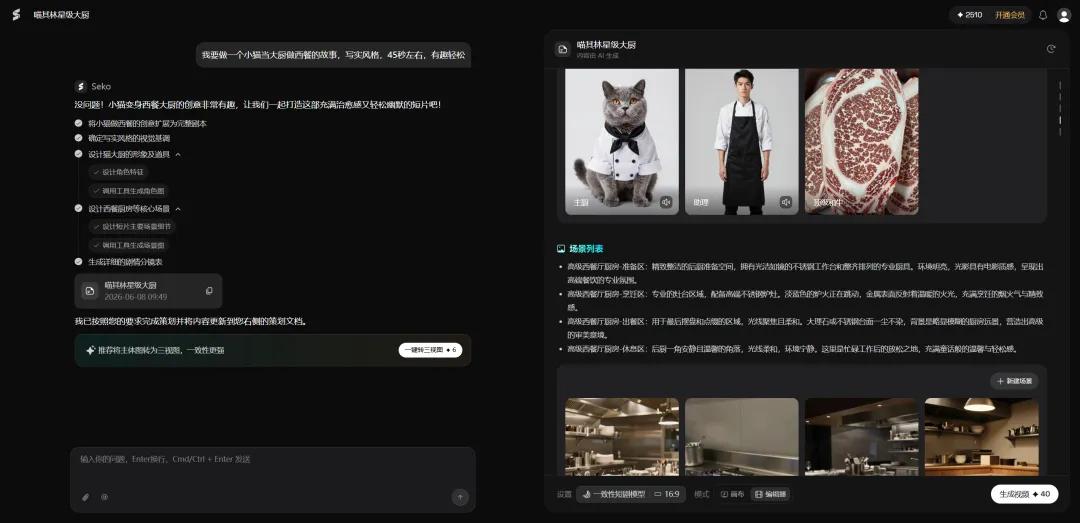
During the test, the DataEye Research Institute automatically generated a complete plan for "A Cat Chef Making Western Cuisine" with characters, scenes, and a storyboard based on a single - sentence inspiration. Then, it directly generated a canvas from the plan. The main elements such as characters and scene images were automatically placed on the left side of the canvas. AI generated a series of storyboard images in batch through the connection mode. Each storyboard image contains reference image citations and prompt information, and users can freely adjust and make fine - tuned modifications. Thus, a complete canvas workflow was formed.
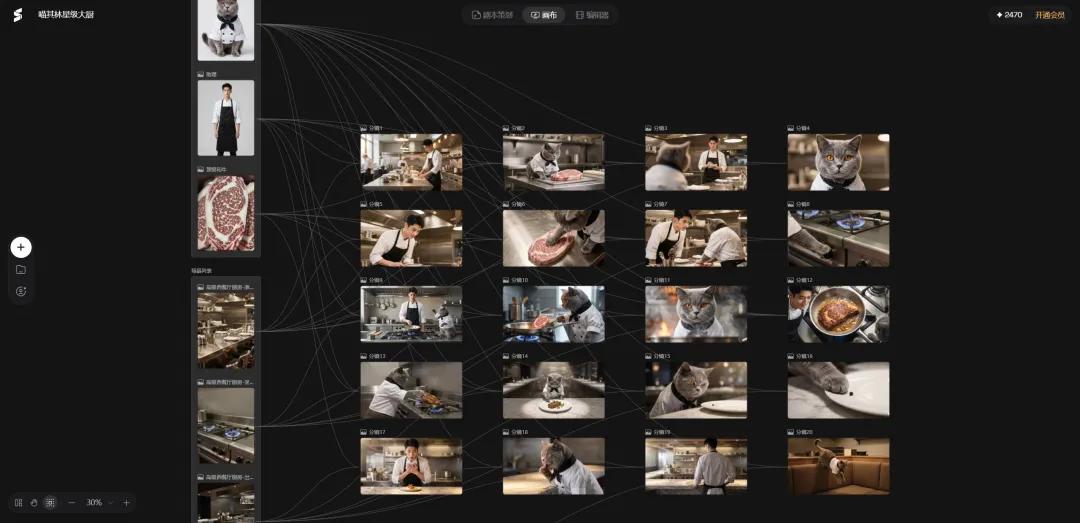
On this canvas workflow, creators can freely adjust the order of storyboards, make fine - tuned modifications and adjustments to the pictures, and the materials in the canvas can be moved to the editor in batch for subsequent editing.
This process is precisely the embodiment of the "Agent Batch + Canvas Refinement" creation mode: The Agent is responsible for the batch generation of the overall content, and the canvas is responsible for building the workflow and making fine - tuned modifications to the materials.
(2) Multiple - episode Assets into the Canvas
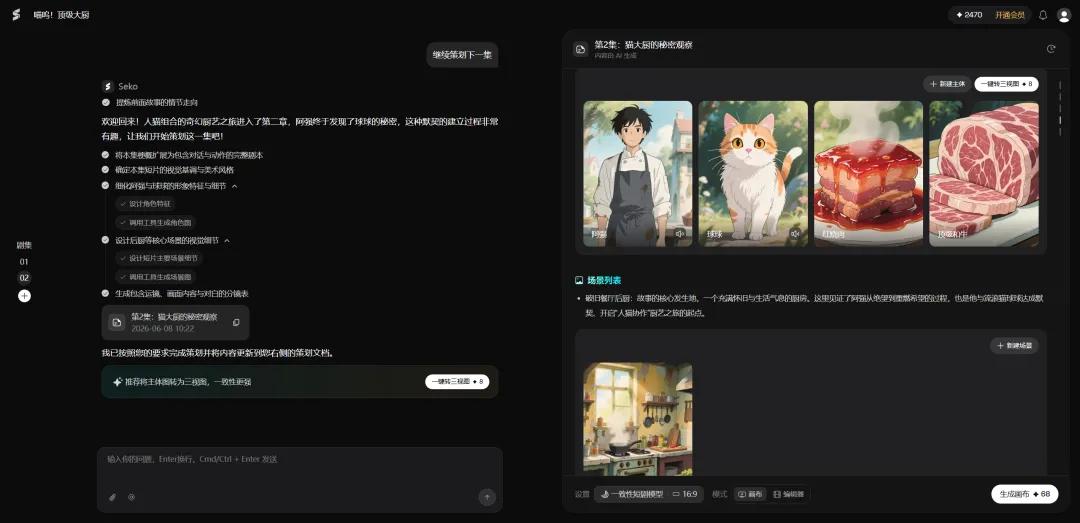
Another highlight of the Infinite Canvas is its full compatibility with Seko's multiple - episode function. Users only need to open the "Multiple Episodes" function on the home page to continue planning the next episode based on the previous one. Each episode can enter the canvas, achieving the unification of the same assets across episodes.
(3) Inter - project Asset Interconnectivity
In addition to multiple - episode assets entering the canvas, assets from any project can be imported into the canvas.
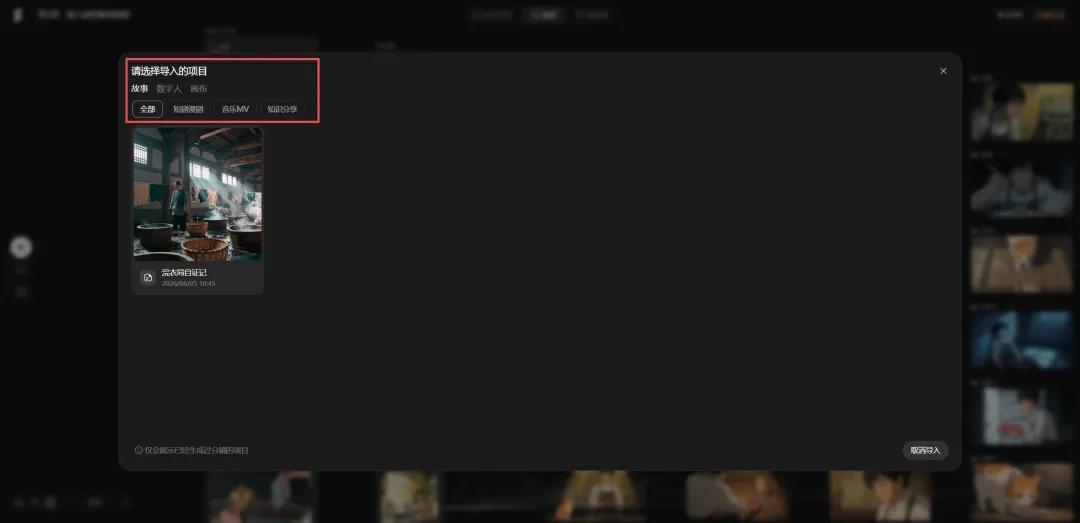
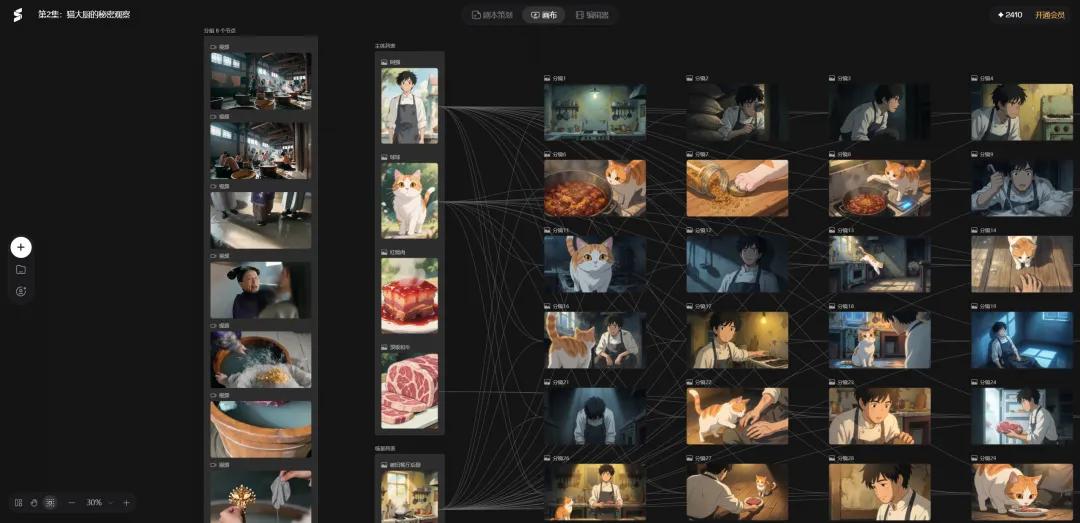
As shown in the figure, during the test by the DataEye Research Institute, assets from different projects were imported into the canvas. Assets from different projects and different episodes can be called simultaneously on the same canvas. With this function, the same assets across episodes and projects are unified, achieving asset interconnectivity, which directly helps creators streamline the production process of long - form dramas and series, significantly reducing the cost of manual verification.
(4) Built - in Creation Toolbox in the Canvas
Finally, it's worth noting that the canvas also has a series of built - in AI native capabilities, such as 720 - degree panoramic view, multi - angle generation, and nine - grid images.
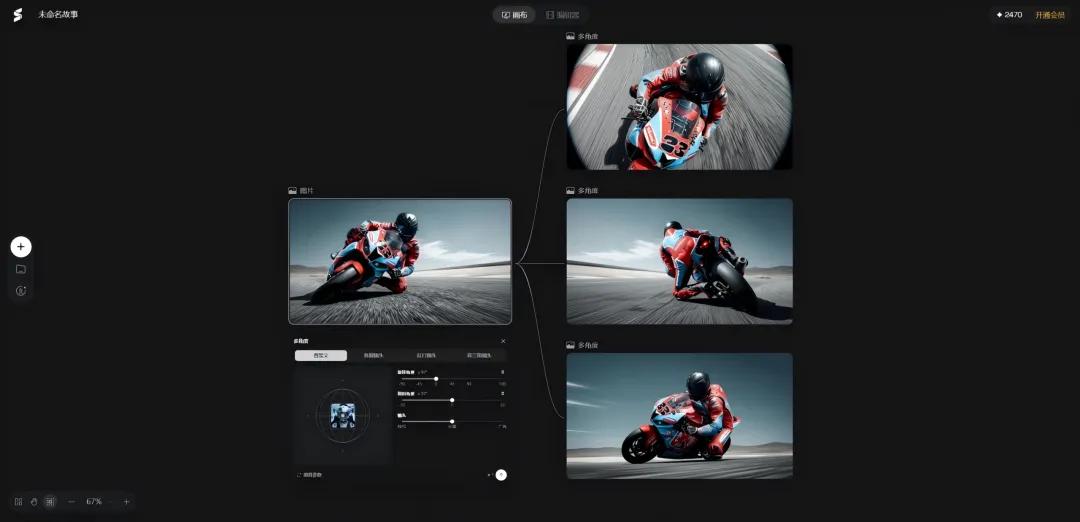
The DataEye Research Institute's experience found that in multi - angle generation, users can manually adjust the rotation angle, tilt angle, and camera perspective of the photo to generate pictures at any angle and perspective. It also presets three parameters for fisheye lens, reverse shot, and Dutch angle lens for easy use.

The nine - grid images include four types: inspiration storm, story narration, martial arts storyboard, and panoramic camera position. Creators can choose according to actual needs. For example, the "story narration" type can generate nine consecutive story plots from a single photo with one click, and the "martial arts storyboard" can generate nine different martial arts action pictures.
In addition, there are functions such as lip - syncing, eraser, layout redrawing, and element addition, which are convenient for creators to make fine - tuned adjustments.
II. Efficiency and High - quality Production: Dual Propositions for AI Drama Creation
The innovation of tools often means the innovation of content quality. Therefore, the success of "The Magic Treasure Basin" is not an isolated case. Viewed in a broader industry context, it validates an emerging consensus: The competitive logic of AI short dramas is shifting towards "the ability to generate content efficiently and with high quality continuously". On this path, efficiency and high - quality production are two hurdles that must be crossed simultaneously.
(1) Redefining "Efficiency"
In the past, when talking about the efficiency of AI creation, the focus was often on the speed of image and video generation. However, in the era of "long - form high - quality production", as the capabilities of large models become similar, the efficiency bottleneck has quietly shifted to the human operation level: the time consumed in repeatedly building workflows, managing cross - episode assets, and switching between different tools is one of the key variables that truly slow down production capacity.
The concept of the Infinite Canvas is to "do less repetitive work": automatically building workflows, reusing assets, etc., so that creators can free their energy from repetitive operations and reduce frictional costs.
(2) The Extension of the Connotation of "High - quality Production"
High - quality production is extending from a single judgment standard of "picture quality" to a dual requirement for "picture quality" and "content quality".
The high - quality production of picture quality requires continuous iteration of models and tools at the underlying level. The series of AI native picture capabilities built into the Infinite Canvas are essentially expanding the creator's control over picture details and making fine - tuned optimizations as much as possible when the capabilities of large models are similar.
The high - quality production of content quality requires that the evolution direction of tools always closely follows market consumption trends and the real needs of creative teams. The product upgrade path of Seko confirms this:
The image - to - Agent link closely follows AI - narrated comic dramas, emphasizing production efficiency, and the multiple - episode function is covered first;
The multi - parameter Agent link closely follows AI live - action dramas, maximizing the characteristics of multi - parameter video models such as Seedance 2.0 and Keling O3;
The Infinite Canvas and asset interconnectivity closely follow the rise of high - quality AI dramas and long - form AI films and TV shows, balancing the efficiency of the Agent and the refinement of the canvas.
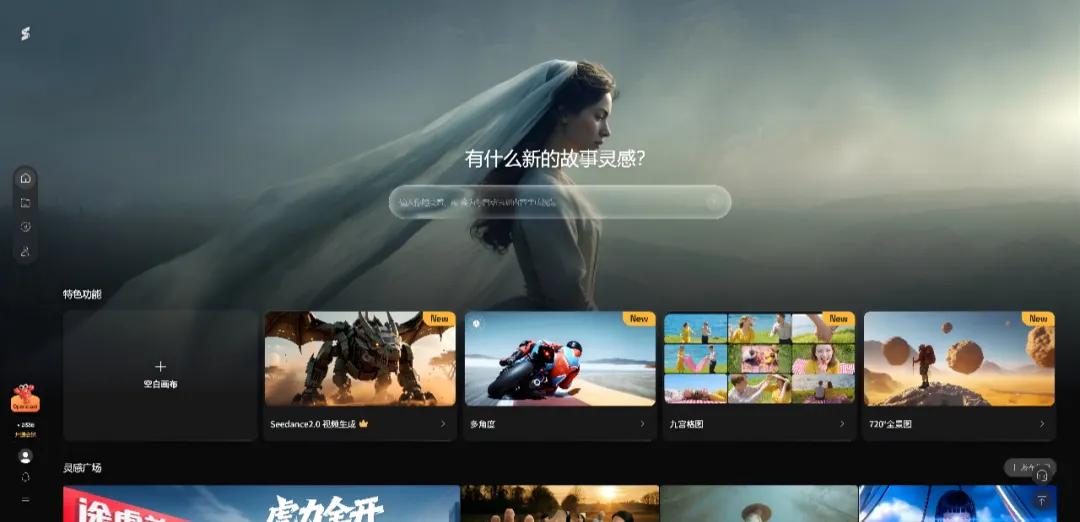
Each iteration corresponds to the practical needs of creators at the current stage. When the improvement of efficiency frees the hands of creators and the iteration of tools makes the picture quality fine and stable, the focus of creative competitiveness naturally returns to content understanding, story - building ability, and aesthetic judgment.
From this perspective, tools and content are complementary: content requirements force tool upgrades, and tool iterations in turn broaden the boundaries of content creation. In the long run, this trend is expected to promote the rapid maturity of AI films and TV shows and drive the quality of short dramas to quickly approach that of traditional films and TV shows.
III. The Watershed of AI Short Dramas Appears
When "one - stop generation" has become the industry standard and "more comprehensive functions" and "industrialized production" are no longer sufficient to form a differentiation, the next watershed in the AI short - drama tool sector is emerging from a more fundamental question: Is it AI "assisting" people in using tools, or AI "replacing" people in using tools?
Although there is only a one - character difference, there is a core difference between the two, that is, the role level that AI plays in the creative process.
The former is the superposition of functions. No matter how powerful the model is and how rich the functions are, AI is still the "object to be operated". People build workflows, configure parameters, and operate AI to perform tasks within the framework. Creators need to have both content - creation ability and tool - handling ability, and their energy is dispersed in two directions.
The latter is a transfer of roles. AI changes from an executor to a collaborator and the builder of the workflow itself. It can understand the creative intention, automatically lay out the framework, and predict content needs. Users change from operators to decision - makers, only needing to make creative judgments and fine - tuned adjustments at key nodes, and their energy is refocused on the content itself.
The difference between the two is not the difference in the number of functions, but the difference in the creative paradigm.
Finally, for practitioners, a signal worth noting is that the next leap in efficiency may not only come from a more powerful model but also from a system that can understand the creative intention and automatically build a production framework.
After all, although tools are changing, the core proposition remains the same: Whoever can help creators focus their energy on the most valuable aspects will win the next stage.
This article is from the WeChat official account "DataEye Short Drama Observation", author: DataEye