With 21.8 billion yuan invested, there are only 5 companies in this track that have reached Series C funding to date.
If we were to explain synthetic biology in one sentence, it would be - treating life as a programmable machine.
Traditional biology focuses on "observing what occurs in nature," while synthetic biology takes the opposite approach: first clarifying "what I want," and then designing, assembling, and debugging a biological system to achieve it. Specifically, through means such as gene editing, metabolic pathway reconstruction, and chassis cell modification, microorganisms can be made to act like miniature factories, producing specific molecules according to human will - these can be drugs, materials, food raw materials, cosmetic ingredients, or industrial enzymes.
The imaginative potential of this field lies in the fact that, in theory, any molecule produced through petrochemical routes could potentially have a biosynthetic alternative, which is also more environmentally friendly and precise. The global market has sent a signal - according to data from Fortune Business Insights, the global synthetic biology market was valued at approximately $17.1 billion in 2025 and is expected to grow to $95 billion by 2034, with a compound annual growth rate of over 21%. According to GEP Research, using a broader scope (including end - products), the global market size exceeded $68 billion in 2025, and the Chinese market was about 142 billion RMB.
So, where does the startup and financing situation in this field in China stand? Based on the IT Juzi database, we sorted out a total of 301 financing events in the domestic synthetic biology field since 2015, involving 110 companies, attempting to provide a comprehensive answer.
Data scope: IT Juzi database, cutting - edge technology in the industry - sub - industry of synthetic biology.
I. Overall Portrait: 21.8 billion, 110 companies, 11 years
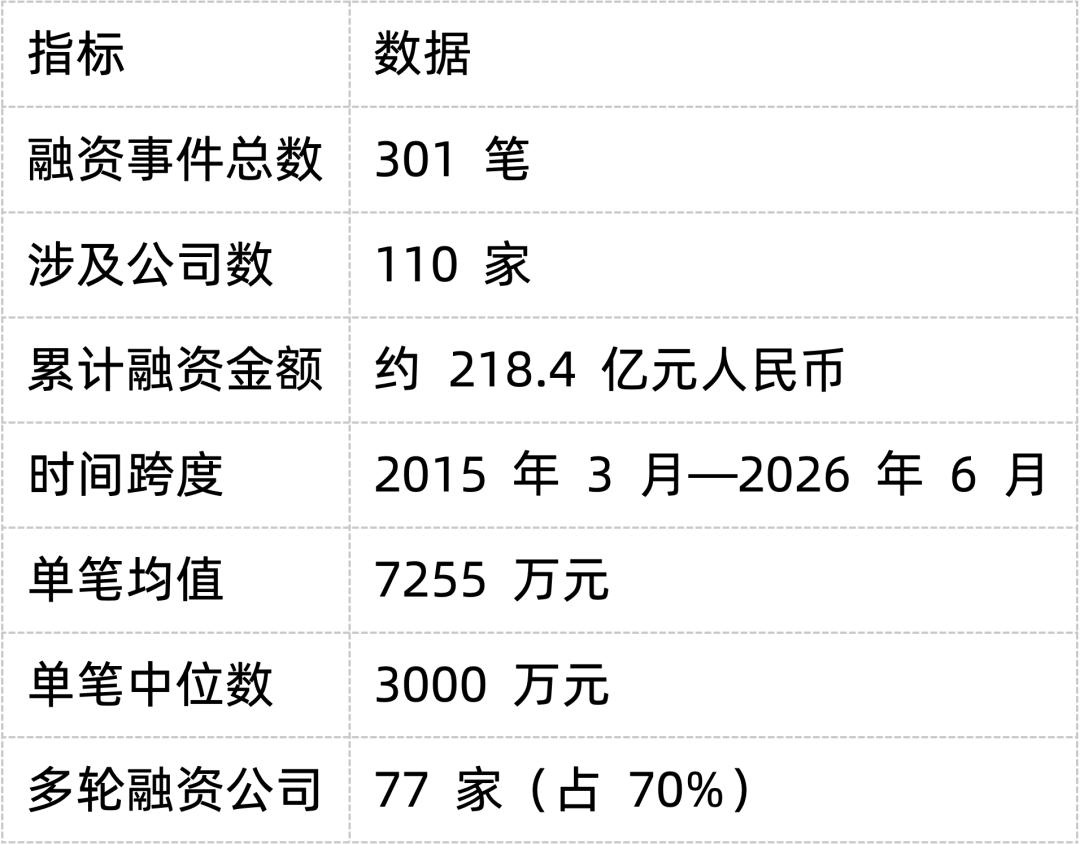
Several features are worth noting:
First, the proportion of companies receiving multiple rounds of financing is high, but very few reach Series C and above. Among the 110 companies, 77 have completed at least two rounds of financing. Bluepha even received 8 rounds of financing. However, only 5 companies have reached Series C or above - Junhemeng (Series C), Yikele Biology (Series D), Meisai Biology (Series C+), etc. This means that the vast majority of companies are still in the "from 0 to 1" stage before Series B. The window for commercial verification has not closed, but the pressure is increasing.
Second, the amount distribution shows a typical "long - tail" pattern. 70 large - scale financing events with amounts over 100 million contributed the majority of the total financing amount, while there were 68 events with amounts below 30 million. The capital - attracting effect of leading projects is obvious, but the financing of small and medium - sized projects is not low - the median is 30 million yuan, which means that even ordinary projects can raise enough funds to support R & D for a period of time.
Third, 97% of the financing is denominated in RMB, and there are only 8 US - dollar financing events. Synthetic biology is a highly "localized" field, with domestic capital being the main participants, and the participation of overseas US - dollar funds is relatively limited.
II. Annual Trends: Peaked in 2022, recovered in 2025, and driven by large deals in 2026
This curve is quite typical - capital started to pour in from 2021 and reached its peak in 2022. In 2023, the number of events continued to increase, but the amount was halved, indicating that capital began to diverge. Small projects were still progressing, but large - scale financing decreased sharply. This contraction trend continued in 2024.
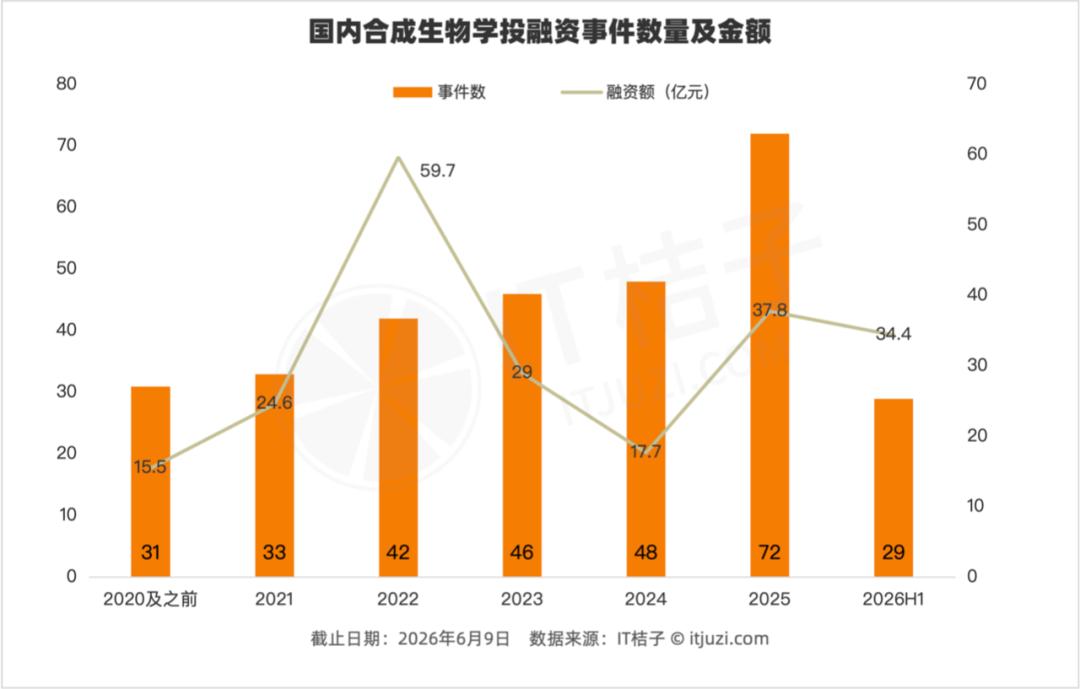
In 2025, there was an obvious recovery: the number of events doubled to 72, and the amount returned to 3.78 billion. However, the structure changed - in 2022, the "hot money" mainly flowed to platform - type and material - related companies (Taitron Biotech alone received about 2.1 billion in its Series A+ round), while in 2025, the funds were more evenly distributed. The food/alternative protein direction emerged prominently, with 17 events, tying with the platform/tool category.
The data for the first half of 2026 should be viewed with caution: 29 events and 3.44 billion yuan seem strong, but the 1.5 billion yuan in the Series B round of Weiyuan Synthetic alone accounted for nearly 44%. After excluding this deal, the remaining 28 events totaled about 1.94 billion yuan, showing a limited increase compared to the same period in 2025 (1.42 billion).
III. Seven Directions: Who is attracting capital and who is in for the long - run
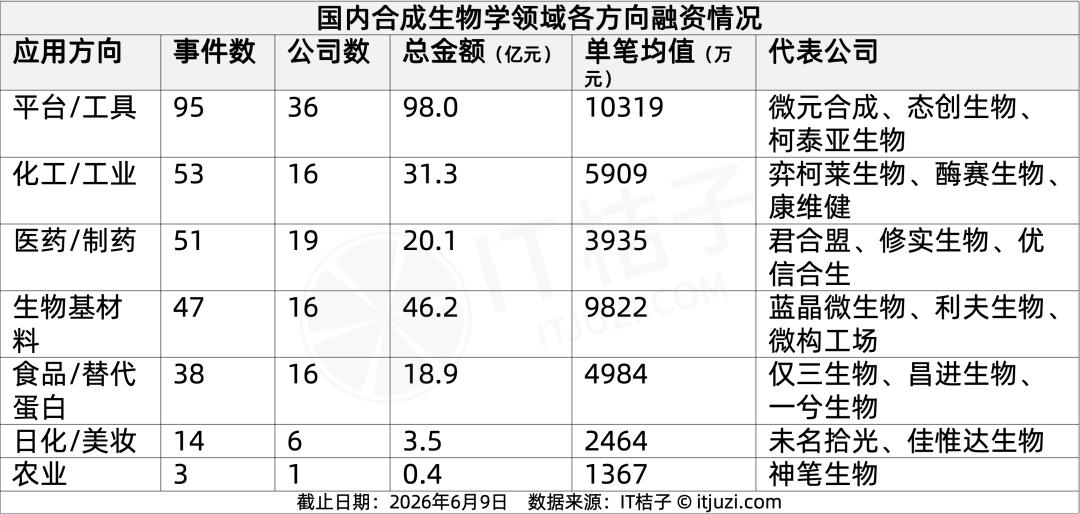
Based on the actual business positioning of each company (rather than broad industry labels), we re - classified the 110 financed companies into 7 application directions:
Platform/Tool: The largest amount, but also the most variable
36 platform/tool - related companies received 45% of the total industry financing, making them the well - deserved "capital magnets." However, this category is also the most complex - companies such as Weiyuan Synthetic, Taitron Biotech, and Ketaia Biotech have businesses spanning multiple directions including pharmaceuticals, food, and materials. In essence, they are operating as "biological contract manufacturers" or "cell factory design platforms."
The story of these companies sounds appealing: one set of underlying technologies with multiple application scenarios, which can theoretically be replicated infinitely. However, the real - world challenge is that the process requirements, regulatory paths, and customer characteristics vary greatly across different application directions. "Doing everything" often means "not doing anything thoroughly." Taitron Biotech had a valuation of over 10 billion in its Series A+ round in 2022, but its subsequent financing pace has slowed down significantly, which indirectly confirms the market's doubts about the commercialization path of platform - type companies.
Biobased Materials: The most expensive per deal, betting on biodegradability
The average amount per deal in the biobased materials direction (98.22 million yuan) is second only to the platform/tool category, and it is highly concentrated in two sub - sectors: PHA (polyhydroxyalkanoates) and furan - based materials. Bluepha received nearly 2 billion in 8 rounds of financing, Weigou Workshop received 660 million, and Lifu Biotech received 750 million - the top three companies accounted for 72% of the total amount in this direction.
The core of the story in this direction is "replacing petroleum - based plastics," with a clear logic but a long commercialization cycle. The production cost of PHA is still significantly higher than that of traditional plastics, and large - scale application depends on policy promotion (such as stricter plastic - restriction orders) and a decline in the cost curve. Since Bluepha completed a 400 - million - yuan Series B+ round in February 2023, it has not disclosed any new financing, which also reflects the market's wait - and - see attitude to some extent.
Food/Alternative Protein: The fastest - growing direction in 2025
The food/alternative protein direction experienced explosive growth in 2025 - the number of events jumped from 6 in 2024 to 17, tying for first place with the platform/tool category. Sub - directions such as HMO (human milk oligosaccharides), ergothioneine, microbial protein, and sweet proteins received intensive financing.
HMO is a typical example: Hongmu Biotech, as the first domestic HMOs raw material enterprise to pass the safety assessment of the Ministry of Agriculture and Rural Affairs and the approval of the National Health Commission, completed 4 rounds of financing from 2024 to 2026. The investors include industrial and state - owned capital such as Mengniu Venture Capital, Hefei Construction Investment, and Hefei Industrial Investment. Yixi Biotech also received 200 million yuan in its Series A round in August 2025 through HMO biosynthesis.
The growth logic in this direction is driven by the "policy liberalization + consumption upgrade" dual - engine, but the risks are also clear - the market education cost for functional foods and raw materials is high, and consumers' acceptance of "synthetic biology - made" products still needs to be verified.
Pharmaceuticals/Pharmaceutical Manufacturing: Low - key but with the highest certainty
The 51 events in the pharmaceutical direction are distributed among 19 companies. The average amount per deal of 39.35 million yuan may seem low, but this is because there are no extremely large - scale financings like those in the platform category. In terms of business logic, the pharmaceutical direction may have the strongest certainty among all directions - the drug R & D path is clear, the regulatory system is mature, and the payers are well - defined.
Xiushi Biotech focuses on the biosynthesis of peptide drugs, Youxinhesheng focuses on live biotherapeutics, and Hengyu Biotech focuses on gene drugs - each company has a clear product pipeline and indications. It should be noted that the application of synthetic biology in the pharmaceutical field is more at the "tool level" (such as using biological methods to replace chemical methods for synthesizing APIs and using engineered bacteria to produce recombinant proteins), and the truly "novel synthetic biology drugs" are still in the early stage.
IV. Regional Landscape: The Yangtze River Delta leads, and Hefei stands out
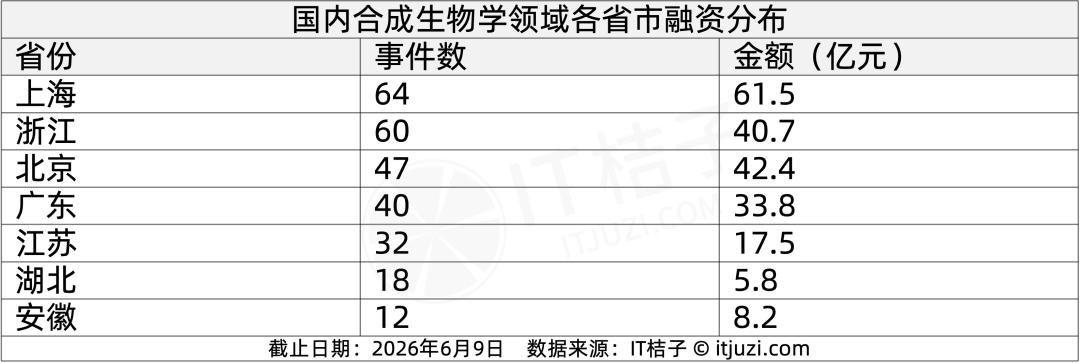
The Yangtze River Delta (Shanghai + Zhejiang + Jiangsu) had a total of 156 events, accounting for 52%. This is highly related to the local industrial foundation - the biomedical ecosystem in Shanghai, the chemical and food processing chains in Zhejiang, and the manufacturing capabilities in Jiangsu form an "iron triangle" for the implementation of synthetic biology.
At the city level, Hangzhou led with 46 events, followed closely by Shenzhen with 33 events and Pudong with 32 events. The high density of synthetic biology startups in Hangzhou is related to the agglomeration effect of local synthetic biology industrial parks (such as the Hangzhou Bay Synthetic Biology Innovation Valley).
Hefei is worthy of attention. With 12 events and 820 million yuan, the absolute amount is not large, but the identity of the investors is special - Hefei Construction Investment, Hefei High - tech Investment, Hefei Industrial Investment, and Anhui Investment Group frequently appear on the investor lists of projects such as Hongmu Biotech and Shenbi Biotech. Hefei is replicating its "state - owned capital leading + industrial introduction" model in the new energy field, and synthetic biology may be the next key area for investment.
V. Who is investing: Fengrui leads, and state - owned capital enters the market
The top 5 most active investment institutions:
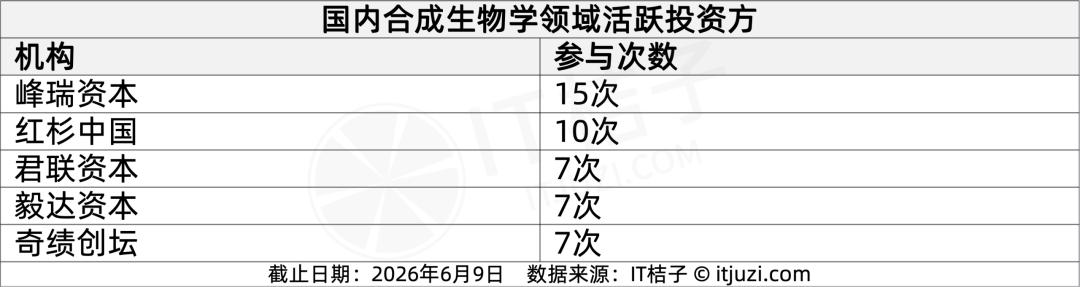
Fengrui Capital led by a large margin with 15 participations and continuously increased its investment in multiple leading projects such as Bluepha and Ketaia Biotech. Sequoia China also had in - depth layouts in projects such as Weigou Workshop and Ketaia Biotech.
An important trend is the systematic entry of state - owned capital. State - owned - background institutions such as Henan Investment Group (5 times), Shunxi Fund (5 times), Yizhuang State - owned Investment (3 times), Lingang Lanwan Capital (3 times), and West Lake Science and Technology Innovation Investment (3 times) have become an important force in the synthetic biology field. This is in line with the policy orientation of local governments to include synthetic biology in strategic emerging industries - in December 2025, China updated the implementation rules of the Biosecurity Law, for the first time including synthetic biological products in the classification management catalog; Beijing, Shanghai, Shenzhen, Hangzhou and other places have also successively introduced special support policies for synthetic biology.
The participation of CVCs is relatively limited: Country Garden Venture Capital participated 4 times (mostly in Bluepha), Tencent Investment participated 1 time, Meituan participated 1 time, and Mengniu Venture Capital participated 1 time. The fact that industrial capital has not entered on a large scale may be because the products of synthetic biology companies are mostly in the pilot - scale or mass - production ramping - up stage, and the supply - chain synergy with the parent companies of CVCs still needs time to be verified.
VI. Risks and Outlook: From "telling stories" to "delivering results"
Synthetic biology is at a critical verification stage. Several core risks cannot be ignored:
1. The "valley of death" from the laboratory to the factory. Synthetic biology often performs well at the laboratory stage, but the scale - up of large - scale fermentation processes is not a simple linear extrapolation - every step, such as strain stability, product yield, and separation and purification costs, may become a bottleneck. Many industry insiders said that the failure rate of scaling up from grams to tons is not low.
2. Uncertainty in the commercialization rhythm. The pharmaceutical direction faces a long clinical approval cycle, the materials direction faces cost competition with traditional petrochemical products, and the food direction faces consumer cognitive barriers. No direction can be easily commercialized.
3. Mismatch of the capital cycle. The typical product development cycle of synthetic biology is 5 - 10 years, but the duration of VC funds is usually 7 - 8 years. The funds that entered the market from 2021 to 2022 are now facing exit pressure. If the invested companies fail to prove their commercialization capabilities in a timely manner, the next round of financing may become more difficult.
4. The industry is still in its early stage. Among the 110 companies, nearly 80% of the events occurred in Series A and before, and only 5 companies reached Series C. This data itself shows that the industry is far from the "harvest period."
However, there are also positive signals: the rapid warming of the food/alternative protein direction in 2025 indicates that policy liberalization is translating into real market demand; the continuous increase of state - owned capital provides "patient capital" for long - term investment in the industry; the integration of AI and synthetic biology (such as Jincheng Technology, Zhiyan Zaowu, Yuxinshuo Biotech, etc.) is shortening the cycle from design to verification.
The synthetic biology track is large enough, and the story is long enough. But from the frenzy in 2022 to the calm in 2024, the market has learned one thing - concept does not equal production capacity, and financing does not equal commercialization.