A Clear Guide to the Chip Industry Chain: Who is Underpinning the Computing Power Empire in the AI Era
Chips are the smallest components in the modern economy and also the largest network.
A mobile phone, an electric vehicle, an AI server, a smartwatch, and an industrial robot may seem like completely different products, but when disassembled, they all come down to chips.
They determine whether a mobile phone can take better photos, whether a car can make faster decisions for assisted driving, whether an AI model can answer questions within seconds, and also determine whether a technology company is selling software, hardware, or the next - generation computing platform.
Many people understand the chip industry chain and are used to summarizing it in one sentence: design, manufacturing, packaging, and testing.
This statement is correct, but it's too broad. It's like saying that a restaurant only has three steps: "buying ingredients, cooking, and serving dishes." It sounds right, but all the truly profitable, bottleneck - causing, and barrier - building aspects are overlooked.
The real structure of the chip industry should be divided into four layers:
At the very upstream are tools, equipment, and materials. They determine "whether a chip can be designed and manufactured."
In the middle are design, manufacturing, storage, and packaging. This is where it's determined "who designs the chip, who does the contract manufacturing, who can achieve mass production, and who can assemble it into a system."
Downstream are mobile phones, automobiles, cloud computing, AI data centers, industrial equipment, and consumer electronics. They determine "why the chip is needed."
In the AI era, the chip industry has several new main lines: GPUs are no longer just graphics cards, HBM is no longer just memory, packaging is no longer just post - processing, and cloud providers are no longer just chip buyers. They are starting to define chips themselves.
This is the most important change in the chip industry today.
01
The Chain of "Selling Shovels - Making Chips - Selling Scenarios"
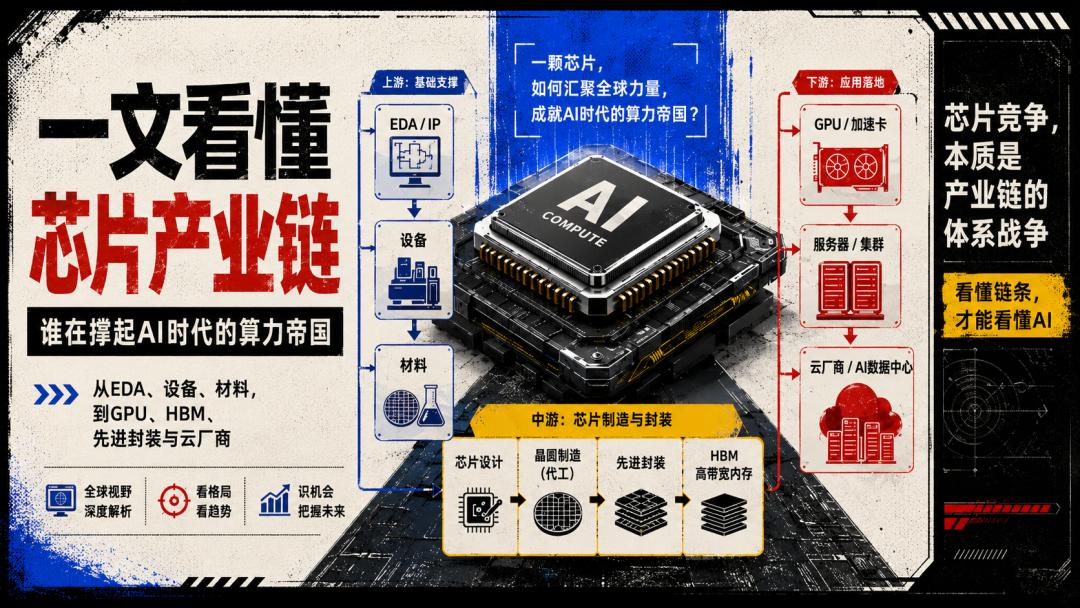
If we regard the chip industry as a gold mine, the people at the very upstream may not directly dig for gold, but they sell shovels, maps, explosives, and mine cars.
EDA software is the "drawing tool" and "simulation tool" for chip designers. An advanced chip may have tens of billions of transistors, and it's impossible for the human brain to complete all the design, verification, and error - checking directly. EDA software is necessary. The global core players in this field are Synopsys, Cadence, and Siemens EDA. Chinese companies include Huada Jiutian, Galen Electronics, and Guangli Microelectronics.
IP licensing is like a "standard parts library" in the chip world. A chip company doesn't have to develop all modules from scratch. CPU cores, interface protocols, image processing modules, and storage controllers can all be obtained through purchasing mature IP licenses. The most important company here is Arm. Arm architecture is widely used in global smartphones, automotive chips, and low - power devices. Other IP companies include Synopsys, Cadence, Imagination, CEVA, and Rambus.
Semiconductor equipment is the real industrial machinery for wafer fabs. Lithography machines, etching machines, thin - film deposition equipment, ion implantation equipment, cleaning equipment, and inspection and measurement equipment are all extremely complex. The most famous one is ASML, which is the sole supplier of EUV lithography machines. Without EUV, it's difficult to advance in advanced processes. Other equipment giants include Applied Materials, Lam Research, Tokyo Electron, KLA, ASM International, Screen, Nikon, and Canon.
Chinese companies include Northern Huachuang, AMEC, Tuojing Technology, Huahai Qingke, Shengmei Shanghai, Xinyuan Microelectronics, Jingce Electronics, and Changchuan Technology.
Materials are the "ammunition" for wafer fabs. Silicon wafers, photoresists, electronic specialty gases, wet electronic chemicals, target materials, CMP polishing solutions, packaging substrates, and lead frames. Any link can become a bottleneck. Representative companies include Shin - Etsu Chemical, SUMCO, GlobalWafers, Siltronic, SK Siltron, JSR, Tokyo Ohka Kogyo, Fujifilm, Merck, DuPont, Entegris, Linde, and Air Liquide.
Chinese companies include Shanghai Silicon Industry Group, TCL Zhonghuan, Leon Microelectronics, Jiangfeng Electronics, Anji Technology, Nanda Optoelectronics, Huate Gas, Jinhong Gas, Yak Technology, Dinglong Co., Ltd., and Tongcheng New Materials.
Therefore, when looking at the chip industry, the real underlying questions are: Who controls the irreplaceable tools? Who controls the irreplaceable equipment? Who controls the irreplaceable materials?
Some companies are not in the spotlight, but they are the real foundation of the industrial chain.
02
Chip Design: Why NVIDIA Is More Than Just a GPU Seller
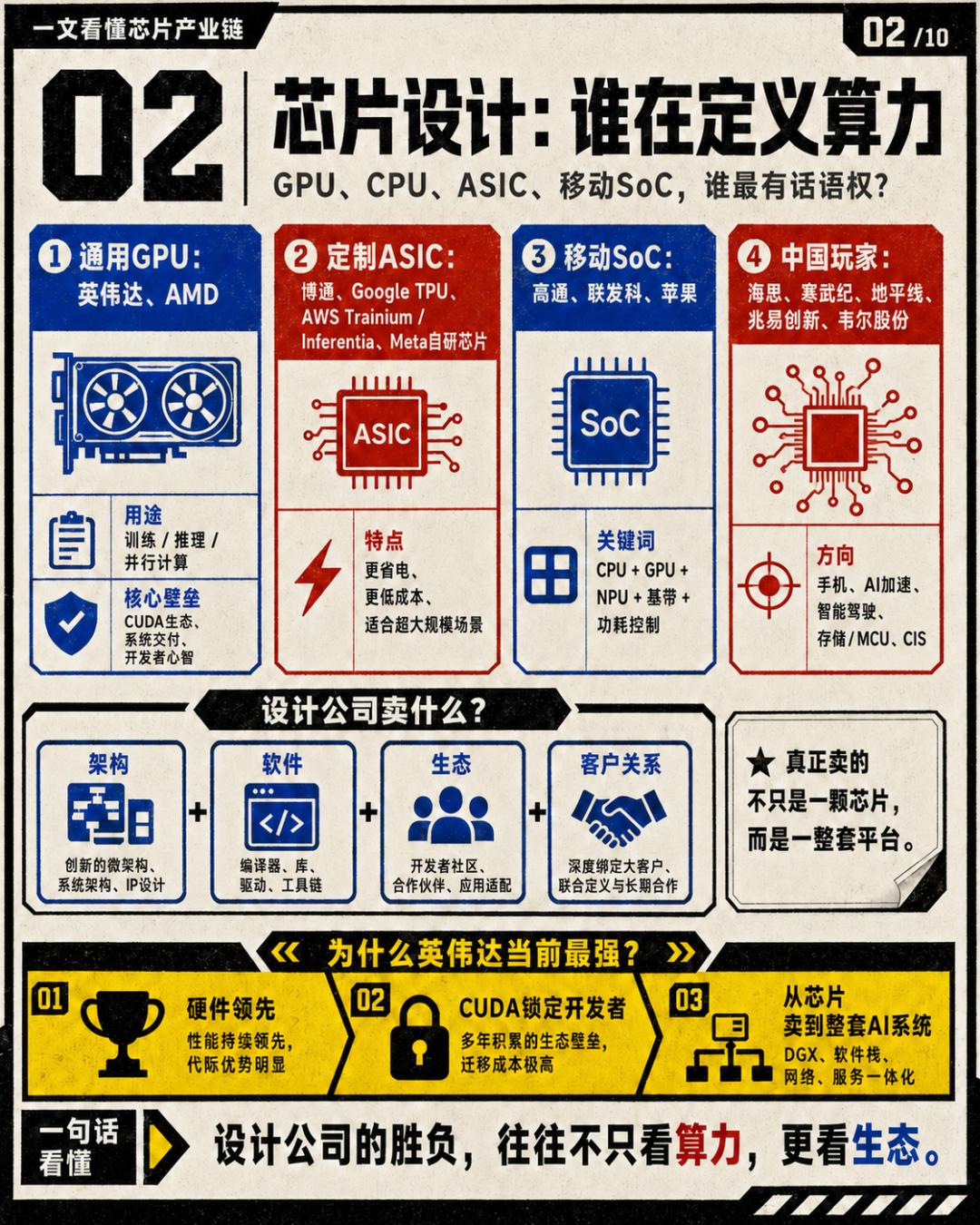
Chip design companies are usually called Fabless, meaning "without a wafer fab." They are responsible for designing chips but don't build their own manufacturing plants. Manufacturing is outsourced to foundries such as TSMC, Samsung, and SMIC.
Representatives of this type of companies include NVIDIA, AMD, Qualcomm, Broadcom, Marvell, MediaTek, Apple, Amazon Annapurna, Google TPU team, and Meta's in - house chip team. Chinese companies include HiSilicon, Cambricon, Horizon Robotics, Black Sesame Technologies, Biren Technology, Moore Threads, Enflame Technology, Muxi Semiconductor, Will Semiconductor, GigaDevice, Montage Technology, Maxscend Microelectronics, Spreadtrum Communications, Amlogic, Rockchip, Allwinner Technology, Espressif Systems, SGMICRO, and Novosense Microelectronics.
However, there are significant differences among design companies.
Qualcomm excels in mobile phone SoCs, basebands, and radio frequencies. MediaTek is strong in the mid - to high - end Android mobile phone market. Apple is strong in software - hardware integration, binding its A - series and M - series chips with the iOS and macOS ecosystems. Marvell is strong in data center connectivity, optical communication - related chips, custom ASICs, and storage control. Broadcom is strong in custom AI chips, network chips, high - speed interconnection, and enterprise infrastructure.
NVIDIA is a more special case.
It sells GPUs, but its real barrier lies in the combination of GPUs, CUDA, networks, NVLink, software libraries, server systems, developer ecosystems, and customer perception.
In the past, GPUs were gaming graphics cards. Today, GPUs are the engines in AI factories. Large - scale model training requires massive parallel computing, and inference requires low latency and high throughput. GPUs are well - suited for handling such tasks. NVIDIA's real strength is that it has turned a single chip into a complete computing platform.
Therefore, when looking at NVIDIA in the AI era, we should ask: Can the CUDA ecosystem be replaced? Are cloud providers willing to maintain a long - term partnership? Will its network and system - level delivery capabilities remain leading? Can customers reduce costs with other solutions?
AMD is the most important challenger to NVIDIA in the field of general - purpose GPUs. It has EPYC server CPUs, Instinct GPUs, and the FPGA and adaptive computing capabilities brought by Xilinx. Its opportunity lies in the fact that cloud providers and large - model companies cannot rely on a single supplier forever. However, its challenges are also clear: Hardware performance is just the first step. Software ecosystems, system delivery, developer habits, and supply - chain priorities are equally important.
Broadcom represents another approach: custom ASICs.
ASICs are application - specific integrated circuits designed for specific tasks. General - purpose GPUs are like Swiss Army knives, capable of doing many things; ASICs are more like specialized machines, optimized for certain tasks. Google TPU, Amazon Trainium and Inferentia, and Meta's in - house AI chips essentially all point to one thing: When the scale of AI computing is large enough, application - specific chips become increasingly attractive.
These are the two future directions for AI chips: one is the NVIDIA - style general - purpose GPU platform, and the other is the cloud - provider - customized ASIC.
The former has a strong ecosystem and is suitable for rapid iteration; the latter has controllable costs and is suitable for large - scale deployment. In the future, it won't be a matter of one completely replacing the other, but rather which is more cost - effective in which scenarios.
03
Wafer Foundry: Why TSMC Has Become the Center of the World
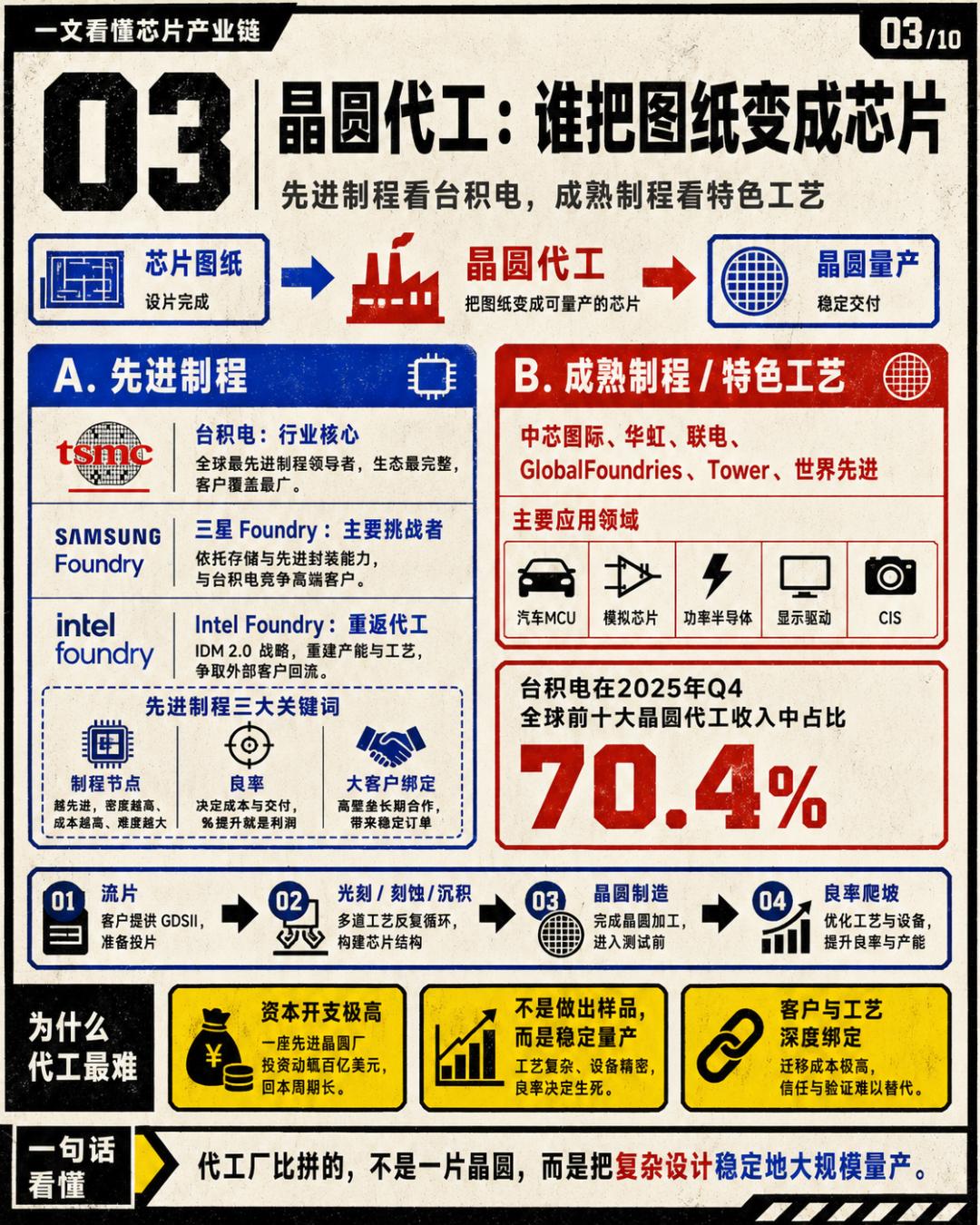
Chip design companies draw the blueprints, but it's the wafer foundries that turn these blueprints into circuits on silicon wafers.
Wafer foundry is one of the most difficult, expensive, and long - term - accumulation - required links in the semiconductor industry. Building an advanced wafer fab often requires an investment of tens of billions of dollars, has a long construction cycle, extremely complex equipment, and may involve more than a thousand process steps. More importantly, success is not just about making one or two samples; it's about achieving high yields, low costs, and stable delivery in large - scale mass production.
TSMC's strength lies not only in its advanced processes but also in its combination of technology, yield, production capacity, customer trust, and ecosystem.
Apple, NVIDIA, AMD, Qualcomm, Broadcom, and MediaTek are all important customers of TSMC. As advanced processes progress, customers are less likely to switch suppliers easily. This is because chip design, process libraries, EDA flows, IP verification, packaging solutions, and yield ramps are all deeply bound to the foundry.
Samsung Foundry is one of the most important players in advanced processes besides TSMC. It has technology, capital, and synergy in storage and packaging. However, since Samsung is involved in both foundry services, its own chip production, and terminal products, there has always been an issue of trust from external customers. Intel Foundry is trying to re - enter the foundry competition with advanced processes and advanced packaging, but it needs to prove that it can not only manufacture its own CPUs but also serve external customers.
Mature processes are a different business.
Not all chips require 3nm or 2nm processes. Many automotive MCUs, industrial chips, analog chips, power chips, display driver chips, CIS, and RF front - ends rely on mature processes and specialized technologies. These chips may not be in the headlines, but they have stable demand, long lifecycles, and are deeply integrated with the real - world industries.
Companies such as SMIC, Huahong, UMC, GlobalFoundries, World Semiconductor, Powerchip Semiconductor, Tower Semiconductor, DB HiTek, Hefei Jinghe Integrated Circuit, and CR Micro are more involved in this area.
Therefore, wafer foundry should be viewed from two perspectives.
For advanced processes, look at TSMC, Samsung, and Intel. The core factors are the technological ceiling, yield, and binding with major customers.
For mature processes, look at SMIC, Huahong, UMC, GlobalFoundries, etc. The core factors are capacity utilization, specialized technologies, customer structure, and the position in the cycle.
04
Storage: AI Turns "Cyclical Products" into Strategic Resources
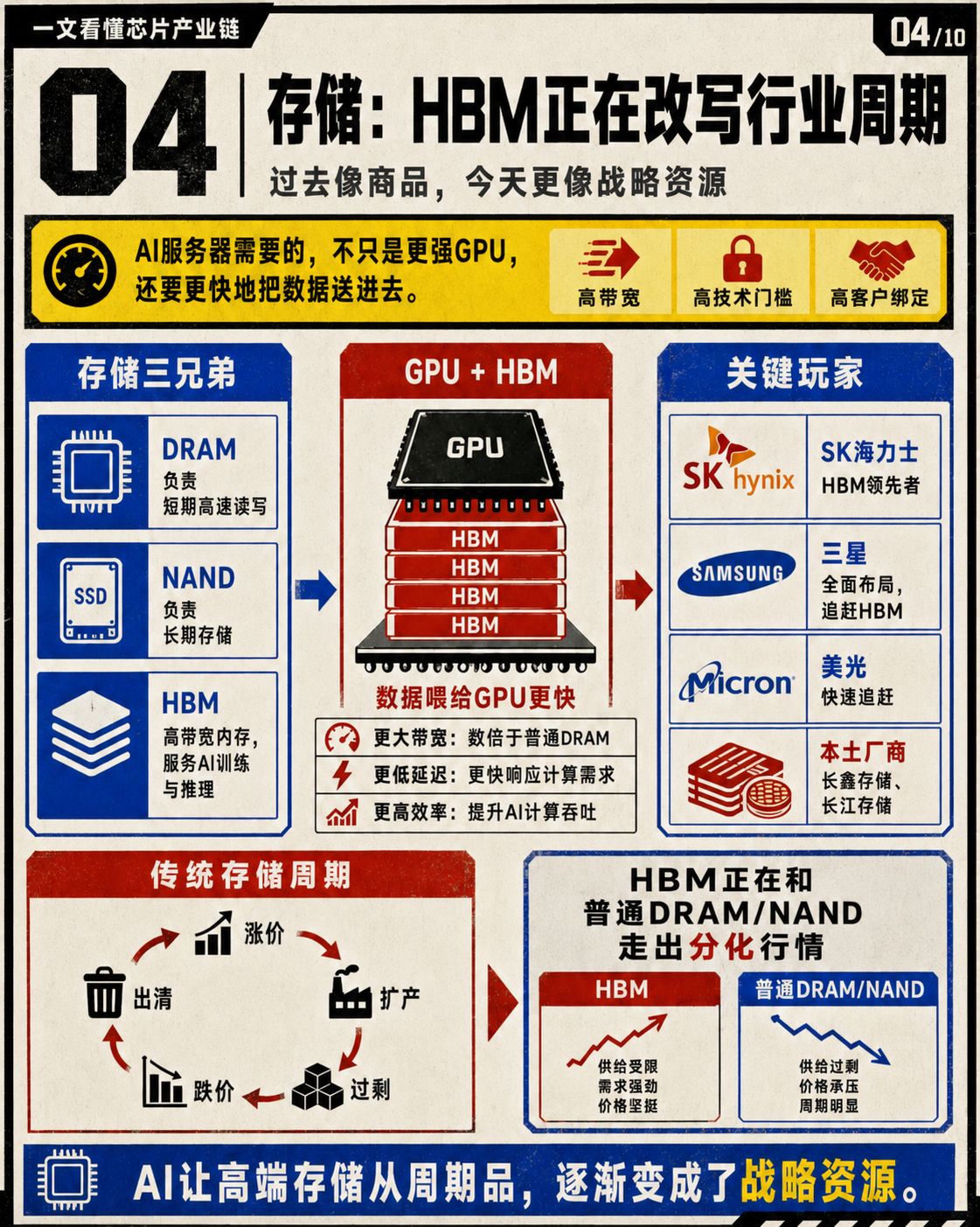
In the past, storage chips were typical cyclical products.
When demand was high, prices rose, and manufacturers expanded production; when over - expansion led to oversupply, prices fell; when prices dropped to the point of causing losses, manufacturers cut production, the supply - demand imbalance was cleared, and then the next cycle began.
However, AI is changing the narrative of the storage industry.
Large - scale model training and inference not only require GPUs but also need to feed massive amounts of data to GPUs quickly. If the GPU computing power is strong but the data supply lags behind, the GPU will be "starved." This is where HBM comes in.
HBM, short for High - Bandwidth Memory, is not like ordinary memory modules that are plugged into the motherboard. Instead, through stacking and advanced packaging, it is placed as close to the GPU as possible to provide extremely high data bandwidth. High - end GPUs in AI servers cannot do without HBM.
The core players in the global DRAM and HBM markets are SK Hynix, Samsung, and Micron. SK Hynix is in the leading position in HBM, Samsung is catching up, and Micron is also accelerating its entry. The main players in the NAND flash memory market include Samsung, Kioxia, Western Digital, Micron, and SK Hynix. Yangtze Memory Technologies and ChangXin Memory Technologies are taking on the role of domestic substitution in the DRAM and NAND fields respectively.
In the AI era, storage has become part of the AI computing power system.
HBM requires DRAM manufacturing capabilities, TSV silicon vias, stacking packaging, joint verification with GPU manufacturers, and stable yields. Its barriers are higher than those of ordinary DRAM, and customer binding is also stronger.
This is why in the AI market, the market not only buys NVIDIA but also SK Hynix, Micron, and Samsung, and may even re - price the storage cycle.
However, we also need to stay rational: Storage will never completely get rid of the cycle. AI can raise the long - term demand level, but if manufacturers collectively expand production on a large scale, there may still be supply - demand fluctuations in the future. The difference is that the cycle of high - end HBM may diverge from that of ordinary DRAM. A price drop in ordinary storage does not necessarily mean that HBM will collapse synchronously.
05
Packaging and Testing: From Back - End Chores to AI Bottlenecks
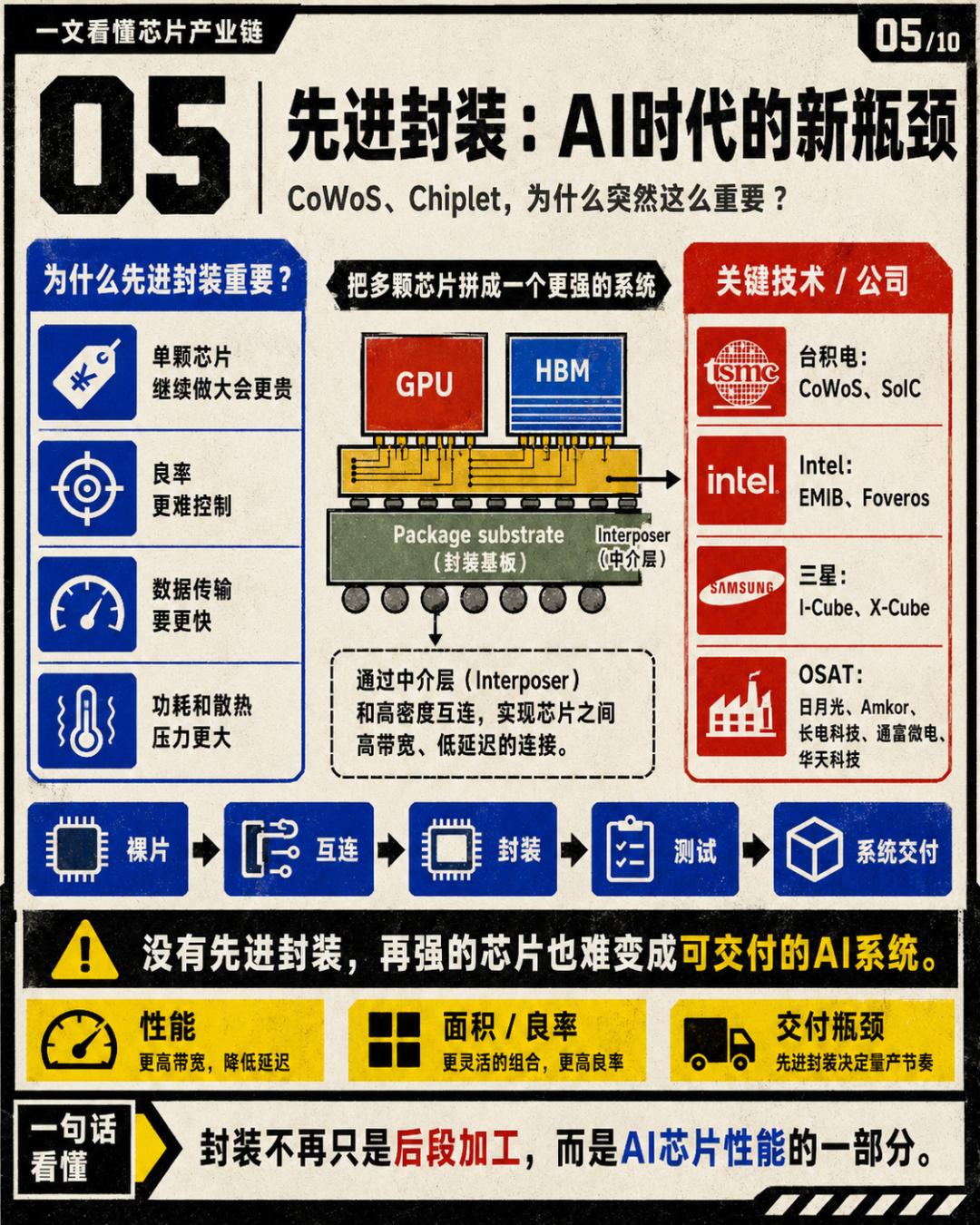
Packaging and testing used to have a low profile in the industrial chain.
Many people thought that since the wafer manufacturing had already produced the chips, packaging and testing were just about enclosing the bare chips, connecting the pins, and testing whether they worked. This understanding was not entirely wrong in the traditional chip era, but it is clearly outdated in the AI era.
The reason is simple: A single chip cannot be made infinitely large.
The larger the area of an advanced chip, the more difficult it is to control the yield, the higher the cost, and the more difficult it is to dissipate heat. So the industry has turned to Chiplet, which means combining multiple small chips into a large system. GPUs, CPUs, I/O Dies, caches, HBM, and network modules can all be combined through advanced packaging.