Before Kimi's A-share listing, Zhipu AI aims to secure more "life-saving funds".
Hong Kong stock investors haven't fully recovered from their excitement when Beijing Zhipu Huazhang Technology Co., Ltd. (hereinafter referred to as "Zhipu") suddenly announced its plan to return to the A-share market and sprint for listing on the Science and Technology Innovation Board of the Shanghai Stock Exchange after its market value soared to a high of HK$600 billion.
According to the announcement, Zhipu plans to issue no less than 9.0988 million and no more than 38.769 million new A-shares, aiming to raise 15 billion yuan for the general base large model of artificial intelligence, the one-stop service platform for large model MaaS, and to supplement working capital.
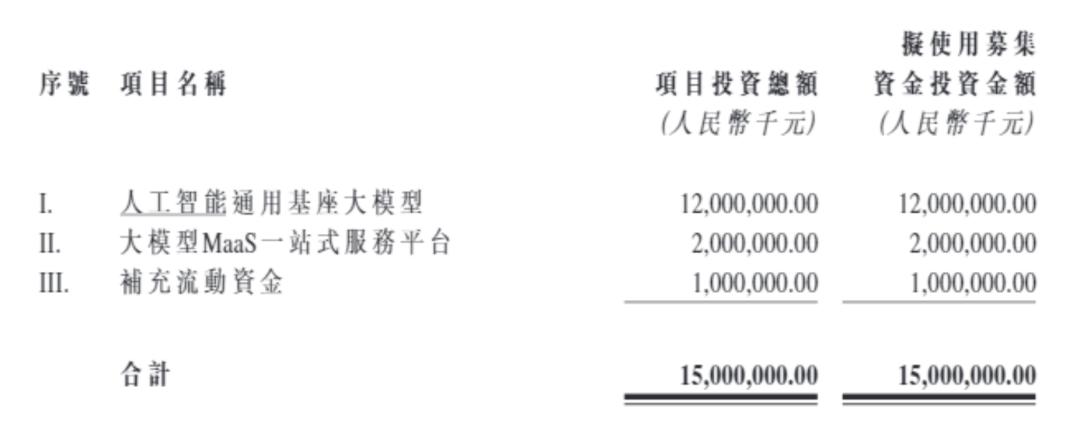
Image source: Zhipu's Hong Kong stock announcement
The news came as a bit of a surprise to the market. After all, just half a year ago, Zhipu was vigorously telling a globalization story, and its market value soared from tens of billions to once exceeding HK$600 billion. It seemed logical to strike while the iron was hot and secure its position as the "first large model stock" in the Hong Kong stock market. However, it chose to "return to the A-share market" at this time.
What's even more interesting is that almost at the same time, MiniMax also announced its plan to return to the A-share market. The fact that these two AI star enterprises are turning around one after another makes people wonder: what exactly have these new upstarts smelled?
01. The Turnaround and Pricing Power Brought by OpenClaw
Going back to the beginning of 2026, the capital market was confused about the growth potential of large models. The low-token consumption model of traditional chatbots could not support high valuations, and the industry was caught in the dilemma of "easy to gain popularity but difficult to make money."
The turning point was the popularity of the open-source project OpenClaw. It brought the model from passive question-and-answer to the era of active agent task execution with high token consumption. The value of the model is no longer judged by fancy answers but by task execution ability. Zhipu became the most aggressive predator in this wave.
On March 10, Zhipu launched AutoClaw leveraging the OpenClaw ecosystem, becoming one of the first domestic service providers to achieve large-scale deployment of localized AI agents. It's obvious to discerning people that Zhipu has cooked up a "commercial dish" on the OpenClaw ecosystem. It not only leveraged the open-source momentum but also directly entered the enterprise-level market with localized and secure packaging.
Just six days later, GLM-5-Turbo was released, and the API price was raised by 20%, accompanied by a low-price token package. At first, the market was hesitant: Where did they get the confidence to raise the price?
However, the impressive operating data directly confirmed Zhipu's confidence.
Zhang Peng, the CEO of Zhipu, disclosed at the 2025 performance briefing that the API call pricing of the company in the first quarter of 2026 increased by 83% year-on-year. Even with the price increase, the overall call volume still skyrocketed by 400%, and the market demand continued to outstrip supply. With the upgrade of the product structure and service model, the gross profit margin of Zhipu's cloud deployment business soared from a low of only 3.3% in 2024 to 18.9% in 2025, achieving a qualitative leap in profitability.
The rare industry phenomenon of simultaneous increase in volume and price and undiminished demand after price increase was highlighted in a research report by JPMorgan Chase. The institution clearly pointed out that Zhipu has established a scarce market pricing power in high-value enterprise service scenarios. China International Capital Corporation immediately raised Zhipu's target price, and the capital market completely redefined its valuation logic for Zhipu.
Regarding this new business logic, Zhang Peng once accurately summarized it with a formula: Business value = Intelligence ceiling × Token scale.
In other words, the intelligence level of the model itself is the ceiling, and the token consumption is the channel to realize this ceiling. The API is the path to convert intelligence into tradable production factors.
What sounded like a slogan at first has now become a self-consistent capital story with the exponential growth of token consumption brought by agents.
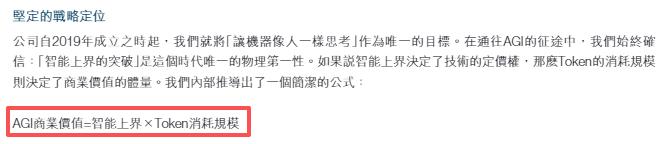
Image source: Zhipu's 2025 annual report
Once Zhipu's scenario of simultaneous increase in volume and price ran smoothly, the market's imagination was completely unleashed. Hot money began to overflow along the same logic chain. Since agents can revalue the commercial value of large models, Zhipu won't be the only beneficiary.
Kimi became the first target pushed up by this wave of sentiment.
Over the past period, Kimi's valuation has skyrocketed almost like a rocket. There have been round after round of financing, with the amount getting larger each time. Investors are rushing to get a share, seemingly with the attitude of "get on the bus first." The reason is simple: Zhipu has paved the way for "increasing volume even with price increases." Naturally, the market believes that players leading in the agent track have the opportunity to replicate this formula.
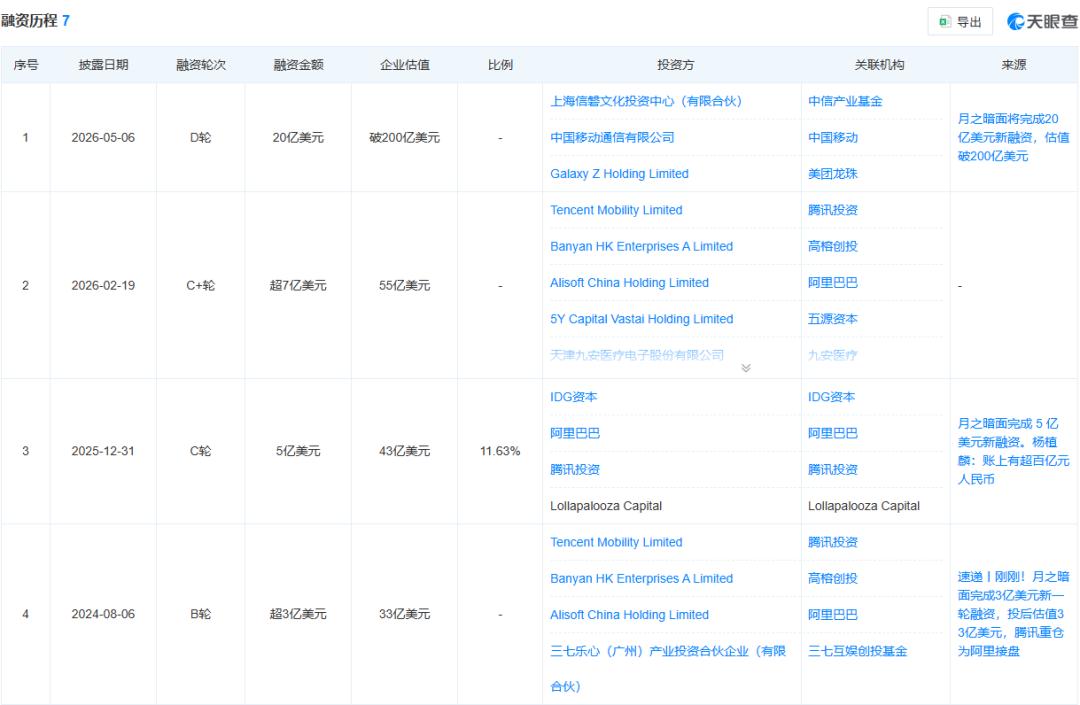
The latest financing situation of Kimi shown on Tianyancha
Even DeepSeek, which has always been "not short of money" and had a calm attitude, has quietly opened its financing window.
Backed by the quantitative giant Magic Square, DeepSeek has always been known for its abundant funds and has always sent out the signal of "no need for financing." However, in the face of the industry paradigm shift triggered by OpenClaw, "not short of money" and "not needing financing" have become two completely different concepts. The exponential token consumption brought by AI agents has directly led to an explosive growth in the demand for inference computing power. Even with a strong financial foundation, it is necessary to reserve ammunition in advance and layout production capacity.
Looking at it this way, Zhipu's stock price being revalued and its market value once reaching HK$600 billion is not entirely due to sentiment. Behind it is the underlying transformation of the large model industry from telling stories based on question-and-answer traffic to making real profits through on-the-ground execution. And OpenClaw has inadvertently become a key fuse to ignite the market sentiment.
02. The "Hidden Agenda" Behind the Timely Return to the A-share Market
Understanding this background, Zhipu's decision to make a "sharp turn" and return to the A-share market doesn't seem so sudden.
In fact, before listing on the Hong Kong stock market in 2025, Zhipu had initiated the guidance for its IPO on the Science and Technology Innovation Board but later voluntarily put it on hold. The core sticking point might be the continuous losses and the unclosed business model.
At that time, domestic large model enterprises generally relied on the growth model of "burning money for scale," with weak profitability and unclear commercialization paths. The A-share capital market had a relatively low tolerance for the valuation of unprofitable technology enterprises, while the lenient listing rules and international capital environment in the Hong Kong stock market became the optimal choice for Zhipu's phased listing.
However, the outbreak of the AI agent market has completely rewritten Zhipu's fundamentals and valuation narrative.
The long-chain tasks with high token consumption have transformed large model services from chat tools charged per use to digital productivity charged by consumption. The gross profit margin has risen rapidly, API revenue has increased significantly, and there has even been a rare user stickiness where demand remains undiminished even after price increases.
This is no longer a pure money-burning Internet story but more like an infrastructure business of selling water and electricity. It has certain "public utility" attributes but can also build barriers through the intelligence ceiling. This hard technology characteristic is exactly the most popular narrative on the Science and Technology Innovation Board.
Another subtle point is that the pricing power in the Hong Kong stock market is still deeply influenced by overseas funds, and geopolitical risks sometimes discount the valuation. Among Zhipu's current customers, a large number of local government agencies, enterprises, and key industries' agent deployments have extremely high requirements for data security and localized services. The concept of domestic substitution can obtain a much higher emotional premium in the A-share market than in the Hong Kong stock market.
Simply put, the same story of high token consumption may be more valuable and stable in the Science and Technology Innovation Board than in the Hong Kong stock market.
Moreover, to some extent, the policy level is also paving the way for Zhipu's return to the A-share market.
Currently, the regulatory authorities are continuously relaxing the listing threshold for unprofitable hard technology enterprises and fully supporting the development of new productive forces represented by large models and AI agents. Zhipu's return with the impressive call data, pricing power advantage, and solid performance of improved profitability in the first quarter just fills the gap in commercialization implementation that was lacking when it aimed for the Science and Technology Innovation Board before.
In addition, Zhipu's sharp turn may also have a more practical strategic consideration - to compete for the title of the "first large model stock" in the A-share market.
Currently, there is no pure large model listed company on the Science and Technology Innovation Board. Whoever can list first will gain the upper hand in pricing power and brand recognition. Zhipu obviously doesn't want to leave this opportunity to Kimi or other competitors eyeing it.
Taking advantage of the high market sentiment, it is understandable that Zhipu hopes to complete the fundraising as soon as possible to reserve sufficient ammunition for the next technological cycle. After all, although its market value once reached HK$600 billion, Zhipu still hasn't solved the problem of losses, and the pressure of continuous money-burning is real.
What's even more noteworthy is that DeepSeek and Xiaomi have pushed the API price to rock bottom, and the risk of a continuous decline in the price system is accumulating. Once the price increase logic driven by agents is eroded by the aggressive price concessions on the cost side, it remains unknown whether Zhipu's current high gross profit margin can be sustained. Therefore, completing the return to the A-share market and raising funds at the high point of market confidence before strong competitors list is not only a strategic move to secure a position but also a way to avoid risks.
Coincidentally, MiniMax also announced its plan to return to the A-share market almost at the same time, which proves that this is not an isolated case.
When the agent model extends the commercial value scale of large models to the token scale, these AI new upstarts have begun to realize that instead of competing with global giants in the overseas market, it's better to return to the A-share market, which understands the local scenarios best and is most willing to pay for execution ability, and firmly anchor the valuation of "tokens as productivity."
However, there are also voices in the market questioning that Zhipu's return to the A-share market at the high point is "too hasty," but the capital market always adheres to the core logic.
When AI agents achieve a leap in token consumption level, when the formula of intelligence ceiling × token scale is effectively converted into revenue, gross profit, and pricing power, and when the overall industry valuation experiences a systematic increase, what Zhipu needs is a pool that can give full premium to this new type of production factor.
And the Science and Technology Innovation Board is probably this pool.
Note: Some of the images in this article are generated by AI or from the Internet. Please inform us if there are any infringements, and we will delete them.
This article is from the WeChat official account "Yuan Media Hub". Author: Xie Chunsheng. Republished by 36Kr with authorization.