"Out of Water, Fish Must Evolve": Revisiting Tian Yuandong, RSI with a $4.65 Billion Valuation and the Self-Evolution of AI
Recently, Anthropic has publicly called for a global pause on AI development, citing that "AI is accelerating its own development process at an astonishing speed". This process is called Recursive Self-Improvement, which refers to the ability of an AI system to independently design and improve itself without human intervention. And this direction is exactly the track that Recursive Superintelligence (RSI), the new lab with a $4.65 billion valuation officially announced by former Meta FAIR Research Director Yuandong Tian, is betting on: enabling AI to achieve self-evolution through AI.
Founded in early 2026 by 8 top AI researchers, this new AI lab officially unveiled itself in May after about 4 months of stealth development. With $650 million in first-round funding, it has become one of the most watched new-generation AI labs in the world.
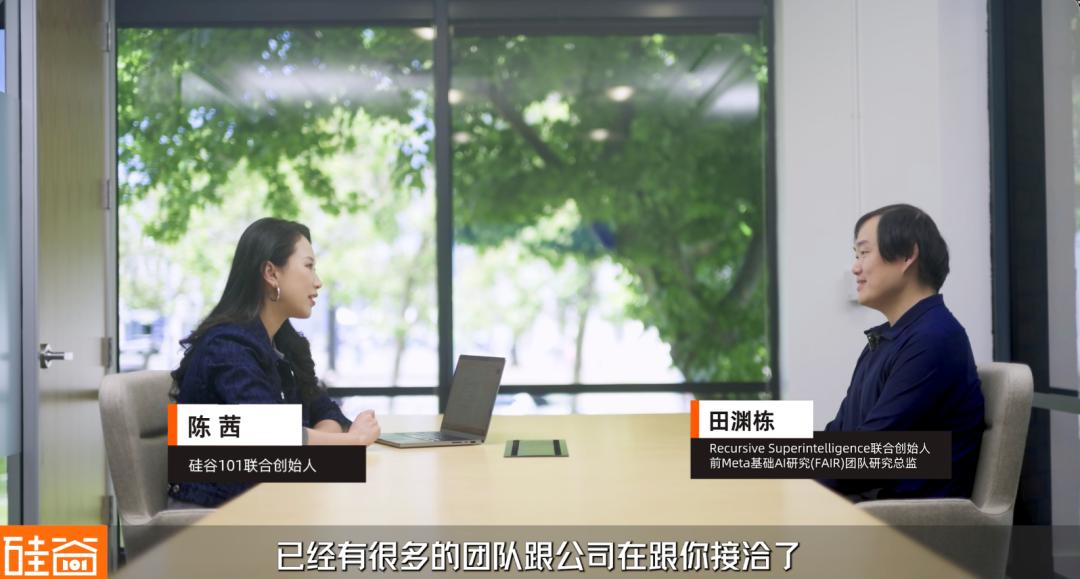
Against the background of increasingly fierce AI competition today, what exactly does RSI want to do? Why are investors so bullish on them?
In our conversation with Yuandong Tian half a year ago, he put forward some very widely discussed conclusions, such as "LLM has a pessimistic future" and so on. Now half a year has passed, facing the ever-changing AI market landscape, what does he think of the current trends and bottlenecks of model technology?
In this interview, regarding the current reality that large companies are accelerating the "distillation" of employees, and ordinary people's career positions are becoming increasingly unstable, Yuandong Tian used a very vivid metaphor: if you only keep jumping between big companies in the future, it may be like a fish constantly jumping out of the fish tank, but the water is getting less and less. In the end, you have to become a "four-dimensional creature" to survive.
So in the AI era, how can we find our own meaning instead of being pushed into a cog in the machine by the times?
This is the second episode of the Silicon Valley 101 Neolabs special video podcast.
01. From Big Tech to New Lab: Why Choose RSI
Chen Xi: Thank you very much Yuandong, welcome to Silicon Valley 101.
Yuandong Tian: Thank you very much for having me, let's continue this round of conversation.
Chen Xi: It has been half a year since we last chatted. Back then you had just left Meta, and you told me that many teams and companies had already approached you. Now you have officially announced joining RSI, can you first talk about why you finally chose this company?
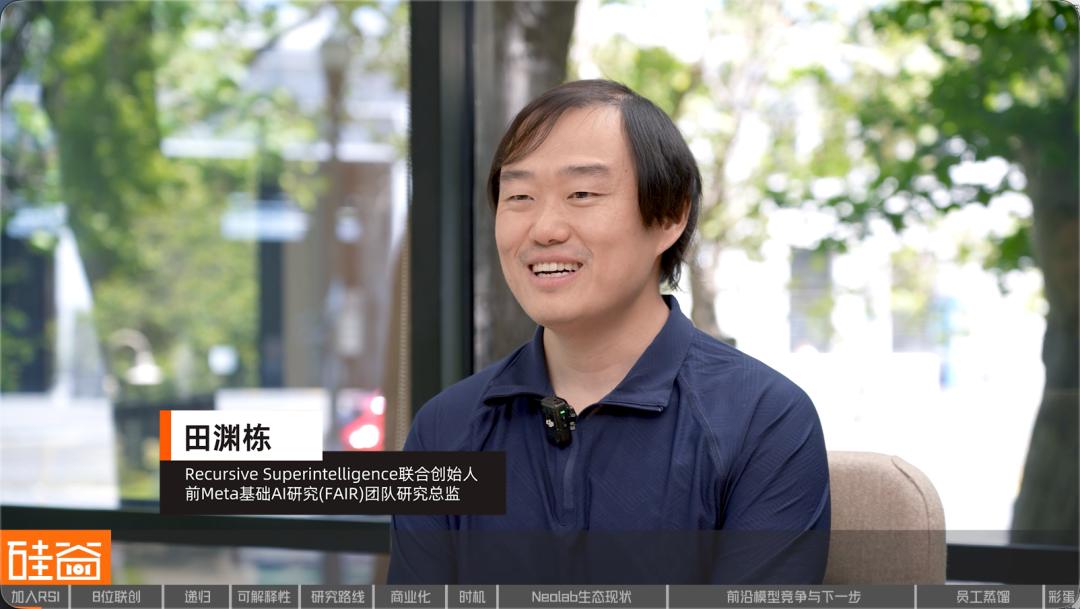
Yuandong Tian: Actually, I had basically made the decision when I did the last interview. It really was a relatively fast decision-making process. Between late October and early November, my phone messages were almost "blowing up", and I didn't have time to reply to everyone one by one.
The ultimate reason for choosing RSI, first of all, is that I want to experience a different life. Because I am also a novelist, I think experiencing life itself is a very important thing. On the other hand, I judge that a trend is emerging in the large model industry: teams will become smaller, faster, and have less organizational friction. "Small and refined" teams getting things done will gradually evolve into a major trend. Against this background, continuing to stay in a big company may no longer be so suitable. In fact, I have also personally seen many large teams have all kinds of problems.
02. 8 Co-founders: Why Are Investors Willing to Invest
Chen Xi: I believe it wasn't just RSI or other neolabs that approached you back then. Richard Socher also came to see you in person, so why did you ultimately choose RSI?
Yuandong Tian: There are two main reasons. First, RSI is a newly formed team, so I talked with Richard, Caiming Xiong, Tim Shi, and Tim Rocktäschel back then. I think, for a newly formed team, the opportunities are inherently greater. Second, I already knew two or three people in the team before, among them Tim Rocktäschel was my colleague at Meta, and he had been working on reinforcement learning before, so we are more familiar with each other.
Of course, many other startup teams also approached me, but most of the time, the role they offered was more like head of AI or head of research, not co-founder. Since we are starting a business, of course it is more appropriate to be a co-founder.
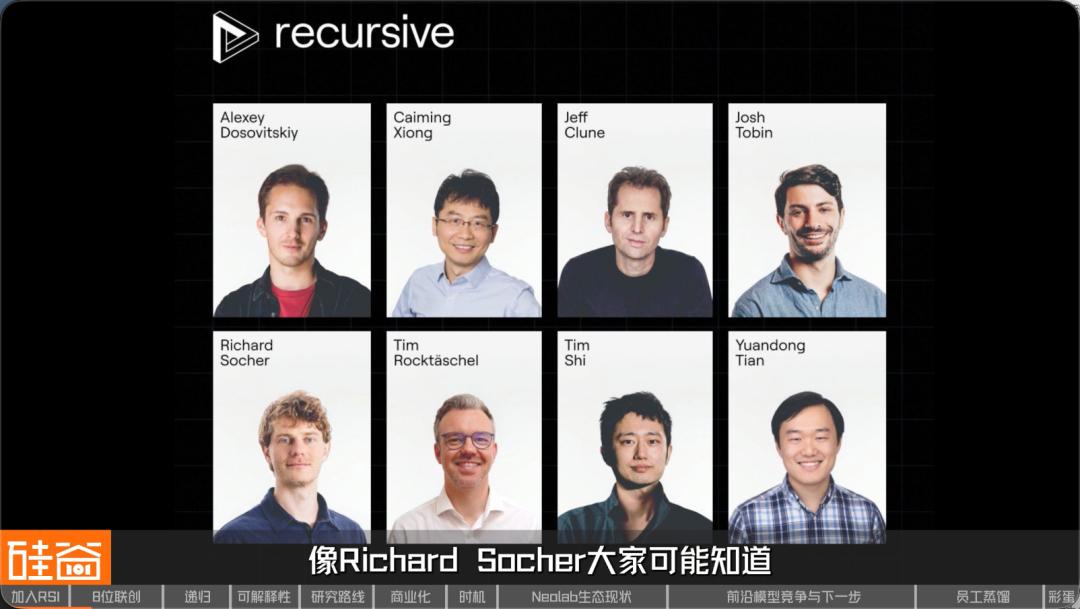
Chen Xi: RSI has 8 co-founders, which is very rare. What kind of structure do you have?
Yuandong Tian: I think it's mainly because each co-founder has different professional knowledge, and they complement each other. Everyone has their own strengths, can appreciate others' strengths, and everyone is smart enough, so 8 people cooperate relatively smoothly.
Chen Xi: Can you introduce to us what each of the 8 co-founders is responsible for?
Yuandong Tian: Of course. Richard Socher has always been more inclined to the CEO role. Previously he founded MetaMind at Meta, which was later acquired by Salesforce; after joining Salesforce, he served as chief scientist for 4 years. After that he founded You.com, which is now profitable. This time he returned to entrepreneurship again as CEO of RSI.
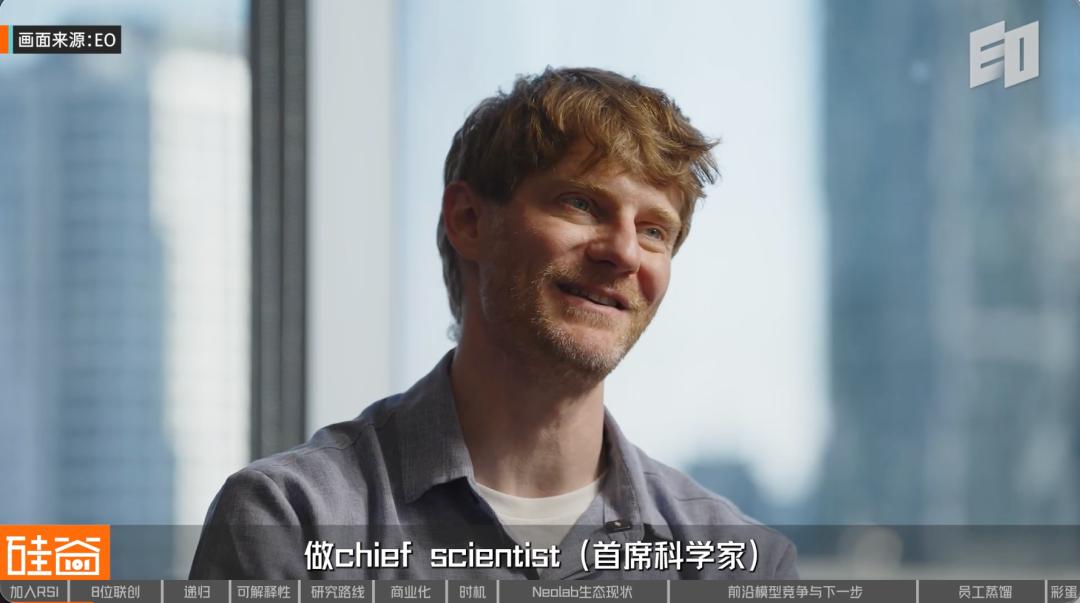
Caiming Xiong previously worked with Richard at MetaMind, and later joined Salesforce together after the company was acquired. After Richard left, Caiming served as Senior Vice President of Salesforce Research, and worked there for more than ten years.
In addition, Tim Rocktäschel is also an important member of RSI. He and I were colleagues at Meta, and later he went to Google DeepMind, in charge of Project Genie 1, 2, 3 and work related to agent Open-Endedness, these directions are very close to what we are doing now. He has always had a good reputation at Google, so he also played a big role in our financing process.
Jeff Clune has long focused on the direction of agent Open-Endedness, and has been working in this field for the past ten years. His recently published The AI Scientist-v2 has even been accepted by Nature, and has strong academic influence.
Josh Tobin was an early employee of OpenAI, later started his own business, and his company was acquired by OpenAI. After that he returned to OpenAI as agent science director, and has rich experience in engineering and agent directions.
I have known Alexey Dosovitskiy for a long time, we all did reinforcement learning back in the day, later he went to Google, participated in work related to Vision Transformer, and was the first author; after that he went to some AI for Science companies, and now he also joined RSI.
There is also Tim Shi, he was previously CTO of Cresta, worked at that company for many years, and built the company very well. Now he is very interested in the "recursive" route, so he resigned from his original position and joined RSI as co-founder.
Chen Xi: So many top researchers and industry practitioners gather together, won't there be disagreements? What if you have different opinions?
Yuandong Tian: We are relatively democratic on the whole. There will be a lot of discussions in the team, and a lot of collisions of ideas. In the end, everyone usually reaches agreement on some ideas and logic, and then promotes them together. So far, the cooperation has been relatively smooth. Everyone is smart, cooperating with smart people is usually more worry-free, everyone wants to get things done and expand the pie together.
Chen Xi: The scale of this round of financing is also very eye-catching, $650 million in financing, $4.65 billion valuation, and this is all without a product. Why are investors willing to invest?
Yuandong Tian:I think top-tier investors value people the most. The AI field changes too fast, it is difficult to clearly explain the business vision and product path at the very beginning. The thing you say you want to do today may change in two months due to new technological progress. At this time, whether the team can respond quickly and execute quickly becomes extremely important. So what investors value first is the judgment of people, including past resume, ability, and the running-in and collaboration between team members. The core reason why the financing amount reached this scale is that investors recognize our past experience and our commitment to this vision.
Chen Xi: What are you mainly responsible for? When we chatted last time, you said you wanted a position that combines engineering and cutting-edge research for your next job.
Yuandong Tian: Actually, when I said that back then, I already roughly knew I would come here, but I couldn't say it in advance. Now at RSI, it is indeed a job that combines engineering and cutting-edge research. Caiming and I have mainly done modeling in the past, compared to pure research, we will continue to do modeling, post-training and other work. At the same time, at the engineering level, we will also do some work related to agentic harness.
03. Recursive Self-Improvement: Betting on AI Automated Research
Chen Xi: Next let's talk about RSI. The full name of RSI is Recursive Superintelligence. Recursive is a very key word. Can you explain what RSI mainly wants to do? What does Recursive self improvement actually mean? Why do you think it is critical?
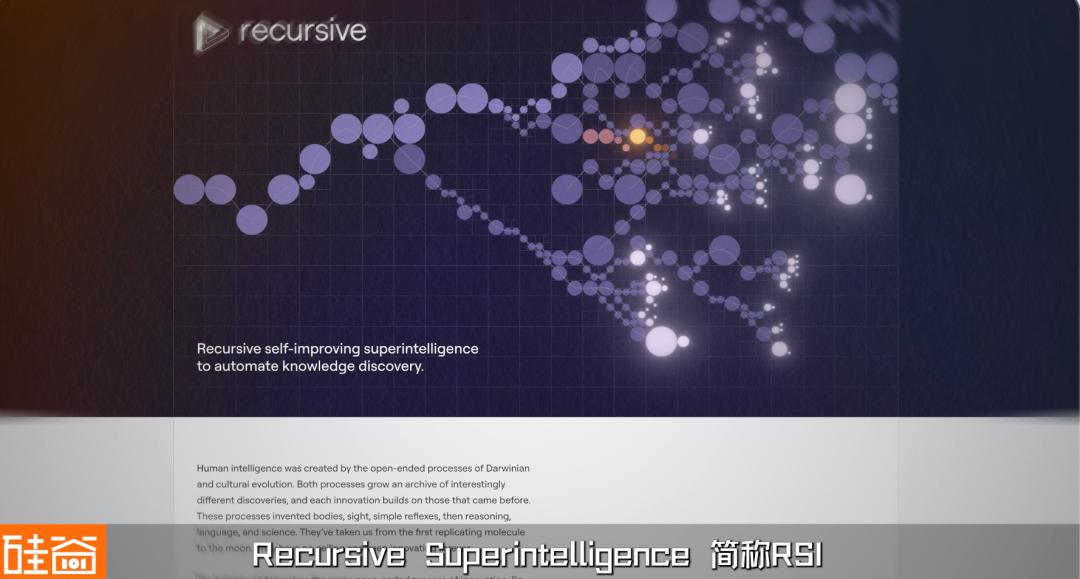
Yuandong Tian: Recursive self improvement means that AI is used to optimize certain links of AI itself, making AI stronger, and then continuing to iterate upward on the new basis. Specifically, we hope that AI can do many things that still require manual work now, such as scientists looking for new ideas and new logic, or using AI to do reinforcement and make new discoveries during the training process. These are all part of recursive. Our ultimate vision is to build a system that, after putting in various computing resources, can output new knowledge, new insights and new understanding. The RSI website says maximizing knowledge discovery rate, which is exactly what it is. Through this approach, we hope to accelerate the progress of human society and improve human ability to discover and understand new knowledge.
Chen Xi: At present, we see that leading large model companies such as OpenAI, Anthropic, and Google still mainly rely on humans to design models, collect data, conduct large-scale training, and then perform manual annotation and alignment. You mentioned before that humans may be a bottleneck on this path. You are betting on letting AI automate the R&D process, is that correct?
Yuandong Tian: Yes. Now when humans or researchers do research and AI discovery, most of the time they are limited by their own physiological conditions. People need to eat, sleep, and rest, they can't devote 100% of their time to research. So if AI can replace at least some tedious, heavy, repetitive work, this must be feasible, and that is the first step. The second step is, can AI further automatically discover new insights and important information on the basis of these basic tasks, thereby accelerating the development process of the entire AI and human society.
Chen Xi: So is what the AI system learns a real improvement in capability, or overfitting to a certain evaluation metric?
Yuandong Tian: I of course hope that it ultimately brings an improvement in capability. For example, AI may now only be able to do what undergraduate students can do, we hope it can do what master students, doctoral students, even researchers can do in the future. As for benchmark, it is essentially just a means to achieve the goal. Chasing high rankings on benchmarks is still relatively superficial; when broken down into specific steps, each step can correspond to certain metrics. What is more important is whether AI can complete truly valuable tasks at a higher level.
Chen Xi: If the AI system starts to design experiments and evaluate results independently, can humans still be reliable judges? How do you solve the recursive problem of evaluating the evaluator, that is, "the evaluator itself also needs to be evaluated"?
Yuandong Tian: At least at the current stage, AI can not reach the evaluation standard of humans, so in the short term humans can still be judges, that's no problem. On another level, when AI becomes strong enough, many evaluation standards will become subjective rather than absolutely objective. For example, letting AI write code, many times humans do not have completely consistent understanding of code structure, module division, and design schemes. In this case, there may not even be a so-called "correct answer", everyone's judgment may be reasonable. Therefore, future evaluation may gradually shift from intermediate benchmarks to the final result, that is, looking at whether the output produced by the combination of human and AI is really useful and satisfactory.
04. When AI Starts Researching AI: Why Interpretability Matters
Chen Xi: In this situation, is interpretability still important?
You also mentioned before that whether scaling succeeds or fails in the end, interpretability is a problem that must be solved. If the model succeeds, we need to ensure that superintelligence will not do harm; if the model fails, we also need to understand why it collapsed in certain places.
So on RSI's path, when AI can modify its own code or weights, and even design a series of experiments by itself, will interpretability become more difficult?
Yuandong Tian:I think this issue is very important, and more important than before. First of all, safety is a core issue. When we launched Recursive, we attached great importance to building safe superintelligence. An important solution for this part of security is achieved through interpretability. Because if we understand the internal mechanism of the model and have a grasp of how it operates, we can roughly judge what kind of threats and problems this model may bring in the future, so this is very critical.
In addition, interpretability itself also provides a very good indicator to help us find the results we want faster. Taking recursive self-improvement as an example, it implies a lot of computing power investment. For example, training a model may require thousands or tens of thousands of GPUs. If we don't understand the model itself, we often can only predict or evaluate whether the model is good or bad after training is completed. This makes the process very slow.