Over five years, the short seller fleeced retail investors out of 140 million yuan. Now facing charges that could land him in prison for life, he is still busy shorting stocks to make profits.
The famous "China concept stock killer", Citron Research, has reaped $140 million from retail investors in five years and is finally going to jail. Now, this short - selling tycoon may end up spending the rest of his life in prison, facing a maximum of 370 years in jail.
The famous "China concept stock killer", Citron Research, has reaped $140 million from retail investors in five years and is finally going to jail.
It took only 173 days from the release of the report to the delisting and dissolution of Longtop Financial Technologies when Citron shorted it.
Citron shorted Qihoo 360 six times in a row, forcing the "Red - clothed Uncle" (Zhou Hongyi) to take the company private and backdoor list in the A - share market.
China concept stocks such as New Oriental, NIO, TAL Education Group, and GSX Techedu have all been precisely targeted.
Now, this short - selling tycoon may end up spending the rest of his life in prison. He may face a maximum of 370 years in jail.
1. The "China concept stock killer" who reaps retail investors will face prison life
Recently, according to media reports, Andrew Left, the founder of Citron Research, was found guilty of securities fraud by a federal jury.
Left faces 17 charges, 13 of which were found to be true. The prosecution said that he made about $20 million in profits through related transactions between 2018 and 2023. He is accused of posting tweets about dozens of companies on social media. These tweets illegally influenced the stock price movements, allowing him to make quick profits.
You may not be familiar with the name Andrew Left, but you must know Citron. They have issued many important short - selling reports, and each time they can cause a big drop in the stock price of listed companies. From 2010 to 2020 was the heyday of Citron's short - selling of China concept stocks. They successively issued short - selling reports against dozens of China concept companies such as New Oriental, Qihoo 360, Evergrande, and GSX Techedu.
This Left is not only the founder and boss of Citron but also runs an account on X (formerly Twitter) and is a big V.
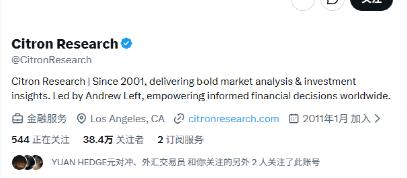
Citron Research's X account has 384,000 followers. Although this number is not large, since the content posted on this account is all about the stock market, either the full text of short - selling reports or views on the industry or companies, the people who follow it are very targeted, mostly retail investors and traders, and the funds they control are immeasurable.
In the emails Left sent to fund managers, he often boasted about his influence among retail investors and said that making money from retail investors was as easy as "taking candy from a baby", and "one tweet could make a stock plummet".
This company claims to be a research institution, but in fact, it is both the referee and the athlete. They place short orders before tweeting and publishing research reports, just waiting for the stock price to drop and make a profit.
During the trial, the prosecutor said that Left "tweeted while trading". He once cooperated with hedge funds. Before the short - selling report was publicly released, he showed it to the fund. If they had stocks, they would sell them first; if not, they could place short orders. Then he would cooperate to publish the research report and post a status on X. Once the stock price crashed, the money was in hand.
Left and those funds made a fortune, but retail investors suffered heavy losses.
A firefighter who testified in court said that because of Left's "genius operation", he lost $110,000, which was his retirement money. After hearing that the court found Andrew Left guilty, the firefighter felt that his injustice had been redressed and said, "I feel good today. I'm sorry he has to go to jail, but I lost a lot of money, and that's not right."
However, not everyone applauded the verdict.
Another former hedge - fund manager, Marc Cohodes, who likes short - selling, posted on X that Left's conviction "will mark the end of the 'pump - and - dump' and short - selling report model" and called on federal authorities to "go after the real violators of this behavior". He also said, "I like Andrew (Left), always have. It's sad to see this, but I hate the way these people operate."
Issuing short - selling research reports is not the exclusive right of Citron. There are also many specialized short - selling institutions such as Muddy Waters. Their business model is to buy short orders in advance, then publicly report the problems of the company, and then drive down the stock price to make a profit. If this business is illegal, they won't get away with it.
2. A fraudster starts a company and turns into a "China concept stock killer"
So, how did Left develop such a great influence step by step? He has always been relying on deception and breaking the rules.
Left was born into an ordinary family, and no one in his family has ever traded stocks. After graduating from Northwestern University with a degree in political science, he became a commodities broker, doing telephone sales, just like what Leonardo DiCaprio played in the movie "The Wolf of Wall Street", deceiving customers into placing orders. But he didn't even work for a year before he was banned from the industry for three years by the National Futures Association (NFA) for "issuing false and misleading information to deceive or defraud customers".
In 1999, Left was hired as the president and CEO of Detour Media. But in February 2002, the company sued him, saying that he stole six checks worth about $25,000 and that he "faked and defrauded, made negligent misstatements, violated fiduciary duties, and engaged in illegal currency transactions". The documents were filed with the SEC.
After being in trouble twice, it's not easy for him to find a proper job in the financial circle.
It's no big deal for him. He can still make it on his own. In 2001, Andrew Left founded the short - selling institution Citron Research. Although it's called a company, in fact, there is only one full - time employee, which is himself.
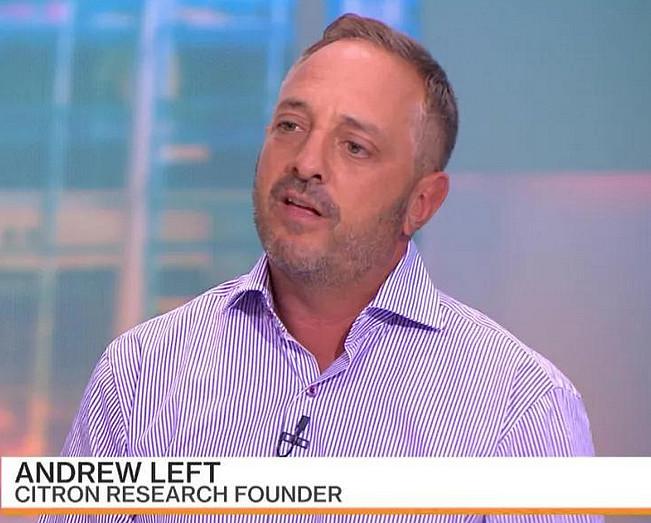
Since 2006, Left has increased the frequency of short - selling. His most remarkable achievement is short - selling China concept stocks, and he is also known as the "China concept stock killer":
In 2009, Citron shorted New Oriental, a China concept stock company. Due to the insufficient content of the report, New Oriental's stock price rose instead of falling. Later, Muddy Waters also came to short New Oriental, which even attracted an SEC investigation. In the end, the two short - selling institutions worked hard but lost money.
On April 26, 2011, Citron published a short - selling report, questioning that Longtop Financial Technologies had an excessively high gross profit margin and was suspected of financial fraud. It also questioned the company's employee recruitment model, management background, management transactions, and audits from multiple perspectives. One month after the short - selling report was released, Deloitte, the original auditor of Longtop, quickly terminated the audit relationship and in turn reported that Longtop's management had interfered with the audit. Four months later, Longtop was delisted from the New York Stock Exchange.
At the same time, Citron targeted 360 and shorted it six times persistently.
In November 2011, Citron released a short - selling report on Qihoo 360, stating that Qihoo 360's stock price was seriously overvalued. On that day, Qihoo 360's stock price dropped by 10.34%. In the following four months, Citron successively released five more short - selling reports, questioning Qihoo 360's revenue data fraud (by analyzing the financial statements), claiming that the past of Qihoo 360's management was "suspicious" (regarding the behavior of senior executives), and that Zhou Hongyi had historical financial problems (whether it complied with procedures).
Citron's approach to short - selling China concept stocks has only three tricks:
First, look for problems in the financial statements. Since the accounting standards of A - shares, H - shares, and US stocks are different, there are differences in financial audits under different standards. Whether there are problems or not, these loopholes can be used as an excuse.
Second, check the improper behavior of corporate executives or related - party transactions.
Third, monitor whether the company complies with procedures, such as whether it discloses and files reports as required. Whether the disclosure time is late or the content is incomplete are all flaws that can be criticized.
That is to say, Citron used all three tricks this time but still failed to bring down 360.
Li Kaifu launched a counter - attack against Citron's short - selling:
"Short - selling institutions and fraud - busting institutions can play a positive role in purifying the environment and driving out fraudsters. However, if such institutions are obsessed with interests and power and think they can influence stockholders, they may go astray and take risks, using fraud to make a profit."
In September 2012, Li Kaifu led 61 corporate executives and others to jointly issue an open letter, accusing overseas short - selling institutions represented by Citron of fabricating facts and spreading lies in their research reports. They also created a website called Citronfraud.com, but this website didn't operate for long and was shut down.
In June 2012, Citron released a report short - selling Evergrande, claiming that it was insolvent. Left shorted 4.1 million shares of Evergrande before the report was released and bought them back after the stock price dropped, making a profit of about HK$1.7 million. As a result, Left was sued. In December 2014, the Hong Kong Securities and Futures Commission launched an inquiry process against him, accusing his report of containing false and misleading information. In 2016, the Market Misconduct Tribunal in Hong Kong ruled that he had issued false information, fined him HK$1.6 million, and banned him from the Hong Kong securities market for five years.
After being punished in Hong Kong, he continued to cause trouble in the US stock market.
In 2020, Citron targeted the China concept stock GSX Techedu again. In April, it released a research report, saying that GSX Techedu's registered users were 40% fraudulent, and there were multiple undisclosed related parties. These related parties were used to fabricate its financial situation and facilitate brush - order activities. "Up to 70% of its revenue was fictional", and it also tampered with and forged the financial data in the audit report. Subsequently, Chen Xiangdong, the founder of GSX Techedu, responded in his WeChat Moments, saying, "We are really speechless about such a shameless report." In August, Citron shorted GSX Techedu again, saying that the company was engaged in securities fraud.
Over the years, Citron and Muddy Waters have repeatedly targeted Chinese companies. However, he doesn't always short - sell.
In January 2020, when Muddy Waters exposed Luckin Coffee's financial fraud, Citron rarely expressed great optimism about Luckin, believing that the company had infinite potential. However, Luckin later admitted to fraud, which slapped Citron in the face.
3. Short - selling retail investors angers the public, and a lifetime in prison is inevitable
In fact, Left not only failed in short - selling China concept stocks but also short - sold stocks to reap retail investors, which angered the public. His current ending can be regarded as "justice being served".
At the beginning of 2021, retail investors in the United States fought against Wall Street, targeting short - sellers led by Citron.
First, in January, Citron released a short - selling report, saying that investors who bought GameStop stocks would be losers, and the company's stock price would quickly fall back to $20 per share. GameStop is a company that rents game discs, and its performance has been in decline for many years. However, at that time, a group of middle - aged people with nostalgia targeted this company that brought back childhood memories and insisted on buying its stocks.
At that time, GameStop's closing price had reached $39.36 per share, which means that Citron thought GameStop's stock price would be cut in half.
So, a large number of retail investors gathered on the US stock forum and joined forces to drive up GameStop's stock price.
That's not enough. They also attacked Citron's social media account and even "greeted" Left's family.
Finally, Citron surrendered directly. "After 20 years of operation, Citron will no longer issue'short - selling reports'. We will focus on providing long - term long - buying opportunities for retail investors." Citron announced on Twitter. Left also said that "family comes first", and then he reported the relevant online attacks to institutions such as the FBI and the SEC.
Soon, retail investors pushed GameStop's stock price from $20 to $483, and Citron lost $20 million overnight.
The mutual confrontation between the two sides even attracted Elon Musk to join the battle. Musk knows how to generate traffic very well, and he unconditionally supported retail investors at a critical moment:
After offending a large number of retail investors, Left's problem is not just losing money.
On July 26, 2024, the US Securities and Exchange Commission (SEC) and the US Department of Justice filed civil and criminal lawsuits against Citron Capital and its founder, short - selling investor Andrew Left respectively.
The SEC accused Left and his company of implementing a "bait - and - switch" strategy by issuing false and misleading stock trading advice, and making about $20 million in profits from illegal transactions involving more than 20 companies. On the same day, the Department of Justice accused Left of participating in a $16 - million stock - market manipulation scam and filed a criminal lawsuit against him, with charges including one count of a securities fraud scheme, 17 counts of securities fraud, and one count of making false statements to federal investigators.
The indictment said that Left deliberately used his ability to manipulate stock prices, targeted stocks favored by retail investors, and posted advice on social media to manipulate the market. If convicted, he will face a maximum of 25 years in prison (for the fraud scheme) and multiple 20 - year sentences (for each count of securities fraud).
If Left is convicted on all charges, in total, he may face a maximum of 370 years in prison. Currently, 13 out of the 17 counts of securities fraud have been found to be true. He is guaranteed to serve at least 260 years in prison.
Before being found guilty, Left was still busy short - selling to make money.
In February this year, Citron shorted SanDisk, publicly announcing that it held short positions in SanDisk. It believed that NAND products were highly homogeneous, and the current supply shortage in the market was just a "mirage" that could disappear at any time during an "earnings conference call".
As a result, SanDisk's stock price dropped slightly on that day, but then it rose continuously for three months, from more than $600 to a maximum of $1,861, tripling in value.
Now that he has been convicted, he has to stay in jail honestly this time.
#FinancialCircle #ShortSeller #NewOriental #SanDisk #NIO #ChinaConceptStockKiller #Investment #Citron #ZhouHongyi #360
The cover is AI - generated.
Reference materials:
"Well - known short - seller and founder of Citron Research found guilty! Manip