15x Growth in 5 Years, Joint Efforts by Ant Group and Meituan, Saudi Capital Enters the Market – Are Exoskeletons Becoming the "Strategic Entry Point" for Silver Tech?
If we rewind the clock five years, or even three years, no one could have imagined that the progress of the "artificial Iron Man" would be so rapid.
It's not the million - level rehabilitation equipment in hospitals, nor the industrial power - assisted devices in factories. Instead, it has become a consumer product that ordinary people can order on e - commerce platforms, rent at scenic spots, or even buy directly for their parents.
From future - oriented technology to everyday equipment, exoskeleton robots are undergoing a new identity transformation in the wave of technology. So, who is driving this spectacular "revolution"?
PART 01
The Capital Battlefield: The Driving Forces Behind Exoskeletons
In the past year, looking at the financing records, we can see that the exoskeleton track has witnessed a large influx of capital from multiple sources. There are "national teams" such as Agricultural Bank International and Chengdu Science and Technology Innovation Investment, internet giants like Ant Group and Meituan Longzhu, and even cross - border support from Middle Eastern capital like Saudi Aramco's Prosperity7.
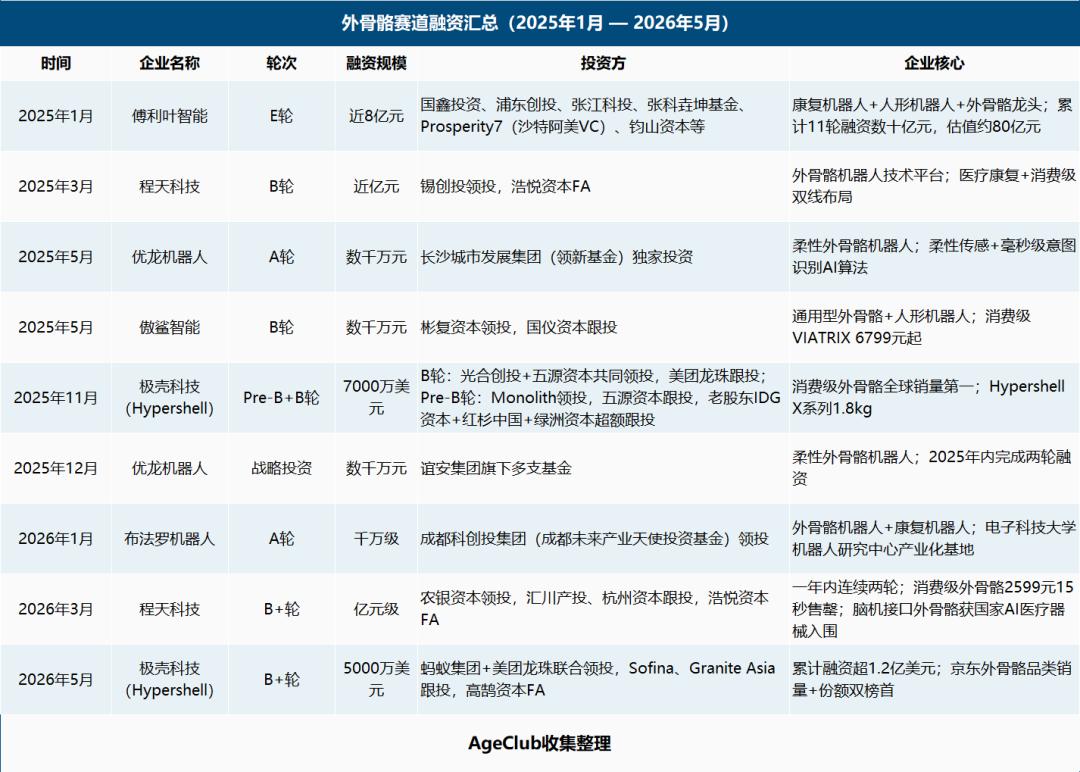
On May 18, 2026, Jike Technology, a consumer - grade exoskeleton brand, announced the completion of a $50 million Series B+ financing round. The leading investors in this round were Ant Group and Meituan Longzhu.
This is a brand - new signal. Before this, almost all the leading investors in the exoskeleton track were professional VCs or industrial funds. It's the first time that internet giants have entered as leading investors.
The confidence that makes top - tier capital place their bets can be traced back to a seemingly crazy starting point five years ago.
In 2021, Sun Kuan, a product manager at the well - known robot company DFRobot, registered a company called Julingshen Technology in Shanghai. This post - 90s researcher, whose research direction is exoskeleton simulation, had a crazy idea: to turn the bulky and expensive exoskeletons into consumer - grade products that ordinary people are willing to buy and use.
At that time, Sun Kuan was rejected by nearly a hundred investors. Almost every time he gave a roadshow, he was asked the same question: "Why do ordinary people need an exoskeleton?" Some investors even bluntly said that it was "an unrealistic science - fiction product."
A year later, another shining "star" - Jike Technology entered the incubation system of Qiji Venture Studio founded by Lu Qi and received its first angel - round investment in the millions.
Different from Sun Kuan's darkest days in the early stage, since then, Jike Technology has been successively led by Oasis Capital, Sequoia China, and IDG Capital. At the end of 2025, it also obtained $70 million in Pre - B and Series B financing, until Ant and Meituan led the Series B+ round. In less than three years, it completed a "triple jump" in its capital structure.
If internet giants represent "market votes," the entry of state - owned capital represents the policy direction.
In March 2026, Chengtian Technology completed a Series B+ financing round worth hundreds of millions of yuan. The leading investor, Agricultural Bank Capital, has the background of a state - owned large - scale bank, and the follow - on investor, Hangzhou Capital, is local state - owned capital.
Meanwhile, the pace of state - owned capital's entry doesn't stop there. In January 2026, Buffalo Robot received tens of millions of yuan in Series A financing from Chengdu Science and Technology Innovation Investment. In May 2025, Youlong Robot received tens of millions of yuan in exclusive investment from Changsha Urban Development Group. In the nearly 800 million yuan Series E financing of Fourier Intelligence in early 2025, Shanghai state - owned capital systems such as Guoxin Investment and Pudong Venture Capital were also the main forces.
The silver - haired economy is a livelihood project, and hard technology is an economic driving force. The frequent actions of local state - owned capital are the result of the deep integration of the two. VC institutions in the track are more like "pathfinders." They placed their bets before internet giants noticed, gambling on the time difference between the technological inflection point and the category's explosion.
Sequoia China and IDG Capital led Jike's Series A in 2024 respectively. BlueRun Ventures accompanied Chengtian Technology through multiple rounds starting from its Series A. Fortune Capital led Chengtian Technology's Series A+. There are also Binfu Capital, Mingshi Capital, and Xianfeng Changqing (Pioneer Evergreen) that invested in Aoshark Intelligence.
Of course, there are also some "independent players" in the market that cannot be ignored. On May 26, Haier Group released the world's lightest AI sports exoskeleton, the W3, with a total weight of only 1.75 kilograms. Haier doesn't need financing. As a Fortune Global 500 company, its direct involvement in product development is a stronger indication of the value of this category than any investment from VC institutions.
PART 02
From Millions to Thousands: Telling a New Story with an Old Product
Although exoskeleton robots are very popular at present, they are not a new thing. The history of exoskeleton robots can be traced back to 1960, and a technological breakthrough was achieved around 2000. Subsequently, they were applied in military, industrial, and other fields. They entered China around 2010, and with the development of flexible exoskeleton technology around 2018, there was a trend of large - scale commercialization in the medical field.
In 2023, from the news reports about the use of exoskeleton robots in the movie The Wandering Earth 2, we could still learn from relevant practitioners and analysts at that time that exoskeleton robots were expensive. "Currently, the average global price of exoskeletons is between 600,000 and 1 million yuan, and the price of some robots is as high as several million yuan."
The first watershed in price appeared around 2020.
Companies such as Fourier Intelligence and Daai Robot introduced exoskeletons to rehabilitation centers, reducing the price to the range of 100,000 - 300,000 yuan, and they began to enter more medical institutions and nursing homes. Daai Robot obtained the first CFDA registration certificate for exoskeleton robots in China. In 2025, the team of Professor Shuai Mei revealed that the price of Daai's exoskeleton had dropped from the million - level to the ten - thousand - level or even the thousand - level.
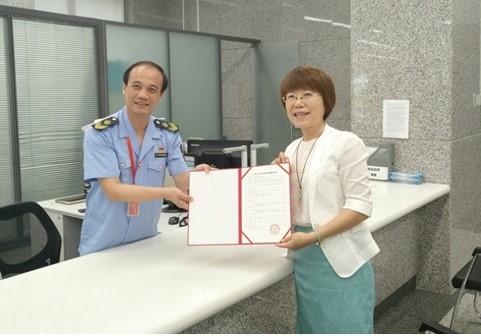
Image source: Beijing Advanced Innovation Center for Biomedical Engineering
The real explosion of consumer - grade exoskeletons started in 2024. That year, Jike Technology began global deliveries. Aoshark Intelligence released its "Meet the Future" series of consumer - grade exoskeletons, with a starting price of 6,900 yuan.
In 2025, at the beginning of the year, the mountain - climbing power - assisted exoskeleton jointly developed by Kenqing Technology and Taishan Cultural and Tourism Group became extremely popular during the Spring Festival. Chengtian Technology launched a consumer - grade exoskeleton priced at 2,599 yuan on the e - commerce platform, and it was sold out in 15 seconds. Haier's first AI sports exoskeleton, the W1, was sold out on the first day of its release.
Simultaneous with the decline in price is the "breaking out" of application scenarios.
Early exoskeleton robots were almost only used in medical, industrial, military, and other fields, and had little connection with ordinary consumers.
In recent years, outdoor sports have become a new scenario. Jike's Hypershell is mainly for commuting, mountain - climbing, and hiking. Kenqing Technology, in cooperation with Taishan Cultural and Tourism Group, launched a mountain - climbing exoskeleton rental service at Taishan Scenic Area. In this context, the elderly walking - assistance scenario has emerged, and it has become possible to develop consumer - grade products specifically for the silver - haired population.
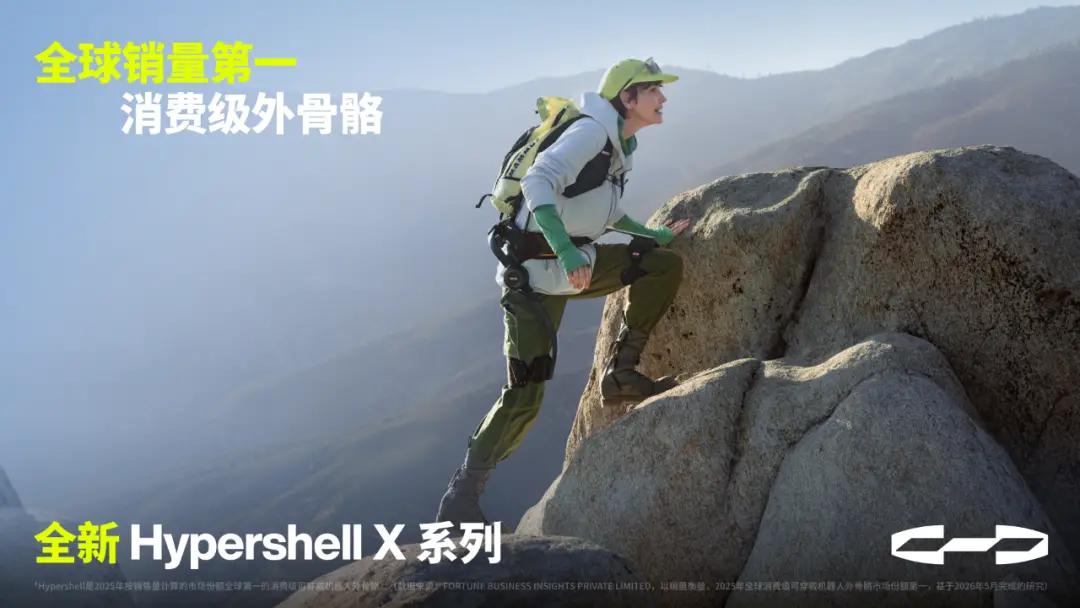
Image source: Shenzhen Bay
Kenqing Technology has developed the "π series" of exoskeletons for the silver - haired population. The founder, Yu Yunbo, said, "The π exoskeleton is mainly targeted at active elderly people. It can assist walking and protect joints, allowing them to fully enjoy the fun of outdoor sports."
Different from Jike Technology and Kenqing Technology, which focus on outdoor sports, Chengtian Technology started from medical rehabilitation. Its brain - computer interface exoskeleton rehabilitation system has been short - listed for the national list of artificial intelligence medical devices.
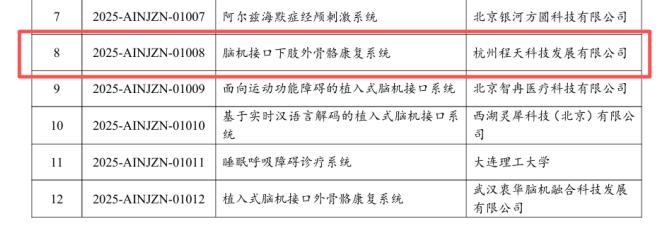
Image source: Ministry of Industry and Information Technology
In fact, a number of exoskeleton companies such as Daai Robot, Fulong Robot, and Maibu Robot have launched relevant products for the elderly.
Behind this evolutionary path is the acceleration of technological inclusiveness. AI gait algorithms enable exoskeletons to recognize the wearer's intentions in milliseconds and adjust the assistance force adaptively. Carbon fiber and titanium alloy have reduced the structural weight by an order of magnitude, and large - scale mass production has significantly reduced costs.
Market data confirms the intensity of this change. According to data from the Leopard Research Institute, the market size of exoskeleton robots in China was only 680 million yuan in 2021, and it soared to about 1.056 billion yuan in 2025, with a compound annual growth rate of up to 98.5%.
Fortune Business Insights predicts that the global market size of wearable robot exoskeletons was $2.49 billion in 2025 and will grow to $64.23 billion by 2034, with a compound annual growth rate of 43.7%.
At the same time, there is another set of more convincing data. At the end of May 2026, the Ministry of Commerce disclosed a set of data. From January to April 2026, the online retail sales of intelligent walking - assistance exoskeletons increased by 785.5% year - on - year.
When the price curve drops from millions to thousands, when the weight drops from 20 kilograms to 1.75 kilograms, and when the online sales volume increases at a nearly eight - fold rate, exoskeletons are no longer "future technology." They are becoming ordinary consumer products.
PART 03
Who Will Pay the Bill? The Elderly May Be the "Base Position" in the Capital Game
With the gradual disappearance of the impossible triangle of price, weight, and sales volume, the market direction of exoskeleton robots is becoming clearer.
In fact, exoskeleton robots have undergone multiple iterations in the market. At first, the question that exoskeleton products needed to answer was "Can consumer - grade products be made?" After the influx of capital, the question became "Is it worth investing in?" Now, there is only one most important question left: "Who will ultimately pay for the products?"
Exoskeleton robots have been in the doldrums for a long time. Although technology has advanced, consumers still lack awareness of them. The core event that really made exoskeleton robots popular and enter the public eye was the deployment of exoskeletons in scenic spots at the beginning of 2025, where the elderly became "Iron Men."
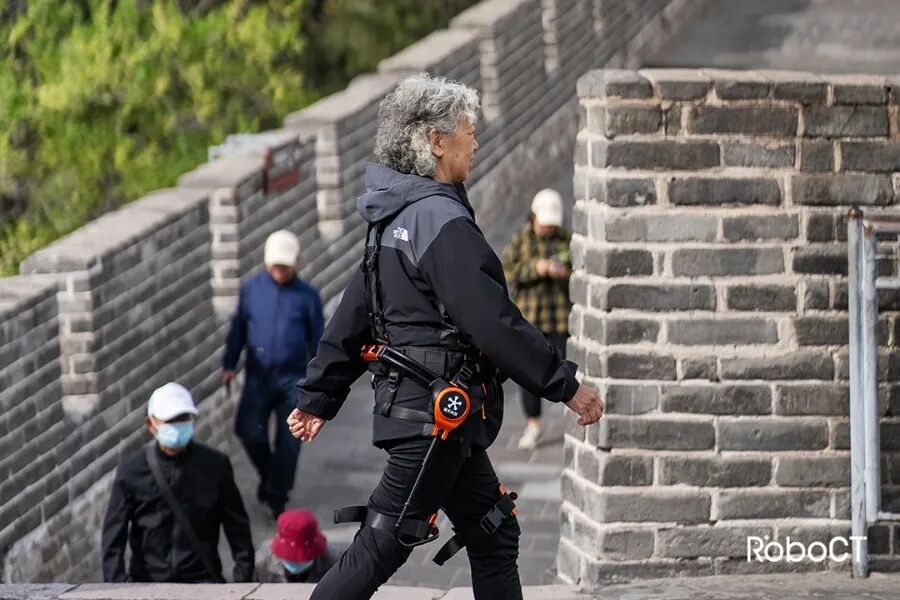
Image source: Chengtian Technology
It is eye - catching, novel, and full of contrast, arousing the exploration desires of people of all ages on the Internet. The use of exoskeleton robots by the elderly in scenic spots was the spark they were waiting for. After breaking through the application scenarios, exoskeleton robots have achieved unprecedented rapid popularization and development, and have become the hottest representative in the silver - haired intelligent technology track.
Neither Ant nor Meituan has publicly explained the reasons for investing in Jike Technology, but it is certain that exoskeleton robots can definitely expand the business ecosystems of these two internet giants.
Let's first look at Ant Group. Ant actually has three businesses directly related to the elderly - Alipay, Ant Insurance, and Ant Aifu.
Alipay connects online purchases and offline rentals. Ant Aifu provides health and chronic disease management services for the elderly, and ultimately becomes the core data source for Ant Insurance. After wearing an exoskeleton robot, the elderly's steps and gaits will become key data for chronic disease management and insurance risk control. Exoskeleton robots have become a physical entry point, providing Ant with first - hand health data from the elderly.
In January 2026, Meituan signed a contract with the Beijing Civil Affairs Bureau to fully launch nursing home services on the platform. In February, it launched elderly care services in Hong Kong. In March, Wang Xing, the founder of Meituan, began to implement his "boundary theory" in the silver - haired track. From food delivery to elderly care, from delivery riders to the elderly, the "local life" boundary of Meituan has covered 323 million silver - haired people.
Meanwhile, Meituan's investment in Jike Technology has been upgraded from a follow - on investment in November 2025 to a leading investment in May 2026, changing from participation to leadership within half a year. With the entry of nursing homes into the platform, the availability of elderly travel aids, and the coverage of the community delivery network, a local life closed - loop centered around the elderly may be taking shape.
In June 2025, Tencent's SSV Silver - Haired Technology Partnership Program was upgraded. In December, JD.com announced that it would invest 1 billion yuan in nursing training in the next three years. The moves of internet giants in the silver - haired track are no longer sporadic explorations but systematic layouts.
Exoskeleton robots are a key piece in the silver - haired ecosystem of internet giants. They not only connect the two core attributes of freedom of movement and care costs but also serve as an entry point for the data ecosystem of internet companies.
If a thousand - yuan - level exoskeleton can enable the elderly to walk independently, reduce the care costs of their children, and enable light - asset operation of elderly care services, its ROI at the economic level is far higher than that of traditional elderly care services.