Is the World Cup with the strongest sense of technology in history coming?
Quick Overview of Key Points
· This article highlights the "cutting - edge technologies" emerging in the upcoming FIFA World Cup jointly hosted by the United States, Canada, and Mexico. From the penalty system to tactical analysis, from the official match ball to the referees' equipment, AI and sensors are rewriting the underlying logic of the sport to an unprecedented depth.
· In terms of AI technology: Over 1,200 players have completed full - body 3D scans, and their AI digital avatars are deeply integrated into the penalty and broadcast systems. The generative AI tactical assistant, Football AI Pro, is for the first time equally accessible to all 48 teams. Data analysis can be retrieved using natural language. Referees' first - person view cameras are equipped with an AI anti - shake algorithm and will officially become part of the global broadcast signal starting in 2026.
· In terms of sensor technology: The semi - automatic offside technology has been comprehensively upgraded. The penalty accuracy has been improved from 50 cm to 10 cm, and the time taken for penalty decisions has been reduced from 70 seconds to less than 25 seconds. The official match ball, Trionda, has a 14 - gram sensor inside, which can accurately capture the exact moment of each touch at a frequency of 500 Hz.

Image source of this article: FIFA official website
This week, the FIFA World Cup jointly hosted by the United States, Canada, and Mexico will kick off. This is the first World Cup in history co - hosted by three countries. With 48 teams, 16 cities, and 104 matches, apart from the expansion in scale, a major highlight of this tournament is its high - tech nature. AI, 3D reconstruction, and high - precision sensors are systematically changing the football field.
Football AI Pro
Bring Tactical Analysis into the Dialogue Box
In the past, after FIFA matches, each team would receive a detailed data report of 50 to 60 pages, covering dozens of indicators such as players' running distances, passing success rates, and formation changes. These reports are information - rich but require a professional match analyst team to spend a lot of time interpreting them. Not all participating teams can afford such a setup. Powerhouses like Brazil, Germany, and France can send a full - fledged data analysis team, while many small - nation teams often have to rely on limited manpower to digest the thick PDF reports.
Football AI Pro, introduced for the first time in this World Cup, aims to break this invisible barrier.
This is a generative AI knowledge assistant trained on hundreds of millions of historical football data points, and it is freely accessible to all 48 participating teams. Coaches or analysts no longer need to flip through the reports page by page. Instead, they can directly ask the system questions in natural language, such as "What is our corner - kick success rate in the last 10 matches?" or "Where are the weak areas in the opponent's defense?" The system will instantly generate text summaries, video breakdowns, or visual charts as required.
There is a clear rule boundary behind this: Football AI Pro can only be used during pre - match preparation and post - match review and cannot be accessed during the game. FIFA hopes to ensure that the outcome of the game still depends on the players, not the algorithms.
This logic is not unfamiliar. Generative AI compresses the work of professional analysts into a dialogue box, transforming complex data interpretation into natural - language interaction with a very low threshold - which is very similar to the evolution path of enterprise software towards SaaS.
AI Digital Avatars
Over 1,200 High - Precision Virtual Images
Over 1,200 players in the 2026 World Cup will have exclusive 3D digital avatars.
During the media days of the tournament, each participating player will undergo a full - body 3D scan. The whole process is extremely fast, but the high - precision virtual images generated will play a continuous role throughout the tournament.
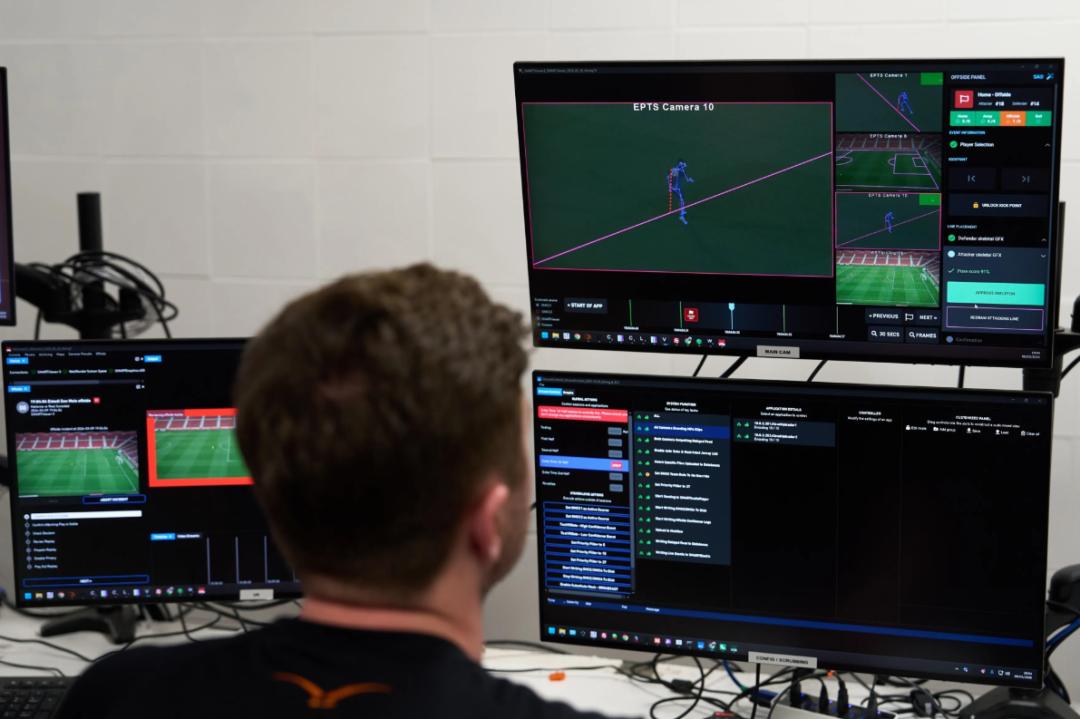
The most direct application is the in - depth integration with the semi - automatic offside technology (SAOT). Traditional offside penalty decisions rely on manual line - drawing, while the digital avatar system can reconstruct the players' exact body postures in real - time, including the position of the arms, the angle of the shoulders, and the direction of the toes. In cases of fast movement or players blocking each other, these details are often at the core of disputes. With digital avatars, referees and VAR can examine every body part in the same frame from any angle, no longer restricted by the fixed perspective of the cameras.
Digital avatars also unlock a previously difficult - to - achieve function: line - of - sight judgment. According to football rules, a player in an offside position is only considered offside when "actively participating in the game." Whether a player "interferes with the goalkeeper's line of sight" is one of the core criteria for determining "active participation." When an attacking player who may be in an offside position stands in front of the goalkeeper, VAR can call up the 3D reconstruction model to accurately simulate the goalkeeper's field of vision at that moment. For the first time, there is an objectively reviewable answer to the question of whether the goalkeeper can see the incoming ball.
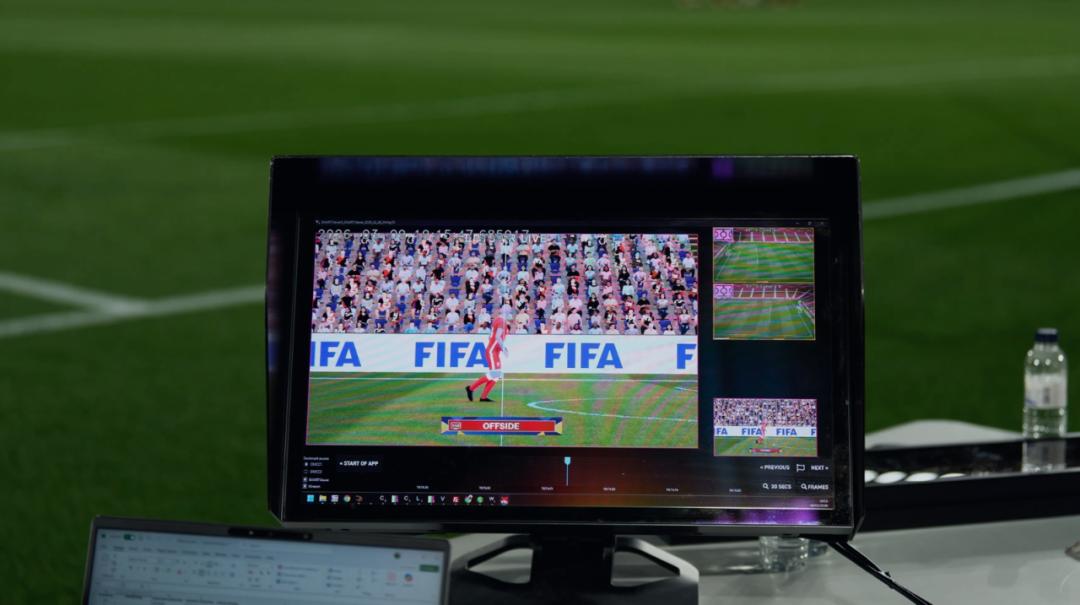
For fans, the offside replay in TV broadcasts will be upgraded from the previous two - dimensional line - drawing to a 3D dynamic rendering with a quality closer to that of a game engine, making the penalty basis clear at a glance.
Semi - Automatic Offside
From 70 Seconds to 25 Seconds
Offside is one of the most controversial penalty decisions in football rules. In the 2022 FIFA World Cup in Qatar, the semi - automatic offside technology (SAOT) made its debut, reducing the average time for penalty decisions to about 70 seconds. In 2026, this system has undergone a comprehensive iteration.
The change is first reflected in accuracy. The system in the previous World Cup only triggered an alarm when a player was offside by more than 50 cm, while in this tournament, the threshold has been lowered to 10 cm. Penalty decisions that used to cause endless disputes due to "a little bit" will for the first time have a precise basis down to the millimeter.
The improvement in speed is also significant. The average time for penalty decisions has been further reduced from 70 seconds to 25 seconds. Referees will directly receive audio alerts through earpieces, no longer needing to go through VAR for transmission. This simplification of the process reduces the situation where the game is in a long - term standstill waiting for penalty decisions.
What supports the operation of this system are the 16 new optical tracking cameras installed in each stadium, one - third more than the 12 in the Qatar World Cup. In each game, these cameras will generate a massive amount of tracking data points in real - time, covering the skeletal structure and movement trajectory of every player on the field.
Trionda
A Physical Laboratory in a Football
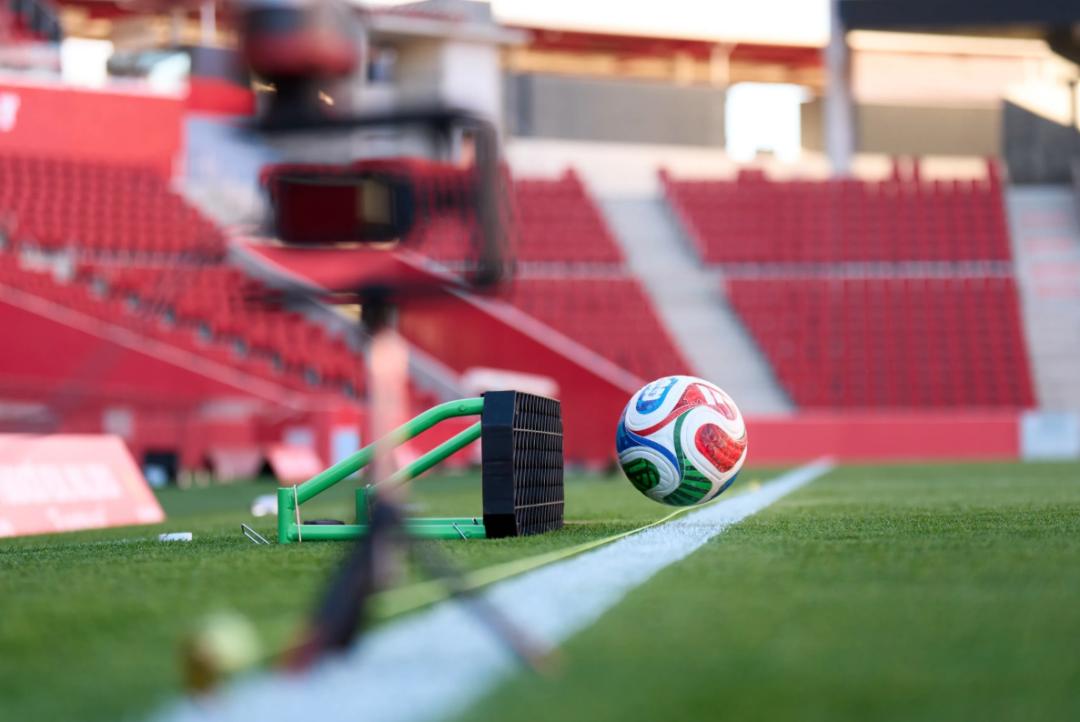
The official match ball of each World Cup becomes a technological symbol. The official match ball in 2026 is called Trionda, which means "triple wave" in Spanish, paying tribute to the three host countries. However, what really attracts attention about this ball is not its appearance but the 14 - gram sensor inside.
The sensor operates continuously at a sampling rate of 500 Hz, collecting 500 data points per second. This frequency far exceeds the mainstream broadcast frame rate, meaning that even the fastest shots or the most tricky curve balls can have their movement trajectories accurately restored in milliseconds. The sensor simultaneously measures three - dimensional acceleration, rotational angular velocity, and movement trajectory, and can accurately identify the exact moment of each touch, that is, the so - called "kicking point."
The "kicking point" is the time anchor point for the entire offside penalty system. The determination of offside must be based on the moment the ball leaves the foot. Before that, even one frame earlier, the legitimacy of the penalty will be fundamentally shaken. The 500 - Hz sensor compresses the error of this time anchor point to an accuracy that the human eye and ordinary cameras cannot achieve.
In terms of battery life, the sensor in Trionda can work for 6 hours on a single charge, which is sufficient to cover a full game including extra time and a penalty shoot - out. The sensor data is synchronized in real - time with the optical tracking cameras in the stadium and together with the VAR system forms an independent and redundant penalty guarantee. The two systems verify each other, further reducing the probability of misjudgment.
The Referee's Eyes
How AI Anti - Shake Reconstructs the First - Person View
In the 2025 FIFA Club World Cup, the referees' first - person view cameras were tested on a large scale for the first time. However, this system faces a tricky physical reality: Referees need to run continuously, stop suddenly, and jump on the field. The severe body movements cause the video to shake, making a large amount of footage unusable.
The core of solving this problem is an AI anti - shake algorithm specifically developed for motion blur. Different from traditional optical anti - shake, AI anti - shake analyzes each frame of the video stream in real - time, identifies the motion vector of the camera, and then performs reverse compensation and stabilization processing on each frame. This process needs to be completed within a millisecond - level delay to ensure that the video is synchronized into the broadcast signal. The main challenge in training this algorithm is the data distribution. The shaking patterns generated by athletes' running are fundamentally different from those of handheld photography or vehicle - mounted shooting in terms of frequency and amplitude, requiring targeted training samples and loss function design.
The referee's perspective video after anti - shake processing will officially become part of the global broadcast signal in the 2026 World Cup. Its value is not only for viewing. For coaching teams and medical staff, the first - person view from the referee's position at that time can provide an additional reference dimension for injury assessment when a player is involved in a collision or suspected of being injured.
Each World Cup is a global technology verification field.
From goal - line technology to VAR, from semi - automatic offside to AI digital avatars, football has taken a long time to start systematically redefining the boundaries of the game with sensors and algorithms. The technologies that will appear in the 2026 World Cup, such as millisecond - level touch recognition, natural - language - driven tactical analysis, AI anti - shake, and 3D reconstruction, are not inventions exclusive to football. They are the concentrated verification of IoT, generative AI, and computer vision in an extreme scenario.
So, here comes the ultimate question: Which team do you support in this World Cup? Welcome to discuss in the comment section.
This article is from the WeChat official account "Sequoia Capital" (ID: Sequoiacap). Author: Hong Shan. Republished by 36Kr with permission.