The AI bubble is already bursting.
In recent days, the market has experienced significant fluctuations, and the "AI bubble theory" has gained widespread attention.
Ray Dalio, the founder of Bridgewater Associates, said that there is a bubble in the AI market, and it is "relatively high."
Jensen Huang, the CEO of NVIDIA, said that there are huge opportunities in AI, and the demand for computing power has just begun to explode.
Whom should we believe?
Both of them are right.
Is there a bubble in the AI industry? There must be.
However, the bubble in the technology field is often the only way for society to pay tribute when facing disruptive and advanced productivity.
It is not simply a derogatory term.
In the long run, this is an inevitable phenomenon at the beginning of the emergence of advanced productivity.
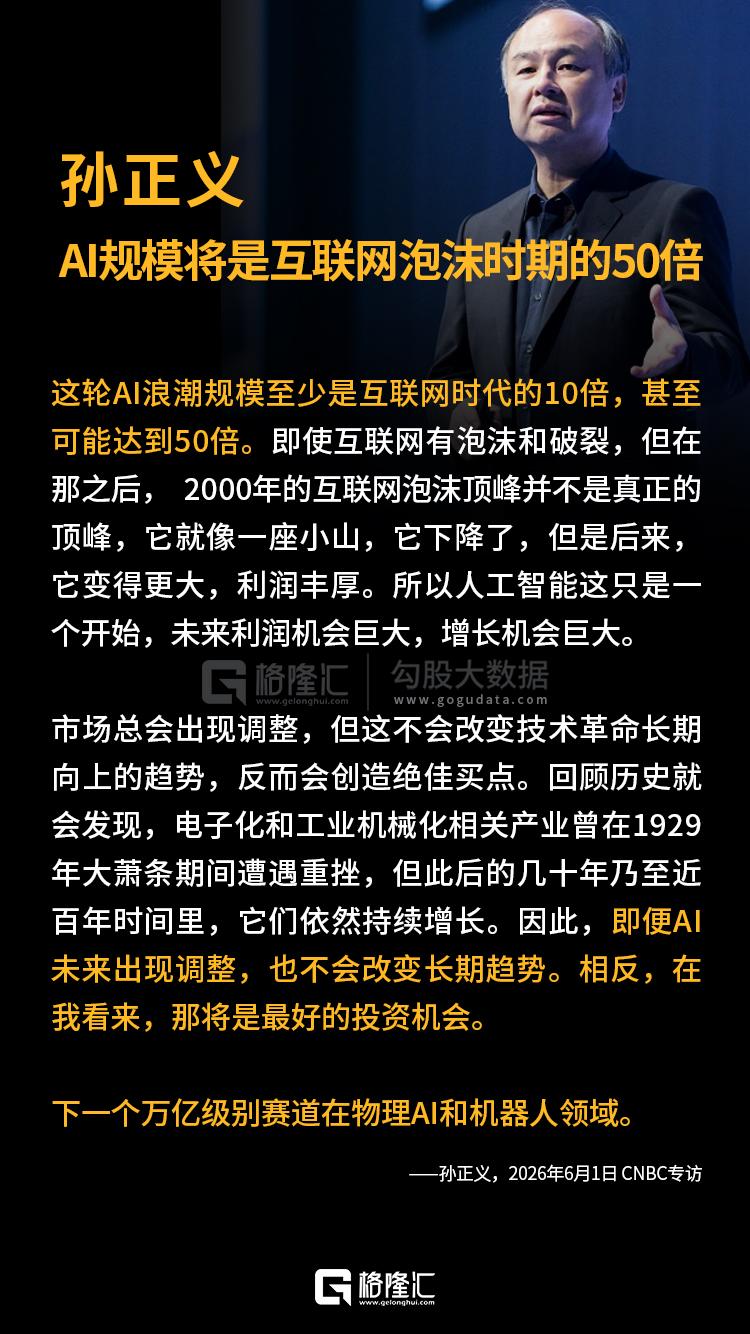
Many people are comparing the current situation to the dot - com bubble in 2000 and are deeply worried.
The dot - com bubble back then did cause the Nasdaq to plummet by nearly 78%, and more than $5 trillion in wealth evaporated.
But twenty years later, which industry can do without the Internet?
Today, the value of the Internet industry has far exceeded that during the bubble period.
The AI bubble, at least on the surface, is a similar situation.
The bubble in the capital market cannot stop almost all industries in society from actively being empowered by AI.
AI + is an irresistible trend.
Just as all industries today cannot do without the Internet, in the future, all industries will also be inseparable from AI.
01
In an era when any company with a.com in its name could go public and raise funds, the Nasdaq soared by nearly 600% between 1995 and 2000. Subsequently, there was a financial storm that lasted for two and a half years.
Among those well - known names back then, the software company MicroStrategy, due to accounting scandals and over - hyping, saw its stock price plummet by 62% in a single day; Pets.com (an online pet food seller) and Webvan (the pioneer of fresh food e - commerce) went bankrupt directly.
...
In panic, almost everyone accused the Internet of being a scam.
However, the physical infrastructure precipitated by the excessive squandering of speculative capital often nourishes the super - giants of the next era at extremely low costs.
The reason for the bubble to burst is not a problem with the Internet technology itself, but that the physical construction speed of the infrastructure cannot keep up with the market rhythm.
For example, those once - prosperous telecommunications companies (such as WorldCom and Global Crossing) invested heavily in laying global undersea cables and dense wavelength division multiplexing networks. Although it led to their own bankruptcy, these cheap "information superhighways" became the perfect breeding ground for the rise of Netflix, Zoom, and the mobile Internet later.
Without the crazy and advanced global investment in telecommunications infrastructure around 2000, there would not have been the explosion of video streaming on YouTube later, let alone the subsequent cloud - computing infrastructure.
The most typical example is Amazon.
Its stock price plummeted from a peak of $107 in 1999 to $7 in 2001, a decline of more than 90%.
But it survived because its underlying business logic, "reconstructing retail with the Internet", is in line with the direction of advanced productivity.
This is the classic Amara's Law: Overestimate the short - term impact of a new technology and seriously underestimate its long - term impact.
In the early stage of a technological revolution, the enthusiasm of speculative capital will inevitably lead to over - investment and form a bubble.
This is the "IQ tax" that must be paid for innovation.
But when the bubble fades, what remains will be more indestructible advanced productivity.
02
Back in 2026, the bubble in the AI industry seems even bigger.
Only the top five cloud service providers such as Amazon, Google, Meta, Microsoft, and Oracle are expected to have a capital expenditure of $690 billion in 2026, and the total investment in AI infrastructure is expected to reach $5.3 trillion by 2030.
Among them, only about 25% is used to buy GPUs, and the remaining 75% is all invested in physical infrastructure: liquid - cooling systems, power transmission, network switches, optical modules, and land.
In terms of revenue, the total revenue of all leading pure AI manufacturers such as OpenAI, Anthropic, Cohere, Mistral, and Perplexity in 2026 is expected to be no more than $40 billion.
Nearly $700 billion is invested in the infrastructure layer, and only a few billion is recovered in the application layer.
What else could this serious asymmetry be but a bubble?
We cannot simply and crudely draw such a conclusion.
There is a key point that cannot be ignored.
In March 2023, when OpenAI released GPT - 4, the mixed cost per million Token inputs was about $30.
By April 2025, with the optimization of the model architecture and the improvement of inference computing power, the price per million Tokens of a model with the same intelligence level plummeted to $0.1 - $0.15.
According to the "AI Index Report" from Stanford University and data from TokenCost: The AI inference cost has dropped by more than 99.7% in the past two years.
According to traditional linear thinking, if the cost drops sharply, enterprises' AI expenditures should decrease.
But in reality, enterprises' AI cloud expenditures tripled between 2024 and 2025.
Why?
Because when the marginal cost of "intelligence" approaches zero, AI is no longer just a simple text - summarizing or chat - companion machine, but has entered a new era of intelligent agents and multi - modal enhanced retrieval.
Enterprises are starting to let AI intelligent agents automatically run thousands of tasks, write code, scan millions of legal contracts, and simulate biological experiments.
Cheap Tokens have unlocked a vast amount of long - tail demand that was previously restricted by cost and could not be commercialized.
We can also see the clue by comparing NVIDIA in 2026 with Cisco, the network hardware hegemon in 2000.
Their ecological niches are extremely similar, but their underlying financial health is completely different.
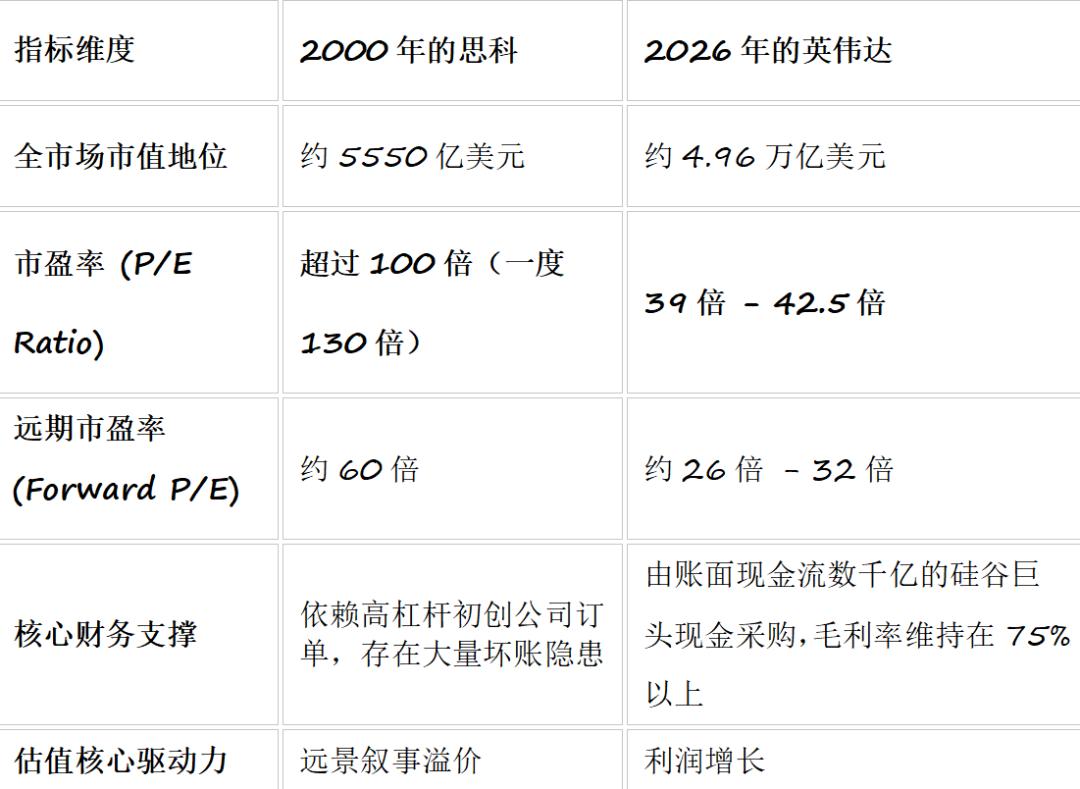
Hardcore financial comparison between NVIDIA and Cisco
This just confirms the "Jevons Paradox" in economics: Technological progress improves energy - use efficiency. Instead of reducing energy consumption, it leads to greater demand due to cost reduction.
Even after the so - called "DeepSeek moment" at the beginning of last year, the market quickly woke up in the following months: The more optimized the algorithm, the lower the threshold for enterprises to adopt AI, and ultimately the total consumption of computing power increases exponentially.
That's why AI has the potential to gradually embed into almost all traditional industries.
Just as all industries have been implementing Internet + in the past two decades.
From SaaS software to biomedicine, and then to advanced manufacturing robots driven by embodied intelligence, in 2026, almost all industries are embracing AI +.
No one is discussing "whether we should use AI" anymore, but is anxious about "whether our data has been properly cleaned? Is the API call quota sufficient? Is the RAG architecture optimal?"

Currently, there is indeed a bubble in the AI industry.
But for enterprises, if they don't embrace the bubble, they will be crushed by the times.
This has been proven in the Internet era of the past two decades.
03
Currently, we are undoubtedly at a crucial node in the technology life cycle: on the verge of the "Trough of Disillusionment" on the Gartner Hype Cycle, or at the turning point in the theory of "Technological Revolutions and Financial Capital".
The AI bubble is actually bursting, but many people haven't realized it.
In the past few years, a large number of venture capitalists (VCs) have suffered from the fear of missing out.
A few new startups could raise funds just by writing dozens of pages of PPTs and wrapping an OpenAI API. Now, as the tide recedes, these companies without moats and only concepts are dying in large numbers.
This is the market's self - purification and a manifestation of the bubble bursting.
But this is just the surface.
Three profound evolutions are taking place in the deep - seated logic of the market:
First, the value transfer from CapEx to OpEx
Currently, the money is being earned by those selling the "shovels", such as NVIDIA, TSMC, and enterprises selling optical modules and server liquid - cooling equipment, who are reaping most of the benefits.
But as computing power gradually becomes "infrastructure - like", like water and electricity, the real excess profits will gradually shift to the application layer.
That is, those AI - native enterprises that can truly solve the pain points of vertical industries and reshape business processes (OpEx optimization) with extremely low - cost Tokens.
Second, valuation multiple compression and performance digestion
The market's over - valuation of AI infrastructure does not necessarily mean a collapse.
In many cases, the high - speed growth of enterprise profits will gradually digest the high valuation in a way of "trading time for space".
As long as the revenue growth rate of cloud - computing giants can keep up with the depreciation rate of capital expenditure, this "hot - potato game" can evolve into an unprecedented industrial upgrade.
For example, global automobile manufacturing giants and chip giants have shortened the R & D to mass - production cycle of new products by 35% and improved the overall equipment efficiency of the production line by 18% through the introduction of end - to - end AI twin technology.
Another example is in the financial industry. In 2026, quantitative trading, risk control, and credit assessment are all comprehensively dominated by multi - modal agents. AI is not only processing macro - expectations with micro - second timestamps but also deeply participating in every micro - level asset pricing.
In industries that highly rely on senior professional knowledge, such as law, medicine, and auditing, AI has also completed the transformation from a "junior assistant" to a "partner - level expert".
Among the more than 1 billion active users of ChatGPT, Gemini, and Claude, a considerable number use them as replacement tools for daily high - intensity mental work.
That includes you and me.
All of the above are real - life events that everyone can see.
04
Looking back at the magnificent history of technology, the "creative destruction" proposed by Schumpeter is always taking place.
The capital market is always impatient, always hoping to invest $1 today and earn $10 tomorrow.
When nearly $700 billion in infrastructure investment cannot be fully converted into application - end profits in the short term, the market will inevitably undergo a cruel reshuffle.
Eliminate those speculative shell companies that only rely on PPTs, and keep those with real technological foundation and implementation scenarios.
After the reshuffle, those cheap and large - scale computing centers and highly optimized model algorithms will serve all industries at extremely low prices.
After 2000, humanity entered a digital era where all industries are inseparable from the Internet.
Today, we are also irreversibly moving towards an era of full - fledged intelligence where all industries are dominated and empowered by AI.
Amid the noise of the bubble, the underlying productivity potential has no moisture at all.
This article is from the WeChat official account "Gelong", author: Chengbei Xugong. It is published by 36Kr with authorization.