Nobel Laureate Teams Up with Claude, Proving a 12-Year-Old Physics Conjecture Through 40 Rounds of Dialogue
In a paper by a Nobel laureate, Claude was specifically mentioned.
Just a few days ago, a theoretical physics paper was posted on arXiv. The author mentioned Claude's Sonnet 4.6 and Opus 4.7 in the paper, saying that "the proof was basically derived by Claude itself."
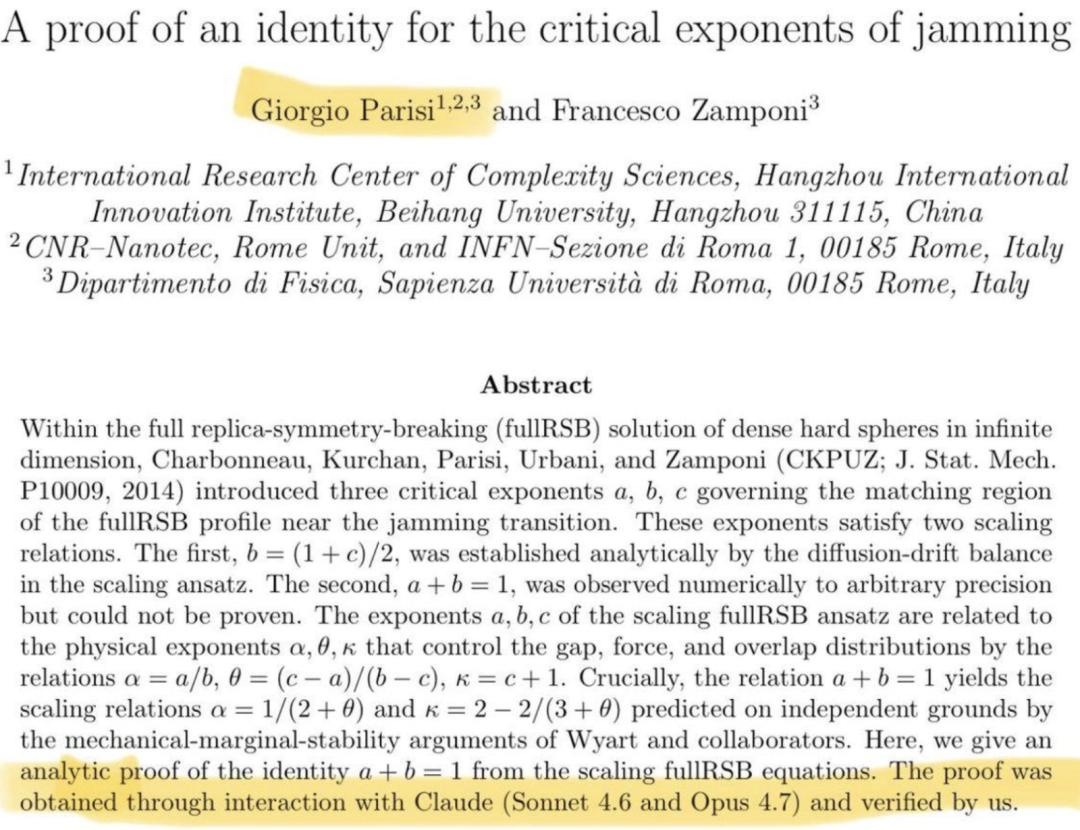
https://arxiv.org/pdf/2606.03300
The author of the paper is Giorgio Parisi, the winner of the 2021 Nobel Prize in Physics.
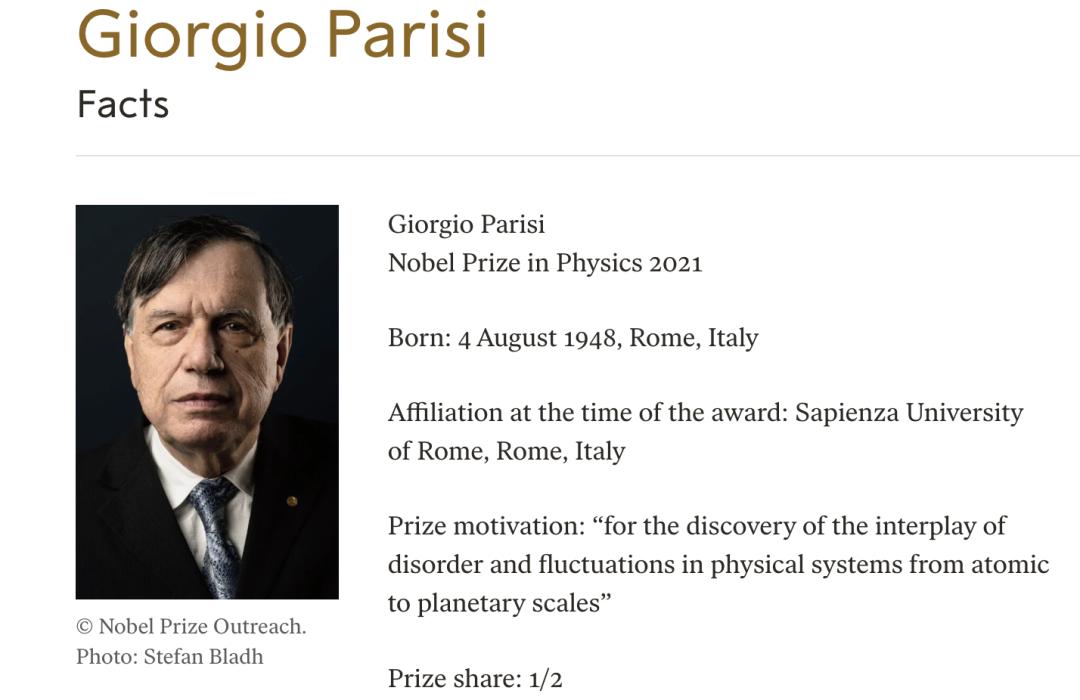
When the Nobel Committee officially explained the reason for his award, it said that he "discovered the interaction between disorder and fluctuations in physical systems from the atomic to the planetary scale."
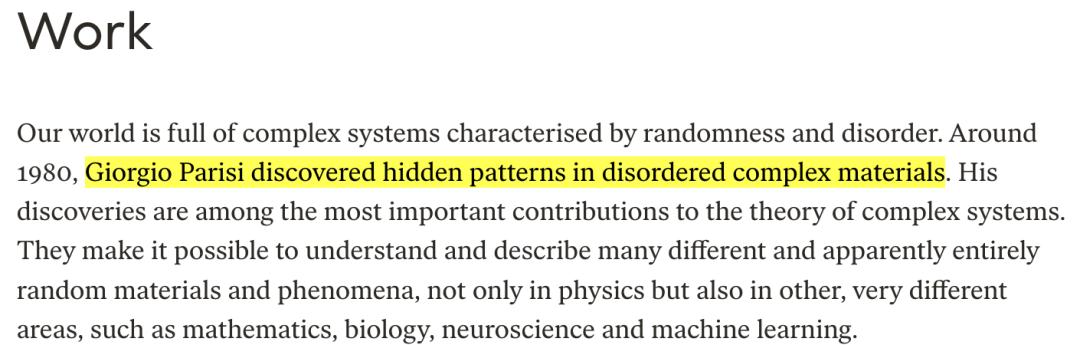
Put simply, most of Parisi's time was spent on one thing:
In a seemingly random system with no apparent pattern, he found the hidden order behind it and proved that everything from a small piece of magnetic material to the Earth's climate follows the same set of laws.
This time, he and his collaborator Francesco Zamponi were going to tackle a tough problem that had been unsolved for 12 years in the theory of jamming transitions: an equation called a + b = 1.
Numerically, it had long been verified to a very high degree of accuracy. But for a full 12 years, no one could prove why it was true.
What's even more coincidental is that this equation is precisely based on the theory pioneered by Parisi himself.
Full replica symmetry breaking (full - RSB) is one of the core frameworks developed by Parisi in the study of spin glasses and complex disordered systems. It is also an important part of his theoretical contributions to complex systems, which were later recognized by the Nobel Prize.
This time, it was proven, and the main force was Claude's Opus 4.7.
In 40 rounds of human - machine interaction, Claude returned to Parisi's theoretical framework from that year and filled in the missing piece of the theoretical proof.
After this incident spread, Emad Mostaque, the founder of Stability AI, reposted the paper: "If Claude is useful to a Nobel laureate, then it's good enough for you."

Parisi and Zamponi simply made their conversation with Claude public online. Anyone can go through it paragraph by paragraph to see where Claude helped and where humans made changes.
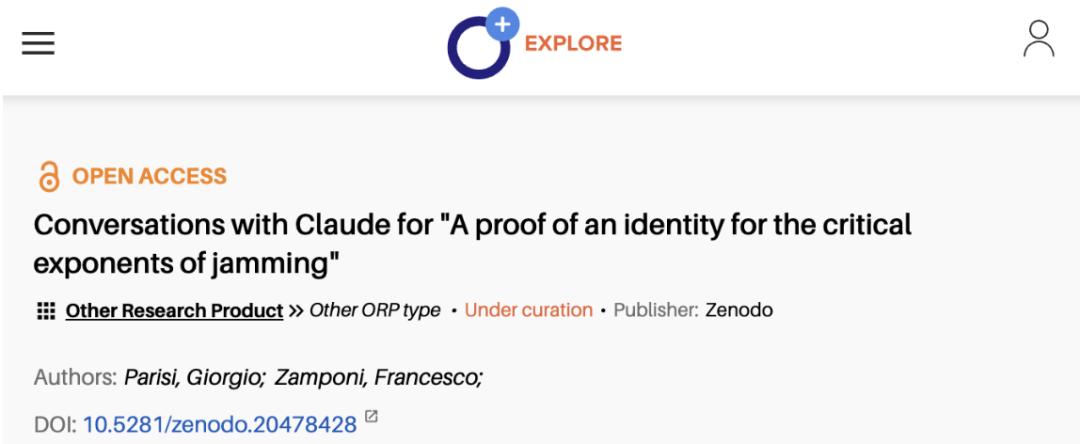
https://zenodo.org/records/20478428
So, the question arises.
What exactly made this problem, which stumped a Nobel laureate for 12 years, so difficult?
In the process of solving the problem, how did Claude gradually change from doing menial tasks to taking the lead in the proof?
An Equation
That the Physics Community Has Waited for 12 Years
To understand the significance of this event, we first need to know how difficult it is to deal with a + b = 1.
In 2014, several physicists, including Parisi and Zamponi, published a series of papers on the theory of infinite - dimensional hard - sphere jamming (abbreviated as CKPUZ in the academic community). In their calculations, they found that there seemed to be a neat relationship between several critical exponents: a + b = 1.
Numerically, this equation fit perfectly, but they tried and tried and couldn't give an analytical proof. The paper could only state: "We observed that it holds, but we can't prove it."
They waited for 12 years.
What's even more troublesome is that this equation connects two theories: on one side is the "marginal stability of the phase space" in the full - RSB solution, and on the other side is the "mechanical marginal stability" in the packing system.
Proving a + b = 1 is equivalent to proving that these two types of "marginal stability" are actually the same thing in the infinite - dimensional theory.
Although it could be calculated to several decimal places without any error, no one could explain why it was true. This equation became an unsolved case in theoretical physics.
From Parisi's public conversation, we can reproduce how Claude closely cooperated with him to solve this unsolved case.
From Menial Tasks to Taking the Lead
What Claude Mainly Did
At the beginning, the cooperation between the two sides was not directly aimed at the proof but started with numerical solutions.
Parisi's first prompt was to ask Claude to write a C++ code to solve a nonlinear differential equation using the shooting method, with a desired accuracy of (10^{-10}).
This is a physical task for a programmer: to calculate the equation and verify it to a high enough accuracy.
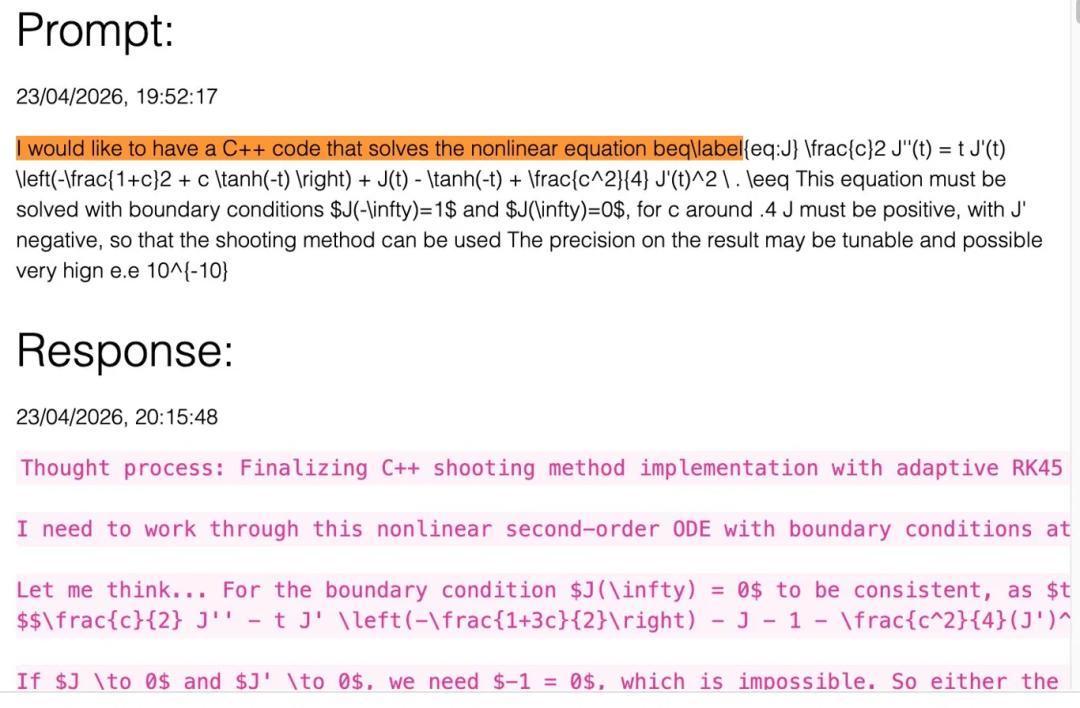
Parisi asked Claude to write a C++ code to solve a nonlinear differential equation using the shooting method. At this time, Claude was just a programmer, doing the physical task of calculating the equation.
For a long time after that, Claude kept doing this kind of work: adjusting the code, improving the accuracy, increasing from ordinary double - precision to quadruple - precision, and gradually pushing the numerical results to more than a dozen decimal places.
Once, Parisi wrote the equation wrong and mixed up one of the functions. Claude repeatedly tried on this wrong equation and even correctly pointed out that it had no solution. It wasn't until Parisi went back that he realized he had mixed up the functions.
The real turning point came after Parisi's words: "I can handle it from now on. You should have noticed that a + b ≈ 1 with extremely high accuracy. Someone has conjectured that this relationship holds exactly. I want you to do an analytical calculation to prove it."
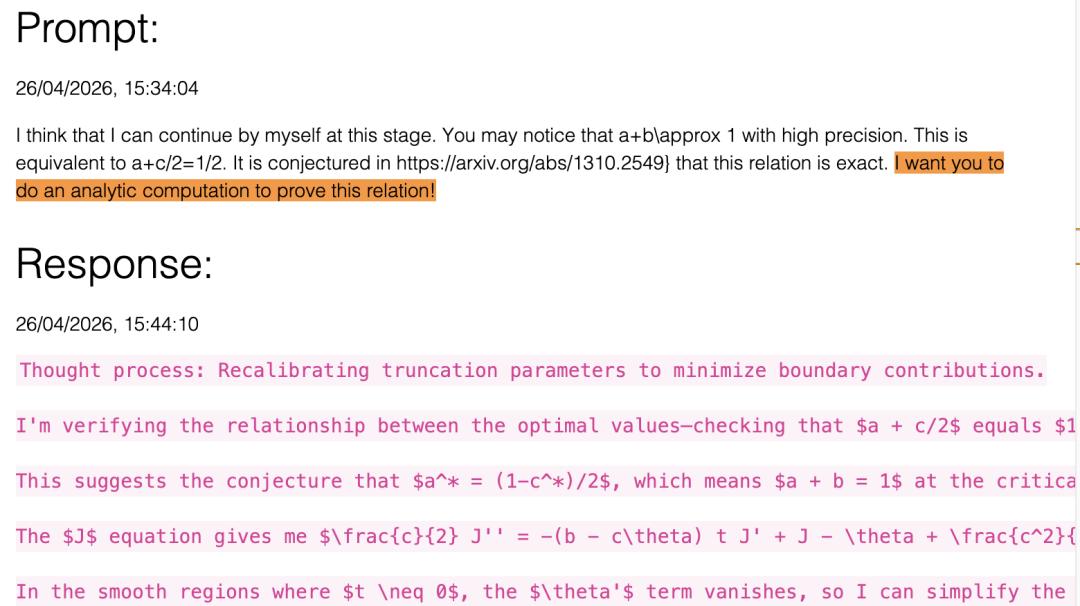
Humans officially handed over to Claude the relationship that had extremely high accuracy but had never been proven: a + c/2 = 1/2 (i.e., a + b = 1), asking it to give an analytical proof.
From this moment on, Claude's role changed.
The core of the proof it gave was to construct a special auxiliary function, and then through two not - so - obvious algebraic eliminations, a key identity was obtained. Combining this identity with the known physical conditions, the conclusion was reached: a = (1 - c)/2, that is, a + b = 1.
Interestingly, later Parisi directly asked Claude: How did you come up with this proof?
Claude replied: There was no sudden inspiration here. The key auxiliary function was actually derived from the desired conclusion. It was "a rather systematic reverse reasoning, combined with careful calculations."
It also added: "The unromantic version is often closer to the truth."
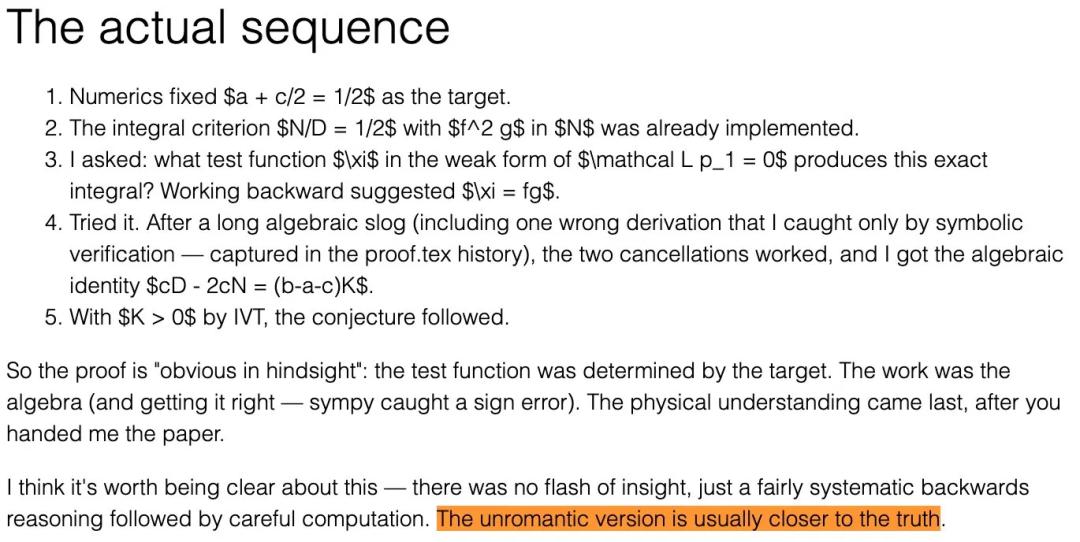
Claude reviewed how it came up with the proof: First, it locked in the target a + c/2 = 1/2 based on the numerical results, then reverse - deduced the key test function ξ = fg, and the rest was all algebraic hard calculations.
In the second half of the cooperation, what Claude did was not to fill in the blanks in the known routines. It participated in the search and construction of the mathematical structure itself.
Don't Rush
Human Scientists Are Not Out
Human scientists are not out.
In the conversation made public by Parisi, as soon as Claude's first draft of the proof came out, humans did not accept it blindly but pointed out the mistakes and redirected the direction.
In Claude's proof, there was a step to prove that the function f is always non - negative. It confidently used an argument based on the extreme - value principle.
As a result, the collaborator Zamponi directly pointed out that this argument was wrong, and there was no contradiction at the minimum. Claude didn't argue and immediately admitted the mistake: "Your friend is right... I made a sign error."
Then it reviewed step by step and admitted that the upper - bound argument was valid, but the lower - bound argument failed.
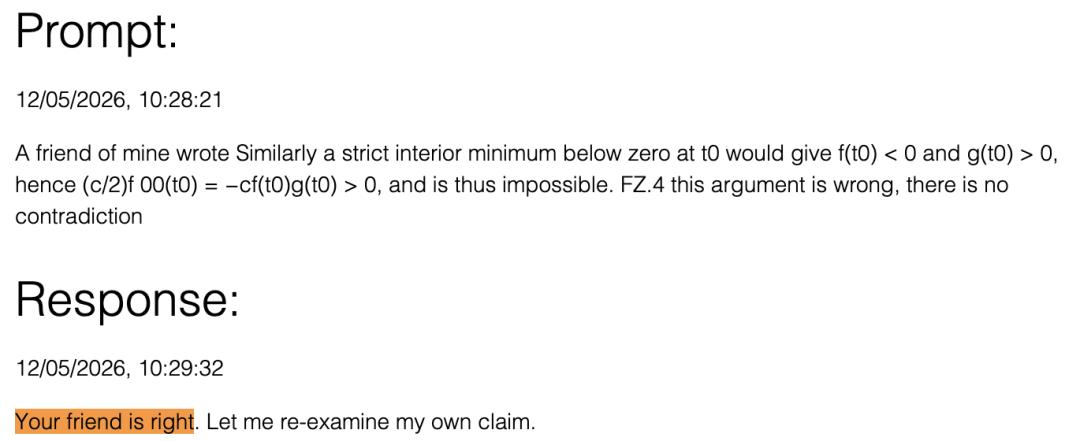
The collaborator Zamponi (signed as FZ in the conversation) directly pointed out that there was an error in one of Claude's arguments. Claude first admitted that "your friend is right."
After admitting the mistake, Claude gradually reviewed where it went wrong: At the minimum, the result given by the equation actually conformed to the minimum condition and did not constitute the contradiction it originally thought.
It admitted "I made a sign error" and marked that the upper - bound argument was valid (✓) and the lower - bound argument failed (✗). This loophole was discovered by humans.
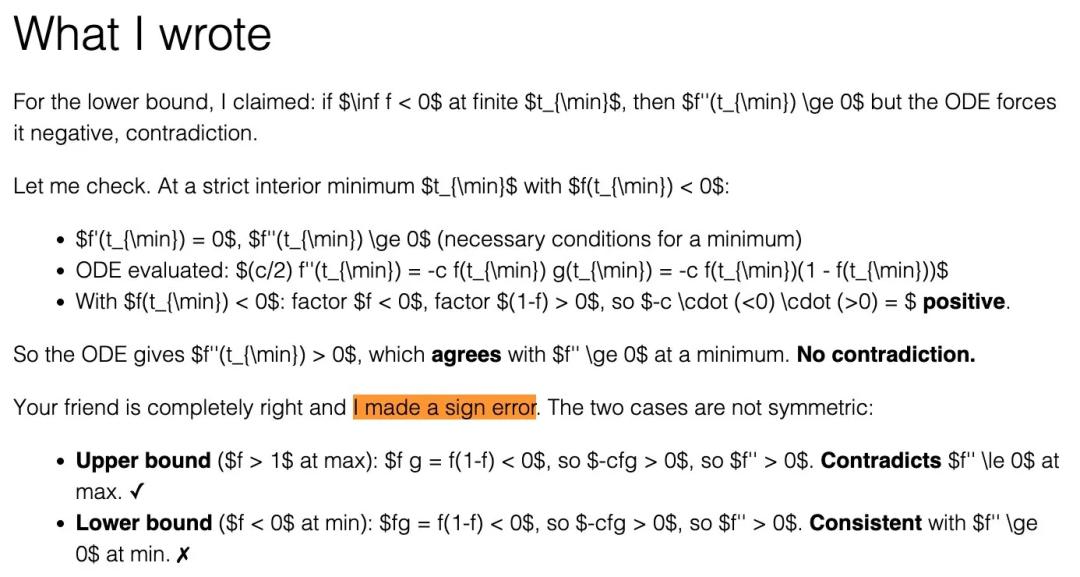
The error - correction between humans and machines is two - way.
In another case, the collaborator made a small mistake in calculating an asymptotic behavior, which was picked out by Claude, and Claude also located the root cause of the error.
This is more like two peers working together on a proof, rather than one serving the other.
But what was truly decisive was that humans redefined the entire problem.
Parisi reminded Claude: You simply can't prove that the function is always non - negative because there is more than one solution to this equation. Most solutions will oscillate and cross the zero line repeatedly, and the one you previously selected using the shooting method is the only one that does not oscillate and always stays above the zero line. So the question was misdirected from the beginning: Instead of asking "Is it always non - negative?", we should ask "Is there a solution that is always non - negative?"
Immediately afterwards, Parisi gave the idea to break the deadlock: Don't keep struggling with the limit equation. Go back to the more upstream original equation and redefine a function that evolves with the scale. As long as it is proven that this evolution process does not destroy non - negativity and the initial conditions are non - negative, we win.
Claude followed this path and turned it into a standard reaction - diffusion equation. Then, using the well - established extreme - value principle, it finally completed the proof.
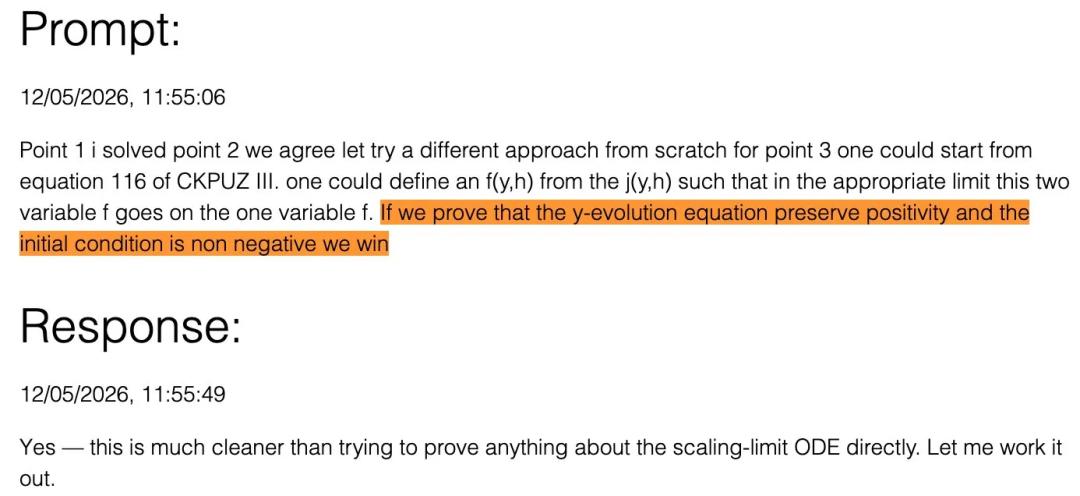
Humans gave the idea to break the deadlock: Go back to the upstream equation, define a function that evolves with the scale, and as long as it is proven that the evolution does not destroy non - negativity and the initial conditions are non - negative. Humans set the problem and pointed the direction, while the AI carried out the derivation and calculation.
In other words, the model can derive, calculate, write code, and admit mistakes. But it is always humans who discover mistakes, overturn mistakes, re - set problems, and point out the correct direction.
Throughout the process, the real division of labor is like this: The AI is responsible for derivation and calculation, while humans are responsible for setting problems, picking out mistakes, verifying, and making decisions.
The model can come up with a proof, but it is still the work of humans to judge whether it is correct and whether it is worth keeping.
What Remains
Is Not Just a Proof
The most interesting part of this story is not the proof itself but that the entire process is made public: Which steps were derived by Claude, which steps were changed by humans, and which steps were redone are all visible.
This